Tour Bag vs Staff Bag: What Wholesale Buyers Need to Know
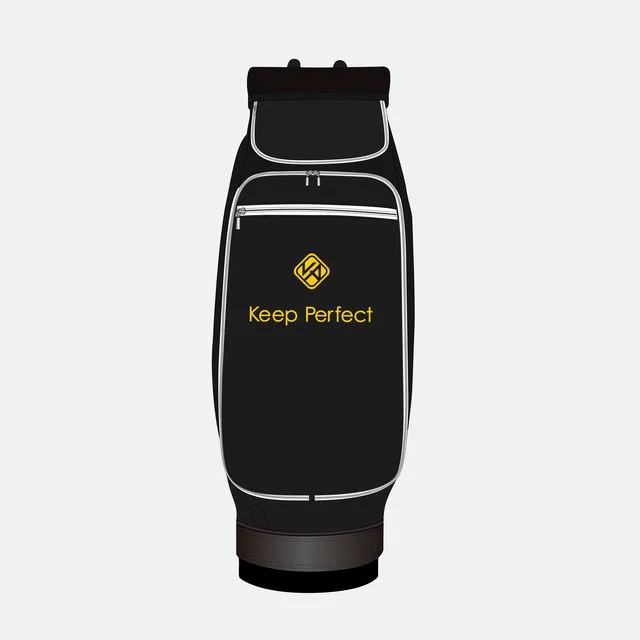
The working difference between a tour bag and a staff bag is 25 mm of top opening, about 1.2 kg of finished weight and three fewer pockets, and those three numbers decide cart fit, caddie load and the retail price band a product can hold. Both shapes carry fourteen clubs, both stand on their own base, and both are bought by the same importers, which is why the two names get swapped freely in enquiry emails. What separates them is the top collar diameter, the base plate footprint, the pocket architecture and the hardware load path. Every figure below comes from the same commercial frame: a 200-unit minimum in one colourway, 100 units accepted as a trial, 500 where a fresh body pattern has to be opened, prototypes finished in six to ten working days, production at 35 to 50 days, and a final check run to AQL 2.5 in ISO 2859-1.
Related reading: Staff Bag vs Cart Bag: The Differences That Matter
How the Two Shapes Are Defined on the Line
A staff bag is the wide-format article a club issues to its professional staff or sells to members who want storage over portability. Production figures cluster tightly: a top opening of 10.0-10.5 inches, six to eight dividers, a base footprint 240-270 mm across, and a finished weight of 3.8-4.8 kg including the stowed rain hood. Six to nine external pockets are normal, among them a full-length apparel pocket with a 380-450 mm zip opening and a valuables pocket lined in fleece or brushed tricot.
A tour bag steps every one of those numbers down once. The top comes in at 9.0-9.5 inches, weight settles at 3.0-3.6 kg, pocket count drops to four or six, and the base narrows to 210-235 mm. The bag still swallows a full set and keeps the tall, upright silhouette that reads as professional equipment, which is precisely why catalogues confuse the two: at three metres the shapes are nearly indistinguishable, and only the top diameter and the pocket count separate them on a spec sheet.
Naming drifts by market. North American buyers almost always call the large format a staff bag and reserve tour bag for the lighter variant, while buyers in parts of Europe and Asia use tour bag for the large format because that is the shape caddies carry at events. Two buyers can write the same words and mean articles that differ by 800 g and 60 mm of base. The only reliable way to close the gap is to specify the top opening, the base footprint and the finished weight, then let the supplier map those figures onto whichever label the local market prefers.
Freight is where the naming argument becomes money. A staff bag ships in a carton around 1,350 x 380 x 360 mm and a tour bag in roughly 1,300 x 340 x 330 mm, so a 40ft high-cube container that takes 480-540 staff bags will take 600-660 tour bags. Over a 2,000-piece season that gap is worth an entire extra shipment, which is a stronger reason to choose deliberately than any catalogue photograph.
Top Opening, Base Plate and Trolley Fit
The top opening is the first dimension a buyer should fix, because it cascades into the divider grid, the collar moulding, the hood pattern and the cart cradle fit. A staff bag top of 10.5 inches gives each of fourteen wells roughly 52-55 mm of usable width once the moulded walls are counted, which is enough for a midsize grip plus a gloved hand. Drop to 9.0 inches on a tour bag and the same fourteen wells fall to 44-47 mm, still workable, but the collar needs thinner walls and the divider grid has to be redesigned rather than scaled.
Collar construction and divider count
Staff collars are usually moulded ABS or glass-filled PP at 3.5-4.5 mm wall, sometimes wrapped in PU or synthetic leather with a contrast topstitch running at eight to ten stitches per inch. Tour collars run thinner, 2.8-3.5 mm, and are more often a moulded ring bonded to a fabric top panel to save weight. Divider count follows the collar: six to eight ways on staff bags, five to six on tour bags, with two or three walls running full depth in either case.
The detail buyers miss is the collar-to-body junction. On a staff bag the collar sits on a 25-30 mm deep skirt that hides the seam and carries the handle anchors. On a tour bag that skirt shrinks to 15-20 mm, so the same 6 kg club load lands on a narrower bond line. This is the single most common structural difference between a bag that survives three seasons of club use and one that starts lifting at the top after twelve months.
Base plate geometry and how the bag sits on a trolley
Base plates are moulded PE, TPU or PP, 4-6 mm thick with a 12-18 mm upstand. The staff plate is wider and often carries four moulded feet plus a pair of strap slots at 90 mm centres, which is what keeps a heavy bag from rolling on a sloping fairway. The tour plate is narrower, lighter and frequently omits the outer feet to save 60-90 g, relying on a single moulded rib to stop rotation.
| Dimension | Staff bag | Tour bag | Why the buyer cares |
|---|---|---|---|
| Top opening | 10.0-10.5 in (254-267 mm) | 9.0-9.5 in (229-241 mm) | Divider layout, hood pattern, cart cradle |
| Divider count | 6-8 way | 5-6 way | Grip separation versus weight |
| Base footprint | 240-270 mm | 210-235 mm | Trolley cradle fit, standing stability |
| Finished weight | 3.8-4.8 kg | 3.0-3.6 kg | Caddie load, airline allowance, freight |
| External pockets | 6-9 | 4-6 | Storage story at retail, cost per unit |
| Export carton | 1,350 x 380 x 360 mm | 1,300 x 340 x 330 mm | Units per container, warehouse cube |
| Units per 40ft HC | 480-540 | 600-660 | Landed cost per bag |
Those two carton figures are worth checking against your own freight forwarder before a season is locked, because carton dimensions are usually driven by the top collar and hood rather than by the body. A 10.5-inch collar on a bag that is otherwise slim still needs a wide carton, and buyers who ask for a wide top on a narrow body end up paying for air.
Where the 1.2 kg Actually Sits
Weight differences between the two formats are not spread evenly. Roughly half the gap sits in the shell and padding, a third in the collar and base mouldings, and the remainder in pockets and hardware. That distribution matters because it tells a buyer where a cost-down request can be granted without changing the silhouette, and where it will visibly change the product.
| Component | Staff bag (g) | Tour bag (g) | Gap (g) |
|---|---|---|---|
| Frame, spine and internal board | 520-600 | 420-480 | 70-120 |
| Top collar moulding | 480-620 | 360-460 | 90-160 |
| Base plate and feet | 380-480 | 290-360 | 70-120 |
| Body shell and lining | 1,150-1,400 | 950-1,150 | 150-250 |
| Padding and foam | 180-260 | 130-180 | 40-80 |
| Pockets, zips and pulls | 480-620 | 340-440 | 100-180 |
| Hardware, strap and D-rings | 300-380 | 240-300 | 50-80 |
| Rain hood, stowed | 190-260 | 150-190 | 30-70 |
| Thread, embroidery, labels | 120-180 | 110-160 | 10-20 |
The frame is a fibreglass rod or a PU tube bonded into the collar and the base. Staff frames run 12-14 mm outside diameter, tour frames 9-11 mm, and the smaller section is the main reason a tour bag feels springier when it is lifted by the handle with clubs inside. Buyers who specify a thin frame on a wide body get a bag that bows in the middle, which shows up in photographs and in warranty claims alike.
Shell fabric follows the same logic. A staff bag in 1,680D polyester or a 900D poly-PU laminate carries 1,150-1,400 g of shell before lining. A tour bag in 600D saves 150-250 g and is the single largest lever on total weight, though it also reduces abrasion resistance where the bag rubs the trolley frame. Where a tour bag must stay under 3.2 kg and still look premium, the usual answer is 600D on the body with 1,680D reinforcements on the base and the collar skirt.
Pocket count is often decided by marketing rather than engineering, and it is the easiest place to lose weight honestly. Each additional pocket on a staff bag costs 55-90 g and 25-40 seconds of sewing time. Removing two pockets from a staff pattern typically saves 140-180 g and, at 200 pieces, a visible amount of labour cost that can be reinvested in the collar or the base.
Pocket Architecture and Load Path
Pocket layout is where a staff bag earns its price at retail and where a tour bag can look cheap if it is handled carelessly. The staff pattern usually carries a full-length apparel pocket on one side, a ball and accessory pocket on the other, a valuables pocket with a fleece lining near the top, a rangefinder or bottle sleeve on the spine, and a cooler or wet pocket at the base. The tour pattern keeps the apparel pocket, drops the cooler pocket and merges ball and accessory storage into one gusseted pocket.
Pocket count versus pocket depth
Depth matters more than count for the buyer experience. An apparel pocket under 90 mm deep cannot take a folded mid-layer, and a ball pocket under 70 mm cannot hold a dozen balls without bulging the zip. On a tour bag, where the body is narrower, pockets grow vertically rather than horizontally: a 340 mm tall zip on a 60 mm gusset gives more usable volume than a 260 mm zip on an 80 mm gusset, and it keeps the profile slim on a trolley.
Zips are the highest-failure component in either format. A staff bag with nine pockets carries around 2.4-3.1 m of zip tape, a tour bag 1.6-2.1 m, and every metre is a potential warranty event. Number 8 or number 10 nylon coil with a reverse-coil finish is normal on apparel pockets; number 5 is adequate on small accessory pockets. Metal sliders look better and last longer in salt air, but they add 18-25 g per pocket and require a heavier tape to avoid pull-through at the ends.
Where each shape fails first
On a staff bag the first failure is usually the base-to-body seam, because the bag is dragged across cart paths and car boots at 4.5 kg. On a tour bag the first failure is usually the collar skirt bond, because the bag is lifted by the handle far more often and the narrower skirt concentrates the load. Both are preventable at the pattern stage: a double-row lockstitch plus a 25 mm bar-tack at each corner for the base seam, and a 6-8 mm bond width plus a stitch line through the skirt for the collar.
Field note. When a buyer sends one tech pack and asks for "the tour version of this staff bag", the answer is never a straight scale-down. The collar, hood, divider grid and base plate all need to be re-drawn, which is a new body pattern and therefore a 500-piece development rather than a 200-piece colour change.
Fabric, Trim and Hardware Specification
Both formats accept the same material families, but the grade split is consistent across programmes and worth writing into the tech pack as a floor rather than a suggestion.
- Body fabric: 1,680D polyester with PU backer on staff bags, 600D on tour bags, both at 320-380 g/m² after coating. Denier below 600 reads thin under studio light on a bag this size.
- Trim: 1.2-1.5 mm PU leather on collar and pocket welts. PVC is cheaper but cracks at fold lines below 10 degrees C, which matters in northern markets.
- Piping: 3 mm corded piping at 2.5-3.0 mm finished diameter. Under-filled piping goes flat after two seasons; over-filled piping puckers at curves.
- Hardware: die-cast zinc or acetal D-rings, 25 mm webbing, and load-rated buckles rated at 25 kg minimum. Plastic-only hardware on a 4.5 kg bag is a warranty bet against the buyer.
- Stitching: bonded nylon or polyester thread, Tex 70 on seams, Tex 45 on topstitch, 7-9 stitches per inch on load seams.
- Lining: 210D polyester taffeta, or 190T for weight saving, with a PU coating on the valuables and wet pockets.
Colour control is the part of a staff bag programme that most often goes wrong, because a staff bag has more visible panel joints than a tour bag and a mismatch at the collar reads immediately. Delta E of 1.0 or lower within a lot and 1.5 across lots is achievable with dyed lot control, but only if the buyer accepts that a collar moulding and a fabric panel will never match perfectly under every light source. Where an exact match is essential, the trim is painted to a physical master swatch rather than to a Pantone number.
From Tech Pack to Bulk: What the Calendar Looks Like
Both formats run through the same eight gates. What changes is the time spent at the front end, because a new collar moulding or a new base plate adds tooling to a programme that would otherwise move straight to cutting.
- Specification review. Top opening, base footprint, finished weight target, pocket schedule and divider layout are checked against the pattern library before anything is quoted.
- Pattern and grading. A staff bag pattern is not graded from a tour bag; the body panels are re-drawn, then a calico mock-up confirms the pocket positions against a real club set.
- Material confirmation. Fabric, trim and hardware are booked against laboratory-dip swatches, and the buyer signs a physical standard rather than a screen colour.
- Sampling. First sample in 6-10 working days for an existing collar and base; 12-15 working days where a new moulding is needed, because the tool is cut, sampled, measured and often revised once.
- Sample approval and fit check. The bag is loaded with fourteen clubs, a dozen balls and a full water bottle, then checked on at least two trolley models for cradle fit and strap clearance.
- Bulk cutting. Panels are cut after the approved sample is signed, with the approved swatch and the signed sample both held on the line as references.
- Assembly and in-line inspection. Collar bond, base seam, zip ends and handle anchors are checked at each station, not only at final.
- Final inspection and packing. AQL 2.5 to ISO 2859-1 at level II, then hood fit, carton drop and container loading plan.
Production occupies 35 to 50 days once the sample is signed off, for either format. The range is driven by fabric dye lot availability, embroidery queue and colourway count rather than by the bag itself: a three-colourway staff programme will take longer than a single-colourway tour programme of the same quantity, even though the tour bag has more components per unit.
For a first order, the practical sequence is a 100-piece trial in one colourway to test the retail response, then 200 pieces per colourway for the main run. Where the buyer wants a new collar moulding, a new base plate or a body shape that does not exist in the pattern library, the development moves to 500 pieces, since the tooling and pattern work has to be amortised across a run of that size.
Inspection Points Where the Two Builds Differ
A generic bag inspection will pass both formats and still miss the failures that matter. The checks below are the ones that separate the two builds in practice, and they are the ones worth naming in the purchase order.
| Check | Staff bag focus | Tour bag focus | Acceptance |
|---|---|---|---|
| Collar bond | Bond width and skirt stitch | Bond width only, thinner skirt | No lift at 8 kg static load, 24 h |
| Base seam | Abrasion patch and corner bar-tack | Seam strength, lighter patch | No separation after 1 m drop, 3 faces |
| Loaded carry | Handle anchors at 10 kg | Handle anchors at 10 kg | No stitch pull, no frame bow over 5 mm |
| Cart fit | Cradle clearance on 250-300 mm cradles | Cradle clearance, strap slot position | Base seats without rocking |
| Zip cycle | Every pocket, 500 cycles | Every pocket, 500 cycles | No skipped teeth, no slider drift |
| Weight | 3.8-4.8 kg tolerance ±3% | 3.0-3.6 kg tolerance ±3% | Weighed per carton, logged |
| Hood fit | Full coverage over 10.5 in collar | Coverage over 9.5 in collar | No gap at collar edge, 3-point attach |
Two laboratory checks belong in every programme regardless of format. Load seams have to survive a grab pull to ASTM D5034 and hold at least 250 N, while shell fabric is torn to ASTM D2261, because a tear that starts at a pocket corner propagates fast on a bag this large. Light fastness is verified against ISO 105-B02 where a contrast panel will sit in direct sun for a season.
The club limit itself is worth a footnote in the tech pack. Under the equipment rules published by the USGA, a player may carry fourteen clubs, and both formats are dimensioned around that number. A 10.5-inch top with eight dividers leaves room for a putter well and an umbrella sleeve; a 9.0-inch top with six dividers does not, which is why tour bags usually place the umbrella on the spine rather than inside the collar.
Spec tip. Weigh the first approved sample on a calibrated scale and write the result into the approval sheet. A staff bag that arrives 300 g over target at bulk is not a cosmetic issue: it changes the carton, the container count and, on a 2,000-piece order, the freight invoice by a four-figure sum.
Commercial Notes Before You Place the Order
Price bands behave differently for the two formats. The extra fabric, three extra pockets, wider mouldings and heavier hardware on a staff bag add 18-26% to material cost and 20-30% to labour minutes, so a staff bag and a tour bag built to the same finish standard are rarely closer than 20% apart at FOB. Buyers who quote one price for both formats usually discover the gap at the sampling stage, after the design work has been done.
Payment and shipping follow the standard structure used across the programme: T/T 30% deposit with 70% against the bill of lading copy, FOB Xiamen. FOB Xiamen suits both formats because the carton sizes are road-legal for a 40ft container and the port handles the volume without transshipment, which matters when a retail launch date is fixed.
The last decision is which format to lead with. A brand selling through green-grass accounts usually starts with a staff bag, because the shape is what members recognise and the storage story sells at a higher price point. A brand selling online or into travel retail usually starts with a tour bag, because weight and freight dominate the unit economics and the slimmer profile photographs well. A brand that wants both should share the collar moulding and the base plate family between them, which keeps tooling to one set and makes the two products read as a collection.
If the two formats are still being compared on a spreadsheet, the fastest way to settle it is to send the intended retail price, the target market and one reference bag. The tour and staff bag range shows the constructions currently running, and the staff bag sizing guide covers the dimension set in more detail than a spec sheet allows.
Next steps: custom solutions, manufacturing capability, and a quotation request. Custom Staff and Tour Bags. Staff Bag Compartment Planning.
Sources and Standards Referenced
- ISO 2859-1:2022 Sampling procedures for inspection by attributes
- ASTM D5034 Breaking strength and elongation of textile fabrics (grab test)
- ASTM D2261 Tearing strength of fabrics (tongue method)
- ISO 105-B02 Colour fastness to artificial light
- USGA Equipment Rules, Rule 4.1b (14-club limit)
Frequently Asked Questions
Is a tour bag the same thing as a staff bag?
Not in production terms. A staff bag is the wider format, typically 10.0-10.5 inches at the top and 3.8-4.8 kg finished. A tour bag is the narrower variant at 9.0-9.5 inches and 3.0-3.6 kg. Some markets use the two names interchangeably for the large format, so the dimensions on the tech pack are the only reliable definition.
What is the standard top size for a staff bag?
Between 10.0 and 10.5 inches is the normal production range, which gives fourteen wells of roughly 52-55 mm usable width once the moulded divider walls are counted. Anything under 10 inches starts to feel like a tour bag in the hand, and anything over 11 inches needs a wider carton and a new hood pattern.
How much does a staff bag weigh?
A finished staff bag runs 3.8-4.8 kg with the rain hood stowed, depending on pocket count, frame diameter and fabric denier. A tour bag built to the same standard runs 3.0-3.6 kg. The gap sits mainly in the shell and padding, with the collar and base mouldings contributing about a third of it.
Will a staff bag fit a standard push cart?
Usually yes, if the base footprint stays at or under 270 mm and the strap slots sit at 90 mm centres. Cradles on most carts accept 250-300 mm. A bag wider than 280 mm at the base will rock or need the strap pulled tight enough to deform the lower panel, which is a common cause of seam failure.
Why do tour bags cost less than staff bags?
Less material and less labour. Three fewer pockets, a narrower shell in 600D rather than 1,680D, thinner collar and base mouldings, and lighter hardware typically cut material cost by 18-26% and sewing time by 20-30%. Two bags built to the same finish standard are rarely less than 20% apart at FOB.
What is the MOQ for a custom staff bag?
The floor is 200 units in one colourway on an existing pattern, and a 100-unit trial can be arranged. A new collar moulding, base plate or body shape counts as a new development, which lifts the entry point to 500 units so the tooling and pattern work can be amortised.
What sampling lead time applies to a staff build?
A prototype takes six to ten working days when the collar and base already exist in the pattern library. A new moulding adds a tool that must be cut, sampled and measured, so plan twelve to fifteen working days before a sample ships.
When does the production clock start?
Count 35 to 50 days from the signed sample, not from the purchase order. The window reflects fabric dye lot booking, the embroidery queue and the number of colourways, so a four-colour programme sits at the top of the range and a single colour sits near the bottom.
Which format should a new brand launch first?
Green-grass accounts usually respond better to a staff bag because the shape is familiar and the storage story supports a higher retail price. Online and travel-retail brands usually start with a tour bag because weight and freight dominate the unit economics. Brands that want both should share one collar moulding and one base plate family.
Can a staff bag be converted into a tour bag?
Not by scaling. The collar, hood, divider grid, base plate and body panels all change, which makes it a new pattern rather than a variant. Budget a 500-unit development and twelve to fifteen working days of sampling if a new moulding is involved.
Which sampling plan governs the final check?
The plan is AQL 2.5 to ISO 2859-1, general level II: 32 bags drawn from a 200-unit lot, with two major defects allowed before the lot is rejected. Checks cover collar bond, base seam, loaded carry at 10 kg, cart fit, zip cycles, finished weight and hood coverage.
What payment terms are normal?
T/T 30% with the order and 70% against the bill of lading copy, FOB Xiamen. Both formats ship in cartons that load efficiently into a 40ft container, so the term works without special handling or transshipment arrangements.
Compare Both Builds
Send one reference bag and your target retail price and the reply will name the format, the collar size and the tooling position that fits, usually within two working days.
Send a Reference Bag See the Staff Bag Range