Custom Waterproof Golf Bags OEM: Rain-Proof Builds
A specification guide to waterproof golf bags from QUANZHOU JUNYUAN BAGS — a sourcing and programme-management company working with an affiliated factory since 2014 — covering water-column ratings, the three-layer build and how each layer is tested.A waterproof golf bag is a system of three layers, not a fabric upgrade: a coated or laminated shell rated 3,000-5,000 mm, seams that are welded at the base and crown and taped along the long sides, and water-resistant zippers under storm flaps. Adding only one layer produces water resistance, not waterproofing. Standard MOQ is 200 pieces, sampling 6-10 working days, production 35-50 days.
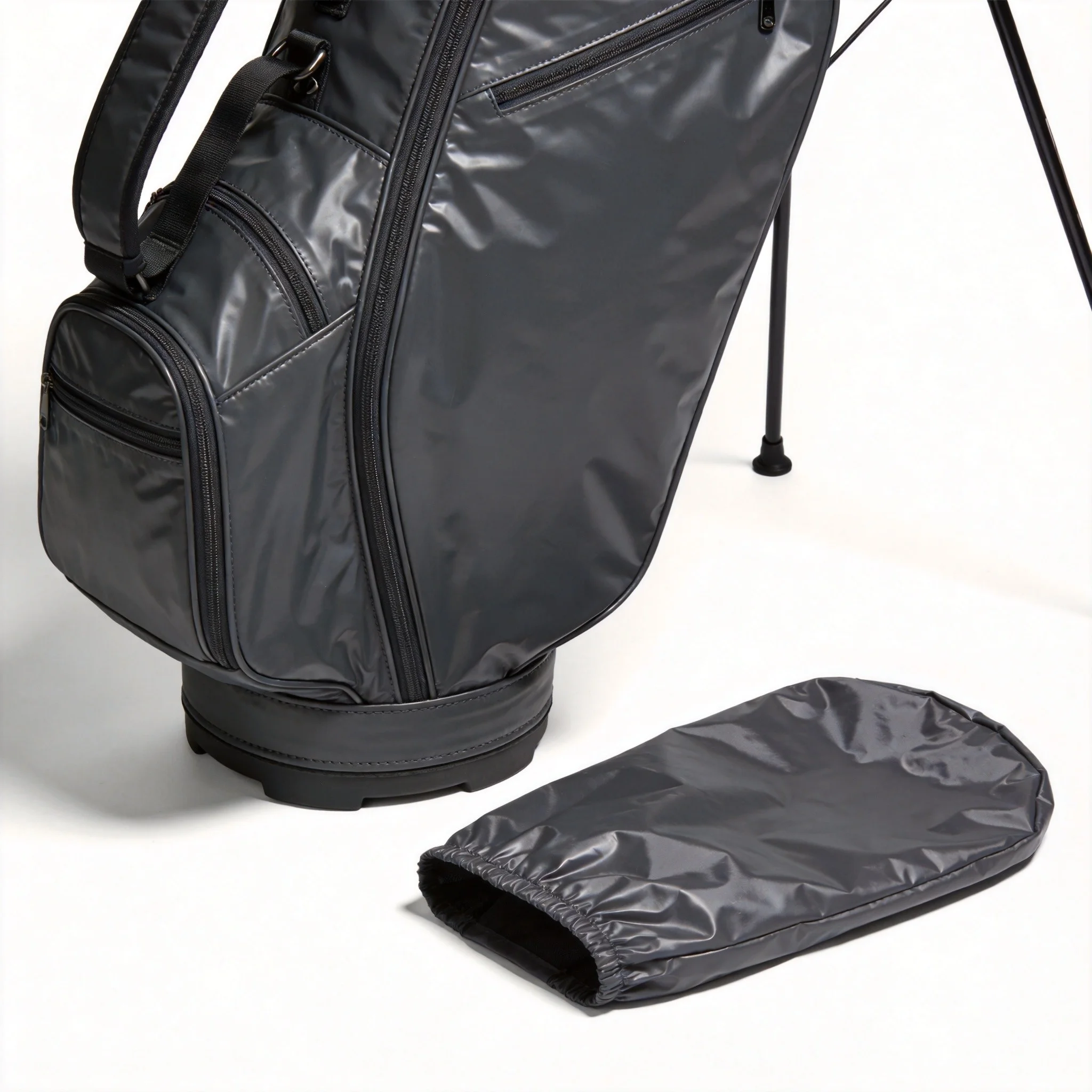
A finished waterproof build: coated shell, sealed base, water-resistant zips and a matched rain hood.
Water Resistance vs Waterproof: The Distinction Buyers Ask About
Almost every golf bag sold as "waterproof" is water-resistant to some degree, and the difference matters commercially because it is the difference between a product that survives an eighteen-hole downpour and one that keeps the clubs dry in a drizzle.
Water resistance is a surface property: a durable water repellent finish makes rain bead and roll off. It degrades with abrasion and washing and gives up entirely under sustained pressure. Waterproofing is a structural property: a continuous barrier — coating, laminate or membrane — that water cannot pass even when the fabric is loaded. A bag can be water-resistant on the panels and waterproof only at the valuables pocket, and that is a legitimate, sellable specification as long as the copy says so.
The practical rule for a B2B buyer is to decide which one you are selling before you choose a single material. A water-resistant bag at 600D with a DWR finish is a mainstream retail product. A waterproof bag at 3,000 mm with welded seams is a premium product with a premium price and a longer QC cycle.
Water-Column Ratings in Plain Terms
A water-column rating (measured in millimetres, following the ISO 811 hydrostatic pressure method) describes how tall a column of water a fabric can hold before it passes through. Higher is more waterproof, but the useful range for golf bags is narrower than the marketing suggests.
| Rating | Holds against | Sensible use on a golf bag |
|---|---|---|
| 0-800 mm | Light drizzle, brief exposure | Water-repellent shell only; do not describe as waterproof |
| 1,500-2,000 mm | Steady rain for 30-60 minutes | Main body of a value waterproof build |
| 3,000-5,000 mm | Heavy rain, cart-cover condensation | The practical premium target |
| 6,000-10,000 mm | Pressure and pooling water | Valuables pocket, base panel, hood |
| Above 10,000 mm | Immersion or prolonged pressure | Rarely justified; adds cost, not sales |
Two caveats keep the number honest. A hydrostatic rating is measured on flat fabric in a lab, so it says nothing about seams, zippers or needle holes — which is where real bags leak. And the rating is taken on a new sample: a coating loses performance with flexing and abrasion, so a 5,000 mm fabric that creases at the base behaves like a 2,000 mm one after a season. Design the high-wear zones thicker, not the whole shell.
Layer One: The Shell
The shell is the coating or laminate on the back of the fabric, and it does most of the work. Four constructions are available at golf bag price points and each has a distinct behaviour.
| Shell construction | Base fabric | Feel | Durability | Best for |
|---|---|---|---|---|
| PU coating (1-2 coats) | 600D-900D polyester | Firm, slightly stiff | Good | Mainstream waterproof builds |
| PU laminate (membrane) | 300D-600D polyester | Softer, more supple | Very good | Premium soft-hand bags |
| TPU laminate | 210D-420D ripstop | Supple, quiet | Excellent | Lightweight and cold-weather builds |
| PVC coating | 600D polyester | Heavy, stiff | Excellent but cracks in cold | Budget; declining in EU/US |
A PU coating at 1,500-2,000 mm is the value option and works if the seams are handled properly. A PU or TPU laminate at 3,000-5,000 mm is the better product: a laminate does not crack where the fabric creases, which is exactly what happens at the base of a golf bag every time it is set down. PVC is still specified for price-led programmes but is increasingly excluded by EU and US retail buyers on environmental grounds.
Whichever shell you choose, specify a DWR finish on the face side as well. The coating stops water getting through; the DWR stops the fabric absorbing water and becoming heavy, which is a separate problem that shows up as a bag that gains a kilo in the rain.
Layer Two: Seams
Seams are where waterproof bags actually fail. Every stitch line is a row of needle holes through the coating, and a bag with a 5,000 mm shell and untreated seams leaks like a 500 mm bag. There are three ways to close the gap and the right answer is a mix.
- Welded seams. Panels are joined by heat and pressure with no needle holes at all. Fully waterproof and strong, but requires dedicated equipment and adds labour. Use on the base and the crown where water pools.
- Taped seams. A heat-applied tape covers a stitched seam. Reliable to roughly 3,000 mm and much cheaper than welding. Use on the long side seams where the load is tension rather than water.
- Seam sealing compound. A liquid sealant applied to the inside of a stitched seam. Cheapest option, adequate on low-stress seams, and the least predictable across a production run — it depends on operator consistency, so it needs its own inspection step.
The cost of sealing is often underestimated. Seam-sealing a full bag adds meaningful labour minutes per unit, and it is the step most likely to be skipped when a factory is under schedule pressure. Build it into the inspection checklist rather than trusting the process: a visual check of every taped seam at final AQL 2.5 inspection is cheap and catches the failures that matter.
Layer Three: Zippers and Closures
The zip line is the largest opening on any golf bag and the most common leak path. Three levels of zipper are relevant, and the choice should follow the pocket rather than the whole bag.
| Zipper type | Water resistance | Feel and use | Where to use it |
|---|---|---|---|
| Standard nylon coil | None | Smooth, cheap | Internal pockets only |
| Water-repellent coil (DWR treated) | Light rain | Near-normal pull force | General pockets on a water-resistant bag |
| Water-resistant coated coil + storm flap | Steady rain | Firmer pull | All external pockets on a waterproof bag |
| Waterproof moulded zip (e.g. TIZIP-class) | Immersion | Stiff, high pull force | Valuables pocket only |
A storm flap — a fabric lip that folds over the closed zip — is the cheapest and most effective upgrade on any external pocket. It costs a fraction of a moulded waterproof zipper and, combined with a coated coil, gets a pocket to the same practical performance for a typical round. Reserve the moulded waterproof zip for the valuables pocket, where the buyer expects it and will pay for it.
One specification detail worth insisting on: a zip garage or a drain channel at the bottom of each pocket. Water will always find the lowest point, and a pocket with no drain holds it against the valuables.
The Rain Hood: The Most Under-Specified Part
The hood covers the top opening — the largest exposed area on any bag — and it is routinely made to a lower standard than the shell it ships with. That is backwards. A hood should be cut from the same coated fabric as the body, taped at the seams, elasticated around the collar and secured with a proper buckle rather than a drawstring that loosens in wind.
Two hood designs are worth quoting. A full-cover hood encloses the whole top collar and is the better product. A club-head hood covers only the clubs, packs smaller and is cheaper, but leaves the divider top exposed — and a divider top full of water drains straight into the bag. If the programme is sold on waterproofing, ship the full-cover hood.
Where Water Actually Gets In
After enough spray tests, the failure list becomes predictable and it is rarely the fabric. Rank the leak paths by frequency and design against them in order.
- Zipper ends and the zip garage — water tracks along the coil and enters at the slider.
- Base seam and the junction between base plate and body — the lowest point, always wet.
- Shoulder strap anchors and D-ring attachments — hardware rivets perforate the shell.
- Embroidered logos on the main body — every stitch is a hole.
- Hood attachment points and the collar seam — flexed constantly, sealing compound fatigues.
The fix for most of these is not a better fabric but a design decision: put hardware on reinforced patch panels, keep embroidery off the crown and base, and give every pocket a drain. Those three changes cost very little and remove four of the five failure modes.
QC and Testing on a Waterproof Build
A waterproof bag cannot be inspected visually. We add a shower test to the standard inspection plan: 30 minutes of directed spray at the crown, both zip lines and the base, with an absorbent tissue pack inside each compartment. Any damp tissue is a fail. The test is run on the pre-production sample and then on a sample basis during bulk.
Alongside that, bulk inspection covers a seam-pull check at the welded joints, a 50-cycle open-close check on every zipper style in the build, and a hardware pull test — all sampled to AQL 2.5 under ISO 2859-1. The broader inspection framework is set out in our quality standards guide.
Specification Summary
| Component | Value build | Premium build |
|---|---|---|
| Shell | 600D polyester, PU coated, 1,500-2,000 mm | 300D-420D, PU or TPU laminate, 3,000-5,000 mm |
| Face finish | DWR spray | DWR spray, re-treatable |
| Base seam | Taped | Welded |
| Side seams | Taped | Taped or welded |
| External zippers | Water-repellent coil + storm flap | Water-resistant coated coil + storm flap |
| Valuables pocket | Water-resistant coil | Moulded waterproof zip |
| Hood | Club-head hood, coated | Full-cover hood, seam-sealed |
| QC | Visual + zipper cycle | Shower test + seam pull + zipper cycle |
If the programme is also being sold into markets with labelling obligations, plan the fabric and coating documentation early — PFAS restrictions on DWR finishes are tightening in the EU and in several US states, and a fluorine-free DWR is now a specification item rather than an optional extra.
Frequently Asked Questions
- What actually makes a golf bag waterproof?
- Three things together: a coated or laminated shell, seams that are welded or taped rather than stitched and left bare, and zippers that are water-resistant or covered by a storm flap. Any one of the three on its own gives water resistance only. A bag with a coated shell and ordinary nylon zippers will let water in through the zip line within a season.
- What water-column rating should I specify?
- For golf bags, 1,500-2,000 mm is enough for rain and dew, 3,000-5,000 mm covers sustained heavy rain and cart-cover condensation, and above 8,000 mm you are paying for performance no golfer will notice. Ratings above about 5,000 mm make more sense on the valuables pocket than on the whole shell.
- Are welded seams better than taped seams?
- Welded seams are stronger and fully waterproof but need dedicated equipment and add cost. Taped seams — a heat-applied tape over a stitched seam — are cheaper, widely available and reliable to about 3,000 mm. On a golf bag the practical build is welded on the base and the crown, taped on the long side seams.
- Can a waterproof bag still have embroidery?
- Yes, but each stitch perforates the coating. The standard solution is to embroider a separate patch and apply it, or to embroider on a non-critical panel and back-seal the area. If the logo must be direct-stitched on the main body, treat that panel as water-resistant rather than waterproof and say so in your product copy.
- Do I still need a rain hood?
- Yes. A waterproof bag protects the clubs from rain coming down; a rain hood protects the top opening, which is the largest exposed area on any bag. Every waterproof build we produce ships with a hood, and the hood should be seam-sealed to the same standard as the shell.
- How much does full waterproofing add to unit cost?
- Typically 20-35% over the same bag in a standard 600D build. The premium comes from the coated shell, the seam-sealing labour, water-resistant zippers and the extra QC step of a spray test on a finished unit.
- How do you test that a bag is waterproof?
- We run a shower test on a finished sample: 30 minutes of directed spray at the crown, the zip lines and the base, then an internal tissue check for ingress. Bulk inspection adds a seam-pull check and a zipper cycle check under AQL 2.5 sampling to ISO 2859-1.
- What is the MOQ and lead time for a waterproof build?
- MOQ is 200 pieces per SKU with a 100-piece trial; a fully new pattern starts at 500. Sampling takes 6-10 working days, or 12-15 for a complex multi-panel build with welded base and custom zippers. Production runs 35-50 days after approval.
Waterproof Guides and Deep Dives
Start with the ultimate guide to waterproof golf bags — it maps the construction layers, water-column ratings, IPX testing and sourcing specifications behind every build on this page. Topic-specific deep dives:
- Benefits of Waterproof Golf Bags for Long-Term Use
- Best Waterproof Golf Travel Bags for Airline Check-In
- Best Waterproof Materials for All Types of Golf Bags
- Custom Waterproof Golf Bags for Wet Climate Countries
- Golf Bag Waterproof Coating and PU Lamination Process
- How to Maintain Waterproof Coating on Golf Bags
- How to Test Waterproof Quality in a Golf Bag
- How Waterproof Golf Bags Perform in Heavy Rain
- OEM Waterproof Golf Bag Production Guide
- Top Waterproof Golf Bags for Golf Courses in Rainy Regions
- Waterproof & Leak-Proof Golf Cooler Bag Features
- Waterproof Golf Bag Testing & IPX Ratings
- Waterproof Golf Stand Bag Options for Wet Weather Golfing
- Waterproof Golf Sunday Bag Options for Travel
- Waterproof Options in High-End Golf Staff Bags
- Waterproof Stand Bags vs Waterproof Cart Bags Compared
- Wholesale Waterproof Golf Bags for Global Markets
Request a Waterproof Build Quote
Tell us the rating you need and which pockets carry the valuables. We will confirm the shell, the seam method and the zipper level, then send a spec sheet and price band.