The Complete Guide to Golf Bag Types: Stand, Cart, Tour, Travel & More
There are six main types of golf bags—stand bags, cart bags, staff/tour bags, Sunday carry bags, travel bags, and specialty waterproof or cooler bags—and the right choice for a brand or player depends on how the round is played. As an OEM/ODM golf bag factory producing for 200+ brands across 100+ countries since 2014 (led by a founder in the bag trade since 2004), we manufacture every category at MOQ 200 pieces (test orders from 100) through an SGS-verified plant with 7 lines, 149 machines and 200,000-piece monthly line capacity. This guide breaks down the anatomy, weight, feature, and sourcing profile of each type so buyers can spec, price and order with confidence.
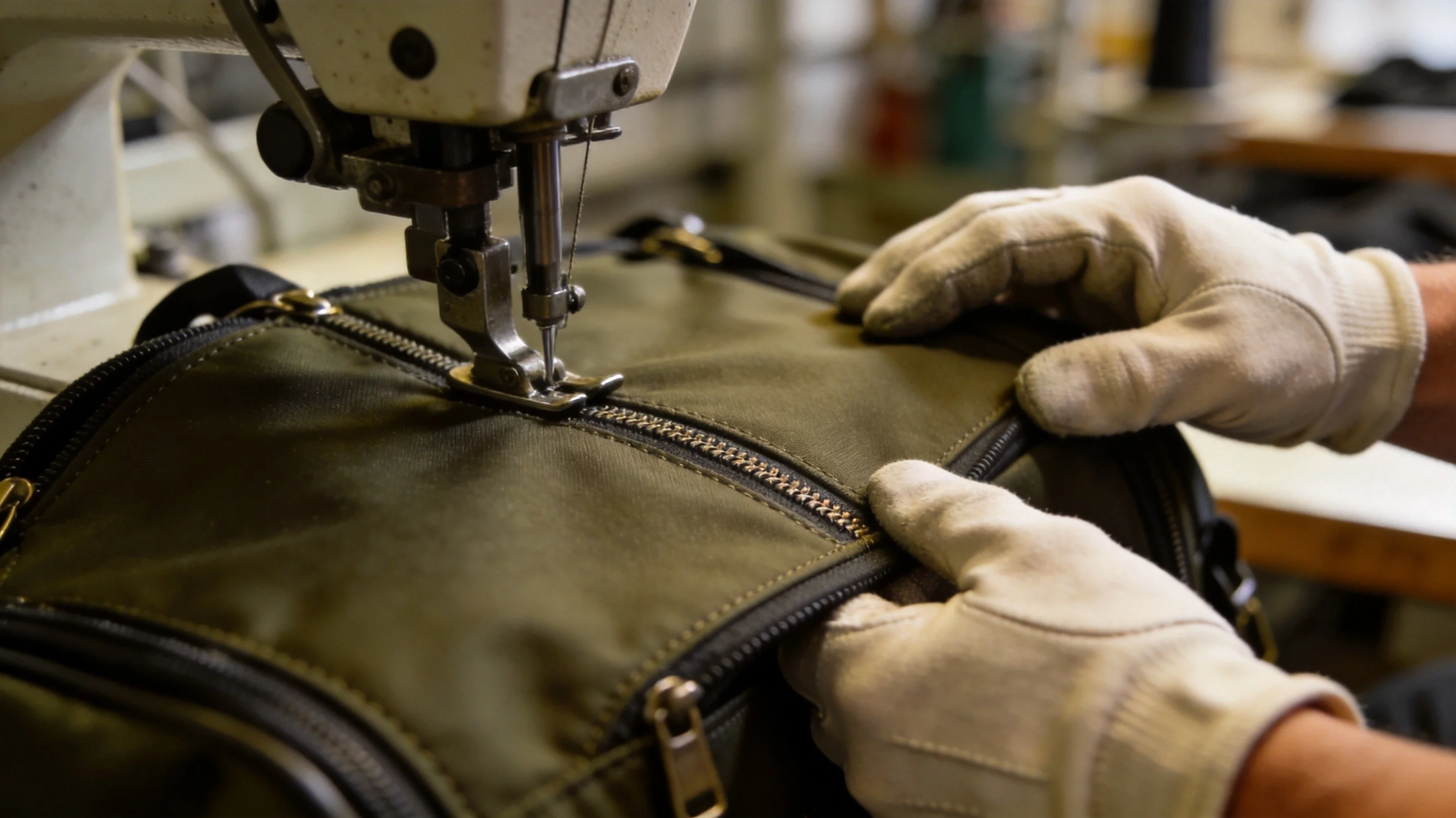
Our SGS-verified affiliated plant in Quanzhou runs 7 production lines with 149 machines (126 sewing stations) and a 200,000-piece monthly line capacity.
Why Golf Bag Type Matters in 2026
Golf bag design has evolved from a simple carry tube into a category-driven performance product. Market data tracks strong growth: the global golf bag market was valued at roughly USD 1.0 billion in 2024 and is projected to grow at a 4–5% CAGR through 2030, driven by rising recreational participation and travel golf (sources: Grand View Research; Fortune Business Insights, golf bag market reports, 2024). For a brand, choosing the wrong type means missed function, wrong price point, or an off-target audience. For a buyer, choosing the right type determines weight, compatibility with a cart or caddie, and how much customization is practical in your price band.
Since walkers dominate public courses and cart golfers dominate resorts, most factories—including ours—see roughly a 40/40 split between stand and cart bags by volume, with staff bags, travel and specialty lines filling the rest. That mix is exactly why a single "golf bag" page rarely converts; audiences search by type. Long-tail queries such as lightweight stand bag for walking, golf cart bag 14-way and golf travel bag with wheels each need a dedicated landing point. Our full golf bag product range covers all of them.
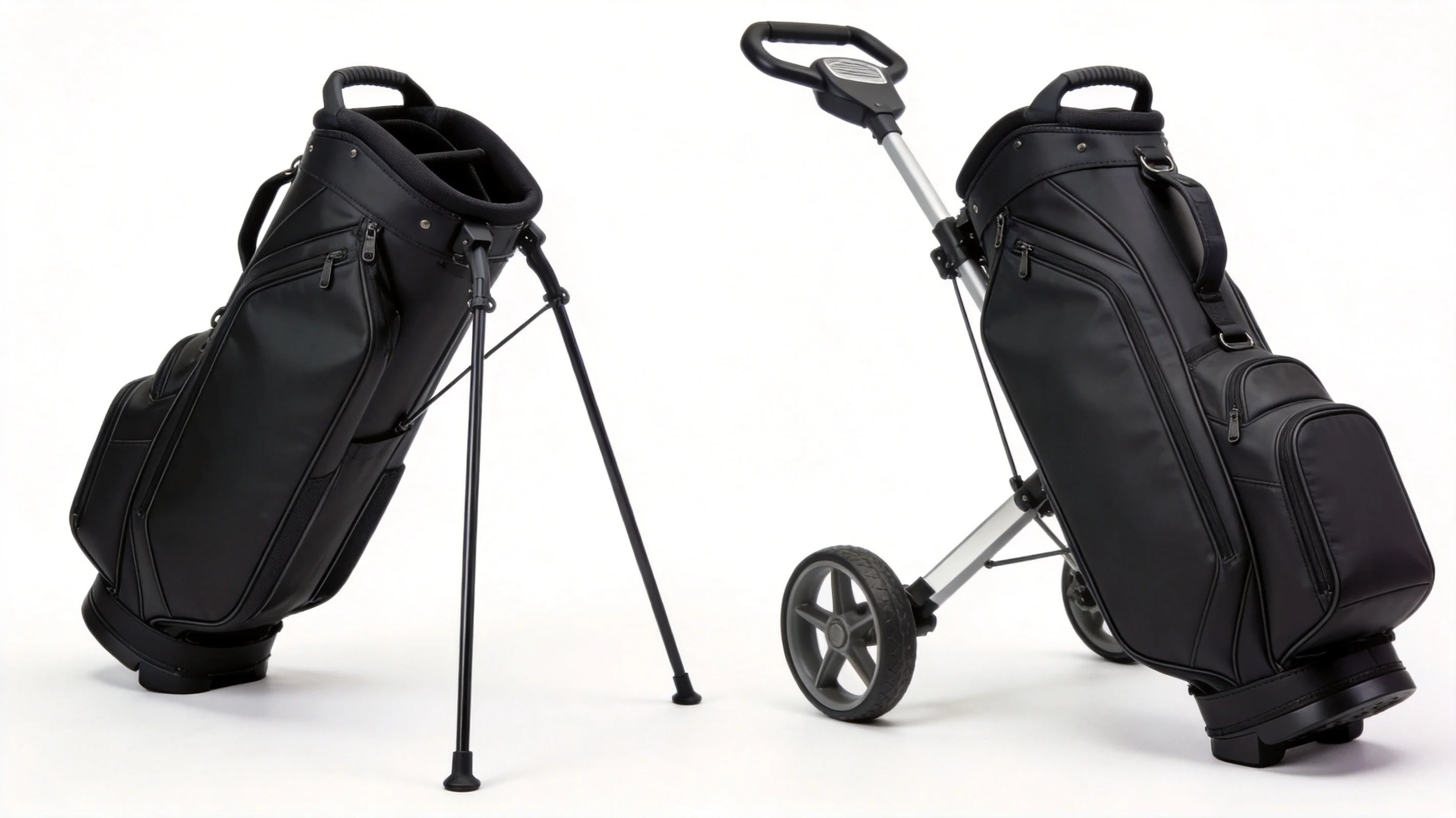
Stand bag vs cart bag — two of the core types we manufacture side by side
1. Stand Bags: The Walker’s Choice
Best for: golf courses where players walk, range practice, club-fitting days and junior lines. The defining feature is an integrated, spring-loaded leg mechanism that lets the bag stand upright on the ground, paired with a hip pad and usually a single-strap or dual-strap carry system designed around posture.
Typical specs at our factory:
- Weight: 2.5–3.2 kg (5.5–7 lb) depending on fabric weight and whether 4-way or 14-way top
- Top: 4-way full-length dividers (walking standard) or 14-way with dedicated putter well
- Legs: aluminium or fibreglass with automatic spring deployment
- Straps: dual ergonomic with quick-release buckles; breathable lumbar pad
- Pockets: 4–7, including a waterproof-lined valuables pocket and insulated drink pocket
Stand bags are the single largest express category for online retailers because they serve amateur and club golfers in equal measure. If your line is walking-heavy or targets weekend golfers, our affiliated stand-bag specialists at golfstandbagsfactory.com can produce dedicated walking-focused models, while we run the full mixed line here. Common customizations: colour-blocking, embroidery chest, dual-strap upgrade, 14-way tops, and custom dividers.
2. Cart Bags: Built for the Trolley
Best for: players who ride in a golf cart or use a push trolley. Cart bags trade portability for capacity: larger bases, more pocket storage, and a wider top that slots into the cart’s bag well.
Typical specs at our factory:
- Weight: 3.0–3.8 kg (6.6–8.4 lb)
- Top: often 14-way with full-length dividers and a dedicated putter slot
- Pockets: 8–12 including cooler pocket, velour-lined valuables, range-finder pocket, rain-cover-ready
- Base: reinforced, non-slip with a cart-strap pass-through
Cart bags carry the highest average price point after staff bags and are the default for clubhouse merchandise because riders outnumber walkers at most private clubs. They offer the best canvas for large embroidery and colour-blocked branding because of their tall, flat front and back profiomic panels.
3. Staff / Tour Bags: The Flagship
Best for: professional tours, teaching professionals, team sponsorships, and premium gift programs. Staff bags are the largest and heaviest category, designed to be carried by caddies and to hold an entire tour player’s gear.
Typical specs:
- Weight: 5.5–8 kg (12–17 lb) empty
- Capacity: 48+ pockets and sleeve layouts; oversized 15-way or 16-way tops
- Materials: premium PVC-free synthetics, PU leather accents, high-density nylon
- Branding: the largest printable surface in golf—ideal for tour logos and team identity
Because staff bags are order-driven and low-volume, they suit a custom program more than a stock line. We produce them for academies, tour caddies and corporate programs; the premium finishing side of high-spec staff manufacture is handled by our high-end facility at golfbagmanufacturer.co when buyers need leather trim or low-volume luxury runs.
4. Sunday / Carry Bags: Minimalist Speed
Best for: par-3 courses, quick 9-hole rounds, range sessions, juniors and travel-lite players. Sunday bags are the lightest type, designed to carry a half set with minimal bulk.
Typical specs:
- Weight: 0.9–1.6 kg (2–3.5 lb)
- Top: 2-way or 3-way, no full-length dividers on most
- Storage: 2–4 slim pockets; single shoulder strap on classic models, dual on modern
- Materials: ripstop nylon, sometimes foldable/compressible
Sunday bags are among the highest-volume low-cost lines and are favourite promotional and custom-branding items because of their low material cost and broad appeal. They are a strong margin category for gift and event programs.
5. Travel Bags: Protect the Set in Transit
Best for: travelling players, airlines, and golfers shipping clubs. Travel bags protect the full set during transit and split into soft-shell (fitted, padded, wheeled) and hard-case (rigid) options.
Typical specs:
- Soft-shell weight: 1.8–3.5 kg; hard-case 4–7 kg
- Capacity: fits full stand/cart bag with clubs inside
- Features: inline or spinner wheels, padded or rigid shell, lockable zips, internal straps, ID pocket
- Materials: 1680D–1680D+ ballistic nylon, EVA or ABS hard shells
Travel is where golf equipment bags differ most from carry bags, and it has its own dedicated buying logic around airline baggage rules. We produced a dedicated golf travel bags range with wheeled and hard-case options, covered in depth in our travel bag buying guide.
6. Waterproof, Cooler & Speciality Bags
The fastest-growing niche categories serve specific playing conditions:
- Waterproof bags use sealed zippers, taped seams and waterproof membranes rated to IPX levels, for wet-climate players. We build waterproof golf bags with fully sealed construction.
- Cooler bags integrate insulated beverage compartments to keep drinks cold; see our golf cooler bags.
- Hybrid bags combine cart and stand features for players who alternate between riding and walking.
Golf Bag Types: Specification Comparison Table
| Type | Typical Weight | Top Dividers | Best Use | Volume |
|---|---|---|---|---|
| Stand | 2.5–3.2 kg | 4 or 14-way | Walking | High |
| Cart | 3.0–3.8 kg | 14-way | Cart/trolley | High |
| Staff/Tour | 5.5–8 kg | 15/16-way | Tour/caddy | Low |
| Sunday | 0.9–1.6 kg | 2/3-way | Quick rounds | Very high |
| Travel | 1.8–7 kg | n/a (case) | Transit | Medium |
| Waterproof/Cooler | varies | varies | Weather/beverage | Growing |
How Buyers Should Choose: Decision Framework
When sourcing, run this sequence: (1) confirm the playing style—walking, riding, or mixed; (2) set a weight ceiling; (3) choose the top/dividers based on club count and preference for full-length separation; (4) decide branding surface needs (staff bags maximise it, Sunday bags minimise it); (5) set MOQ and budget. A balanced factory portfolio across all six types lets a buyer consolidate multiple SKUs in one shipment—reducing per-unit logistics cost and qualifying for better bulk pricing.
Our custom OEM/ODM program supports all six types under one roof: MOQ 200 pieces, prototyping in 10–20 days, bulk in 45–60 days, with in-house QC on 7 lines. For material performance depth, read our waterproof material guide and our quality and manufacturing overview.
Material & Construction Deep-Dive by Type
Beyond type, fabric and construction determine durability, weight and price. The most common shell fabrics are 600D, 840D and 1680D nylon and polyester. Denier tells you yarn weight: 600D suits Sunday and value lines; 840D is the workhorse for stand and cart bags; 1680D ballistic nylon is reserved for travel and premium staff bags where abrasion resistance matters most. In our experience, roughly 60% of bulk golf bags are 840D nylon, with polyester used where suppliers need lower cosmetic stretch and better print hold.
- Nylon: highest abrasion resistance and tensile strength per weight; the default for performance lines.
- Polyester: excellent colour and UV retention, slightly lower strength; cost-competitive with consistent quality.
- PU leather / vegan leather: used for staff-bag trim, logos and premium accents; requires strict QC on coating to avoid peeling.
- Waterproof membranes & TPU: laminated layers or coated fabrics for fully waterproof builds; pricing scales with the membrane spec.
Thread count and seam construction are equally decisive. A standard 4-way bag uses roughly 60–90 metres of thread; a 14-way cart bag with full-length dividers uses more internal webbing and divider fabric, which is why 14-way tops add measurable cost but strong perceived value for riders. Zippers are a frequent failure point—we spec YKK or equivalent waterproof zips on premium and travel lines, with double pulls and lockable sliders on cases.
For a full material-by-material comparison including abrasion, weight and cost trade-offs, our materials evolution guide and waterproof material guide go deeper.
Weight Engineering: The Tension Every Buyer Faces
Weight is the single most trade-off-heavy spec. A stand bag under 2.8 kg with a 14-way top requires lighter fabrics (420D–600D), aluminium legs, and a reduced pocket set—each of which trims cost or durability elsewhere. A cart bag can afford heavier fabric and more pockets because it never sits on your back. Buyers should decide weight before pockets: every added pocket adds roughly 150–300 g and USD 0.5–1.5 of wholesale cost depending on hardware.
- ≤2.8 kg: premium walking stand bags, using light aluminium legs and 600D hybrid shells.
- 2.8–3.5 kg: mainstream stand bags and entry cart bags; the volume sweet spot.
- 3.5–4.5 kg: full-featured cart bags with 10+ pockets.
- >4.5 kg: staff bags and heavy travel cases.
Because weight is guaranteed by fabric and hardware choices, we quote it as a spec band and verify actual weights on pre-production samples rather than promising a single number that production can’t hold.
Pricing & MOQ Benchmarks by Type (2026)
Wholesale/FOB pricing varies with fabric, hardware and order size, but these are realistic FOB bands from our 2026 production data:
- Sunday/carry bags: roughly USD 6–14 FOB depending on fabric and features.
- Stand bags: USD 15–28 FOB; 14-way and premium straps push toward the top.
- Cart bags: USD 18–32 FOB with 14-way and cooler pockets at the higher end.
- Tour/staff bags: USD 35–70 FOB, order and finish dependent.
- Travel bags: USD 18–45 FOB (soft-shell) and USD 40–80 (hard-case).
- Waterproof & cooler: USD 20–40 FOB depending on membrane and insulation spec.
MOQ breaks the same way: complex 14-way cart and staff programs typically set MOQ 200–300 pieces per colourway; simple Sunday and travel soft-shell lines can run at 100–200 units. We quote wholesale programs with tiered pricing at 100, 300, 500 and 1,000 units, and explain lead times (sampling 10–20 days, bulk 45–60 days) in our OEM/ODM process guide.
Customization Options Across the Six Types
Every type supports the full customization stack, but each has a natural ceiling:
- Logo & branding: embroidery (front chest, back panel, staff bag side), heat-transfer print, woven labels, hang tags—all six types.
- Colour-blocking: most pronounced on staff and cart bags with large flat panels.
- Hardware: zippers, buckles, D-rings, feet colour and plating.
- Structural: divider layout, pocket count and layout, strap config, leg material, internal sleeve.
- Packaging: custom cartons, MOQ-based poly/combo bags, retail-ready hang displays.
Our custom program manages design-to-production for all six types, with speciality custom work handled by our dedicated custom-golf-bag facility. For the corporate and team gifting angle, see our logo and embroidery guide.
Quality & Compliance for Golf Bag Production
Whatever the type, buyers validate these before booking: fabric tensile and abrasion testing, zipper cycle testing (typically 5,000–10,000 cycles), strap tensile load, leg articulation cycles for stand bags, waterproof ratings (IPX) where claimed, and overall AQL inspection (we use AQL 2.5 general, 4.0 for travel cases). Our plant is SGS-verified for Alibaba.com (March 2026) and runs 7 production lines and 149 machines with 137 staff. We maintain stock and custom quality programs across all six types; our manufacturing and QC overview details the full testing regime.
Frequently Asked Questions
- What is the lightest type of golf bag?
- The Sunday/carry bag is lightest, from 0.9 to 1.6 kg, because it holds only a half set with minimal pockets and dividers.
- Which golf bag is best for riding a cart?
- A cart bag, typically 3.0–3.8 kg with a 14-way top and 8–12 pockets, is built to sit in a cart’s bag well and keep clubs organized and accessible.
- Are staff bags bigger than tour bags?
- In modern usage the terms overlap; "staff" and "tour" bags both refer to the largest, most feature-rich category (5.5–8 kg) carried by caddies on professional tours.
- What is the minimum order quantity for custom golf bags?
- At a full-service factory, MOQ is typically 200 pieces per type (test orders from 100), with Sunday and travel lines often lower and staff/cart lines sometimes at 300 for complex builds.
- Can I mix multiple golf bag types in one order?
- Yes. Consolidated mixed-SKU orders reduce logistics cost and can qualify for better tiered pricing; belt factories and established suppliers routinely combine stand, cart and travel lines in one shipment.
2026 Trends Reshaping Golf Bag Categories
Several material and consumer trends are redefining how each type is sourced this year:
- Sustainability-driven fabric: recycled PET (rPET) shells and recycled nylon are moving from premium niches into mainstream stand and cart lines. Buyers increasingly ask for GRS (Global Recycled Standard) certification; offering rPET 840D as a standard option future-proofs a line. See our recycled materials guide.
- Modular and convertible systems: hybrid stand/cart bags with removable straps continue to grow because one SKU serves both walkers and riders, halving a retailer’s required SKU count.
- Lightweight engineering: 14-way tops are now demanded on walking bags that previously shipped 4-way, pushing fabric and hardware innovation to hold weight down.
- Personalization at order level: small-run customization (from 100 units) for clubs, academies and corporate programs turns generic types into branded products with real margin.
- Eco packaging: polybag reduction, recycled cartons and hang-tag consolidation are becoming RFQ line items rather than afterthoughts.
These trends matter because they change what the word “standard spec” means from one season to the next. A factory that can quote an rPET shell, 14-way top and reduced-packaging option in the same breath is easier to design with than one offering only baseline stock.
Sourcing Checklist: From RFQ to Bulk Delivery
Whatever type you order, the same eight verification steps keep a project on track:
- Confirm type & usage: walking vs riding vs travel drives weight, top and pocket specs.
- Set the spec sheet: fabric denier, weight band, divider layout, hardware, branding surface and packaging.
- Validate the supplier: check factory licence, SGS/Alibaba verification, QC process and a genuine production-line history.
- Order a pre-production sample: verify weight, fit, zippers, straps and colour against the approved spec before any bulk.
- Agree on AQL and inspection: set acceptable quality limits (commonly AQL 2.5) and whether third-party mid-line/final inspection applies.
- Lock lead times: sampling 10–20 days; bulk 45–60 days, with milestones for material, sewing, QC and packing.
- Confirm MOQ and tiered price: 100/300/500/1,000 unit breaks and how mixed SKUs are priced.
- Plan logistics: FOB, EXW or DDP; carton dimensions and weights for freight; compliance with destination labelling rules.
We run buyers through this exact sequence on every golf bag project, from a first RFQ to repeat bulk shipments. The wholesale pricing negotiation guide and the OEM/ODM services page expand each step with worked examples and timeline detail.
Regional Demand Differences Buyers Should Know
Demand skew varies by market, and buyers who plan inventory around it hold an advantage:
- United States: the largest market; cart bags and 14-way stand bags dominate, with strong demand for oversized cooler and smartphone-ready pockets.
- United Kingdom & Europe: walking culture keeps stand bags and hybrids prominent; weather drives waterproof demand.
- Asia-Pacific: fast-growing participation pushes both value Sunday bags and premium tour lines; course labour costs make cart bags increasingly common at resorts.
- Middle East: premium staff bags and branded travel sets for corporate and hospitality segments.
Because factors of 100+ countries, we see these patterns directly and size production mix accordingly. Telling us your target market early lets us steer fabric, colour and feature choices toward what actually sells there.
How to Get a Quote for Your Golf Bag Range
The fastest way to a reliable quote is a complete brief: target type(s), volume per type, fabric preference (or “factory recommendation”), 14-way vs 4-way, branding method, packaging, target FOB price and destination. With that, we return pricing, MOQ, sampling cost and a production timeline—typically within 24 hours. Reach the sourcing team at service@junyuanbags.com or call/WhatsApp +86 17750020688, or browse our full product range to start shortlisting.
Final Thoughts: Type as a Portfolio, Not a Single SKU
The retailers and brands that win treat golf bag “type” as a portfolio decision rather than a one-SKU bet. A balanced opening line usually pairs a strong 14-way stand bag with a value Sunday carry bag and a travel option, then extends into cart, staff or waterproof based on the customer data that actually arrives. Because lead times run 45–60 days on bulk, ordering across types in one consolidated program keeps shelf and warehouse turns in sync and simplifies QC, vendor management and freight.
If you are planning a golf bag range for 2026 or beyond, the practical starting point is a two-or-three-type portfolio that covers your core customer. Map each type to a price band, verify weight and features against real play, and confirm the factory can run all your SKUs under one QC standard. That is the difference between buying bags and building a consistent, defensible product line.
Start the conversation with our sourcing team—service@junyuanbags.com or +86 17750020688—and we will help you shortlist the types, spec the samples and scale the program.