Golf Bag Manufacturers in China: A Sourcing Guide
What sourcing golf bags from China actually involves — from QUANZHOU JUNYUAN BAGS, a sourcing and programme-management company working with an affiliated factory since 2014 — covering the manufacturing cluster, cost structure, MOQ, Incoterms, duty, inspection and IP.Golf bag production in China concentrates in Fujian province, around Quanzhou and Xiamen, where fabric mills, hardware suppliers, moulded top-collar tooling, embroidery and printing all sit within a short drive of the sewing floors. A realistic first order is 200 pieces per SKU at FOB Xiamen, with 6-10 working days sampling and 35-50 days production. Plan four months from brief to warehouse.
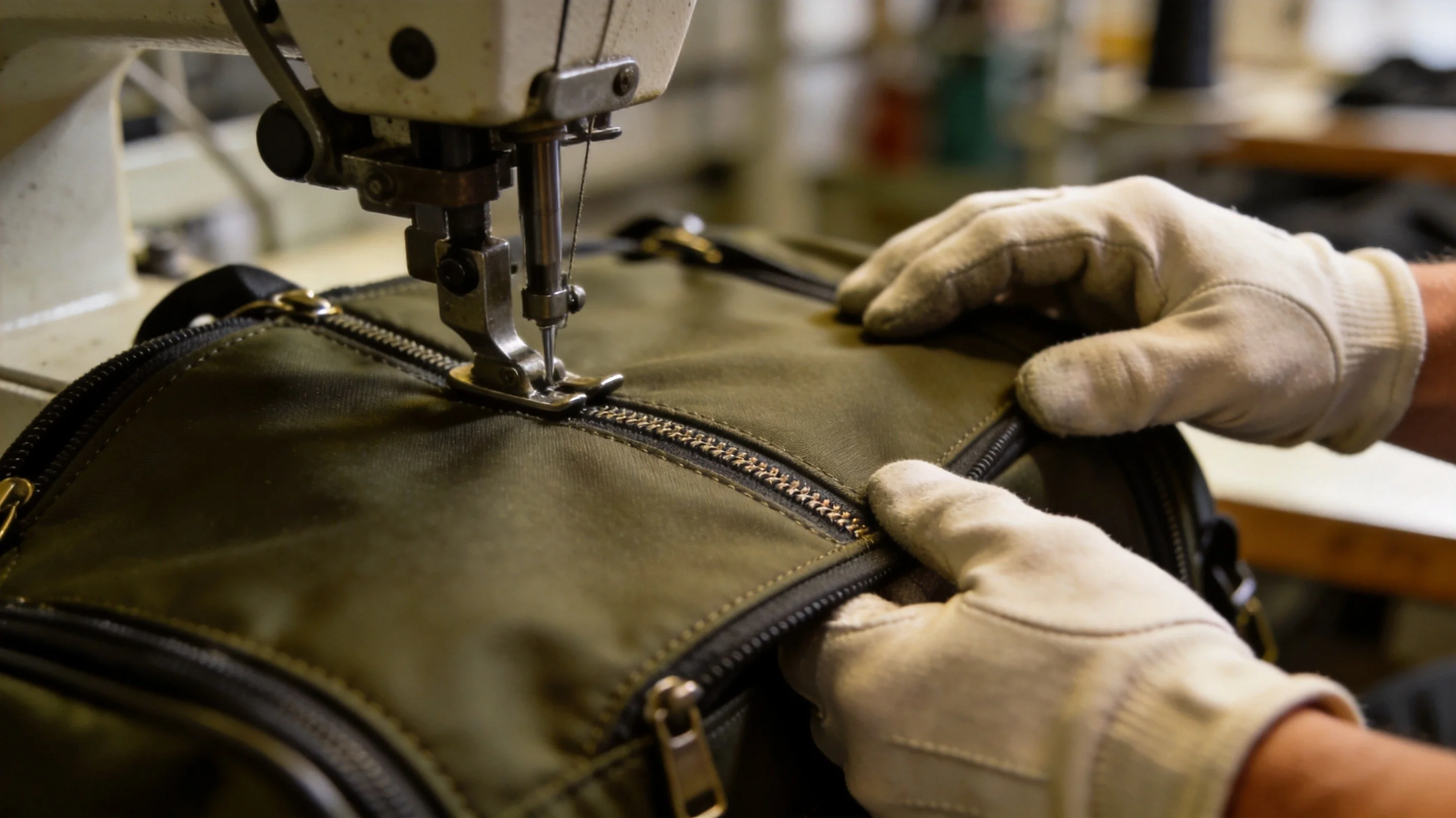
A golf bag production floor in Quanzhou: cutting, sewing, top-collar assembly and final inspection.
The Manufacturing Cluster
Golf bags are not made in one place in China, but they are concentrated. Understanding where and why is the difference between a supplier who can solve a problem and one who has to ship the problem elsewhere.
Fujian province is the centre of gravity. Quanzhou is the densest concentration of bag sewing capacity in the country — bags, luggage, backpacks and accessories share the same labour pool, the same trim suppliers and the same hardware vendors. Xiamen, an hour away, is the port. That combination of production and export in one small geography is why the region dominates this category.
Guangdong — Dongguan and Guangzhou — is the second cluster and skews toward leather goods and higher-end trim. Zhejiang has strength in softgoods and textile accessories. For golf bags specifically, Fujian is the default and Guangdong is the alternative when the build is leather-heavy.
The practical significance of a cluster is not cost, it is problem-solving speed. When a zipper fails an abrasion test, a local supplier delivers a replacement sample in a day. When a top collar needs a 3 mm change, a local tooling shop can turn it around in a week. In a non-cluster location the same two events cost two to three weeks each, and the schedule absorbs it.
What China Is Good At, and What It Is Not
A sourcing decision made on cost alone usually disappoints. The honest position is that China is extremely strong at some things and weaker at others, and a programme should be designed around that.
| Strength | What it means in practice |
|---|---|
| Component depth | Dividers, top collars, hardware, webbing, zips and labels all sourced locally |
| Sewing skill at volume | Complex multi-panel construction reproduced consistently across thousands of units |
| Tooling turnaround | New moulded parts sampled in 1-3 weeks rather than months |
| Material range | 600D to 1680D, PU and PU laminate, TPU, ripstop, all available locally |
| Cost at scale | Unit cost falls predictably from 200 to 5,000 pieces |
| Limitation | How to manage it |
|---|---|
| Colour accuracy across lots | Specify Pantone TCX, approve a lab dip, and buy fabric in one dye lot |
| English technical communication | Write the spec sheet, do not describe it verbally |
| Consistency between orders | Sign a golden sample and keep it; re-check at first-off on every reorder |
| Deadline behaviour under pressure | Build a buffer into your own plan rather than relying on the factory's |
| IP discipline | NDA, written exclusivity, and a limited reference sample rather than a full tech pack |
None of the limitations is disqualifying. All of them are manageable with process — which is the actual skill in sourcing from China. The buyers who struggle are usually the ones who treated a supplier relationship as a transaction rather than as a process with gates.
The Cost Structure
Unit price is the least interesting number in a quotation. What matters is which cost blocks you can influence and which are fixed.
| Cost block | Share | Lever |
|---|---|---|
| Shell fabric | 15-25% | Denier, coating, stock colour vs custom dye |
| Labour (cut, sew, assemble) | 25-35% | Panel count, pocket count, trim complexity |
| Tooled components | 10-20% | Top collar mould, base plate, divider layout |
| Hardware and zippers | 8-15% | Zipper grade, metal vs plastic, finish |
| Branding | 5-12% | Number of positions and process |
| Packaging | 3-8% | Hangtag, poly bag, gift box |
The two blocks with real leverage are labour and tooled components, and both are driven by panel and pocket count rather than material quality. Cutting a build from ten pockets to seven can save more than downgrading the shell from 1680D to 600D — and it usually produces a better bag, because a cart bag with ten pockets is heavier and harder to organise than one with seven well-placed ones.
Tooled components are a fixed cost, which is why MOQ exists. A moulded 14-way top collar costs the same to tool whether you order 200 or 2,000; the difference is how many units absorb it. This is also why a new pattern carries a 500-piece floor while an existing pattern runs at 200.
MOQ and Lead Time, Without the Optimism
Every supplier quotes a lead time that assumes nothing goes wrong. The realistic version is longer, and planning to the realistic version is what separates a launch that lands from one that slips a season.
| Stage | Quoted | Plan for |
|---|---|---|
| Quotation | 3-5 days | 1-2 weeks (includes spec clarification) |
| Sampling | 6-10 working days | 2-3 weeks with one revision round |
| Sample approval | 2-3 days | 1 week (internal sign-off takes time) |
| Production | 35-50 days | 5-7 weeks |
| Sea freight to US/EU | 14-24 days | 3-4 weeks port to door |
The window most often under-planned is sample approval. The factory can turn a sample in ten days; getting four stakeholders in a brand to agree on the colour of a binding takes longer. Consolidate comments into one document and nominate a single decision-maker before the sample arrives, not after.
Incoterms and FOB Xiamen
For a first order, FOB is almost always the right Incoterm. The supplier is responsible for export clearance and for loading the goods on board; you appoint the forwarder and control the freight cost. That split is clean, and it gives you visibility of the one cost line a supplier has an incentive to mark up.
EXW looks cheaper because the quoted price excludes everything after the factory gate. In practice you then have to manage Chinese export documentation, inland transport to the port and export clearance — usually through a forwarder who charges more for the fragmented scope than an FOB supplier would have paid. It is rarely worth it below very large volumes.
CIF and CFR shift freight to the supplier, which is convenient but removes your control over routing and timing. DDP is occasionally offered and should be treated with caution: the supplier is taking on import duty and clearance in your country, which means either a very large margin cushion or an optimistic duty assumption that lands on you later.
The full comparison of terms, with the cost lines each one covers, is in our wholesale pricing guide.
Duty, Tariffs and Landed Cost
Golf bags generally classify under HS 4202.92 — travel bags, sports bags and similar containers with an outer surface of textile materials. The classification matters because the applied duty rate varies by destination, by material, and by whatever additional measures are in force at the time of import.
Do not build a landed-cost model on a rate you read in a guide, including this one. Rates change, and additional tariffs on Chinese-origin textile goods have been applied and revised repeatedly in both the US and the EU. Confirm the current rate for your specific origin, destination and HS code with a customs broker before you price the product.
Landed cost has six components, and buyers routinely account for three:
- Ex-works or FOB unit price
- Freight and insurance to destination port
- Import duty at the applicable rate
- Customs entry, brokerage and port fees
- Inland transport to warehouse
- Import VAT or sales tax, and any applicable trade-remedy measures
A product that looks viable at FOB often is not viable once the full stack is applied. Build the model before the first order, not after it, and stress-test it at a 10% duty increase — that is the scenario that has actually happened, repeatedly.
Quality: AQL, Inspection and the Golden Sample
Quality in Chinese manufacturing is a process question, not a nationality question. Factories build to the standard you specify and inspect to; if the specification is vague, the output will be whatever was convenient on the day.
The baseline to agree in the contract is AQL 2.5 to ISO 2859-1 for major defects, with a tighter level for critical defects. On top of that, three mechanisms do most of the work.
- The golden sample. A signed, physically retained pre-production sample that becomes the reference for every unit. Photographs are not a substitute; colour and hand-feel do not survive a screen.
- Third-party inspection. On any first order, commission an independent inspection before shipment. It costs a fraction of a reworked container and it changes how the factory prioritises your order.
- First-off check on reorders. The first unit off the line on every repeat order is checked against the golden sample before the run continues. This is where drift is caught.
The inspection framework, including what to check at each stage, is set out in our quality standards guide.
IP and Design Protection
The realistic IP risk in bag sourcing is not a factory selling your exact design to a competitor. It is a design circulating as a reference sample — shown to other buyers as an example of capability, and eventually reproduced with small changes.
Four measures reduce that risk materially. Sign an NDA before the technical conversation. Put pattern exclusivity in writing as a contract term, not as an email assurance. Register your trademark in your destination markets and, where the budget allows, in China. And share a limited reference sample plus a written specification rather than a complete tech pack before an NDA is in place.
The questions worth asking any supplier on this topic — and the answers that should concern you — are in our manufacturer selection guide.
Payment Terms
New relationships typically run 30% deposit with 70% before shipment, or 30/70 against a copy of the bill of lading. Both are normal and neither should be resisted on a first order.
What is worth negotiating is the structure over time. After two or three clean orders, 20/80 becomes reasonable; after a year of consistent volume, 30/70 with the balance at 30 days against documents is achievable. Payment terms are a function of relationship history, and asking for relaxed terms on a first order signals inexperience rather than negotiating skill.
Never pay the full amount before shipment on a first order, whatever the discount offered. A 5% discount is not adequate compensation for losing control of the balance.
The Failure Modes Worth Knowing
Most first orders that go wrong go wrong in one of these ways. All of them are preventable.
- Vague specification. "Same as the sample" is not a specification. Write the spec sheet.
- No golden sample retained. Without a physical reference, a colour drift on reorder is undetectable and unarguable.
- Sample approved by photograph. Colour and hand-feel do not survive a screen; someone has to hold the bag.
- No third-party inspection on a first order. The cost of an inspection is trivial against a reworked container.
- Unrealistic deadline. Asking for 25 days production gets you either a refusal or a rushed run. Neither is useful.
- Landed cost modelled at FOB. The product that looked viable at FOB may not be viable duty-paid.
- Freight booked after production. Book the forwarder when the order is placed, not when the goods are ready.
The common thread is that every failure is a planning failure rather than a manufacturing one. China can build an excellent golf bag. Getting an excellent golf bag delivered on time and at a predictable cost is a programme-management problem, and that is where the effort belongs.
How to Start
- Write a one-page specification: format, dimensions, fabric, pocket list, hardware, branding, quantity.
- Send it with a reference photo and your target retail price, and ask for a quotation at two quantities.
- Sign an NDA, then share the detail; request a technical spec sheet back before sampling.
- Approve a physical sample against the spec, and retain it as the golden sample.
- Book the forwarder, commission a pre-shipment inspection, and confirm the duty rate before the goods move.
A first order that follows those five steps rarely surprises anyone. The buyers who get into trouble are the ones who compress the sequence — usually because a retail date is closer than the plan allows.
Frequently Asked Questions
- Where are golf bags made in China?
- The dominant cluster is Fujian province, and within it Quanzhou and Xiamen. Quanzhou has the densest concentration of bag sewing capacity in the country — bags, luggage and accessories share the same labour pool, trim suppliers and hardware vendors. Guangdong (Dongguan, Guangzhou) is the second cluster and skews toward leather goods and higher-end trim.
- Why is Quanzhou significant for golf bags?
- Because the whole supply chain is local. Fabric mills, webbing and zipper suppliers, moulded plastic top collars, metal hardware, embroidery shops and printing houses are all within a short drive. That matters operationally: a replacement zip or a re-cut divider does not stop a production line for a week waiting on a delivery.
- What is a realistic MOQ when sourcing from China?
- 200 pieces per SKU is the standard for an existing pattern with your branding, 100 pieces for a trial, and 500 where the pattern has to be developed. Any supplier quoting a much lower minimum on a custom bag is usually describing a stock product with a logo applied, not a custom build.
- How long does production take?
- Sampling runs 6-10 working days, or 12-15 for complex builds with leather trim or multi-position embroidery. Bulk production runs 35-50 days after written sample approval. Add two to four weeks for sea freight to the US or EU.
- What Incoterm should I use?
- FOB is the standard for a first order, and FOB Xiamen is the usual port for Fujian-based suppliers. FOB keeps the supplier responsible for export clearance and loading, and gives you control of the freight forwarder. EXW is cheaper on paper but leaves you managing Chinese export documentation, which is rarely worth it.
- How much duty will I pay?
- It depends on the destination, the HS classification and the current tariff schedule. Golf bags generally fall under HS 4202.92, but the applied rate varies by country and by material, and additional measures can apply. Confirm the rate with a customs broker for your specific lane before you commit to a landed-cost model — do not rely on a rate you read in a guide.
- How do I check quality before shipment?
- Agree an inspection standard in the contract — AQL 2.5 to ISO 2859-1 is the usual baseline for golf bags — and commission a third-party inspection before shipment on any first order. On repeat orders, an in-line check plus a final inspection is usually enough.
- How do I protect my design and brand?
- Sign an NDA before the technical discussion, put pattern exclusivity in writing, and register your trademark in the destination markets and, where practical, in China. Do not send a complete tech pack before an NDA is signed. The realistic risk is not a factory copying a design outright; it is a design circulating as a reference sample to other buyers.
Request a Sourcing Quotation
Send your specification, quantity and destination market. We will return a technical spec sheet, a unit price band at two quantities and a realistic production calendar.