How to Choose a Golf Bag Manufacturer: 12 Critical Factors That Protect Your Brand, Budget, and Reputation
Choosing a golf bag manufacturer comes down to 12 verifiable factors, not promises: real production capacity, honest minimum order quantities, material and hardware sourcing, bag-type specialization, third-party quality certification, supply-chain structure, sampling speed, production lead time, customization depth, export compliance, communication discipline, and proven track record. A factory that meets all 12 will quote a minimum order of 200 pieces (with 100-piece test orders available), deliver a prototype in 10–20 days and bulk goods in 45–60 days, and back every claim with an independent on-site audit — for example, an SGS verification report you can actually download.
Every good golf bag brand starts with the same question, which is also the question that gets most overseas buyers in trouble: which factory do I actually trust with my product, my deadline, and my money? In the golf bag market, demand keeps climbing — The R&A's 2024 Global Golf Participation Report counted 108 million adults and juniors playing the sport across its affiliated markets, up almost three million in a single year. More players means more demand for bags, which means more suppliers claiming to make them. Many of those suppliers are trading companies with nothing more than an office and a catalog. This guide gives you a repeatable, evidence-based evaluation framework so you can separate a real manufacturing partner from a middleman — and choose the right one on the first attempt.
As a maker behind QUANZHOU JUNYUAN BAGS — a golf bag project founded in 2014 by an operations leader who entered the industry in 2004, today working with 200+ brands across 100+ countries — we have watched too many importers sign with the first factory that answered an email. This article walks you through the twelve factors that actually decide whether your golf bag program succeeds. Read it before you request quotes, and keep the checklist table handy when you compare suppliers.
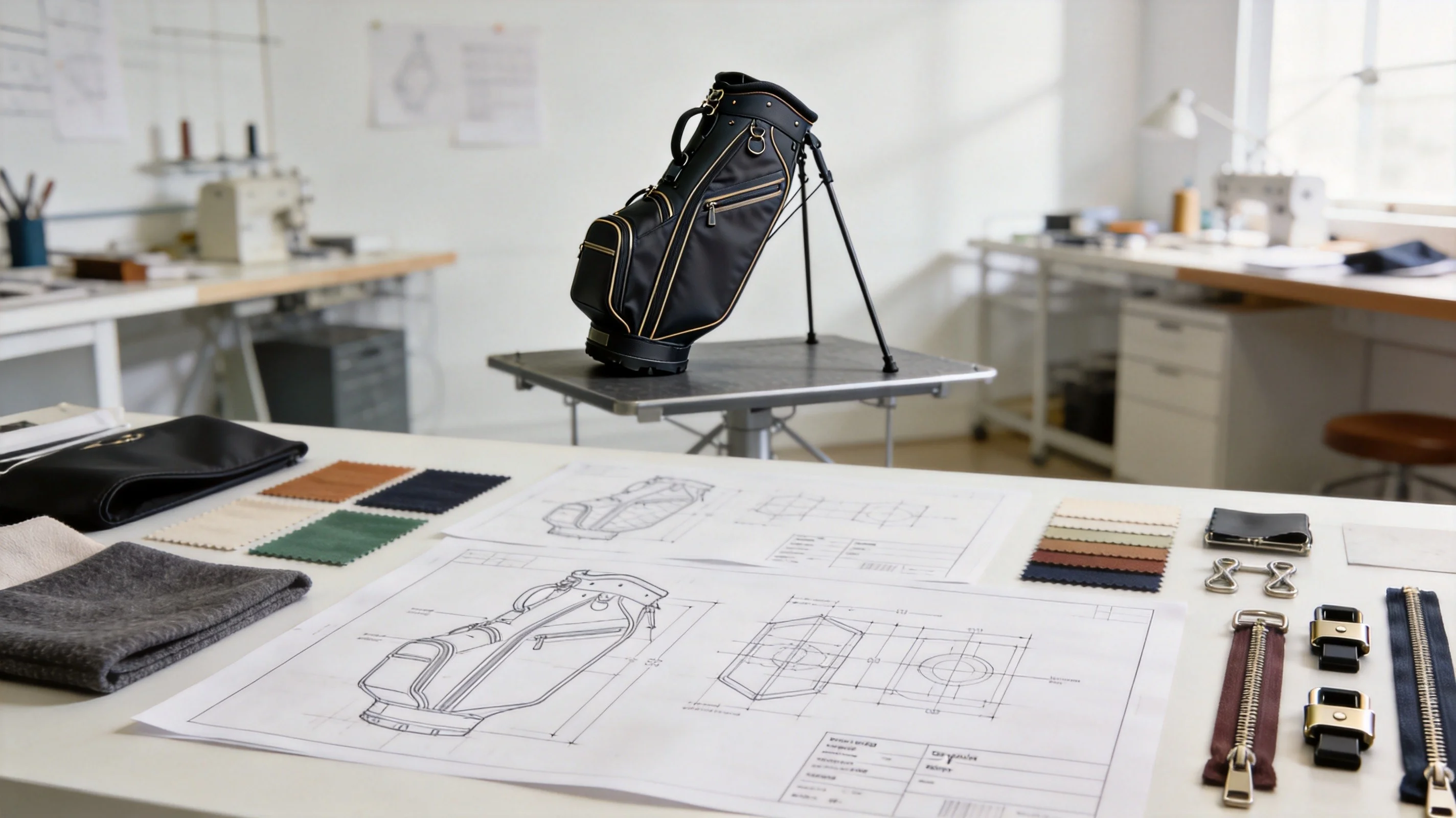
A reliable partner audits patterns and hardware first: pre-production samples, then approval before bulk cutting begins.
1. Production Capacity and Real Manufacturing Capability
Capacity is the first thing that separates a manufacturer from a middleman. Your brand may start with 300 units, but you want a partner who can scale to 50,000 without suddenly elongating lead times or cutting corners. Ask for the factory's actual floor data: square meters of production space, number of production lines, machinery count, headcount, and monthly output.
A professional setup we can describe honestly should look like this: a main facility of about 4,950 square meters, roughly 7 production lines, around 149 sewing and finishing machines, about 137 staff, and a monthly production capacity near 200,000 pieces. These are the kinds of numbers you should request from every candidate — and then verify, because any trading company can type them into an email.
Two red flags to watch for: a supplier who cannot or will not name their affiliated production base, and a supplier whose stated capacity roundly exceeds the floor space they claim. Production capacity should be described per month and per bag type, and the supplier should be able to walk you through how a single order flows from cutting, to sewing, to assembly, to final pack.
Capacity also drives service quality. A factory near capacity tends to quote long lead times; an underused one may eagerly take orders but lack the skill depth of an established operation. A partner at the sweet spot delivers consistent output, reserves capacity for reorders, and can still show you live production photos on request. Learn more about how we organize the floor in our manufacturing process overview.
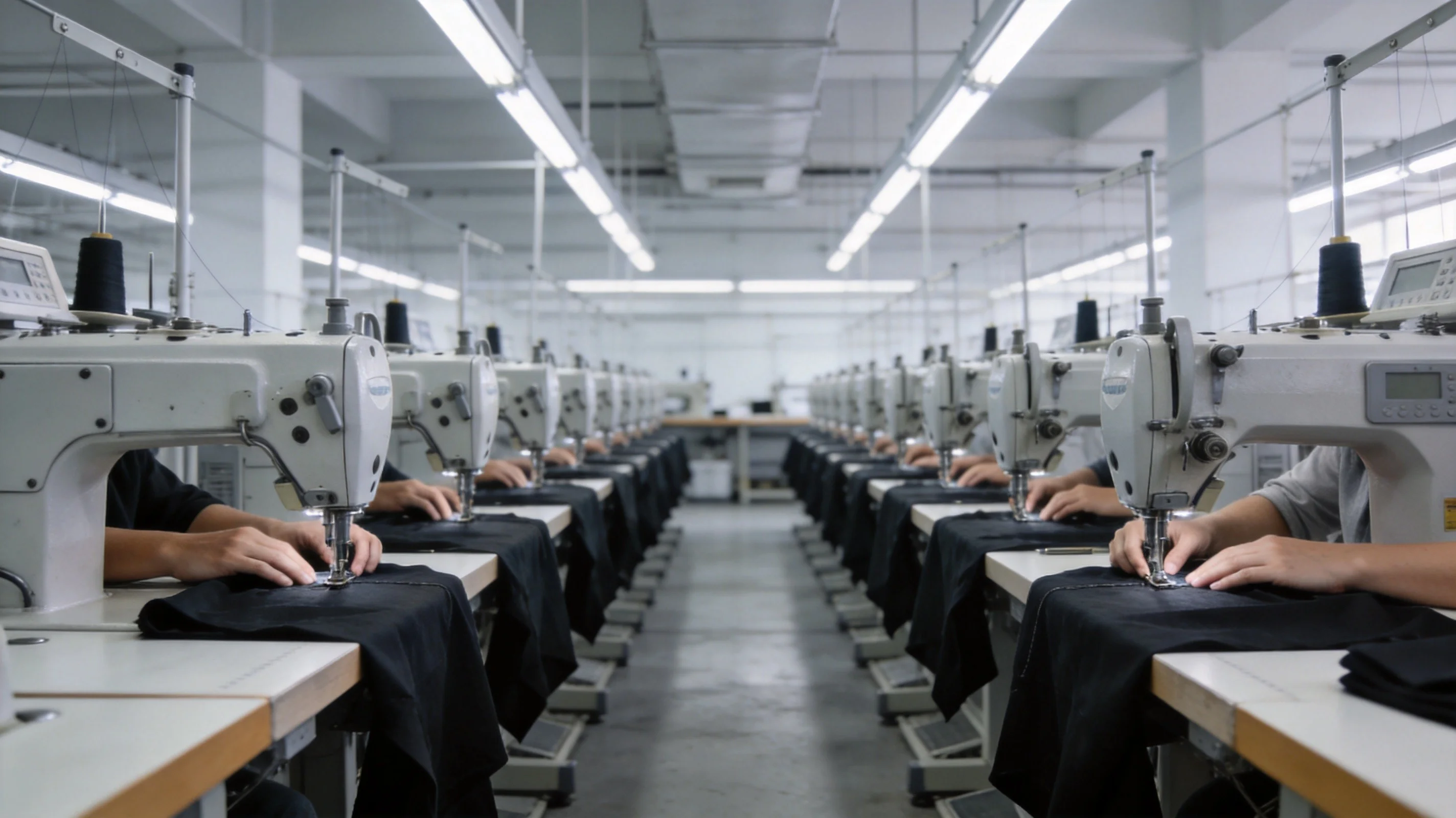
Our affiliated workshop floor — production capacity you can verify before you commit
2. Minimum Order Quantities and a Workable Sample Policy
Minimum order quantity (MOQ) is where most sourcing conversations stall. A low MOQ may look attractive, but it often hides a weaker factory that lacks confident tooling or that silently pushes small jobs to a subcontractor. A high MOQ can lock a young brand into dead inventory. You want an MOQ that is realistic for the factory yet low enough to test two or three designs before committing.
A sensible benchmark: a standard MOQ of 200 pieces per design, with a 100-piece test order path for brands de-risking a new product line. This lets you validate stitching, foam density, colorfastness, and packaging before you scale — without forcing an unrealistic first commitment. Confirm the exact MOQ in writing, and confirm whether it is per style, per colorway, or per order, because these three mean very different cash outlays.
Equally important is the sample policy. Clarify who pays for the sample and shipping, how many revision rounds the sample price includes, and whether the sample fee is credited back against a confirmed bulk order. Require a physical, pre-production sample with your exact materials and logo before any bulk commitment. A factory unwilling to produce a matching pre-production sample is a dealbreaker, no matter how attractive the quote.
Compare MOQ and sample terms side by side for every shortlisted factory — the wholesale golf bag ordering guide lays out the kind of layout you should request from each candidate.
3. Material, Hardware, and Sourcing Transparency
A golf bag is a small assembly of many parts: face and lining fabrics, foam padding, zippers, buckles, D-rings, webbing, hook-and-loop straps, and thread. Each component has a quality tier, and the difference between a premium YKK-style zipper and a bargain component can be the difference between a bag that lasts a decade and one that fails mid-season. Ask exactly what materials each price tier uses and whether those materials are testable.
Good suppliers distinguish the fabric (for example polyester, nylon, or canvas) and the denier or gauge — for a golf bag this affects abrasion resistance of the bottom, the durability of the dividers, and whether the bag can stand upright under a full set of clubs. They can also name their hardware source and offer you the option to specify branded zippers and buckles at a known cost adder.
Require transparency in three places: a written material specification sheet attached to every quotation, an option to approve material samples in advance, and accurate documentation on the bill of materials. A factory that hedges on material details in the quote will also hedge on them in production. You also want to know the future-proofing story — how the factory adapts to new materials and trend-driven finishes over time.
Understanding how material choices affect cost and durability protects your margins. See how we structure material selection and sourcing inside our OEM/ODM service model.
4. Bag-Type Specialization and Production Fit
Not every factory is strong at every bag. A golf bag program covers distinct constructions — stand bags with integrated leg mechanisms, cart bags engineered to sit in the cart, staff bags for tour use, sunday bags for minimal carrying, and travel covers that must survive airport abuse. Each type demands different machinery and pattern expertise. Ask a supplier which types they make most, and ask to see those bags in production, not just in a catalog.
Specialization matters because the failure points differ by type. Stand bags fail first at the leg mechanism and the straps; cart bags fail at the base plates and the club dividers; travel covers fail at the stitching and the wheel fixtures. A factory with proven volume in the type you need has already solved these problems, and its defect rate will be lower from day one.
Ask two targeted questions: "How many units of my bag type did you ship in the last twelve months?" and "Can I see production or quality records for that type?" A factory that makes a balanced mix across stand, cart, staff, sunday, and travel bags can also advise you on which construction suits your retail price point and your golfers' use case. To compare the main bag categories before you choose, read our golf bag types guide.
5. Quality Control and Independent Third-Party Certification
Quality control is not a promise; it is a documented process with inspection points and pass/fail criteria. Ask how many inspection stages a golf bag passes — a robust operation typically checks incoming materials, in-line production, pre-shipment finished goods, and packaging. Ask who performs each check, what the defect thresholds are, and whether you can participate in a final inspection (in person or via video) before shipment.
Independent certification adds a layer of verification no factory can give itself. The strongest signal is a third-party on-site audit from an organization like SGS, Intertek, TÜV, or Bureau Veritas — the firms used by Alibaba's Verified Supplier program, which require an in-person check of the business license, production floor, equipment, staff, and processes. In our case, our production base underwent an SGS on-site verification via Alibaba in March 2026, and that published audit report is available for buyers to review. Always ask a candidate to share their actual audit report, not just to say they are "certified."
Remember what a third-party audit does and does not prove. It confirms the factory exists, has equipment, and documents a quality system; it does not guarantee your specific product is defect-free. That is why you still need the in-process and pre-shipment checks described above, plus your own random inspection on the first few orders.
6. Supply-Chain Structure: Trading Company vs. Affiliated Factory
In the bag industry, the exporting company and the factory are not always the same entity, and that is not automatically a reason to walk away — it is a reason to investigate. Some of the most reliable operations export through a trading arm that is closely backed by and invested in an affiliated manufacturing facility. Transparency about this structure is what separates a professional partner from an opaque middleman who cannot tell you where the goods are actually made.
How this works in a healthy model: the trading company (in our case the export entity behind QUANZHOU JUNYUAN BAGS) manages international sales, documentation, logistics, and buyer communication, while production is handled by its affiliated manufacturing partner. When the arrangement is genuine, the trading company has real equity or a long-standing contract in the factory, can take you to the plant, and controls quality on-site rather than emailing a distant subcontractor. Ask directly: "Is your factory your own, or affiliated and invested? Can you substantiate that relationship?"
You should distrust a supplier who cannot answer the ownership question at all, whether they are a thin trading company or a "factory" that quietly subcontracts. The right answer is transparency: an export entity paired with a named affiliated factory that you can visit, audit, and request production records from — and whose public SGS audit report matches the plant you see on the video call.
We explain this two-layer model openly on our company profile, along with the history behind our 2014 founding and 2004 industry roots.
7. Sampling Speed and Prototype Accuracy
Lead time on your product launch is measured partly in sampling. Some suppliers quote two months for a first sample; a good one turns around a prototype in roughly 10–20 days, because their pattern team and sample room are genuinely integrated with production rather than a slow request queue. Ask the candidate for their current sample lead time in writing, and treat a vague answer as a sign of weak internal control.
Speed matters, but accuracy matters more. A fast sample that ignores your spec is worthless. Evaluate how precisely the sample matches your art on colors, embroidery, dimensions, divider count, and hardware placement. Confirm how many revision rounds are needed to lock the approved sample, and whether the factory captures that approved sample in writing so bulk production replicates it exactly.
Prototype accuracy is also where a factory demonstrates its development depth. Strong partners will flag a seam placement that will chafe, a zipper that will snag a club, or a base that will tip. That technical honesty during sampling is the best preview of how they will behave on a large order. Time your sampling so the approved sample, production scheduling, and your seasonal deadline line up cleanly.
The end-to-end development schedule — from design brief to approved pre-production sample — is shown step by step in our golf bag OEM/ODM process guide, which doubles as a timeline template for your own planning.
8. Production Lead Times and Scheduling Discipline
After the sample is approved, bulk production lead time determines whether your stock lands before your golf season. A realistic, healthy benchmark for golf bags — a product that is genuinely labor-intensive to assemble well — is roughly 45–60 days for bulk production after sample approval. Lead times you can plan around are one of the clearest signs of a disciplined factory.
Pressure-test the schedule with three questions. First, what is the lead time for the exact quantity and bag type you need, not the range in their marketing? Second, what happens if the factory misses the date — penalties, shared air-freight cost, or a vague apology? Third, how transparent is their production status reporting, such as a weekly progress update with photos at cutting, sewing, and finishing?
Scheduling discipline also shows in whether the factory reserves capacity for your reorder and how honestly they say "no" when they are full. A factory that promises impossible delivery to win the order will quietly slip the date later, turning your launch into a scramble. Prefer the partner who quotes a realistic window and hits it, even if a competitor's number looked shorter.
9. Depth of Customization: OEM, ODM, and Private Label
Most brands do not need a factory to invent a bag from nothing; they need a partner to execute their design. Understanding the customization tiers prevents costly miscommunication. OEM (original equipment manufacturing) means the factory builds your design to your spec. ODM (original design manufacturing) means the factory provides the design or improve your concept. Private label means you take an existing factory product and put your logo and colors on it.
A strong partner can deliver all three and, importantly, know which one you actually need. They can handle the execution details that define a branded golf bag: embroidered or printed logos, colorway changes, custom hang tags, packaging inserts, and brand-matched hardware. Ask to see real examples of the customization work they have shipped — particularly in your construction type — and confirm the factory does the logo work in-house rather than outsourcing it.
Clarify exactly what customization is included in the base price and what triggers an adder: a new colorway, an embroidered logo, a custom divider layout, a proprietary bottom plate. Written scope prevents surprise fees and keeps your margin intact. If you are choosing between building from your own design or adapting a proven factory design, the decision affects both development cost and time-to-market.
Before you brief a factory, map your customization needs against the options in our full product range and our custom golf bag solutions.
10. Compliance, Packaging, and International Shipping Expertise
The bag may be finished, but the job is not done until it clears customs in your market. Compliance mistakes — wrong fiber content labeling, missing care labels, incorrect declaration values, or packaging that does not survive freight — quietly destroy margin and reputation. Evaluate the factory's export experience: which markets they ship to, which regulations they already handle, and whether their documentation is accurate and complete.
Packaging is a non-negotiable detail. A golf bag shipped flat or rolled needs protective packaging that prevents frame damage, strap kinks, and scuffs. Ask how the factory packs for sea freight and air freight, whether they offer retail-ready packaging and hang tags, and whether they will test a packaged sample in transit. Clarify the shipping terms — EXW, FOB, CIF — so you know exactly where their responsibility ends and yours begins.
Fields beyond golf implement the same compliance discipline, and a factory that exports to 100+ countries has already navigated most of the labeling and documentation variance you will face. Ask for a sample commercial invoice, packing list, and inspection certificate from a recent shipment so you can verify the paperwork standard before you commit.
11. Communication, Documentation, and Traceability
A factory's real responsiveness reveals itself in the small things: how quickly they answer a pricing question, whether they proactively flag a material substitution, and whether they keep written records of decisions. Time-zone coverage and a clear single point of contact matter when a small issue would otherwise turn into a three-week email chain.
Demand documentation discipline. Insist on a written purchase order that captures price, quantity, materials, lead time, and inspection terms. Require the approved sample to be recorded, and request a production tracking sheet or weekly updates you can audit. Traceability — knowing your batch's material lots and which workers and machines handled it — becomes essential when a defect arrives later and you need the factory to fix it at their cost rather than argue.
Observe how the team communicates during negotiation and sampling, because that is how they will behave under a tight deadline. Ask about their on-site English capability and whether QC staff, not just sales, can communicate with you directly. A factory that writes clearly, updates proactively, and documents decisions is quietly saving you money and risk for the entire life of the partnership.
12. Track Record, Scalability, and Long-Term Partnership Fit
Finally, evaluate whether this is a one-off vendor or a long-term manufacturing partner. Look for evidence of a durable track record: the number of brands served, the countries shipped to, repeat-order behavior, and how long key customers have stayed. A factory trusted by 200+ brands across 100+ countries over a decade has a base of work that keeps it stable and keeps its quality bar high.
Scalability is the other half of the fit. Your brand may start small, but you want a partner that grows with you — one that can absorb a doubling or tripling of volume without dropping you for a bigger customer. Ask how they handle reorders, whether they hold your materials, and how seasonal spikes are managed. A partner who treats your brand as a repeat relationship rather than a single transaction will protect your tooling, your specs, and your lead-time priority as you scale.
Choose a partner you can build on: one whose quality, communication, and capacity you would re-verify at the same level on your tenth order as on your first. The framework in this guide is designed to be rerun annually, because factories — like brands — change over time.
Golf Bag Manufacturer Evaluation Checklist
Use this table to compare shortlisted suppliers row by row. Ask every candidate the same questions and score them consistently.
| Factor | What to Ask | Strong Signal |
|---|---|---|
| Production capacity | How many lines, machines, and monthly units? | Named facility, 7 lines, ~149 machines (126 sewing machines among them), ~200k/mo |
| MOQ & samples | MOQ per design? Test order? Sample fee credited? | MOQ 200, 100-piece test order, prepaid sample available |
| Materials & hardware | Which fabric, denier, hardware brands per tier? | Written BOM + approved material samples |
| Bag-type fit | What types and volumes have you shipped? | Real production records for your bag type |
| Independent audit | Share your SGS/Intertek/TÜV audit report. | Downloadable on-site SGS report (e.g. Mar 2026) |
| Supply-chain structure | Export entity vs. factory relationship? | Trading arm + named affiliated/invested factory |
| Sampling | First prototype lead time? Revision rounds? | Sample in 10–20 days, sample captured in writing |
| Bulk lead time | Production window after sample approval? | Realistic 45–60 days with status updates |
| Customization | OEM/ODM/private label in-house? What adders? | In-house logo work, written scope & pricing |
| Compliance & shipping | Which markets, labeling, incoterms, packing? | Exports to 100+ countries; clean docs & packaging |
Frequently Asked Questions
- What is a realistic MOQ for custom golf bags in China?
- A realistic standard is about 200 pieces per design, with a 100-piece test order path available for brands validating a new model. Confirm whether the MOQ is per style, per colorway, or per order, and always verify the sample fee policy before you commit.
- How long does it take to get a sample and then a bulk order?
- A well-integrated sample room delivers a first prototype in roughly 10–20 days. After the pre-production sample is approved, bulk production for golf bags typically takes 45–60 days, since finishing a durable bag is genuinely labor-intensive. Always confirm these windows in writing.
- How do I verify a factory is real and not just a trading company?
- Ask for a downloadable independent on-site audit — for example an SGS, Intertek, TÜV, or Bureau Veritas report (Alibaba's Verified Supplier program uses these). Ask directly about the relationship between the exporting company and the factory, ask to visit or video-call the plant, and request actual production records for your bag type.
- Is it a problem if the exporter is a trading company backed by an affiliated factory?
- Not if the relationship is genuine and transparent. Many reliable operations export through a trading arm invested in an affiliated production base. The concern is not the structure but the opacity — a partner who can name, visit, and audit its affiliated factory, and whose audit report matches the plant, is fine. An exporter that cannot answer the ownership question at all is the risk.
- What are the most common failure points on golf bags?
- Stand bags usually fail first at the leg mechanism and straps; cart bags at the base plates and club dividers; travel covers at the stitching and wheel fixtures. Choose a factory with proven volume and quality records in your specific bag type, and add in-process plus pre-shipment inspection points.
- What documentation should a factory provide before I sign?
- Insist on a written quotation with a material specification sheet, a written purchase order capturing price, quantity, materials, lead time, and inspection terms, plus the approved sample recorded in writing. For exported goods, request samples of the commercial invoice, packing list, and inspection certificate from a recent shipment to verify their paperwork standard.
- Should I order a pre-production sample, or trust the factory's promise?
- Always order a pre-production sample using your exact materials, colors, and logo, and approve it in writing before bulk production. A factory unwilling to produce a matching pre-production sample is a dealbreaker regardless of how competitive the quote looks. The sample is your contract with reality.
Sources
- The R&A — Golf participation continues to surge worldwide (2024 Global Golf Participation Report)
- Alibaba — Introducing Verified Suppliers (on-site audits by SGS, Intertek, TÜV Rheinland)
- SGS — third-party inspection, testing and verification provider
Start your due diligence today. Request a written quote with a material spec sheet, MOQ and lead-time terms from QUANZHOU JUNYUAN BAGS, and ask to review our SGS on-site audit report. Reach us at service@junyuanbags.com or WhatsApp / +86 17750020688, or compare our approach with the considerations in our earlier guide on selecting the right golf bag factory for your brand.