Golf Bag Manufacturing: The Complete OEM/ODM Process Guide
OEM golf bag manufacturing is a six-stage pipeline—enquiry and spec, design and proto, material sourcing, production, QC and shipping—that typically runs 10–20 days to first sample and 45–60 days to bulk delivery, with MOQ from 100–200 pieces. As an SGS-verified factory (Alibaba.com, March 2026) producing for 200+ brands across 100+ countries since 2014, we run 7 production lines with 149 machines and 137 staff at a 200,000-piece monthly line capacity. This guide walks buyers through each stage with realistic timelines, cost drivers and the documentation you should request at every gate.
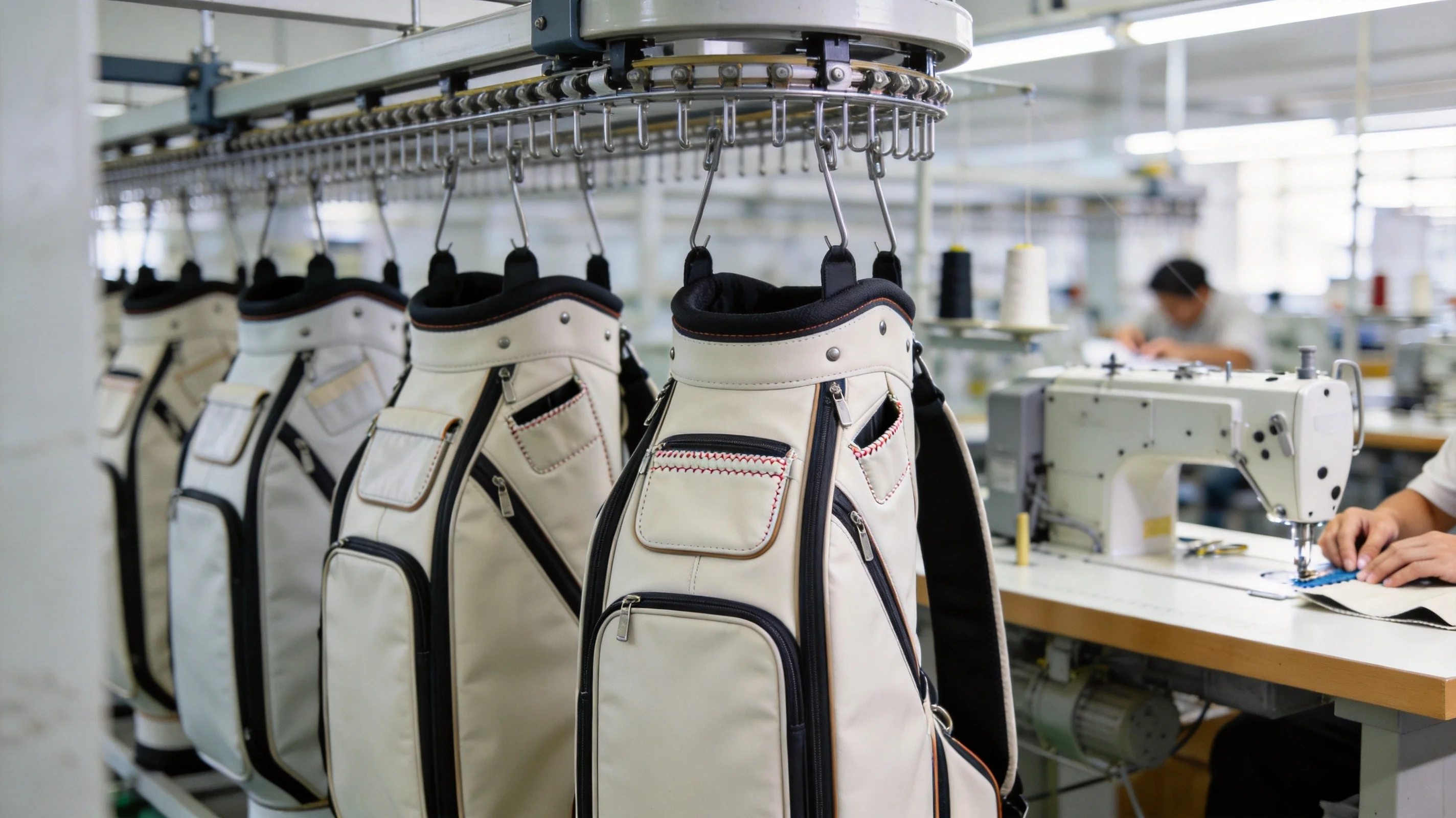
Stage-by-stage OEM production: patterns, pre-production sampling and line cutting all happen in-plant, with AQL inspection before packing.
What Does OEM Mean in Golf Bags, and How Is It Different from ODM?
OEM (Original Equipment Manufacturing) means you supply the design or tech pack and the factory produces exactly to it. ODM (Original Design Manufacturing) means the factory owns an existing design and offers it to you—with customization of materials, colours and branding. In practice most golf bag programs combine both: a buyer brings a core spec, and the factory fills gaps with its own proven patterns, top layouts and pocket constructions.
The distinction decides who owns the design risk. In OEM, design ownership and the patent/design-risk sit with the buyer; in ODM, the factory carries proven tooling and can quote faster and cheaper because no new pattern engineering is needed. Established suppliers—like ours, with a full custom portfolio—offer both and usually steer you to whichever de-risks your first order.
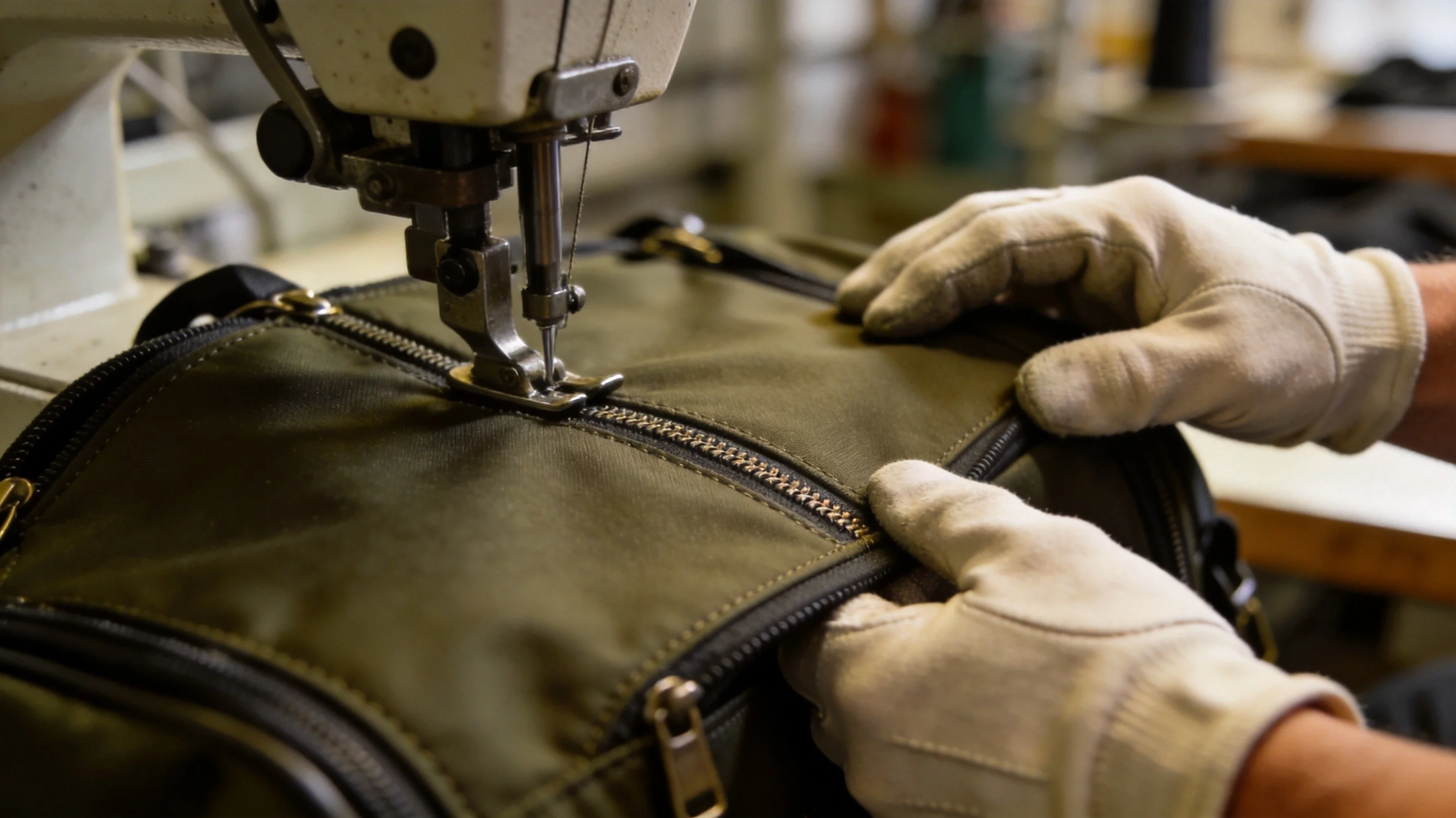
From pattern to production — the OEM/ODM pipeline inside our affiliated factory
Stage 1: Enquiry, Budget and Spec Definition (Days 1–5)
The process opens with a clear brief. The fastest RFQs specify: target bag type(s), volume per type, fabric preference or “factory recommendation”, divider layout (4 vs 14-way), branding method, packaging, target FOB price and destination market. We return pricing, MOQ, sampling cost and a production timeline within about 24 hours.
- What we ask for: target price band, annual/order volume, markets, compliance needs (Prop 65, REACH, BSCI), and any reference photos or spec sheets.
- What you should request back: unit FOB price, MOQ, sampling fee and sample days, production lead time, QC/AQL plan, and plant verification documents.
- Budget reality-check: wholesale FOB for serious golf bags ranges from about USD 15 for value lines to USD 70+ for tour/staff bags; quoting below that usually means a spec trade-off somewhere.
For a worked template of what to send and what to demand at this stage, see our wholesale buying guide.
Stage 2: Design, Pattern & Pre-Production Sampling (Days 6–25)
Once the brief is agreed, the factory converts it into:a spec sheet, technical drawing, pattern set and a pre-production sample (PPS). This is where weight, fit, dividers, pockets, zippers and colour are locked before any bulk commitment.
- First sample(s): 10–20 days for most types; complex 14-way cart or staff builds can take longer.
- Revision rounds: two to three rounds are normal; each round 5–10 days depending on scope.
- What to verify on the sample: actual weight against spec band, divider fit, zipper smoothness and pull, strap load and padding, colour/printing, and any waterproof rating claimed.
- Sample cost: usually paid or credited against the first bulk order; terms vary by factory and program size.
Our about page documents the plant, lines and verification that back this stage.
Stage 3: Material Sourcing & Confirmation
Materials are the single biggest cost line—typically 55–65% of a golf bag’s wholesale price. Fabrics (600D/840D/1680D nylon or polyester), webbing, zippers, dividers, foam, hardware and any waterproof membranes each need sourcing and approval before bulk.
- Fabric confirmation: swatches and colour lab-dips sent for approval; hold tolerance must be agreed.
- Hardware: zipper brand (YKK or equivalent), buckles, D-rings, feet—locking these avoids surprise changes.
- Trim & embroidery: thread colours, logos, woven labels, hang tags and branding surface pre-flighted.
- Eco options: rPET recycled shells, GRS-certified yarns and reduced packaging are increasingly standard RFQ options.
Choosing materials properly shapes durability and price—our materials evolution guide explains the fabric trade-offs in depth.
Stage 4: Production on the Line (45–60 Days Bulk)
After final sample approval, bulk production begins. A realistic full-run timeline is 45–60 days, gated by material lead time, line capacity and order size. Our SGS-verified affiliated plant runs 7 lines with 149 machines; a typical 840D cart bag goes through cutting, sewing, assembly, pocket/divider attachment, hardware fitting, and final QC.
- Progress: we share production-stage photos and milestone updates (material arrival, sample line, mid-production, packing) so buyers are never guessing.
- Capacity: monthly line capacity is 200,000 pieces; scheduling larger programs simply requires earlier production slots.
- Mixed SKUs: consolidated multi-type orders share one QC and one shipment; per-colourway MOQs still apply on complex builds.
For the physical fabrication side, our manufacturing overview details the lines, machines and processes.
Stage 5: Quality Control & Compliance
Quality gates separate a reliable factory from a commodity one. Standard practice: in-line inspection during production plus a final random inspection (AQL) before packing, typically AQL 2.5 general for golf bags (4.0 for travel cases). Serial-specific tests include fabric tensile/abrasion, zipper cycle testing (5,000–10,000 cycles), strap tensile load, leg articulation for stand bags and waterproof ratings where claimed.
- Compliance: Prop 65 (US), REACH (EU), and BSCI audits for social compliance are common buyer requirements; confirm what your market needs.
- Third-party inspection: buyers may appoint SGS/BV/TUV for mid-line or final inspection; we cooperate with all.
- Documentation: request inspection reports, material certificates, and test reports from your factory.
Quality, compliance and accreditation are covered in more detail in our golf bag quality standards guide.
Stage 6: Packaging, Logistics & Delivery
Final QC leads to packing per your specification (custom cartons, poly/combo bags, retail-ready displays) and shipping under agreed Incoterms (FOB, EXW, DDP). We handle export documentation, customs paperwork and coordinate freight to your destination, providing carton dimensions and weights for freight planning.
- Lead time recap: sampling 10–20 days; bulk 45–60 days; transit varies by destination.
- Quality before dispatch: final inspection sign-off precedes container loading.
- Post-delivery support: defective-rate handling, repeat-order pricing and annual QC sync.
Cost Drivers: What Actually Moves the Wholesale Price
- Fabric: 600D vs 840D vs 1680D; rPET and waterproof membranes add cost.
- Divider layout: 14-way full-length dividers add webbing, fabric and labour over 4-way.
- Pockets & hardware: each pocket adds weight and USD 0.5–1.5; branded zippers and hardware cost more.
- Branding: embroidery (number of stitch positions), woven labels, hang tags.
- Volume & MOQ: tiered pricing at 100/300/500/1,000 units pulls unit cost down.
- Compliance & testing: third-party inspection and certifications (BSCI, GRS) add fees.
For actual FOB bands by bag type, see the pricing breakdown in our golf bag types guide.
Choosing the Right Manufacturing Partner
The margin between a smooth and a painful first order is usually decided before production begins: verification evidence (SGS/Alibaba), a genuine QC structure, a linear production process and honest lead-time gatekeeping. We recommend any buyer validate the factory licence, ask for plant verification, order a pre-production sample, and agree AQL and inspection before committing bulk spend.
Read our structured factory selection guide and the 12-factor framework in our how to choose a golf bag manufacturer page before you shortlist.
The OEM/ODM Process in One Table
| Stage | Timeline | Key Deliverable | Buyer Action |
|---|---|---|---|
| Enquiry & spec | 1–5 days | RFQ + quote | Send full brief |
| Design & sample | 6–25 days | PPS + revisions | Approve sample |
| Materials | parallel | Swatches/lab-dips | Approve fabric/brands |
| Production | 45–60 days | Bulk output | Track milestones |
| QC | in-line/final | AQL report | Inspection sign-off |
| Ship | per Incoterm | Delivery docs | Freight coordination |
Start Your Golf Bag OEM/ODM Project
Whether you are a startup launching your first line or an established brand consolidating production, the fastest path to a reliable program is a complete brief and a factory with proven verification. Contact our sourcing team at service@junyuanbags.com or +86 17750020688 to start the process, or review our OEM/ODM services first.
The Spec Sheet: The Document That Runs the Whole Project
Every clean golf bag project starts with a spec sheet, and the more precise it is, the fewer surprises come back. A complete golf bag tech pack covers nine blocks:
- Type & silhouette: stand, cart, staff/tour, Sunday, travel, waterproof or cooler—and the target body shape.
- Dimensional spec: height, width, depth in cm, plus top opening dimensions for the divider layout.
- Fabric spec: shell fabric and denier, lining, foam/padding thickness, and any waterproof membrane or coating.
- Divider layout: 4-way vs 14-way, full-length or bottom-anchored, putter-well position.
- Pocket plan: count, position, size and closure type (zipped, velcro, dump) for every pocket.
- Hardware: zipper brand and size, buckles, D-rings, feet, leg mechanism (stand), wheels (travel).
- Strap system: single vs dual, padding, quick-release, ergonomic features.
- Branding: decoration areas, logo method (embroidery/print/woven label), colour codes.
- Packaging & compliance: carton spec, polybag/combo, hang tags, and Prop 65/REACH/BSCI requirements.
If you do not have a full tech pack, an ODM route works better: the factory holds the pattern and you customize materials and brand. We run both—for custom programs we can build from your tech pack, a reference sample, or our own proven ODM catalog.
Sampling Realities: How Many Rounds Should You Budget For?
First-time buyers often underestimate sampling. Industry practice is two to four rounds for a new golf bag design. A conservative budget is:
- Round 1 (PPS): first full sample—verify silhouette, weight, dividers, hardware and general construction.
- Round 2: corrections to fit, pocket placement, strap ergonomics and branding placement.
- Round 3 (optional): final colour, printing/embroidery and packaging approval samples.
Each round typically costs a sampling fee (often credited against the first bulk order) plus 5–10 days. Experienced factories compress this by pre-flighting patterns and materials before cutting the first sample. We aim to keep most programs to two rounds and always share progress photos so you can catch issues early rather than at the final approval gate.
How Long Does Golf Bag Production Really Take?
Total calendar time from kickoff to bulk delivery usually lands in the 60–90 day window, and here is exactly where the days go:
- Spec & quote: 1–5 days.
- Pattern + first sample + revision: 15–30 days across rounds.
- Material lead time: 7–15 days (fabric, zippers, hardware, trims) once approved.
- Bulk production: 20–45 days depending on volume and line allocation (a 1,000-unit stand bag run is near the low end; large 10,000+ mixed programs schedule longer).
- QC and packing: 3–7 days.
- Shipping: transit time on top, by destination and Incoterm.
Straight-day summaries like “45–60 days” refer to bulk production after sample approval, not the full calendar journey. We publish realistic total timelines at the enquiry stage so buyers can plan retail seasons rather than being surprised mid-project.
Realistic lead-time planning protects your retail calendar. For a standard OEM golf bag order with one round of sample revision, the total journey — from enquiry and spec confirmation to sea freight arriving at your port — typically spans 75–95 days: roughly 5 days for spec sign-off, 10–20 days for sampling, a further 3–5 days for approval and material purchase, 45–60 days for bulk production, and 7–10 days for inland logistics plus ocean transit. Importers who back this out from their seasonal launch date and place the order before the Chinese New Year rush are the ones who hit their shelf dates without split shipments.
Capacity & Scheduling: Why Early Slots Matter for Peak Seasons
Golf retail has two distinct peaks—spring (March–May, driving-season stock) and the holiday/gift season (October–December). Factories fill production slots unevenly across the year, so a program targeting a launch date should book its production slot one to two quarters ahead. Our plant holds a monthly line capacity of 200,000 pieces on 7 lines, but that capacity is not evenly available at every date—earlier scheduling guarantees line allocation, material buying and QC inspection windows.
- Spring launch: finalize specs by the prior autumn; book bulk production for January–February.
- Holiday launch: finalize by spring; book bulk for September–October.
- Reorders: repeat programs run faster because the pattern and materials are already proven—typically 35–50 days bulk.
Planning ahead also protects you from fabric supply spikes and freight rate increases, which are most volatile in peak seasons.
Common Pitfalls and How to Avoid Them
- Weight creep: an attractive heavy fabric spec can push a bag past its target weight band. Lock weight as a hard spec and verify on the PPS.
- Pocket bloat: every added pocket adds weight and cost; spec the pocket plan, don’t approve additions casually.
- Colour drift: approve lab-dips and keep a physical standard; reorder against the approved sample, not a photo.
- Unrealistic timelines: treat “45–60 days bulk” as production-only and plan the full calendar path accordingly.
- Unclear MOQ per colourway: on multi-colour programs confirm MOQ applies per colourway, not just per type.
- Skipping third-party inspection: for your first order, a final AQL inspection by you or an agency is cheap insurance.
Choosing Between China, Vietnam and Other Sourcing Hubs
While this guide focuses on a verified Chinese factory, buyers benefit from understanding the landscape. China remains the golf bag manufacturing centre of gravity for depth of material supply, embedded ODM catalogues, and the density of experienced stitchers and hardware vendors. Vietnam and some South-East Asian hubs offer competitive labour economics on simpler product but with thinner vertical supply for golf-specific hardware. For most golf bag programs, the deciding factor is not hourly labour but the factory’s pattern depth, QC structure, verification evidence and speed to sample—areas where an established Chinese supplier with audited affiliation, like ours, stays ahead. The trade-off is always validated by ordering a real pre-production sample rather than comparing price lists.
Frequently Asked Questions
This guide has walked the full OEM/ODM journey from a single RFQ to a delivered shipment. The recurring theme is that every risk—weight, colour, timeline, cost, compliance—can be managed if it is specified early and verified at the right gate. A clean spec sheet, a real pre-production sample, agreed AQL, and an honest schedule convert a golf bag factory engagement from a gamble into a repeatable, budgeted supply program. That is the standard we hold ourselves to, and the standard we recommend every buyer set with their manufacturing partner before a single bulk dollar moves.
- What does OEM mean in golf bag manufacturing?
- OEM means the buyer supplies the design or tech pack and the factory produces exactly to it; ODM means the factory offers its own proved design with material and branding customization.
- How long does golf bag production take?
- Sampling runs 10–20 days to a first sample; bulk production runs 45–60 days, with full calendar time from kickoff to delivery typically 60–90 days.
- What is the MOQ for custom golf bags?
- MOQ is typically 200 pieces per type (test orders from 100), with Sunday and travel lines often lower and staff/cart lines sometimes at 300 for complex builds.
- What are the main cost drivers for a golf bag?
- Fabric (55–65% of price), divider layout (14-way adds cost), pocket/hardware additions, branding method, volume tier, and compliance/testing fees.
- Should I choose OEM or ODM for my first golf bag line?
- If you have a full tech pack and design ownership, choose OEM. If you want proven tooling and faster quoting, choose ODM and customize materials and brand.
The Factory Audit: What Verification Actually Proves
Supply-chain diligence has moved from “does the factory exist” to “what specifically has been independently verified.” The most common verification a buyer should look for is a third-party supplier audit run for a marketplace (SGS for Alibaba.com is the classic example). Such an audit, when current, confirms the legal entity, plant address, footprint (e.g., 4,950 sqm), production lines (e.g., 7), machinery count (e.g., 149 machines plus 126 sewing machines), headcount (e.g., 137 staff), monthly line capacity (e.g., 200,000 pieces) and any trade or export status. Importantly, a trading-affiliated model separates the export entity (the trading company, which holds the customs and import/export codes) from the manufacturing entity (the affiliated factory that holds the SGS production verification). That is normal and legitimate—the buyer should simply confirm both exist, that the affiliation is stated, and that the numbers in the audit match the quote.
We make our SGS verification and the affiliated-plant structure visible so buyers can check the very numbers quoted on this page. Reading a report correctly—versus taking a logo at face value—prevents most sourcing disappointments.
Negotiating MOQ, Pricing Tiers and Payment Terms
Once you understand the manufacturing economics, negotiation becomes fact-based. Three levers matter most:
- MOQ flexibility: instead of asking for one low MOQ, ask how MOQ changes with complexity and per-colourway. A Sunday bag can legitimately run at 100; a 14-way cart bag rarely below 200–300.
- Tiered pricing: confirm price breaks at 100/300/500/1,000 and how mixed SKUs are computed (usually a blended or highest-tier approach).
- Payment terms: standard is a deposit (e.g., 30%) with balance against BL or before shipment; long-term partners may qualify for more favourable timing, but first orders normally run on standard terms.
Documenting these in the PO protects both sides. For a deeper negotiation playbook, see our wholesale pricing negotiation guide.
Sustainability in Golf Bag Production
Buyer demand for lower-impact production is accelerating, and it is practical rather than aspirational in the factory: rPET recycled shells, GRS-certified yarns, water-based print/embroidery, reduced polybag plastic, recycled cartons and consolidated packaging. Each option carries a small spec or cost consequence that should be decided at the brief stage, not mid-production. Because more than 100 of the 200+ brands we serve ask for at least one sustainability feature, we keep recycled and reduced-packaging options as standard RFQ lines—our recycled materials guide explains the trade-offs and certifications.
Start Building Your Golf Bag Program
Understanding the manufacturing process is the single best de-risking step a buyer takes. Now that you can read the six stages, the cost drivers and the factory-verification basics, you are equipped to write a clean brief, demand the right documentation and hold a genuine timeline. Bring your earliest target and biggest questions to our sourcing team—service@junyuanbags.com or +86 17750020688—and we will turn the process guide into a scheduled, budgeted program for your brand.
To summarize the trade-off cleanly: choose OEM when you own the design and want exclusive control; choose ODM when you want proven tooling, faster quoting and a lower de-risking burden. Most successful golf bag programs blend the two—and the factory that can bridge both, verify its plant and communicate timelines honestly is the one worth building a line with. That is the operating model behind everything on this page.