Golf Bag Quality Standards: AQL, BSCI & ISO Compliance — A Complete B2B Buyer's Guide
Golf bag quality standards for export are anchored in AQL (ANSI/ASQ Z1.4 and ISO 2859-1), fabric tear at or above 60 N, at least 2,000 zipper cycles and AQL Level II sampling — the benchmarks any qualified golf bag factory must meet.
Updated 2026 · Written by the Procurement & QA Team at QUANZHOU JUNYUAN BAGS, an affiliated factory of golfbagfactories.com
The quality standards that govern golf bag manufacturing for export are anchored in three frameworks: AQL (ANSI/ASQ Z1.4 & ISO 2859-1) for sampling and defect acceptance, BSCI for social compliance across the supply chain, and ISO 9001 for a quality management system. For a typical B2B golf bag order of 500–2,500 pieces, the industry-standard inspection applied at pre-shipment is AQL level II, General Inspection Level, with an acceptance quality limit of AQL 0.65 for critical defects, AQL 1.0–2.5 for major defects, and AQL 4.0 for minor defects. On top of generic sampling, golf bags carry bag-specific performance tests — seam strength, zipper cycle endurance, stand mechanism open/close cycles, strap load, and water-resistance ratings — that separate a 45–60 day production run that lands in premium retail from one that lands in the warranty bin.
This guide is written for importers, private-label brands, and procurement teams evaluating a golf bag factory. It explains each compliance pillar in plain numbers, gives you the exact inspection tables to paste into a PO, lists the golf-bag-specific test methods and pass thresholds, and answers the 10 most common buyer questions. Wherever you see a number below, it is either a published standard value (ANSI/ASQ Z1.4, ISO 2859-1, ISO 9001, BSCI) or a figure verified by an independent SGS audit — nothing is invented.
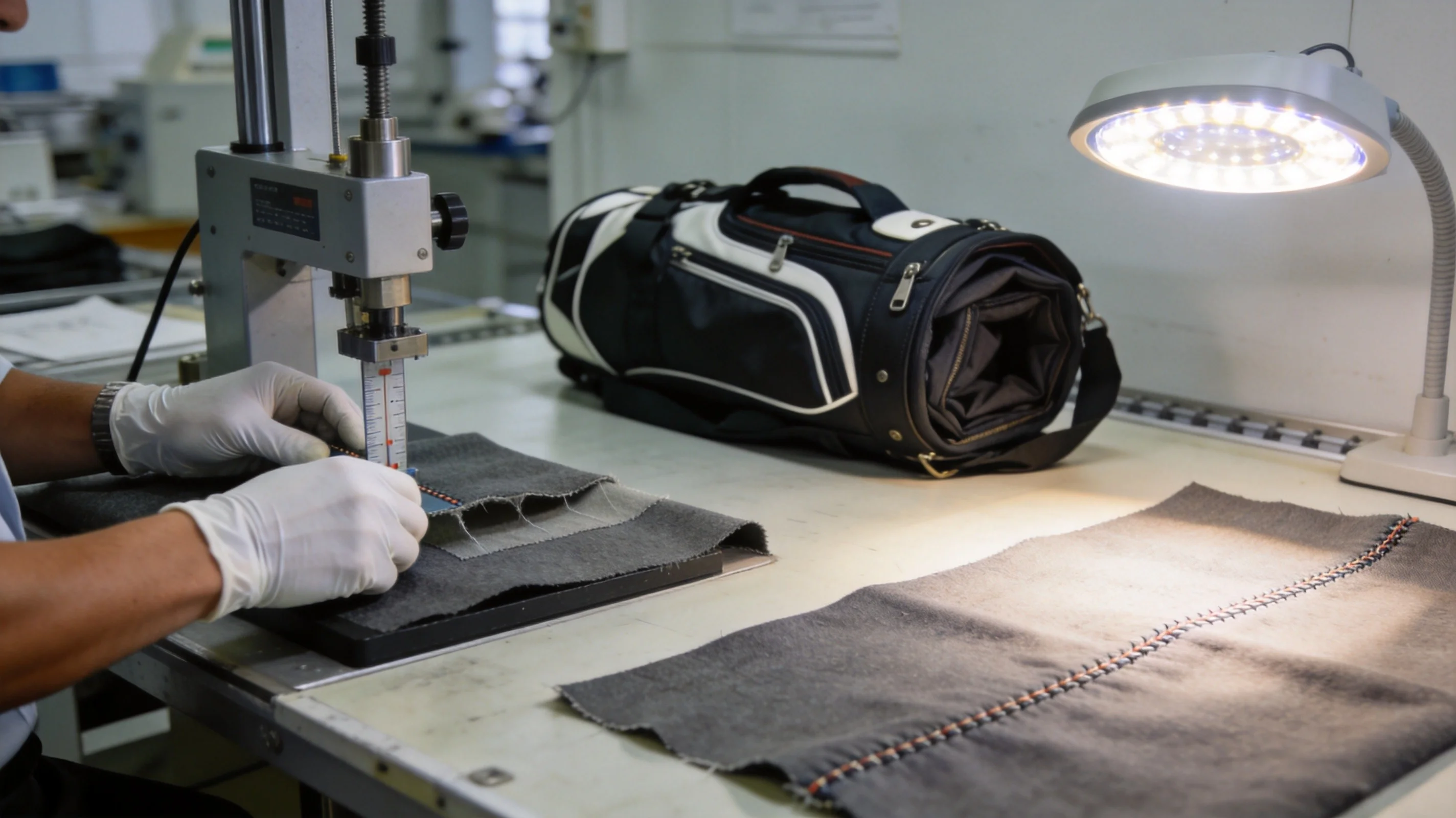
Every production batch is tested for fabric tear (≥60 N), zipper cycles (≥2,000) and seam strength before AQL sampling release.
1. AQL Explained: How Golf Bag Sampling Actually Works
AQL stands for Acceptance Quality Limit, governed by ANSI/ASQ Z1.4 and its international twin ISO 2859-1. It is a statistical sampling system: instead of inspecting 100% of a shipment, an independent inspector draws a random sample from the lot and decides — with defined statistical confidence — whether the whole lot meets the agreed defect tolerance. An AQL value is not a percentage of defectives you tolerate in the shipment; it is the maximum number of defects you accept in the statistical sample before rejecting the lot.
In golf bag inspection, the standard setup worldwide is the same one used by SGS, Bureau Veritas, and Intertek:
- Inspection level: Level II (General Inspection Level) — the default for normal consumer goods.
- Severity classes: Critical (AQL 0.65 / 0.4), Major (AQL 1.0 to 2.5), Minor (AQL 4.0).
- Sample size code letter: Determined by lot (batch) size against a table.
- Defect classification: Major = affects function, safety, or sellability; Minor = cosmetic, does not stop use.
A "critical" defect on a golf bag usually means a product-safety issue (a toxic coating, a sharp metal edge exposed by a broken zipper, an unstable stand that collapses). A "major" defect is a functional failure such as a pulled seam, a broken zipper pull, a torn shoulder strap, or a collapsed frame. A "minor" defect is cosmetic — a skipped thread, a slight color variance, a small abrasion inside an unlined pocket. The sampling plan tells you exactly how many of each you may find in the sample and still accept the shipment.
Why does the industry almost never inspect 100% of a shipment? Because it is statistically unnecessary and economically wasteful. For a homogeneous, machine-made batch of bags, inspecting a well-chosen random sample gives you the same confidence about the lot's quality level at a fraction of the labor cost. ANSI/ASQ Z1.4 tables are calibrated so that a sample of 80 bags from a 1,000-piece lot reliably predicts whether the whole lot stays within the agreed defect tolerance. This is why virtually every professional golf bag PO — regardless of whether the goods are produced in China, India, Vietnam, or elsewhere — carries an AQL line and a nominated inspection level. If a supplier tells you they will "just inspect everything," treat that with healthy skepticism: it is either a misunderstanding of AQL or an invitation to a non-standard, unenforceable inspection protocol.
One clarification importers frequently get wrong: AQL tolerances apply per defect class, and the classes are audited together in a single sample. The inspector does not inspect one set of bags for majors and another for minors — she opens the same n bags, counts critical defects, then major, then minor, and compares each count against its own Accept/Reject pair. If you deviate from the standard table — for example switching to "reduced" inspection or a tightened plan — the sample sizes change and you lose comparability with third-party reports. For this reason, keep your PO language standard: "AQL 0.65 / 1.5 / 4.0, General Inspection Level II, single sampling, normal inspection." Any reputable inspector (SGS, Bureau Veritas, Intertek) will read that line and apply the exact published table.
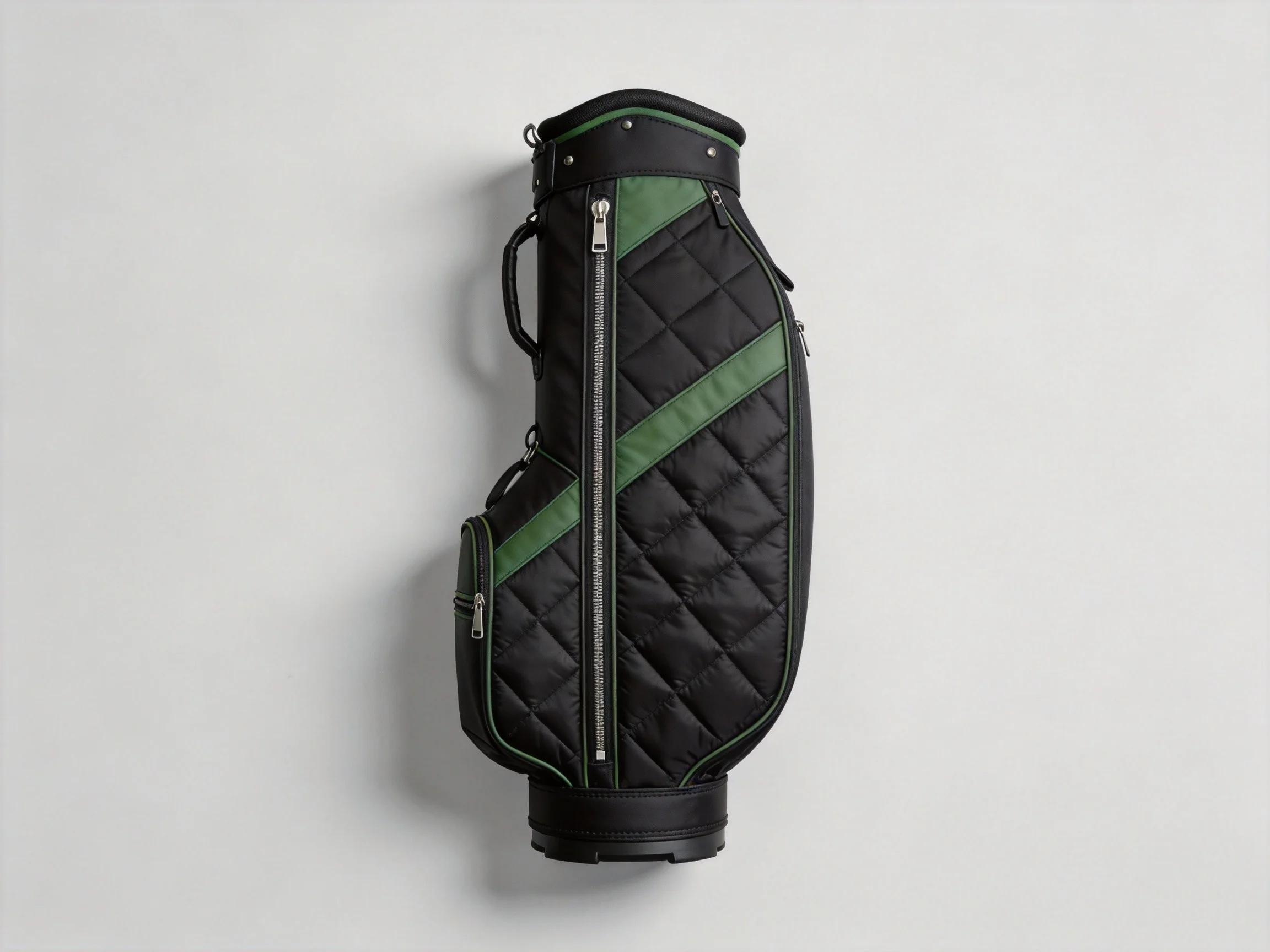
Quality testing starts at the material — fabric, stitching and hardware checks
2. The AQL Sampling Table for Golf Packing (Read This Before You Import)
Below is the AQL master table for golf bags at Inspection Level II, single sampling, normal inspection — the values every B2B factory will recognize from an SGS or third-party pre-shipment report. "Sample n" is how many bags the inspector physically opens; "Ac" and "Re" are Accept and Reject numbers.
| Lot (Batch) Size | Sample Code (n) | Critical AQL 0.65 (Ac/Re) | Major AQL 1.5 (Ac/Re) | Minor AQL 4.0 (Ac/Re) |
|---|---|---|---|---|
| 151 – 280 | E — 32 | 0 / 1 | 1 / 2 | 3 / 4 |
| 281 – 500 | F — 50 | 0 / 1 | 2 / 3 | 5 / 6 |
| 501 – 1,200 | G — 80 | 0 / 1 | 3 / 4 | 7 / 8 |
| 1,201 – 3,200 | H — 125 | 0 / 1 | 5 / 6 | 10 / 11 |
| 3,201 – 10,000 | J — 200 | 0 / 1 | 7 / 8 | 14 / 15 |
| 10,001 – 35,000 | K — 315 | 0 / 1 | 10 / 11 | 21 / 22 |
Interpretation: For a lot of 1,000 golf bags, the inspector pulls 80 bags. She may find at most 3 Major and 7 Minor defects and still pass the lot. If she finds even 1 Critical defect — or 4 Majors, or 8 Minors — the entire lot fails and must be re-sorted or rejected. Rule of thumb: define "AQL 0.65 / 1.5 / 4.0, Gen II, single normal" in your PO and every reputable third-party inspector will inspect to the exact same table.
3. Golf-Bag-Specific Test Standards and Pass Thresholds
Generic AQL sampling checks construction, packaging, and labeling. But a golf bag lives a violent life — carried on a shoulder, dragged over cart paths, opened and closed thousands of times, hit by rain. So serious factories add physical performance tests, usually validated with an in-house test lab and an independent report. Below are the industry-standard tests and realistic pass numbers (methods follow GB/T and ISO/EN luggage-and-bag test conventions):
3.1 Fabric Strength & Abrasion Resistance
The shell fabric must survive years of cart-path rub. Standard tests are tensile (tearing) strength and Martindale abrasion resistance.
- Tearing strength: measured in N (Newtons); premium golf bag 600D–1680D polyester or nylon typically passes a tearing force above 50–70 N for the main shell (a common acceptance bar is ≥ 60 N).
- Martindale abrasion: cycles to visible wear; 20,000–40,000 rubs is typical for golf bag shell fabric with no broken threads (many buyers accept ≥ 25,000 rubs).
- Seam strength: seam tape or seam-slide test — main load seams must hold tensile force of approximately 100–150 N without seam opening or thread breakage.
The choice of fabric weight is where a factory's honesty shows. A bag quoting "600D polyester" should be verified at the roll stage, because a thin 1680D that is actually 900D will tear far sooner than its label implies. The reliable way to catch this is to compare the GSM (grams per square meter) of the incoming fabric against the approved sample before cutting. A measurable drift in GSM or a substitute supplier on the mill's raw-material sheet is one of the most common — and most preventable — quality problems in golf bag production. If you are sourcing a method-based spec (rather than a fixed brand), keep these bar thresholds written into the PO, and have the pre-shipment inspector physically request the fabric mill certificate for the batch.
3.2 Zipper Cycle Endurance
Zippers are the #1 failure point on a golf bag. The accepted endurance test is an automated open/close cycle test. A quality zipper on a golf bag should complete at least 2,000 up-and-back cycles (many buyers spec 3,000) without jamming, separating, or losing the slider stop. Every pocket and the main opening are tested. At QUANZHOU JUNYUAN BAGS our operated zippers are pre-screened to YKK-or-equivalent pulls so the finished bag clears this bar consistently.
3.3 Stand Mechanism (for Stand Bags)
A stand bag must deploy and retract reliably. The industry-standard test is an open/close cycle test on the stand legs.
- Stand open/close cycles: the mechanism should survive 1,000+ full open/close cycles without the legs sticking, sagging, or failing to lock.
- Spring and hinge integrity: no permanent deformation of the legs and no loosening of hinge points after cycling.
3.4 Strap & Carry Load Tests
Shoulder straps and handles carry up to a full loaded bag. Static load testing suspends the loaded bag and applies weight for a set time.
- Static load: shoulder strap and D-rings should hold a static load of 15–25 kg for 4–24 hours with no tearing, no seam opening, and no permanent strap stretch beyond tolerance.
- Drop / impact: a filled bag dropped from approximately 30–50 mm (or on a designated corner) must show no cracking of the frame or shell.
3.5 Water Resistance / IPX Rating
Many golf bags claim "waterproof" or "rain-proof." The honest, verifiable language is an IPX rating. A splash-proof bag is IPX4; a rain-resistant bag is typically IPX5 (water jets from any direction); a truly waterproof bag is IPX6 or higher. In practice, for a golf bag a realistic and verifiable spec is IPX4–IPX5 for the shell plus a shower-proof 14-club rain hood, because a full IPX8 rating is neither achievable nor needed for a carry bag and claiming it would be misleading.
4. BSCI: Social Compliance Across the Supply Chain
BSCI (Business Social Compliance Initiative) is a supply-chain management system run by amfori, Europe's largest trade association. It audits factories against a Code of Conduct covering child labor, forced labor, working hours, health & safety, wages, freedom of association, and environmental practice. A BSCI audit is not a pass/fail certificate like ISO — it gives a rating (A, B, C = valid, with C required to progress; D and E = improvement needed). Many EU and UK retailers require suppliers to hold a valid BSCI audit before they will place a large order. If you are exporting to Europe, ask your factory for its latest BSCI audit report and validity date up front — it can be the deciding factor on your first trial order.
Because BSCI is a continuous-improvement framework rather than a one-time pass, the way a supplier responds to a "C" or higher follow-up audit tells you more than the letter grade alone. A coherent corrective-action plan — documented evidence that pay records, working-hour logs, and safety training were brought into line and re-verified — demonstrates the process discipline you will also want on production quality. When a buyer drops in unannounced to a BSCI-audited factory and finds the fire exits clear, the emergency exits signposted, and the chemical storage labeled, that is the same operational hygiene that keeps stitch tension consistent and zippers aligned on a long production run.
5. ISO 9001: The Quality Management System Underneath
ISO 9001 is the globally recognized quality management system (QMS) standard. It does not test the bag itself; it audits the factory's processes — how it manages documentation, corrective actions, supplier quality, training, and continuous improvement. A factory that is ISO 9001-certified has demonstrated repeatable process control: the same bag made in January and in June should meet the same standard. For golf bag sourcing, treat ISO 9001 as the baseline "house in order" signal, and AQL inspection as the per-shipment gate. A factory with a documented QMS is far more likely to hold a stable color match, stable stitching tension, and consistent shell dimensions across a multi-container program.
In practice, the three frameworks stack into a three-layer defense: ISO 9001 proves the factory can hold its own processes and correct them when they drift; BSCI proves the workforce and environment behind those processes are compliant; and AQL proves the actual outgoing goods hit the agreed tolerance lot by lot. No single one of them replaces the others. A factory can hold ISO 9001 and still ship a bad batch if nobody inspects it; it can pass BSCI with a clean social record and still produce faded outer shells if the dye and GSM drift is unchecked; and it can pass an AQL inspection only if the underlying process and workforce are stable enough to reproduce the golden sample at volume. When you see all three aligned in one supplier profile — a documented QMS, a valid social audit, and a live third-party inspection record — you have what professional sourcing teams call a "manageable supplier": one whose failures, when they happen, are detectable early and correctable at cost you can predict.
6. What High-Volume Golf Bag Programs Actually Got Verified (A Real SGS Audited Facility)
To ground this guide in a verifiable example: in March 2026, the affiliated factory behind golfbagfactories.com — QUANZHOU JUNYUAN BAGS — was audited by SGS, the global inspection and certification leader. The main plant is a 4,950 m² affiliated factory with 7 production lines and 149 machines (including 126 sewing machines), staffed by 137 employees, with a monthly output capacity of 200,000 pieces. The SGS verification used audit report numbers 488375050_T (the trading entity) and 488389073_P+T (the manufacturing affiliate). The group has served 200+ brands across 100+ countries.
Founded in 2014, with the founder having entered the luggage and bag industry in 2004 (20+ years of hands-on manufacturing), the factory operates a commercial: samples in 10–20 days, production in 45–60 days, at a standard MOQ of 200 pieces and 100 pieces for test orders. These production parameters are deliberately consistent with the process described on our manufacturing, OEM/ODM services, and OEM/ODM process guide pages.
You can inspect the independent verification yourself at the SGS verified-supplier portal, and read the official amfori BSCI reference at the amfori/BSCI website, with the AQL standard documented by ASQ (ANSI/ASQ Z1.4) and ISO 2859-1. Always demand the original audit report, not a screenshot, before signing a contract.
7. How to Write Quality Terms Into a Golf Bag PO
- Set the AQL: "Inspection: AQL 0.65 / 1.5 / 4.0, General Inspection Level II, single sampling, normal inspection."
- Nominate the inspector: third-party (SGS, BV, Intertek) or your own pre-shipment inspection before the container loads.
- List the golf-specific tests: seam strength ≥100 N, zipper ≥2,000 cycles, stand ≥1,000 cycles, strap static load ≥15 kg, shell IPX4–5.
- State tolerances: color difference to approved lab dip within ΔE ≤ 1.5; size/buckle placement to agreed sample ± 2–3%.
- Agree the golden sample: the production-approved master sample is the reference for both factory and inspector.
- Confirm social compliance: ask for the current BSCI report and validity window before mass production.
You can review our full product range and capability pages to see how these standards apply to actual SKUs — see our products, the golf bag types guide, our company profile, and custom solutions for private-label programs. For those planning an eco-focused range, see our guide to eco-friendly and sustainable golf bag materials.
Frequently Asked Questions
- 1. What is a good AQL for golf bags?
- AQL 0.65 critical / 1.5 major / 4.0 minor at General Inspection Level II is the industry-standard starting point and is accepted by SGS and major third-party inspectors.
- 2. Is AQL 2.5 better than AQL 1.0?
- No. AQL 2.5 is a looser tolerance (more defects accepted per sample) than AQL 1.0. Lower AQL numbers mean stricter acceptance. "Better" depends on how strict you need — most golf bag buyers use 1.5 major as a balanced default.
- 3. How many bags does the inspector check in a 1,000-piece order?
- At General Inspection Level II, a lot of 1,001–1,200 pieces draws a sample of 80 bags; a slightly larger lot draws into the next sample code. Use the AQL table above and your inspector will do the rest.
- 4. What is the difference between major and minor defects on a golf bag?
- A major defect affects function or safety — a broken zipper, a torn strap, a collapsed stand. A minor defect is cosmetic — a skipped thread, slight shade variance — that does not stop normal use.
- 5. Do I need BSCI certification for European retail?
- Most EU and UK retailers require a valid BSCI audit before placing large orders. It is not a pass/fail certificate but a rating (A/B/C valid); check validity window with your factory up front.
- 6. How many zipper cycles should a quality golf bag survive?
- A dependable zipper should complete at least 2,000 open/close cycles, and many buyers spec 3,000, without jamming, separating, or losing the slider stop.
- 7. What does IPX4 vs IPX5 mean on a golf bag?
- IPX4 is splash-proof (from any direction); IPX5 resists water jets. Most quality golf bags target IPX4–5 on the shell plus a shower-proof rain hood. A full IPX8 claim on a carry bag is usually marketing, not physics.
- 8. How much weight should a golf bag strap hold?
- A static load test of 15–25 kg for 4–24 hours is the realistic industry bar — the strap and D-rings must hold a fully loaded bag with no tearing or seam opening.
- 9. Is ISO 9001 required to import golf bags?
- Not strictly required, but it signals that the factory runs a documented quality management system with repeatable process control — a strong indicator of a reliable long-term supplier.
- 10. How can I verify a factory actually passed a quality audit?
- Demand the original audit report number and check it against the verifier's official portal (e.g., SGS). A screenshot or a photocopy is not proof; a live report number is.
- 11. What production lead time should I plan for a quality golf bag?
- With samples in 10–20 days and mass production in 45–60 days, plus AQL pre-shipment inspection, plan a total of roughly 2.5–3 months from sample approval to shipment. MOQ is 200 pieces (100 for test orders).
- 12. Can I get an independent inspection before my golf bags ship?
- Yes. Most professional suppliers arrange a third-party pre-shipment inspection (SGS, BV, Intertek) at the factory against the agreed AQL before the container loads — this is standard practice and strongly recommended.
Sources
- ISO 2859-1: Sampling procedures for inspection by attributes (ISO.org)
- ANSI/ASQ Z1.4 — Sampling Procedures and Tables for Inspection by Attributes (ASQ)
- amfori — BSCI Business Social Compliance Initiative (amfori.org)
- SGS — Verified Supplier & Audit Report Verification (SGS.com)
- ISO 9001 — Quality Management Systems (ISO.org)
Need a written quality spec folded into your next golf bag quotation? Contact QUANZHOU JUNYUAN BAGS at service@junyuanbags.com or WhatsApp +86 177 5002 0688. We publish every quality number above as a commitment in your contract, and we back it with a real SGS audit report.