Low MOQ Custom Golf Bags: Small Orders Explained
What a low minimum order really means in golf bags — from QUANZHOU JUNYUAN BAGS, a sourcing and programme-management company working with an affiliated factory since 2014 — including what a 100-piece trial costs, where the levers are, and when a small order stops making sense.There is no genuine zero-minimum golf bag, because every order carries a cutting, sewing and inspection setup that has to be absorbed by a minimum quantity. What exists is a 100-piece trial against a 200-piece standard MOQ, at roughly 15-30% more per unit than the 200-piece price. On formats with low setup cost — Sunday bags, cooler bags, accessories — a 100-piece run is genuinely viable.
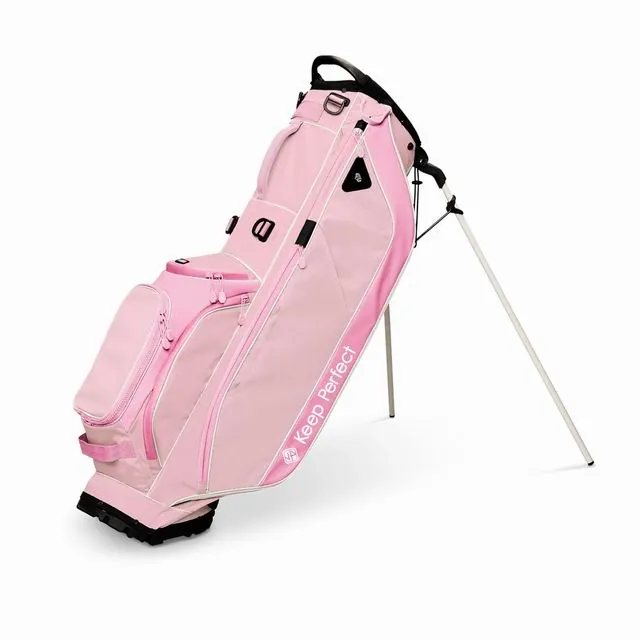
A 100-piece trial: one pattern, one colourway, one logo position, stock fabric.
What "No Minimum" Actually Means in Golf Bags
Search for custom golf bags and you will find suppliers advertising "no minimum order". In practice that phrase usually means one of three things, and none of them is a zero minimum on a custom bag.
- Stock product with your logo applied. The bag already exists in the supplier's range and you add a logo. The minimum is low because no cutting or pattern work is involved — but the shape, colours and specification are not yours.
- A sample quantity. Some suppliers will sell 5-20 units at sample prices. That is a sample order, not a production run, and the unit price reflects it.
- A 100-piece trial. A real production run at the smallest quantity the process can absorb. This is what a low-MOQ programme actually offers, and it is the honest version of the claim.
The reason a true zero minimum does not exist is structural. Cutting a golf bag requires a lay — fabric spread and cut in multiples of the marker. Sewing requires a line setup with the correct machine attachments. Inspection requires a sampling plan. All of that happens whether you order 10 bags or 1,000, and below a few dozen units the setup dominates the cost so completely that the price becomes absurd.
A 100-piece trial is the point where setup cost is still meaningful but the price stays defensible. That is why it is the standard low-MOQ offer in this category rather than an arbitrary round number.
The Four Levers That Lower a Minimum
If a 100-piece trial is not low enough for your situation, there are four levers. Each one trades something away, and knowing which one you are pulling is what makes the conversation productive.
| Lever | What it does | What you give up |
|---|---|---|
| Use an existing pattern | Removes pattern making and cutting-die setup | The shape is not unique to you |
| Use stock fabric and colour | Removes dye-lot minimums and fabric minimums | You choose from a palette |
| Reduce colourways | Concentrates the order into one cutting lay | Less shelf variety |
| Simplify the build | Fewer panels, pockets and hardware positions | Lower perceived value per unit |
| Use a smaller format | Sunday bags and coolers have far lower setup | Different product category |
| Accept a longer lead time | Order can fill a gap in the production line | No control over the ship date |
The first two levers do most of the work. A 200-piece order on an existing pattern in a stock fabric is comfortable for any supplier. The same 200 pieces with a new pattern and a custom-dyed shell is a different proposition entirely, because the pattern and the dye lot are both fixed costs that have to be recovered.
The most common mistake at this stage is trying to pull all four levers at once — a new pattern, a custom colour, four colourways and a 100-piece quantity. That combination is not a low-MOQ order; it is a full development programme with a small production run attached, and it is priced accordingly.
What a 100-Piece Trial Really Costs
The unit-price premium on a small order is real, and it is worth understanding where it comes from before negotiating. It is almost entirely setup amortisation.
| Setup item | Fixed cost band | Per unit at 100 | Per unit at 1,000 |
|---|---|---|---|
| Pattern and grading | Fixed | High | Negligible |
| Cutting dies | Fixed | Moderate | Negligible |
| Top collar tooling | Fixed | High | Low |
| Embroidery programme setup | Fixed per position | Moderate | Negligible |
| Line setup and first-off check | Fixed | Moderate | Low |
| Fabric and labour | Per unit | Same | Same |
That is why a 100-piece trial typically lands 15-30% above the 200-piece price and 30-50% above a 1,000-piece price. The fabric and labour cost per bag barely moves; what changes is how many units share the fixed setup.
The right way to think about the premium is as the cost of validating a design before committing capital. If the trial sells through, the reorder drops to the standard price and the premium is recovered on the second order. If it does not sell, you have lost the premium rather than the cost of a full container.
Colour Splitting Rules
Colour splitting is the lever buyers ask about most and understand least. The rule is simple: splitting is free within a stock fabric, and expensive across a custom dye.
| Order size | Colourways | Fabric | Practical outcome |
|---|---|---|---|
| 100 | 1 | Stock | Straightforward |
| 100 | 2 | Stock | Usually possible; ask before committing |
| 100 | 3+ | Stock | Difficult — each colourway needs its own cutting lay |
| 200 | 2-3 | Stock | Comfortable |
| 200 | 4+ | Stock | Possible with a minimum cut length per colour |
| 200 | Any | Custom dyed | Dye-lot minimum usually forces 300+ per colour |
A dye-lot minimum for golf bag fabric typically sits at 300-500 metres. Depending on bag size that is anywhere from 150 to 400 bags of a single colour, so a 100-piece custom-dyed order is not usually possible whatever the supplier says.
The workaround that actually works at low volume is to move the colour out of the main shell and into the trim, the hardware or the print. A stock black or charcoal body with your brand colour on the binding, the zip pulls and the logo reads as a branded product and costs nothing in dye minimums. It is also, in most seasons, a better-looking bag.
Where Small Orders Get Expensive
Beyond the unit-price premium, four specific cost traps catch buyers running small programmes. All four are avoidable with a decision made early.
- Freight per unit. A 100-piece order still pays for a container or a consolidated LCL slot. Per-unit freight on 100 bags can be two to three times the per-unit freight on 1,000. Consolidating with another buyer or accepting a longer sea route is the mitigation.
- Packaging minimums. Printed mailers and gift boxes often carry a 500-1,000 unit minimum of their own. At 100 bags you will either pay a small-run premium or use stock packaging with a printed label.
- Revision rounds. Each sample revision is real cost. Two rounds are normal; four rounds on a 100-piece order can erase the margin entirely. Consolidate comments into a single document.
- Payment terms. Small first orders usually run on stricter terms — often 30% deposit and 70% before shipment. That is normal for a new relationship and worth planning for in cash flow.
The single biggest avoidable cost is revision rounds. A buyer who sends comments in five separate emails over three weeks will spend more on resampling than on the price difference between 100 and 200 pieces.
Which Formats Suit a Low MOQ
Not every golf bag is equally suited to a small run, because setup cost varies enormously by format.
| Format | Setup cost | Practical trial size | Why |
|---|---|---|---|
| Accessories (headcovers, pouches) | Very low | 50-100 | Few panels, no frame, no tooling |
| Cooler bags | Low | 100 | Small panels, simple top, no frame |
| Sunday / carry bags | Low-moderate | 100 | 6-9 panels, simple moulded top |
| Stand bags | Moderate | 200 | Leg mechanism and bracket add setup |
| Cart bags | High | 200-500 | Moulded 14-way top collar dominates |
| Tour / staff bags | High | 200-500 | Trim, more panels, more branding positions |
| Travel covers | Moderate | 200 | Large panels, wheel base tooling |
This is why a brand building a first range usually starts with a Sunday bag or a cooler bag. It is not a compromise on quality — it is the format where a small order is economically honest for both sides.
Our Sunday bag and cooler bag pages detail the component breakdowns that make this possible.
How to Use a Trial Properly
A 100-piece trial is a market test, and it only produces useful information if there is a channel to sell it through. Three patterns work.
The first is a limited release through your own store or a single stockist, measured on sell-through over 8-12 weeks. The second is a pre-order or crowdfunding run, where the trial quantity is effectively the production run for orders already taken. The third is a corporate or club programme with a committed buyer, where the 100 pieces are already allocated before they are produced.
What does not work is producing 100 units with no channel and then trying to find one. That is not a trial, it is inventory risk with extra steps.
If the trial sells through, the reorder is the moment to move to the standard price — and to consider whether the range needs a second colourway or a second format. Our private label programme guide covers what that expansion looks like, and the wholesale programme page covers tiered pricing at volume.
Negotiating a Trial Price
A small-order price is not usually negotiable in the way buyers expect, because the premium is a real cost rather than a margin cushion. What is negotiable is the structure around it — and there are five levers that move the number materially without asking anyone to work for less.
- Commit to a reorder quantity, not just a trial. A 100-piece trial with a written intention to reorder 300 within six months is a different conversation from a one-off 100. The setup gets amortised across the commitment even though it is invoiced on the first order.
- Accept a stock fabric and a stock colour. This removes a dye-lot minimum and a fabric minimum in one decision, and it is usually the single largest saving available at low volume.
- Reduce the number of branding positions. Each embroidery position has its own programme setup. One position instead of three can remove a meaningful share of the fixed cost.
- Take delivery in one shipment. Splitting a small order into two releases doubles the freight and documentation cost per unit, which at 100 pieces is a large percentage of the total.
- Be flexible on the ship date. An order that can fill a gap in the production line is worth a price concession; an order that must ship in a specific week is not.
What does not work is asking for a lower price on the same specification with no change to any of the above. The honest answer is that the price is the price at that quantity, and the way to reduce it is to change the quantity or the specification — not to negotiate against a cost that exists either way.
One related point on payment. Small first orders usually run on 30% deposit and 70% before shipment, and that is not a negotiating position. It reflects the fact that a new buyer with a 100-piece order has no track record. After two or three clean orders the terms relax, and asking for relaxed terms on the first order signals inexperience rather than leverage.
When Low MOQ Stops Making Sense
There is a point where paying the small-order premium is the wrong decision, and it is worth recognising it before you commit.
If you have already validated the design elsewhere — a previous brand, a competitor product you are replicating, or a licensing arrangement — there is nothing left to test, and the premium buys you nothing. If your channel is committed, whether through pre-orders or a distributor agreement, order at the quantity the channel justifies. And if the per-unit freight on a small order pushes the landed cost above what your retail price can absorb, the correct answer is a larger order or a different format, not a smaller one.
The honest summary: a 100-piece trial exists to reduce the cost of being wrong. The moment you are confident, it becomes an expensive way to buy.
Ordering a Trial
- Confirm the format and the pattern — an existing pattern removes the largest setup item.
- Choose a stock fabric and one or two colourways.
- Send vector artwork for one logo position and confirm the label and packaging plan.
- We quote at 100 and at 200 so the premium is visible before you choose.
- Sample in 6-10 working days, approve, then produce in 35-50 days.
Frequently Asked Questions
- Do you have a no-minimum order option?
- No — and a genuine zero minimum does not exist in golf bags, because every programme carries a cutting, sewing and inspection setup cost that has to be absorbed by a minimum quantity. What does exist is a 100-piece trial alongside a 200-piece standard MOQ, which is low enough to test a design in the market before committing to volume.
- What is the smallest order you will run?
- 100 pieces per SKU as a trial, on an existing pattern in a stock fabric. Below that the setup cost per unit stops making sense for either side. A brand-new pattern starts at 500 because the pattern and tooling have to be built.
- How much more per unit does a 100-piece trial cost?
- Typically 15-30% more than the 200-piece price, and 30-50% more than a 1,000-piece price. The gap is setup amortisation, not materials — the fabric and labour cost per bag barely changes. Treat the premium as the cost of validating the design rather than as a supplier markup.
- Can I split a low-MOQ order across colours?
- Yes, within limits. A 200-piece order can usually be split across two or three colourways in a stock fabric. Across four or more, or where the fabric has to be custom-dyed, each colourway attracts its own minimum cut length and the effective minimum rises sharply.
- Can I get a custom colour at 100 pieces?
- Rarely on a custom dye — a dye lot minimum usually sits at 300-500 metres, which is more fabric than 100 golf bags consume. The practical route at low volume is to match your brand colour to the closest stock shade, or to move the colour into the trim, hardware or print rather than the main shell.
- Which products suit a low-MOQ programme best?
- Sunday bags, cooler bags and accessories. They use fewer panels, less hardware and simpler tops, so setup cost per style is low and a 100-piece run is genuinely viable. Cart bags and staff bags are far harder to run small because the tooled top collar dominates the setup.
- How long does a low-MOQ order take?
- The same as any other order: 6-10 working days for sampling and 35-50 days for production. A small order does not move faster through cutting and sewing, because the process steps are identical. It can sometimes be scheduled into a gap in the line, but that is a scheduling opportunity rather than a promise.
- What is the best way to use a 100-piece trial?
- As a market test with a real retail channel behind it. Place it with two or three stockists or on your own store, measure sell-through over 8-12 weeks, then reorder. A trial with no channel to sell through is a marketing expense, not a test.
Request a Low MOQ Quote
Tell us the format, the quantity you have in mind and your target retail price. We will quote at 100 and at 200 so you can see exactly what the trial premium is.