Corporate Golf Gifts: Branded Golf Bags for Business
How to run a branded golf bag gifting programme — from QUANZHOU JUNYUAN BAGS, a sourcing and programme-management company working with an affiliated factory since 2014 — covering format selection, logo methods, quantity bands and deadline planning.A corporate golf bag programme works when the format is matched to the recipient and the deadline is planned backwards from the event. Cooler bags and accessory sets suit broad guest lists at 50-200 pieces, Sunday bags suit players who already own a full set at 100+, and cart or staff bags are the top-tier gift at 200+. Production runs 35-50 days, so plan eight to ten weeks before the event.
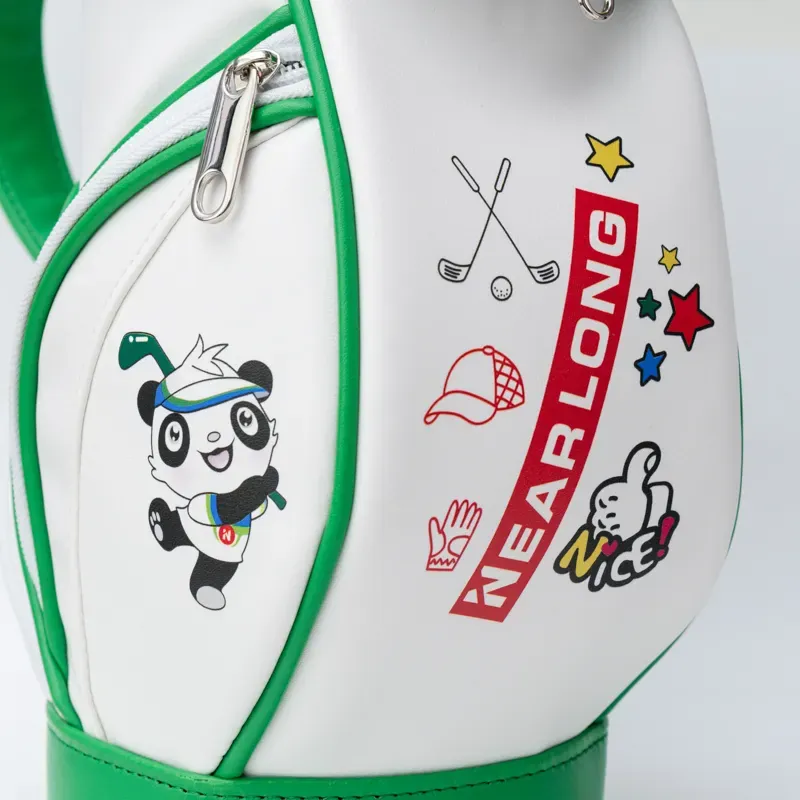
A corporate cart bag: one embroidered front-panel logo, brand trim and a printed hangtag.
Why a Golf Bag Works as a Corporate Gift
Most corporate gifts fail on one of three counts: they are used once, they are thrown away, or they are so generic that the recipient cannot remember who sent them. A golf bag avoids all three, which is why it persists as a gifting category despite the unit cost.
It is used repeatedly and in public — a bag on a cart is visible to three other players for four hours. It has a long service life, so the brand impression compounds rather than decaying after a week. And it is a product the recipient would plausibly have bought, which is the definition of a gift that lands: useful, specific and not obviously a promotional item.
The commercial consequence is that golf gifting budgets survive scrutiny better than most marketing line items. A bag that is used weekly for three seasons produces far more brand exposure per pound than the same spend on a disposable item, and finance teams tend to accept that argument.
Choosing the Format
The single most common mistake in corporate gifting is buying one format for the entire recipient list. A twenty-handicap club member and a sponsored professional do not need the same bag, and sending both the same product wastes budget at the top and under-delivers at the bottom.
| Format | Unit cost band | Best recipient | Pieces |
|---|---|---|---|
| Accessory set (headcovers, towel, pouches) | Low | Broad guest list, staff, suppliers | 50-500 |
| Cooler bag | Low-mid | Broad guest list, event attendees | 50-500 |
| Sunday / carry bag | Mid | Players who already own a full bag | 100-300 |
| Cart bag | Mid-high | Regular players, client gifts | 200-500 |
| Travel cover | Mid-high | Travelling players, senior clients | 200-300 |
| Tour / staff bag | High | Sponsors, top clients, long-service recognition | 200+ |
A three-tier structure works for most programmes: an accessory or cooler tier for everyone, a Sunday or cart bag tier for the core group, and a staff bag for the handful of recipients where the relationship justifies it. Splitting the budget this way produces a better-perceived programme for the same money than a single mid-tier item sent to everybody.
Format detail — dimensions, build options and what each one costs to produce — is on the individual category pages: cooler bags, Sunday bags, cart bags, travel covers and staff bags.
Budget Tiers and What Each One Buys
Corporate gifting budgets are usually expressed per recipient, and the format question resolves quickly once that number is on the table. What follows is how the budget maps onto a credible product, rather than the absolute price, which varies with quantity, specification and freight.
| Budget tier | What it buys | Branding density | Realistic at |
|---|---|---|---|
| Entry | Accessory set or a basic cooler bag | One logo position, stock packaging | 50-500 pieces |
| Mid | Sunday bag or a six-can cooler bag | One or two logo positions, branded hangtag | 100-300 pieces |
| Upper-mid | Cart bag, standard specification | Two positions, brand trim, printed bag | 200-500 pieces |
| Premium | Cart bag, premium build or travel cover | Two to three positions, patch or metal badge | 200-300 pieces |
| Top tier | Staff bag, PU body with leather trim | Three to six positions, gift box | 200+ pieces |
Two structural notes. First, moving up a tier costs less than most buyers expect, because the setup is shared across the order — the difference between an entry and a mid-tier gift is often 30-50% per unit, not a multiple. Second, packaging carries a disproportionate share of perceived value: the same bag in a printed gift box reads as a materially better gift than in a poly bag, for a very small increment.
Pricing structure and how volume breaks work is set out in our wholesale pricing guide.
Logo Application for Corporate Buyers
Corporate buyers usually have one logo and one colour, and the question is which process carries it best. Four options cover almost every case.
| Method | Best for | Durability | Notes |
|---|---|---|---|
| Embroidery | Most logos, especially text and simple marks | Excellent | 90 mm logo = 6,000-10,000 stitches |
| Screen print | One or two flat colours, large areas | Good | Cheapest at volume; fine detail suffers |
| Heat transfer | Photographic or gradient artwork, small runs | Moderate | Can lift on high-abrasion panels |
| Silicone / PVC patch | Fine detail, soft-touch, premium | Very good | Can be applied over a seam |
| Metal badge | Top-tier gifts and sponsorships | Excellent | Reserve for the front panel |
Three practical rules prevent the usual failures. Keep embroidery off zip lines and high-flex panels, where stitches stiffen the tape and the zip starts to bind. Approve a sewn strike-off on the actual bag fabric rather than on a swatch card, because the same thread reads differently on 600D polyester. And supply vector artwork — a bitmap logo redrawn by the factory is the most common cause of a rejected corporate sample.
If the programme needs individual names, plan it as variable data from the outset. Sixty different names inside one production run needs a sequenced cutting plan, a check sheet and a packing list that keeps each bag with its correct name. It is routine work, but it has to be specified before the bags are sewn, not after.
Quantity Bands and What Changes
Corporate orders cluster into three bands, and each one has a different practical character rather than just a different price.
50-100 pieces
Achievable on stock patterns and low-setup formats — cooler bags, accessories, Sunday bags. Some suppliers will run 50 on accessories. At this size expect a per-unit premium and stricter payment terms, and choose formats where setup cost is low rather than trying to force a cart bag into a small run.
100-300 pieces
The comfortable band for a corporate programme. A cart bag, a travel cover or a Sunday bag all run credibly here, and colour splitting across two or three colourways is realistic in a stock fabric. This is where most client-gift and event programmes sit.
300-1,000+ pieces
The band where custom colours, custom packaging and multi-position branding all become economic. If the programme is annual and recurring, this is the size at which a bespoke pattern earns its tooling.
A fourth structure worth considering for recurring programmes: commit to an annual quantity but take delivery in two or three releases. It secures the volume price while keeping inventory manageable, and it is the standard arrangement for club and sponsor programmes that run on a seasonal calendar.
Deadline Planning
Corporate gifting has a hard date by definition, and it is the item most often planned too late. The schedule below is the realistic one, not the optimistic one.
| Step | Duration | Cumulative |
|---|---|---|
| Format, quantity and budget decision | 1 week | Week 1 |
| Quotation and specification | 1 week | Week 2 |
| Logo artwork approval + sample | 2-3 weeks | Week 4-5 |
| Production | 5-7 weeks | Week 10-12 |
| Sea freight to US/EU | 2-4 weeks | Week 12-16 |
| Sorting, kitting, distribution | 1 week | Week 13-17 |
That is eight to ten weeks to a port, or twelve to seventeen weeks to a recipient. Programmes that start six weeks before an event either pay for air freight — which can add more to landed cost than the bags themselves — or accept a reduced specification.
One calendar trap specific to golf: the gifting season clusters around spring and early summer, which collides with the peak production window for the retail season. A programme intended for a June event should be confirmed in February, not April.
Kitting, Packaging and Distribution
A corporate gift is a presentation, and the last ten percent of the experience is packaging. Three levels are worth quoting.
- Poly bag and hangtag. The minimum retail-ready format. Cheap, protects the bag in transit, and the hangtag carries the brand story and any message from the sender.
- Printed gift box. The default for a premium corporate gift. Tooled and printed separately, usually with a 500-1,000 unit minimum, so it needs to be started in parallel with the bag artwork.
- Kitted presentation. Bag plus an accessory, a printed card and a ribbon, packed as a single unit. The most impactful option and the one that requires the most planning, because kitting is a separate operation with its own labour and its own quality check.
Distribution matters as much as packing. A consolidated delivery to one address is standard; individual drop-ship to recipients is possible where quantities and destinations justify it but changes the packing, labelling and freight structure entirely. Decide which model you need before quotation, because it is far harder to add afterwards.
Working With Distributors and Resellers
A large share of corporate golf gifting runs through a promotional distributor rather than directly from the brand or the club. That changes the requirements, and it is worth understanding before you quote.
A distributor needs three things a direct corporate buyer does not: a trade price with a visible margin structure, a product that can be re-quoted at several quantity bands, and documentation — spec sheets, certificates, imagery and lead times — that can be forwarded to their client without editing. Providing those as a standard pack shortens every quotation cycle.
The quantity bands matter more in this channel than anywhere else. A distributor will typically quote the same product at 100, 250 and 500 pieces and the client chooses. If your price breaks are coarse, or if the 100-piece price carries a premium that makes the entry option look poor value, the distributor will default to a competitor with a flatter curve. It is worth designing the price ladder for that behaviour rather than discovering it during a tender.
Two practical points. First, white-label or neutral packaging is often required so the distributor can brand the gift as their own — which means the bag itself should carry only the end client's logo, not yours. Second, turnaround on artwork approval is usually faster through a distributor because they consolidate client feedback before it reaches you, so the revision cycle is shorter than on a direct corporate order.
Where Corporate Programmes Fail
The failures are consistent enough to list. Almost all of them are planning failures rather than product failures.
- Artwork arrives late. The bag can be made in 35-50 days; a logo approval that takes three weeks is what breaks the schedule.
- One format for every recipient. Wastes budget at the top of the list and under-delivers for the recipients who matter most.
- No sample approved. Production starts on an unapproved design and the first-off check has nothing to check against.
- Names specified after production. Variable data has to be planned into the cutting and packing sequence.
- Packaging started last. Packaging has its own minimum and lead time and is the most common cause of a late delivery on an otherwise on-time order.
- No buffer in the freight plan. Sea freight estimates are estimates; a two-week buffer is not padding, it is risk management.
The pattern behind all six is the same: the bag is the predictable part, and the schedule fails on the items that depend on the buyer rather than the supplier. Starting the artwork and packaging in week one, in parallel with the bag specification, removes most of the risk.
Frequently Asked Questions
- What is the minimum order for corporate golf gifts?
- 50 pieces on accessories and cooler bags, 100 on Sunday bags, and 200 on cart bags and staff bags. Where the gift is a single logo position on a stock pattern, a 50-100 piece run is realistic; where the bag itself is customised in colour and trim, the standard MOQ applies.
- How long before an event should we order?
- Work backwards eight to ten weeks: 35-50 days production, two to three weeks sea freight, and a buffer for artwork approval and one sample round. For a hard date inside six weeks, air freight is possible but adds materially to landed cost, so confirm the date at enquiry stage.
- Which golf bag makes the best corporate gift?
- It depends on the recipient and the budget. A cooler bag or accessory set works for a broad guest list; a Sunday bag works for players who already own a full bag; a cart bag or staff bag is a top-tier gift for clients, sponsors and long-service recognition. The mistake is buying one format for every recipient tier.
- What logo method should we use?
- Embroidery is the default for golf bags: durable, readable and it does not crack or peel. Screen print or heat transfer suits one-colour marks and photographic artwork. A silicone or PVC patch is the premium option and handles fine detail better than stitches. Avoid embroidery across zip lines and high-flex panels.
- Can each bag carry a different name?
- Yes. Individual names on a bag, a pocket flap or a name strip are a common corporate requirement and we run them as variable data inside a single production order. It has to be specified at enquiry stage with a sequenced name list, because the cutting and packing plan changes.
- Do you ship direct to individual recipients?
- Not as standard — goods ship as a consolidated order to one address. Individual drop-ship is possible where the quantities and destinations justify it, but it changes the packing, labelling and freight structure and should be raised before quotation.
- Can we supply our own packaging and gift boxes?
- Yes, and for a corporate gift it is usually worth doing. A printed gift box or a branded mailer turns a bag into a presentation item. Packaging is tooled and printed separately with its own minimum, so start the artwork at the same time as the bag artwork.
- Are the bags suitable for clients in the US and EU?
- Yes. For EU and UK destinations, labelling for fibre content, origin and care is generally required, and PFAS restrictions on water-repellent finishes are tightening. Tell us the destination markets at enquiry stage so the label set and fabric finish are specified correctly.
Plan a Corporate Gifting Programme
Tell us the recipient count, the event date and the budget per recipient. We will propose a two- or three-tier format plan and a schedule that works backwards from your date.