Private Label Golf Bags: OEM Programme Guide
What a private label golf bag programme actually involves — from QUANZHOU JUNYUAN BAGS, a sourcing and programme-management company working with an affiliated factory since 2014 — covering brand assets, MOQ, sampling gates, packaging and labelling.Private label means the finished bag carries only your brand: your logo, colourway, labels and packaging, and it is not sold to anyone else. Standard MOQ is 200 pieces per SKU with a 100-piece trial, 500 where a new pattern has to be developed, sampling takes 6-10 working days and production 35-50 days. The binding constraint is rarely the bag — it is brand asset approval and packaging artwork.
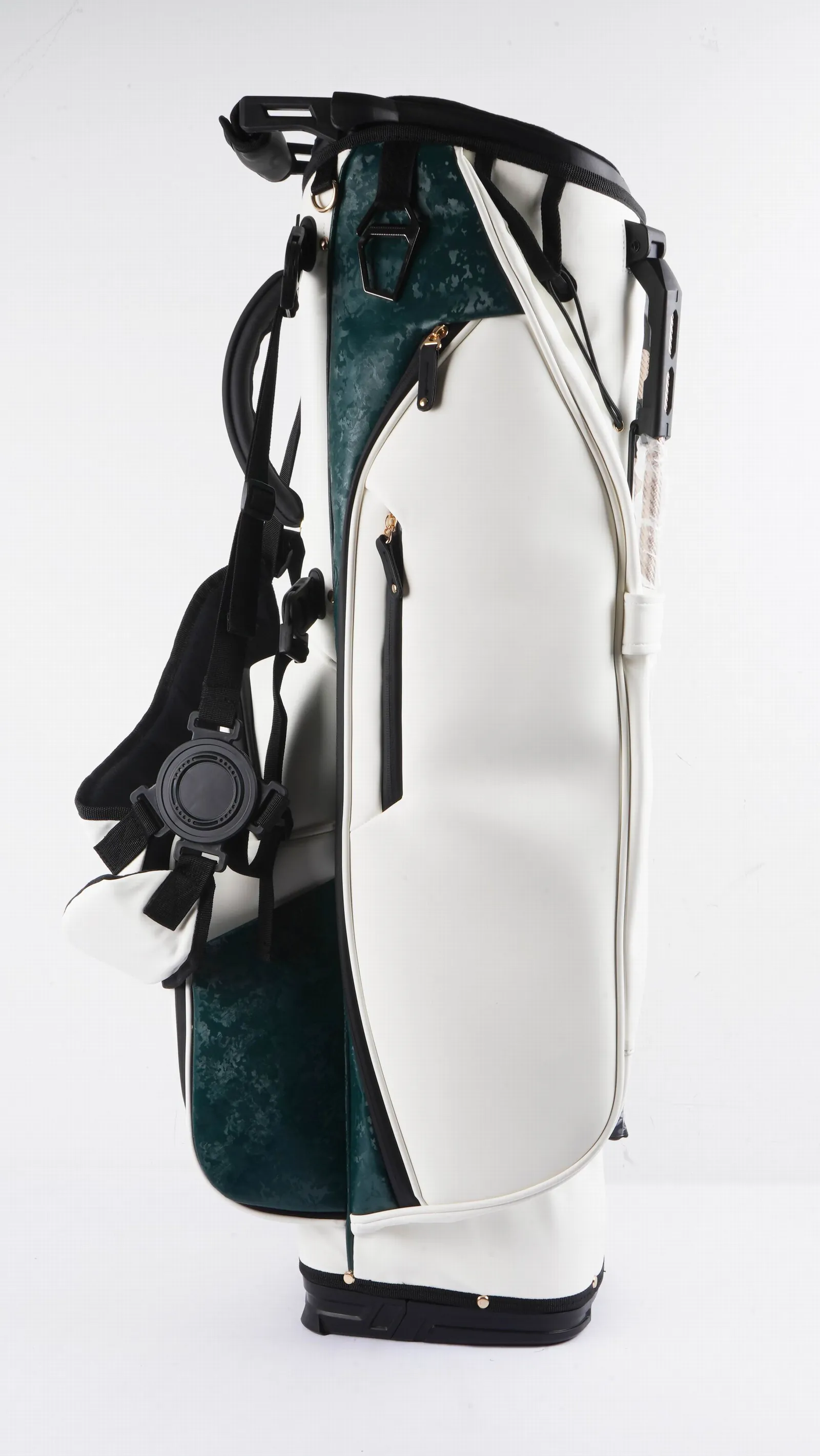
A private label cart bag: one brand position, custom colourway, branded label and hangtag.
Private Label, OEM and ODM: What Each One Actually Means
The three terms are used interchangeably in sourcing conversations and they describe different things. Getting them straight at the start avoids a mismatch between what a buyer expects and what a supplier quotes.
| Arrangement | Who designs it | Who brands it | Typical MOQ | Best for |
|---|---|---|---|---|
| White label | The factory | Nobody, or a sticker | Stock, no MOQ | Testing a category cheaply |
| Private label (semi-custom) | Factory pattern, buyer colours and branding | The buyer | 200 | Retail brands and pro shops |
| ODM | The factory owns the design | The buyer | 200-500 | Fast route to a full range |
| OEM (full custom) | The buyer | The buyer | 500+ | Brands with their own design language |
In golf bags, the majority of programmes sit in the second row. The buyer picks a pattern the factory already runs, changes the fabric colourway, chooses hardware, adds one or two logo positions, and specifies labels and packaging. That is a private label programme, and it is the fastest and cheapest way to get a credible product onto a shelf.
Full OEM — where you supply drawings, a tech pack and a specification — costs more and takes longer, because the pattern, cutting dies and any new tooling have to be built. It is the right choice when the bag itself is the differentiator, not just the logo. The process for that route is set out on our OEM and ODM services page.
The Four Ways to Put Your Brand on a Bag
Branding a golf bag is not one decision. There are four separate surfaces, and a coherent private label programme uses all four deliberately rather than defaulting to a logo on the front panel.
1. The logo on the product
Embroidery is the default for golf bags: durable, colour-fast through washing, and predictable enough to quote per position by stitch count. A 90 mm logo runs 6,000-10,000 stitches. Silicone and PVC patches handle fine detail and soft-touch finishes and can be applied over a seam. Heat transfer suits photographic artwork and small runs but abrades faster. Metal badges are the premium option and belong on the front panel or the putter well, not on a wear point.
2. The trim and colourway
This is the cheapest branding in the whole programme and the most under-used. A two-tone body-and-trim split in your brand colours reads as a branded product from thirty metres away, with no logo at all. It costs nothing beyond a fabric selection, and it is the single strongest signal of a considered range.
3. Woven and printed labels
A woven label at the strap anchor, a printed label inside the apparel pocket with fibre content and care instructions, and a size or model label where relevant. Labels are cheap — a few cents each — and their absence is the fastest way to make a well-made bag look like an unbranded import.
4. Packaging and hangtags
The hangtag is the only part of the product a buyer reads before they touch the bag. A printed hangtag at 60 x 120 mm with the brand story, the material callout and a barcode costs very little and changes the perceived price point. Add a branded poly bag and, for a premium range, a printed mailer.
The Brand Asset Checklist
A private label programme stalls for one reason more often than any other: incomplete brand assets. The factory can build the bag, but it cannot guess what the logo should look like. This is the list to have ready before the first technical conversation.
- Vector logo. AI, EPS or PDF with text converted to paths. Supply a one-colour and a full-colour version, plus a reversed version for dark panels.
- Pantone references. One per brand colour, with a coated reference for fabric and an uncoated reference for print. "Navy" is not a specification.
- Logo placement drawing. A flat bag outline with each position marked, dimensioned and labelled with the process to be used.
- Label copy. Exact wording for the woven label, the interior label (fibre content, care, origin) and the hangtag, in the language of the destination market.
- Packaging artwork. Poly bag print, hangtag layout, mailer or gift box artwork, at the printer's required resolution.
- SKU and barcode data. If the goods ship to a retailer, an EAN or UPC per colourway and size, plus any retailer-specific label format.
Two of those items routinely cause delays. Pantone references for fabric are not the same as Pantone references for print — a coated print reference will not match a dyed polyester. And label copy in a second language needs a native check, not a machine translation, because a mislabelled fibre content is a compliance problem rather than a cosmetic one.
MOQ Structure and Colour Splitting
The MOQ structure is simple and does not change with the branding: 200 pieces per SKU on an existing pattern, 100 pieces for a trial, 500 where the pattern is new. What buyers usually want to know is how far that can be stretched across colourways.
| Scenario | MOQ applies to | What is possible at 200 pieces |
|---|---|---|
| One colourway, one logo set | 200 per SKU | Straightforward; best unit price |
| Two or three colourways, same fabric | 200 total per SKU | Yes, if fabric is stock or dyed in one lot |
| Four or more colourways | 200 total | Possible but each colourway carries a minimum cut length |
| Custom-dyed fabric | Per colour, plus dye lot minimum | Usually forces 300+ per colour |
| Different hardware per colourway | 200 total | Yes, hardware is a separate line item |
| Different pattern per colourway | 200 per pattern | No — each pattern is its own SKU |
The practical rule: colour splitting is free within a stock fabric and expensive across a custom dye. If the range needs four colourways and a tight budget, choose stock colours that sit close to your brand palette rather than commissioning a dye lot for each. The full set of levers is on our low MOQ programme page.
The Sampling Gates
A private label programme runs through three sample stages, and each one exists to catch a different class of mistake. Skipping a gate is the most reliable way to end up with a production run that has to be reworked.
Gate 1 — Development sample
The first physical bag, made to your specification with your colourway and a placeholder or actual logo. Its job is to prove the design. Produced in 6-10 working days, or 12-15 for a complex build. Expect to comment on proportions, pocket positions and hardware.
Gate 2 — Pre-production sample (PPS)
Made after your comments are incorporated, in the production fabric with the production logo and the actual labels. Its job is to prove that the design can be reproduced. This is the sample that gets signed off, and the signed PPS becomes the reference for the whole run.
Gate 3 — Production first-off
The first unit off the line, checked against the signed PPS before the run continues. Its job is to catch drift — a colour that reads differently in the production lot, an embroidery registration that has shifted, a hardware finish that does not match.
The whole sequence, including what to check at each gate, is on our sampling and prototyping page.
Where the Unit Cost Comes From
A private label golf bag has six cost blocks, and understanding them is what makes a price negotiation productive rather than adversarial.
| Cost block | Share of unit cost | What moves it |
|---|---|---|
| Shell fabric | 15-25% | Denier, coating, custom dye vs stock colour |
| Labour (cut, sew, assemble) | 25-35% | Panel count, pocket count, trim complexity |
| Tooled components | 10-20% | Top collar mould, base plate, divider layout |
| Hardware and zips | 8-15% | Zipper grade, metal vs plastic, finish |
| Branding | 5-12% | Number of positions, process, stitch count |
| Packaging and labels | 3-8% | Hangtag, poly bag, mailer, label set |
The two blocks with the most leverage are labour and tooled components, and both are driven by panel and pocket count rather than by material quality. Reducing a build from ten pockets to seven can save more than downgrading the shell from 1680D to 600D, and it usually improves the product. This is the conversation worth having at quotation stage.
Two further points are worth understanding before a price is negotiated. The first is that setup cost is amortised across the order, not charged separately — which is why the same bag is 15-30% cheaper per unit at 1,000 pieces than at 100, even though the materials are identical. The second is that branding and packaging carry a disproportionate share of perceived value relative to their cost: a printed hangtag and a branded poly bag add a few percent to unit cost and change how the product reads on a shelf far more than the same money spent on a heavier fabric would.
Where prices diverge between suppliers on the same specification, the difference is almost always in one of two places: how much tooling is being amortised into the quoted quantity, and how much of the labour content is subcontracted. Asking directly which components are tooled for your programme and which are stock makes those differences visible.
Detailed pricing logic, including tiered bands and how volume breaks work, is set out in our wholesale pricing guide.
Packaging, Labelling and Retail Readiness
Private label goods are usually sold through someone else's shelf, which means they have to arrive retail-ready. Three items turn a bag into a retail SKU: a hangtag with a barcode, an interior label with fibre content and care instructions, and a poly bag that protects the product in transit without looking like warehouse packaging.
Labelling obligations vary by market. EU and UK retail generally require fibre content, country of origin and care instructions in the local language; the US requires fibre content and origin. Where a bag includes a coated fabric or a DWR finish, PFAS restrictions on water-repellent finishes are tightening in the EU and in several US states, so the finish specification should be confirmed at enquiry stage rather than after the fabric is ordered.
For packaging specifically: tooling and printing are separate from the bag, with their own minimums (often 500-1,000 units for a printed mailer) and their own lead time. Run packaging artwork in parallel with bag sampling, not after it, or packaging becomes the item that delays the launch.
IP, Exclusivity and What to Put in Writing
A private label programme depends on the product not appearing under someone else's brand. That should be a contract term, not an assumption. Three points are worth agreeing before sampling starts.
- Pattern exclusivity. Any pattern developed for your programme is yours and is not offered to other clients. For an existing pattern adapted with your colourway, ask for a commitment that your exact colourway and logo combination is not reproduced for another buyer.
- Artwork ownership. Your logo files remain yours; the factory holds them only for the duration of the programme and does not use them for anything else.
- NDA before technical disclosure. If you are sharing a tech pack, drawings or sales data, the NDA should be signed before the conversation, not after the quotation.
We sign an NDA before a technical discussion as standard and confirm exclusivity in writing as part of the quotation. The questions worth asking any supplier on this topic are listed in our manufacturer selection guide.
End-to-End Timeline
| Stage | Duration | What you need to have ready |
|---|---|---|
| Brief and quotation | 3-10 working days | Reference bag or sketch, target price, quantity |
| Development sample | 6-10 working days | Vector artwork, Pantone references, placement drawing |
| Revision round | 5-8 working days | Consolidated comments in one document |
| Pre-production sample | 7-12 working days | Approved label copy and packaging artwork |
| Bulk production | 35-50 days | Signed PPS, deposit |
| Sea freight to US/EU | 14-24 days | Booking, documentation |
Four months from brief to warehouse is a realistic plan. Three months is achievable only if brand assets and packaging artwork are already finished and no revision round is needed.
Frequently Asked Questions
- What does private label mean for golf bags?
- Private label means the bag is built to your specification and carries only your brand — your logo, your colourway, your labels, your packaging. The product design may come from an existing pattern (semi-custom) or from your own drawings (full custom). What makes it private label is that the finished goods carry no other brand and are not resold to anyone else.
- What is the difference between private label, OEM and ODM?
- Private label is the branding arrangement: your name goes on the product. OEM means built to your design. ODM means built to a design the factory already owns, which you then brand. In golf bags most programmes are a blend — an existing pattern adapted with your colours and logo, which is technically ODM with private label branding. We quote all three.
- What is the MOQ for a private label golf bag?
- 200 pieces per SKU for an existing pattern, 100 pieces for a trial, and 500 pieces where the pattern has to be developed from scratch. Colour splitting does not multiply the MOQ as long as the fabric is in stock or is dyed in a single lot.
- What artwork and brand assets do I need to supply?
- A vector logo (AI, EPS or PDF with text converted to paths), a Pantone reference for every brand colour, the exact wording and layout for woven labels and hangtags, and barcode or SKU data if the goods ship to retail. Bitmap artwork redrawn by the factory is the most common cause of a rejected sample.
- Can I use my own packaging?
- Yes, and it is usually worth doing. Options run from a printed poly bag and a branded hangtag up to a printed mailer or a gift box. Packaging is tooled and printed separately from the bag, so it has its own minimum and its own lead time — plan it in parallel, not afterwards.
- Who owns the design and the patterns?
- You own your brand assets and any design you supply. Patterns we develop specifically for your programme are exclusive to you and are not offered to other clients. We will sign an NDA before a technical discussion and will confirm exclusivity in writing as part of the quotation.
- Do private label bags need labelling for retail?
- It depends on the market. EU and UK retail generally require fibre content, country of origin and care instructions; the US requires fibre content and origin. If the goods are sold through a large retailer, expect a specific label format. Tell us the destination market at enquiry stage and we will build the label set into the quotation.
- How long does a private label programme take end to end?
- From brief to delivered goods, plan four months: one to two weeks for the spec and quote, 6-10 working days for sampling plus a revision round, 35-50 days for production, and two to three weeks for sea freight. Brand asset approval and packaging artwork are the two items most likely to add time.
Start a Private Label Programme
Send your logo files, a reference bag and your target retail price. We will come back with a pattern recommendation, a branding plan and a price band at your quantity.