Private Label Golf Bags: Step-by-Step Launch Guide
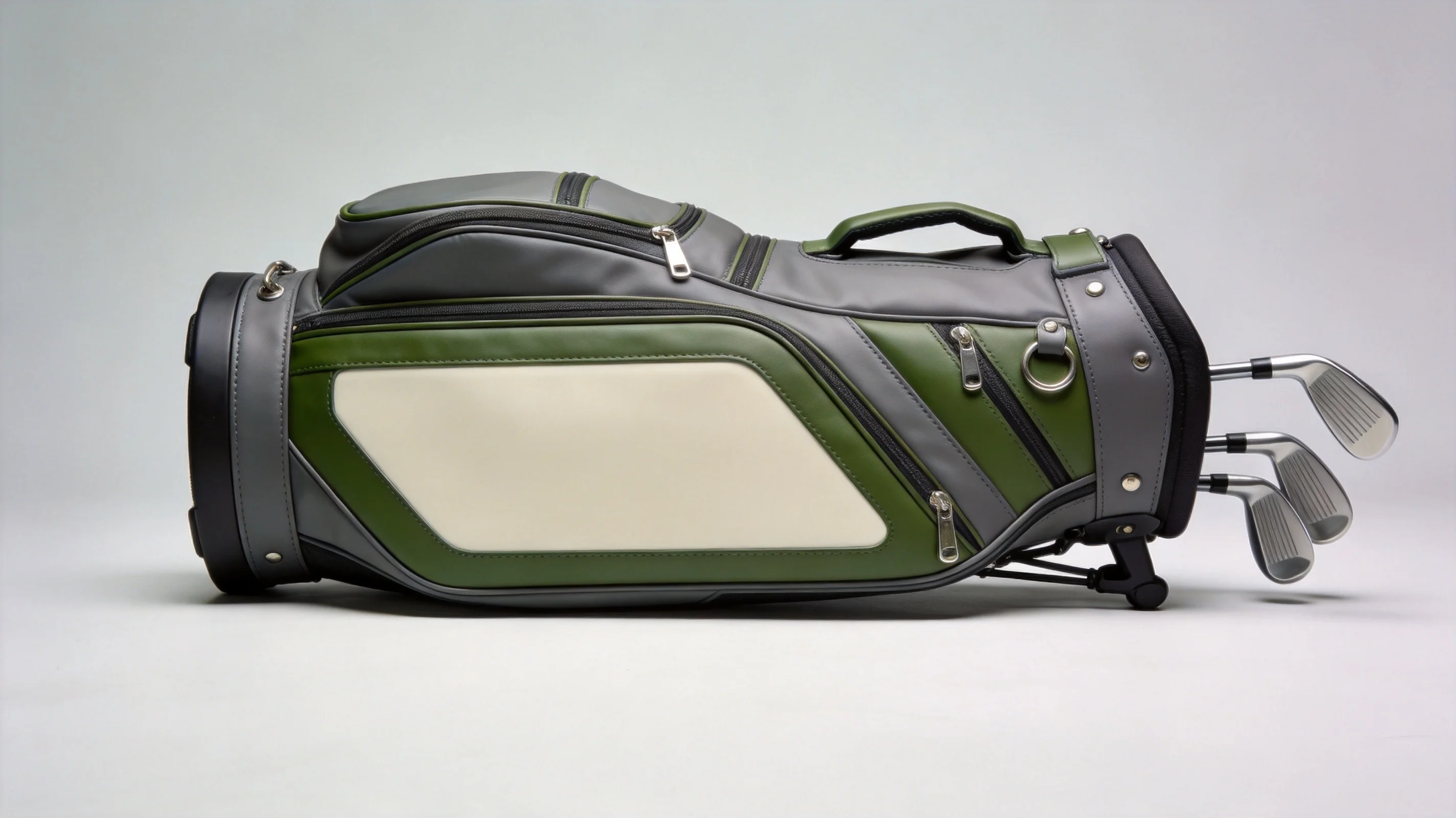
Launching an own-label golf bag is a twelve-week programme with eight decision points, not a purchase: platform, price band, branding files, sample rounds, labelling, packaging, payment structure and the countdown to first delivery. In the own-label model, a retailer, club or new brand commissions bags built to its specification and sold under its own name; the workshop that sews them stays invisible. The two versions of that model behave very differently. A stock platform with your branding needs 100-200 pieces and a short cycle; a fully developed shape needs 500 pieces, new tooling and 12-15 working days of sampling. Standard terms across both: sampling 6-10 working days, bulk 35-50 days, AQL 2.5 under ISO 2859-1, T/T 30/70, FOB Xiamen.
Related reading: Starting a Golf Bag Brand: The Full Route
How the Own-Label Model Works in Golf Bags
An own-label bag is a bag made to a buyer's specification and sold under the buyer's name. In practice the market runs two versions. The first is a stock platform: the maker already owns the pattern, the top mould and the divider, and the buyer changes fabric colour, trim, print, labels and packaging. The second is full development: the buyer brings a shape, and the pattern, tooling and construction are built for that programme alone.
The commercial difference is large. A stock platform can start at 100-200 pieces because nothing new is cut, while a developed shape starts at 500 because the tooling and first-article work must be recovered. Neither is better in the abstract; they answer different questions. A club that wants its crest on a good bag belongs on a platform. A brand that wants a bag no one else can buy needs development, and should plan for the cost and the calendar that go with it.
Stock platform versus full development
Choose the platform if you need to be in market within a season, if your volume is under 500 pieces, or if your differentiation lives in colour, print and packaging. Choose development if the bag itself is the product idea, if you need a specific top geometry or pocket layout, or if you expect to sell 1,000 pieces a year and want the tool in your own name. A useful middle path is a stock shell with a developed trim package: new badge, new zip tape, new lining colour, same moulds.
One point is worth settling before anything else: who owns the pattern and the tooling. In an own-label arrangement the buyer should own the brand assets and, ideally, hold or co-hold the tool. If the tool stays with the maker and the relationship ends, the shape may reappear under another label. Our notes on protecting design assets set out what to put in writing.
Picking the Platform: One Bag, One Price Band
New labels fail more often from range breadth than from product quality. Three or four SKUs at launch, all in one price band, gives a coherent story and a manageable fabric commitment. A stand bag, a cart bag and a travel cover is a credible first collection; eight SKUs across four price points is a cash-flow problem dressed as ambition.
The price band determines more of the specification than most first-time buyers expect. A bag at USD 30-40 FOB can carry a 600D shell, a moulded divider and a basic trim package. At USD 45-60 the same bag can add a laminated waterproof shell, a fourteen-slot top whose main walls run most of the depth of the bag, and better hardware. At USD 65-90 the conversation moves to premium trim, branded pullers and a developed collar. Choosing the band first stops the specification from drifting upward one feature at a time.
| SKU | Typical FOB band | Standard MOQ | Why start here |
|---|---|---|---|
| Stand bag, 6-7 way | USD 30-45 | 200 per colour | Widest retail appeal, exercises the full branding package |
| Cart bag, 14-way | USD 42-65 | 200 per colour | Higher ticket, strong pro-shop and resort channel |
| Sunday or pencil bag | USD 18-30 | 100-200 | Low entry cost, good gift and event volume |
| Travel cover | USD 45-80 | 200 per colour | Seasonal but high margin, pairs with the bag range |
For a first order, resist the urge to cover every format. One bag sold in three colourways teaches more about your market than three bags in one colourway each, and it keeps the fabric in a single dye lot.
Branding Files: Logos, Colours and Labels
Branding is where the calendar slips most often, because artwork approval sits outside the production schedule and usually involves someone who is not in the room. The file set that avoids delay is small: a vector logo in AI or EPS with outlined text, a one-colour and a reversed version, the exact colour references, and a placement drawing showing size in millimetres and position in millimetres from the nearest seam.
Pantone, TCX and the colour gap
A Pantone number is a print reference; a TCX number is a textile reference. They are not interchangeable, and neither is a screen. Fabric absorbs and scatters light differently from paper, so a logo that matches on a monitor will not match on a 600D shell. The fix is a physical lab dip or a sewn sample of the actual decoration before bulk, approved in daylight and under the same light box the factory will use.
Woven label, print or rubber patch
Each decoration method has its own economics. A woven label is the cheapest way to put a brand on a bag, with low set-up and a minimum in the hundreds. Screen printing is inexpensive per unit but needs a screen per colour and works best on flat panels. Embroidery reads premium and tolerates curves, but a detailed logo loses definition below about 25 mm of height. A rubber or TPU patch is the strongest signal of quality and the highest set-up cost, typically USD 300-900 for a mould, which is why it is usually reserved for one hero placement.
| Method | Set-up cost | Practical minimum | Best placement |
|---|---|---|---|
| Woven label | USD 50-150 | 200-500 labels | Pocket face, strap, lining |
| Screen print | USD 60-120 per colour | 200 pieces | Flat body panel, pocket |
| Embroidery | USD 40-100 per design | 100 pieces | Ball pocket, collar, hood |
| Rubber or TPU patch | USD 300-900 for the mould | 500 pieces | Front panel, hero placement |
Spec tip. Put the logo size and position in millimetres on the tech pack, not in a picture. "Centred on the ball pocket" means three different things to three sample hands, and the difference shows up as a 15 mm shift between the sample and bulk.
The Sampling Sequence and What Each Round Proves
Sampling is not one event. A disciplined programme runs three rounds, and each answers a different question. Skipping a round saves a week and costs a season.
- Prototype. Confirms the shape, the proportions and the construction. Made from stock or nearest-match materials; colour is indicative only. Six to ten working days on a stock platform.
- Colour and material round. Confirms the actual shell, trim, lining and decoration against your standards. This is where a lab dip or a sewn logo sample gets approved, in daylight and in a light box.
- Pre-production sample. The exact bag, in the exact materials, built on the production line with production methods. This is the reference for bulk and for inspection. Twelve to fifteen working days where new tooling is involved.
The pre-production sample is the document that matters commercially. It should be photographed from six angles, weighed, measured at the top opening and base, and signed by both parties with a date. When a bulk shipment is disputed, this sample is the arbiter. Sample fees are normally charged and then credited against the bulk order, which keeps the incentive on both sides to reach approval quickly.
One rule prevents most sampling arguments: approve the bag you can actually produce. If the prototype uses a fabric that is not available in your target colourway, do not approve the prototype. Wait for the colour round. The alternative is discovering at bulk that the approved look cannot be repeated at the approved price.
Labelling, Origin and Compliance Basics
A golf bag is not apparel, so the labelling regime is lighter, but it is not absent. Country of origin marking is required in most destination markets, and for US imports the marking must be legible and permanent enough to survive normal handling. Fibre content and care labelling requirements vary by market and by whether the product is classified as a bag or an accessory, so the safe approach is to confirm the exact requirement for your destination and product classification before the labels are printed.
Material compliance sits alongside. Under EU REACH, substances in articles, including textile dyes, coatings and plasticisers, are restricted, and a supplier should be able to provide a declaration for the specific materials in the bag. If you sell into the EU or UK, ask for the declaration at the colour approval stage, because substituting a material after approval invalidates the paperwork.
Two practical details trip up first-time importers. First, the country of origin on the label is the country where the bag was substantially transformed, which is a customs question rather than a sewing question, so confirm it with your importer or broker rather than with the factory. Second, the importer of record is legally responsible for the accuracy of the markings, which means the buyer, not the supplier, carries the exposure.
- Origin marking: permanent, legible, on the product or the permanent label.
- Material declaration: requested at colour approval, covering shell, lining, trim and coating.
- Care instructions: matched to the actual coating and lining, not copied from another bag.
- Barcode and carton marks: agreed before packaging is printed, not after.
- Retained standards: one signed bag, one colour standard, one label proof, held by both parties.
Packaging and Retail Readiness
Packaging is the cheapest part of the launch and the most visible at the point of sale. A polybag, a hangtag, a tissue wrap around the collar and a printed carton do more for perceived quality than an extra pocket, and they cost a fraction of a specification upgrade. The constraint is minimum order quantities: printed cartons usually start at 500-1,000 units, and custom hangtags at 1,000, so a 200-piece first run often uses stock cartons with a printed label.
Barcodes belong on the hangtag or the polybag, not on the bag itself. A UPC or EAN needs to be issued to your company, and the number must match the variant: a colourway is normally a separate code from the same bag in another colour. Getting the codes right before the packaging print run is the difference between a clean retail launch and a warehouse full of re-labelled cartons.
Also agree the carton specification early: bags per carton, carton dimensions, gross weight and the marks printed on the outside. Carton cube drives freight cost, and a 20 mm difference in carton height across 200 bags is a measurable difference in a container plan. A 200-piece run packed four bags to a carton is fifty cartons, which ships as a single pallet by sea but is charged on dimensional weight if it flies. Check the carton volume against the freight mode before the print run locks the size, and put the standard suffocation warning on any polybag sold into a market that requires it. Our packaging and shipping notes cover the carton marks and loading sequence in more detail.
Costing the Launch and the 30/70 Structure
A launch budget has four blocks: product, tooling and sampling, packaging, and freight and duty. Product is the FOB price times quantity. Tooling and sampling are one-time costs, normally USD 300-900 for sampling and USD 3,000-9,000 where a new mould is required, often credited against bulk. Packaging is the wildcard, because a custom carton at 1,000 units on a 200-piece order leaves 800 cartons in a warehouse.
Payment follows a standard structure in this category: 30% deposit with the order, 70% against the shipping documents, by T/T. The deposit covers materials, which is why suppliers ask for it before the fabric is booked. Terms beyond 30/70 are a negotiation lever tied to volume and history rather than a standard option, and a first order at 200 pieces should expect the standard structure.
Landed cost is the number to model, not the FOB price. A bag at USD 38 FOB with 12% freight and 8% duty lands near USD 46 before warehousing, and the retail price has to carry that plus your margin and the retailer's. A wholesale price at twice landed cost and a retail price at twice wholesale is the conventional ladder, which puts that bag near USD 184 on shelf. Buyers who build a price ladder on FOB alone usually discover the gap when the first invoice arrives. Duty rates and freight move, so confirm current rates for your HS classification at the time of writing.
| Cost block | Typical amount | Timing | Recoverable |
|---|---|---|---|
| Sampling and colour approval | USD 300-900 | Before bulk | Often credited on order |
| New mould or tooling | USD 3,000-9,000 | Before bulk | Amortised or buyer-owned |
| Product, 200 pieces | FOB x 200 | 30% deposit, 70% on documents | No |
| Packaging print | USD 400-1,200 | Before bulk | No |
| Freight and duty | Roughly 12% and 8% | On shipment | No |
A Twelve-Week Countdown to First Delivery
Working back from a launch date keeps the sequence honest. The plan below assumes a stock platform with custom branding; a developed shape adds three to four weeks for tooling and first article.
- Weeks 1-2: brief and platform. Fix the SKU list, price band, quantities and the specification sheet. Confirm tooling ownership if a new shape is involved.
- Week 3: branding files. Deliver vector artwork, colour references and a placement drawing in millimetres. Request label and packaging quotes at the same time.
- Weeks 4-5: prototype. Review shape and construction. Do not approve colour at this stage.
- Week 6: colour and material approval. Lab dip or sewn logo sample, approved in daylight and in a light box. Material declaration requested.
- Weeks 7-8: pre-production sample. Signed, photographed and weighed. Packaging and carton marks confirmed.
- Week 9: bulk release. 30% deposit paid, fabric booked, production scheduled for 35-50 days.
- Weeks 9-16: bulk production and inspection. Inspection at AQL 2.5 under the ISO 2859-1 scheme, general level II, plus weight and logo placement checkpoints.
- Weeks 16-20: freight and launch. Sea freight 25-40 days, or air for a faster first drop at a per-unit premium.
The countdown looks comfortable on paper and rarely is, because weeks 3 and 6 depend on approvals from people outside the project. The two decisions that save the most time are choosing the platform before the artwork and locking the colour at the colour round rather than reopening it at pre-production. Our sampling service page covers what each round includes, and the own-label programme sets out how a first range is structured from 200 pieces.
Next steps: custom solutions, manufacturing capability, and a quotation request. Own-label programme. OEM and ODM process guide.
Sources and Standards Referenced
- US Customs and Border Protection, importer and origin marking guidance
- ECHA REACH regulation, substance restrictions in articles
- ISO 2859-1:2022 Sampling procedures for inspection by attributes
- ASTM D5034 Breaking strength and elongation of textile fabrics (grab test)
- ISO 9001 quality management systems
Frequently Asked Questions
What does private label mean for a golf bag?
It describes a bag made to a buyer's specification and sold under the buyer's own name, with the workshop staying invisible. The model runs from a stock platform with custom colour, print and labels at 100-200 pieces up to a fully developed shape at 500 pieces with dedicated tooling.
How many bags do I need for a first own-label order?
200 pieces per colourway on a stock platform with custom branding. A recurred or printed run on an existing construction can start at 100 pieces as a trial. A new shape, top mould or laminate needs 500 pieces to carry the tooling and first-article cost.
How long does it take to launch a golf bag label?
About twelve weeks for a stock platform, assuming artwork arrives on schedule. Sampling occupies 6-10 working days, bulk 35-50 days, and the sea passage 25-40 days. A developed shape adds three to four weeks for tooling and first article.
What files do I need to supply for branding?
A vector logo in AI or EPS with outlined text, a one-colour and a reversed version, exact colour references, and a placement drawing showing size and position in millimetres from the nearest seam. A picture alone is not a specification.
Should I use Pantone or TCX for the logo colour?
Use Pantone for print references and TCX for textile references, and never treat either as a guarantee. Approve the colour on an actual sewn sample or lab dip in daylight and under a light box, because fabric reflects light differently from paper or a screen.
Is embroidery better than a printed logo?
It depends on the logo and the placement. Embroidery reads premium and handles curved panels, but fine detail closes up below about 25 mm of height. Screen print is cheaper per unit and holds fine detail on flat panels. A rubber patch is the strongest quality signal and the highest set-up cost.
What does a sample cost and is it refunded?
Sampling typically runs USD 300-900 depending on rounds and decoration, and it is usually credited against the bulk order. A new mould is separate, at roughly USD 3,000-9,000, and should be owned or co-owned by the buyer if the shape is core to the brand.
How many sample rounds should I expect?
Three: a prototype for shape, a colour and material round for the actual shell and decoration, and a pre-production sample built with production methods. The last one is the reference for bulk and for inspection, so sign it, photograph it and keep a copy.
What labelling is required on an imported golf bag?
Country of origin marking is required in most markets and must be legible and durable. Fibre content and care labelling depend on the destination and the product classification. The importer of record is responsible for accuracy, so confirm the requirement before labels are printed.
What payment terms are normal for a first order?
30% down with the order, the remaining 70% released against the bill of lading, settled by T/T, FOB Xiamen. The deposit covers materials before the fabric is booked. Better terms are negotiated against volume and history, so a 200-piece opening order generally sits on that standard basis.
How do I calculate landed cost, not just FOB?
Start with FOB, add freight as a percentage of value, add duty for your HS classification, then add warehousing and inland delivery. A USD 38 bag often lands near USD 46 before storage. Confirm current freight and duty rates rather than using last season's figures.
Can I use stock cartons for a 200-piece launch?
Yes. Custom printed cartons usually start at 500-1,000 units and hangtags around 1,000, so a first run often uses stock cartons with a printed label and a custom hangtag. Agree carton dimensions early, because carton cube drives freight cost.
Build Your Launch Plan
Send your launch date and target price band, and our team will return a platform recommendation, a sampling calendar and a landed cost estimate within two working days.
Plan My Launch See Custom Solutions