Packaging and Shipping for Bulk Golf Bag Orders

For bulk golf bag orders, packaging and shipping are where margins are won or lost: because golf bags are bulky, the decisive freight metric is chargeable volume, not gross weight, so a packing design that lowers CBM can cut per-unit freight 10–20%; a supplier running about 200,000 bags of monthly capacity, shipping to 100+ countries, with samples in 10–20 days and production in 45–60 days, can lock your packing spec, book the lane and clear customs as one controlled flow. This guide covers everything a wholesale buyer needs to plan safe, cost-efficient packaging and shipping for golf staff bags, cart bags, stand bags and travel covers — from carton construction and poly-bag protection to master-carton packing, freight mode selection, incoterms, customs and receiving inspection. We write from the operating experience of our affiliated manufacturing network in Quanzhou, Fujian (main plant 4,950 m², founded 2014, founder in the trade since 2004), and every tariff and trade reference is verifiable in the Sources below.
Why Bulk Packaging Is a Cost Line, Not a Detail
In wholesale golf bag programmes the packaging spec is often decided last, and it is exactly where the best margins quietly leak away. A single golf bag is a three-dimensional object that holds its shape aggressively — a staff bag with a rigid top and full-length dividers, or a cart bag with a rigid base, claims a lot of volume per unit of weight. That makes the product the perfect candidate for dimensional-weight freight billing, where the carrier charges on the greater of actual weight and the space the carton occupies. The packaging that collapses and packs tightly is therefore a direct, recurring saving on every container, every season.
Packaging also carries real safety risk. A bag that arrives with a bent leg set, a scuffed top or a burst carton is a claim waiting to happen, and in bulk the law of large numbers means a weak carton design will eventually cost you. The right packing design defends both the freight line and the product condition simultaneously.
Primary Protection: Poly Bags and Inner Liners
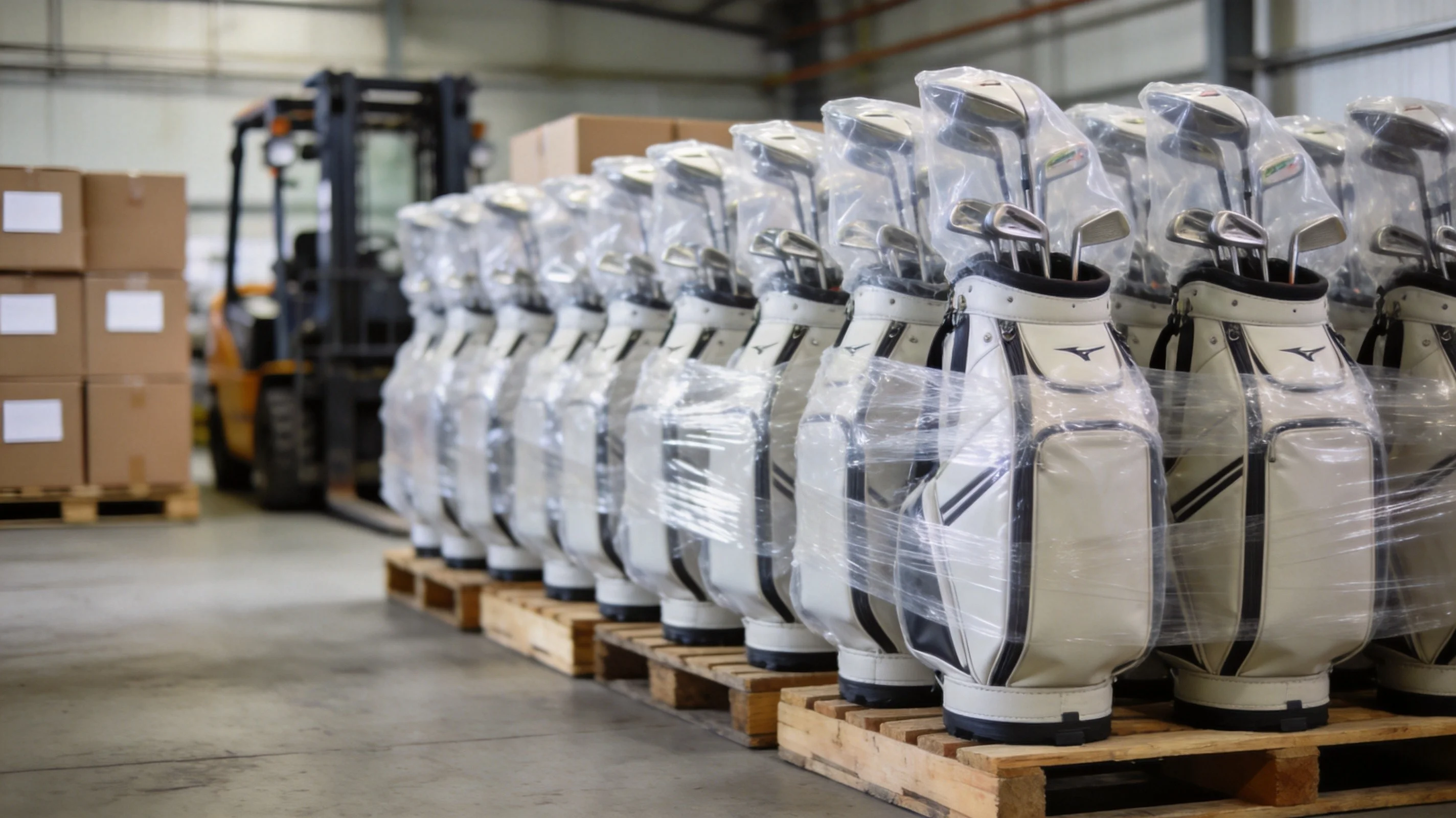
The first layer of protection is the poly bag — the individual plastic bag that each golf bag ships in. Its jobs are to keep dust and moisture off the product, to hold small loose components in place, and to present a clean unit to the retailer. For bulk export, the poly bag also matters for protecting against the humidity of a long ocean voyage, especially for bags with metal hardware and zippers that can tarnish in transit. A well-chosen poly bag is sized to the bag with minimal air, so it does not add to the carton’s dimensional footprint.
Some programmes add a layer of protection at stress points — corner pads on a rigid base, a wrap on a zipper pull or a bubble layer on a top opening. Exactly how much protection you need depends on the transit mode, the bag type and the destination. A domestic short-haul programme needs far less than a transpacific container that will stack, sway and handle at several ports.
Master Cartons: Construction, Size and Strength
The master carton is the workhorse of bulk shipping, and its three decisions — material grade, dimensions and packing count — together decide the carton’s strength and its freight cost. Corrugated board is graded by weight and flute type; for a bag with a rigid leg set or a heavy zipper, you want a board that does not crush under stacking. The common bulk box is a regular slotted carton (RSC), strong, cheap and stack-friendly, but some programmes use a box with a test or double-wall construction for the rudest sea legs.
The dimensions and the pieces-per-master together set the chargeable volume. Moving from a 2-piece to a 4-piece master carton that packs the bags flat and tight can lower the per-unit CBM meaningfully and, with it, the per-unit freight. This is where the factory’s packing engineering talks directly to the freight quote: a packing change agreed at the sampling stage is a saving realised on every later container, with zero cost to the product. Always test-pack the master carton with the actual production bag — not a drawing — before locking the spec.
Packing the Carton: Orientation and Weight Limits
How bags are oriented inside the carton matters as much as the carton itself. For stand bags, the leg set and body usually dictate the tightest packing orientation; for staff and cart bags, the top opening and dividers are the volume driver. The factory’s packing line should use the orientation that minimises height and air, while keeping the product free of creasing and crushing. A bag that is folded or loaded so it takes a permanent crease across a panel can be rejected by a picky retailer even though it travelled safely.
Also respect weight limits. A master carton that is overweight relative to labour-safety expectations or to the board’s crush rating is a throughput problem at the warehouse and a claim risk on the road or in the hold. Keep each master within a sensible weight band — typically well under statutory and labour limits for manual handling — and balance cartons so the container loads evenly and unloads without surprise.
Packaging engineering is one of those disciplines where a little planning at the front repays across every later stage. Because a golf bag’s shape is dominated by its frame — a rigid base and full-length dividers on a cart bag, a leg mechanism and a padded body on a stand bag — the biggest packaging wins come from understanding exactly which parts of the product set its minimum dimensions. If the top opening can be shipped with the dividers folded or the bag laid in a specific orientation, the master-carton height falls and the chargeable volume falls with it. A factory that prints and tests the packing plan at sampling time, rather than improvising on the loading dock, is a factory whose buyer pays less freight on every shipment.
It is also worth sizing the carton to the container, not just to the bag. A carton that packs the bag efficiently but leaves an awkward gap in a forty-foot container wastes real volume across the whole load. The skilful move is to check the master-carton dimensions against the container width and height before locking the box, so the cartons cube out the container with minimal void. This is the quiet geometry of container planning, and it is one of the most overlooked savings in the whole bulk golf bag shipping picture.
Carton Marking and the Master Carton Label
Every master carton should carry clear, durable marks: the importer or brand name, the carton number of total, the product/colourway description or code, the piece count, the gross and net weight, and the shipping marks that match the packing list and the bill of lading. Carton marks exist to let the receiving warehouse reconcile the physical shipment against the documents in minutes. A mark that is illegible, missing or inconsistent with the packing list is the fastest way to stall a customs clearance or confuse a receiving audit.
In addition to shipping marks, include handling and caution marks where relevant — keep dry, this side up, fragile — so every pair of hands in the chain can protect the load without knowing anything else about it. The best carton label tells a stranger exactly how to handle the box and exactly what is inside.
Freight Mode: Sea, Air and Rail for Golf Bags
The freight decision is the biggest single packaging-adjacent cost in a bulk programme. Sea freight via a full container load (FCL) is the value champion for runs of hundreds or thousands of pieces: the volume economics work out, the per-unit rate is low, and the schedule is predictable within a weekly sailing pattern. For smaller first orders or reorders, less-than-container (LCL) sharing can work but comes with consolidation and handling risk. Air freight rescues samples, emergency reorders and season-critical stock at a premium. Rail corridors from China to Europe sit in between on speed and price.
Because golf bags are volume-heavy, compare quotes on chargeable volume, not per-kilo, and make sure every party quotes the same pack. A forwarder’s “per-CBM” number is meaningless unless the packing is fixed, so lock the master-carton dimensions before you ask for a serious rate.
Container Loading and Stowage
A well-stowed container is a protection system. Cartons should be loaded to fill the container footprint without leaving voids that let boxes move and crush each other on the voyage, and without overloading the floor or walls. For containers to a humid port, the loading plan should also consider airflow and the risk of condensation — desiccants inside a container can be a cheap, effective way to protect textiles and hardware from moisture on a long sea crossing.
Fragile cartons go on top; heavy cartons go low and toward the centre. The loading record — how many cartons, which product/colourway, in which position — should be captured at the moment of loading so that a partial discharge or an inspection can be handled without unpacking everything. A disciplined loading plan is the quiet partner of a disciplined packing line.
Incoterms: Who Owns the Shipping Work
The incoterm on your purchase agreement decides who arranges and pays for each leg, and therefore who owns the freight risk. FOB hands the goods over at the named port and leaves the buyer to arrange and pay ocean freight. CFR and CIF put freight on the seller, with CIF adding insurance. DDP makes the seller responsible through to delivery — including customs and duty — which gives the buyer maximum price certainty but concentrates risk on the seller. For most wholesale buyers, FOB with your own forwarder gives the clearest view of the freight line and the most control; DDP trades that control for certainty.
Whichever term you choose, make sure the packing list and the transport document agree on the incoterm, because a mismatch between the commercial invoice and the packing list on a bulk sea shipment is the most common, most avoidable cause of customs holds and storage charges.
Marine Insurance for the Voyage
Even with resilient packaging, a deep-sea voyage is an insured risk, not a certainty. Rough seas, container mishandling at a port, and the classic textile threats of humidity and fresh water are all real exposures for a hold of soft goods. Marine cargo insurance to at least the cargo value, plus a small margin, is inexpensive relative to the loss it covers, and it is the first line budget buyers tend to cut and the last they should. A claim on a full container of private-label stock is far greater than several years of premium.
When you arrange insurance, verify that humidity and fresh-water damage — the recurring textile risk — is within the coverage, and confirm the deductible and the claim procedure with the carrier or forwarder before the goods sail, not when a claim is already underway.
Customs, Duties and the Shipment Documents
Clearing a bulk golf bag shipment rests on documents that agree. The core set is the commercial invoice, the packing list, the bill of lading and any certificate of origin. Into the US, golf bags classify under HTSUS heading 4202; into the EU, under CN code 4202; both carry rates you can verify on the official USITC HTSUS portal and EU Access2Markets. Capture the classification, origin and value at the moment the goods are packed — put the code on the packing line — so the buyer’s broker files a declaration consistent with the cartons.
Digitizing the packing data — carton marks, piece counts, weights and the duty code on every master — lets the receiving warehouse reconcile the container with the packing list instantly and lets customs clear it faster. The single most expensive error in bulk shipping is a discrepancy between the invoice and the packing list discovered at the destination port.
Inspecting the Packed Goods Before They Sail
A pre-shipment inspection (PSI) on the packed goods is the highest-value quality control in a bulk programme. A statistical AQL draw checks not just the bags but the packing itself — the poly bag, the carton, the marks, the piece count per master — because a wrong carton mark or a mis-packed colourway is a defect that travels in every unit even when the sewing is perfect. Our affiliated network runs its own 100% department checks and passed an SGS on-site audit in March 2026, which is the kind of third-party evidence wholesale buyers increasingly require.
Set the inspection standard — critical, major and minor defects and the acceptance number — in the contract so every party measures the same thing. And always inspect the packed goods, never only loose bags, because the packing is part of the deliverable.
Receiving Inspection and Unpacking on Arrival
The shipping operation ends only when the goods are verified in your warehouse. On arrival, check the carton count against the bill of lading, verify the marks, and spot-check for transit damage and humidity before the stock reaches the racks. Reconcile the physical cartons against the digital packing list so your inventory system starts accurate, and log any discrepancies immediately — a claim against the forwarder or insurer is only as good as the arrival record that supports it.
Finally, use the arrival event as your reorder trigger. Because production takes 45–60 days and the transit window sits on top, the reorder that sustains a season is placed the day the first delivery enters the warehouse, not the day the shelf looks thin.
Bulk Packaging and Shipping Quick Reference
| Element | Role | Pro Packing Practice |
|---|---|---|
| Poly bag | Dust, moisture and scratch protection | Size to bag, minimal air, humidity-safe |
| Master carton | Stack strength and freight unit | Right board grade, tight CBM, test-packed |
| Packing count | Sets pieces per master | 2–4 pcs/master; balance weight |
| Carton marks | Reconciliation with documents | Match packing list exactly |
| Container stowage | Protection in transit | Fill voids, desiccant for humidity |
| Inspection | Verify packed goods | AQL PSI before sailing |
Packaging Specs That Prevent In-Transit Damage
Bulk golf bag orders fail in transit most often because of under-specified cartons, not rough handling. Set the carton specification before you place the order: a five-layer corrugated master carton, an inner poly bag per unit, corner protection on the base where the bag's stand legs and club dividers concentrate weight, and a clear pallet pattern with stretch wrap so cartons cannot shift. State a compression strength requirement (such as a stacking weight limit) in the packing clause, and agree call-per-unit and pallet-per-container counts with your forwarder. Moisture is the silent killer on ocean routes, so add a desiccant bag per carton or a moisture barrier liner when your lane crosses high-humidity regions during container crossing. These few lines in the spec sheet protect far more value than the freight cost itself.
Frequently Asked Questions
- How many bags fit in a master carton?
- Typically 2–4 bags per master for stand and cart bags, depending on bag size and whether they collapse flat; the exact count should be test-packed with the production bag before the carton is locked.
- Is sea freight or air better for bulk golf bags?
- Sea FCL is the value champion for runs of hundreds or thousands; air rescues samples and reorders; rail splits the difference to Europe. Compare on chargeable volume, since golf bags are bulky.
- Why is dimensional weight so important for golf bags?
- Bags occupy far more space than their weight suggests, so carriers bill on the space used. Packing that lowers CBM can cut per-unit freight meaningfully.
- How long does bulk production take before shipping?
- Full production runs 45–60 days from material confirmation, with samples in 10–20 days; then add the freight and customs transit window.
- Should I buy FOB or DDP for bulk orders?
- FOB with your own forwarder gives control and cost visibility; DDP gives price certainty to the door. Price both for your lane and choose based on who should own the shipping risk.
- What is the biggest shipping mistake to avoid?
- A packing spec locked too late, and an invoice/packing-list mismatch at the destination port — both quietly convert a good deal into storage charges and a lost season.
A final discipline worth building into a repeat programme is a continuous-improvement loop on packaging cost. After each season, review the realised freight rate per unit, the rate of damaged or returned cartons and the warehouse handling complaints, and feed the findings back into the packing spec for the next run. Most packaging is never revisited once a seller “has a box that works”, yet a single packing change — a different orientation, a tighter master count, a lighter but still adequate board — can reappear as a saving year after year. The best importers treat packaging as a living spec to be tuned, not a finished box to be reused. That habit, more than any single freight discount, is what keeps bulk shipping margins honest over the long run.
From the first master-carton drawing to the last container inspection, the buyers who keep bulk golf bag shipments profitable are the ones who treat packaging as a cost centre to be engineered and the voyage as a process to be rehearsed — because freight is etched in volume, and volume is decided before a single bag reaches a dock.
Lock your packing early, book the lane on chargeable volume, keep the documents consistent and inspect the packed goods before they sail.
Planned well, packaging is the cheapest freight discount and the most reliable protection a wholesale buyer can buy; planned late, it is the quietest margin leak in the programme.
Do the packing geometry once and the savings repeat on every container for the life of the product line.
Respect the volume, protect the carton and let the lane repeat — and wholesale golf bag shipping becomes a predictable profit centre.
Sources
Tariff, classification and trade references in this guide can be verified against these official sources:
- US Harmonized Tariff Schedule — USITC — heading 4202 rates for golf bags.
- US Customs and Border Protection — cargo, entry and import requirements.
- European Commission Taxation & Customs Union — EU customs and combined nomenclature.
- EU Access2Markets — CN duties, origin and import formalities.
- US International Trade Administration — logistics and market intelligence for importers.
Plan your next bulk shipment with our wholesale team, compare wholesale pricing, or start factory-direct. For custom private-label work, see OEM/ODM services and custom solutions. Contact service@junyuanbags.com or +86 17750020688.