How to Choose a Golf Bag Supplier: 20 Questions to Ask
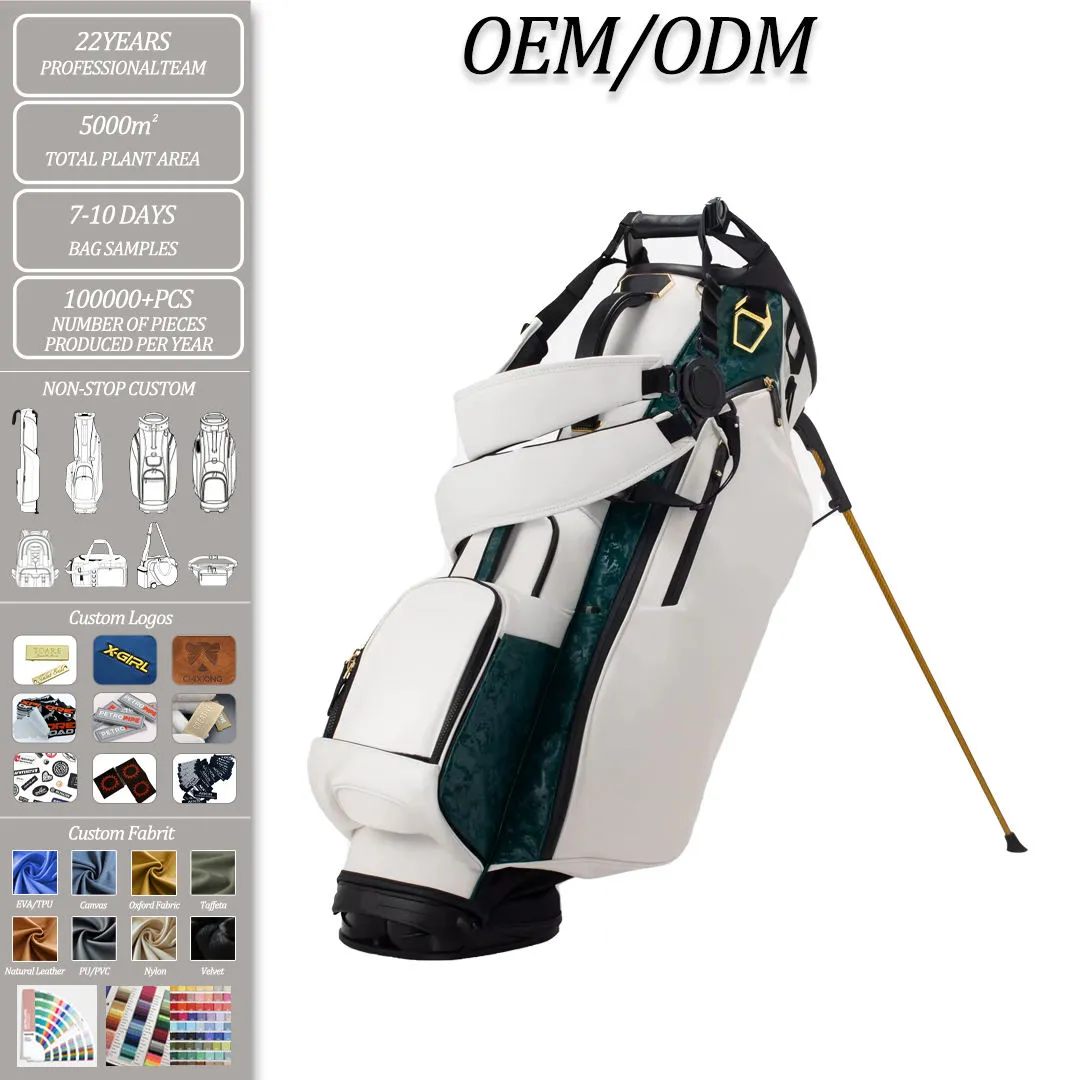
Twenty questions separate a supplier you can build a five-year programme with from one that looks competent until the first container lands. The questions below are the ones that produce an answer you cannot fake: a unit count with a time period attached, a named component that is bought in rather than made, a tool that has an owner written down, a sampling plan with an acceptance number, and a lead time that a material order can actually support. They are grouped so that a single call of about ninety minutes covers all twenty, and each section ends with what a strong answer sounds like. The numbers to test every answer against are 200 pieces per colourway, 100-piece trials, samples inside 6-10 working days, bulk at 35-50 days, AQL 2.5 per ISO 2859-1, thirty per cent deposit with seventy on documents, FOB Xiamen.
Related reading: Golf Bag Factory Audit Checklist for Importers
Related reading: How to Evaluate Golf Bag Samples for Quality
Capability and Capacity: Five Opening Questions
Capacity questions work only when they force a number with a unit and a period. A supplier who answers in adjectives has told you something useful, just not about capacity. Ask these five before anything else, because a supplier who fails question one will not survive question fourteen.
- How many bags do you complete in a month, on how many lines, and what share of that is already committed? One line running 300 bags a day is a very different supplier from six lines running 2,000 a day with three customers taking 80 per cent of the output.
- Which components do you make in-house and which do you buy in? Cutting, sewing, assembly and final inspection are normally in-house; zippers, webbing, moulded top collars, base plates and often embroidery are bought in or subcontracted.
- Who owns the tooling, where is it stored, and what is its expected life? A tool that lives at a subcontractor and is owned by nobody is a tool that disappears when the relationship ends.
- What proportion of your output is golf bags rather than other bag types? A workshop that runs golf bags four days a week has pattern knowledge that a general bag line does not.
- Can we see the line that would run our bag, and can we audit without a fixed date? Announced audits show a prepared floor. Unannounced access is the answer that matters.
Listening for the tell
The pattern to listen for is specificity about what is not done in-house. A supplier who claims to make zippers, webbing, moulded collars and embroidery under one roof is either very large or is describing a supply chain as if it were a building. The second answer is fine; the pretence is not, because it means you will never get a straight answer about a material substitution later.
A second pattern is the share of capacity already committed. A line that is 95 per cent booked by two accounts cannot absorb a 200-piece trial in three weeks, whatever the sales deck says, and the delay will land on the sampling stage where it is hardest to recover.
Development: Four Questions About Sampling and Tooling
Development is where a relationship is either calibrated or mispriced. The answers here determine whether your first article arrives in ten days or in five weeks, and whether the second sample is a revision or a restart.
- What exactly does a first article include, and who measures it? A dimensional report signed by the person who measured it is worth more than a photograph of a bag on a table.
- Is there a sampling fee, and is it credited against the bulk order? A fee of USD 150-400 per sample set is normal on a new development; crediting it against a 200-piece order is a reasonable ask.
- What tooling does this bag need, what does each tool cost, and how long does first article take? A 14-way divider grid runs USD 3,500-9,000; a badge mould USD 250-600; a logo screen USD 45-90.
- What happens when we change the specification after sample approval? The answer should distinguish a colour change from a pattern change, because one is a re-cut and the other is a re-sample.
Sampling at 6-10 working days is achievable on a pattern that already exists, using materials the workshop holds in stock. Where a new mould has to be cut, allow 12-15 working days, because the first shot is measured before anything is shown to a buyer. A supplier quoting three working days for a new pattern is either not sampling properly or is planning to show you a stock bag with your logo on it, which is a distinction worth testing by asking what will be different between the sample and the bulk.
The tooling question deserves a follow-up that most buyers skip: what is the tool life, and who pays for a replacement at end of life? A 14-way divider mould might run 50,000 shots before refurbishment. On a programme that will never approach that volume, the answer is academic, but the willingness to answer tells you whether the tool has a maintenance record at all.
One further development question is worth asking even though it is not on the list of twenty: how many revisions does a typical new pattern take before bulk approval? Three is normal, five is common on a bag with a new divider geometry, and a supplier who says one is describing a stock pattern with a new shell colour. Budget for two rounds of sample courier either way, because the second round is where a placement or a weight problem gets fixed.
Materials: Three Questions About What Goes Inside
Fabric is the largest single line in a golf bag bill of materials, which makes it the line most exposed to substitution. Three questions close that exposure almost completely.
- Which mills do you buy from, and can you show the mill certificate for the lot used on our order? A certificate with a lot number is verifiable; a swatch in a folder is not.
- What is the coated weight in grams per square metre, and what is the coating? A nominal 600D can run from 240 to 340 gsm depending on the PU or PVC backer, and that spread is where a cheap quote hides.
- What is your policy on substitution, and who signs off on it? The only acceptable answer is that no substitution happens without written approval, and that the approval names the replacement reference.
Coated weight is the specification that buyers most often accept on trust. Two shells both described as 600D polyester can differ by 80 gsm, which shows up as a bag that feels thin at the base and creases at the pocket, and which no photograph will reveal. Ask for the weight of the finished coated fabric, not the yarn count, and check it against a sample on a kitchen scale if the number is disputed.
Why the backer decides the bag
The PU or PVC backer does more work than the face yarn. It carries the water resistance, it holds the shape of the shell when the bag is loaded, and it is the layer that fails first when a bag is stored damp. A 600D face with a 60 g backer and the same face with a 120 g backer are different products at the same nominal denier, and the second is what a fleet or a daily-use bag needs.
Where a bag carries a recycled or solution-dyed claim, add a fourth question in the same breath: what document supports the claim, and does the certificate name the specific lot? A claim without a chain-of-custody document is a marketing line rather than a specification, and it will not survive a retailer asking for evidence.
Quality: Four Questions About Inspection and Testing
Quality answers are easy to give and easy to verify, which is why vague ones are informative. Ask for the scheme, the level, the sample size and the person who signs the report.
- Which acceptance scheme do you run, at which inspection level, and what is the acceptance number? Look for AQL 2.5 and ISO 2859-1 at level II general, followed by the sample size and acceptance number those tables produce.
- Which tests do you run in-house and which go to a third-party laboratory? Seam strength and tear strength are usually in-house; colour fastness, coating adhesion and restricted-substance testing usually are not.
- What happens to a lot that fails inspection? A defined answer covers rework, re-inspection and, where rework is not viable, a documented rejection with the disposition recorded.
- Can we nominate our own inspection agency, and will you give them floor access? A supplier who resists a nominated inspector is telling you the internal report is the only version you will see.
The arithmetic is worth knowing before the call, because it turns a vague promise into a checkable claim. At AQL 2.5 and level II general, a lot of 200 draws 32 pieces and allows 2 majors before the lot fails. A supplier who says the lot is checked at 10 per cent has described a different scheme, which may be adequate but is not the one you asked for.
Reading the sampling plan
| Lot size | Sample size | Accept | Reject |
|---|---|---|---|
| 91-150 | 20 | 1 | 2 |
| 151-280 | 32 | 2 | 3 |
| 281-500 | 50 | 3 | 4 |
| 501-1200 | 80 | 5 | 6 |
Ask also what the inspector physically does with a sampled bag. A report that records only visual defects misses the failures that matter on a golf bag: a divider that binds a midsize grip, a leg that does not lock at full extension, a strap attachment that creeps under a 15 kg load. A test protocol with numbers attached is the difference between an inspection and a photograph.
Field note on audit timing. Book the audit on a day when your product is actually running. A factory floor producing another customer bag tells you about housekeeping; it does not tell you how your top collar is set or whether your divider is seated before the lining goes in.
Commercial Terms: Three Questions About Money
Price is the easiest thing to compare and the least useful without the four lines that sit around it: Incoterm, payment split, what is included, and what is charged again on a repeat.
- What are the payment terms, and what specifically triggers the balance? T/T 30/70 is standard, with the balance released against shipping documents rather than against a verbal completion notice.
- What is included in the quoted price and what is extra? Ask about sampling, tooling, logo setup, testing, inspection, palletisation, inland haulage to the port and documentation.
- How is a repeat order priced, and is setup charged again? Screens, transfer dies and digitised name files should be kept, and that arrangement belongs in the order rather than in an assumption.
Terms are quoted FOB Xiamen, which means the supplier delivers to the vessel and the buyer carries freight, insurance and destination charges. A quote that does not name an Incoterm is not a quote, and one that quietly assumes CIF will look cheaper than it is until the freight line appears.
Two commercial questions are worth adding informally. The first is what happens to the price if the fabric lot changes mid-programme, because a mill discontinuing a reference is common and a supplier who absorbs the change silently will substitute rather than call you. The second is how a small top-up of 20-30 pieces is priced, since every programme needs one eventually and the answer usually carries a 15-25 per cent premium on the original price.
Delivery: One Question That Exposes the Schedule
One question, asked precisely, reveals whether a delivery date is a plan or a hope.
- What is the realistic production lead time in days from sample sign-off, and what are the three most common causes of delay on an order like ours? A strong answer names fabric lead time, colourway count and trim arrivals, and gives 35-50 days. A weak answer gives a number with no constraints attached.
The follow-up is where the real information sits: ask which of those three causes has delayed a shipment in the last twelve months, and what changed afterwards. A supplier who can describe a specific failure and a specific corrective action has a working production system. One who has never had a delay is either new, lucky, or answering a different question.
Add the freight reality to the same conversation. Bulk production at 35-50 days plus 25-40 days of ocean transit and clearance means a purchase order placed today lands in eleven to fourteen weeks, and any plan that assumes otherwise will compress the wrong stage. The production timeline breakdown shows where the days actually go.
Scoring the Answers
Twenty answers are hard to weigh in your head, so score them. The table below is the pattern that matters more than the individual responses: an answer that is specific and verifiable scores two, an answer that is plausible but unverifiable scores one, and an answer that avoids the question scores zero.
| Area | A strong answer sounds like | Red flag |
|---|---|---|
| Capacity | Units per month by line, plus the share already committed | A number with no unit, or a claim to make everything |
| Ownership | Names the parts made in-house and the parts bought in | Zippers, moulds and embroidery all claimed in-house |
| Tooling | States the owner, the storage location and the tool life | Ownership left unspoken |
| Testing | In-house checks listed separately from laboratory tests | No scheme or standard named |
| Price | FOB Xiamen with inclusions and extras itemised | A single number with no Incoterm |
| Schedule | Days from sign-off, with the constraints named | A lead time shorter than the material lead time |
- A score below 26 out of 40 usually means the supplier is a reseller that does not control the line, and the specification will drift.
- A score of 26-33 is workable for a first order if a nominated inspection agency is used and the golden sample is signed.
- A score above 34 with an unannounced audit is a supplier worth a multi-year agreement, because the answers were already verifiable before you asked.
Two documents close the loop after the call: a signed specification sheet that lists every component by reference, and a quality agreement that names the sampling scheme and the disposition of a failed lot. The tech pack guide covers how to write the first, and the quality standards guide covers the second. Both are short documents that prevent most of the disputes a five-year programme would otherwise produce.
The list is also the one QUANZHOU JUNYUAN BAGS answers for its own orders, a company in operation since 2014 with a team working in bags from 2004, and it is written to be answerable in writing rather than in a sales meeting.
Next steps: custom solutions, manufacturing capability, and a quotation request. Supplier selection guide. OEM and ODM services.
Sources and Standards Referenced
- ISO 2859-1:2022 Sampling procedures for inspection by attributes
- ASTM D5034 Breaking strength and elongation of textile fabrics (grab test)
- ASTM D2261 Tearing strength of fabrics (tongue method)
- ISO 9001 Quality management systems
- USGA equipment rules and conformance testing
Frequently Asked Questions
What is the first question to ask a golf bag supplier?
Monthly output in units, the number of lines, and how much of that capacity is already committed. A supplier who answers in adjectives rather than numbers has told you that capacity is not something they track, which matters more than the number itself.
How can I tell a real production line from a reseller?
Ask which components are made in-house and which are bought in. A genuine producer names the bought-in items without hesitation: zippers, webbing, moulded collars, often embroidery. A reseller claims everything is in-house, then cannot describe the cutting room when asked what happens after the pattern is graded.
Should I ask for a factory audit before the first order?
Yes, and book it on a day when your product is running. An audit of a floor making another customer bag tells you about housekeeping, not about how your divider is seated or your top collar is set. Unannounced access is the answer that separates a controlled line from a prepared one.
What MOQ should a supplier quote?
Two hundred pieces per colourway on a pattern that already exists, with 100-piece trials workable once shell, fabric and logo method are settled. A new shell or new tooling moves the threshold to 500. A quote of 50 pieces on a custom colourway is usually a stock bag with a printed patch.
How long should sampling take?
Six to ten working days on a pattern that already exists and materials held in stock. Where a new mould has to be cut, allow 12-15 working days, because the first shot is measured before it is shown. Bulk then takes 35-50 days from the approval date.
What does a supplier mean by 600D fabric?
Very little on its own. The denier describes the yarn, not the finished cloth. A nominal 600D shell runs from 240 to 340 gsm depending on the PU or PVC backer, and the difference shows up as a thin base and creased pockets. Ask for coated weight in gsm and a mill certificate with the lot number.
What AQL should a golf bag order use?
The answer should name AQL 2.5 and ISO 2859-1 at level II general, plus the sample size and acceptance number that follow from it. A supplier describing a 10 per cent check is running a different scheme, which may be fine but is not the one you specified.
Who should own the tooling?
The buyer, in writing, with the storage location and the tool life recorded. Tooling costs range from USD 45-90 for a logo screen to USD 3,500-9,000 for a 14-way divider mould, and a tool owned by nobody is a tool that disappears when the relationship ends or the subcontractor changes hands.
What payment terms are normal?
T/T 30/70: 30 per cent with the order, 70 per cent against shipping documents. Any quote should name an Incoterm, and FOB Xiamen is standard for this category. Terms without an Incoterm are not comparable between suppliers, because freight and insurance may be inside the price or outside it.
What is a realistic lead time for a custom golf bag?
Thirty-five to fifty days of bulk production from sample sign-off, plus 6-10 working days of sampling and 25-40 days of ocean transit and clearance. A purchase order placed today typically lands in eleven to fourteen weeks, and any plan that assumes less compresses the wrong stage.
Which documents should I request before paying a deposit?
A dimensioned specification sheet listing every component by reference, a quotation naming the Incoterm and the inclusions, a mill certificate for the shell fabric, a sampling plan with its acceptance number, and a signed golden sample retained by both sides.
How do I handle a supplier who answers vaguely?
Re-ask the same question once with a unit attached, then move on and score it zero. Vague answers on tooling ownership, fabric weight and inspection scheme are the three that cost the most later, and a supplier who cannot answer them before the order will not answer them after it.
Compare Us Against the Twenty
Send the list and the specification you are buying, and the answers come back in writing with the documents that support them.
Request Written Answers Review Our Capability