Lead Time and Timeline for Custom Golf Bag Production
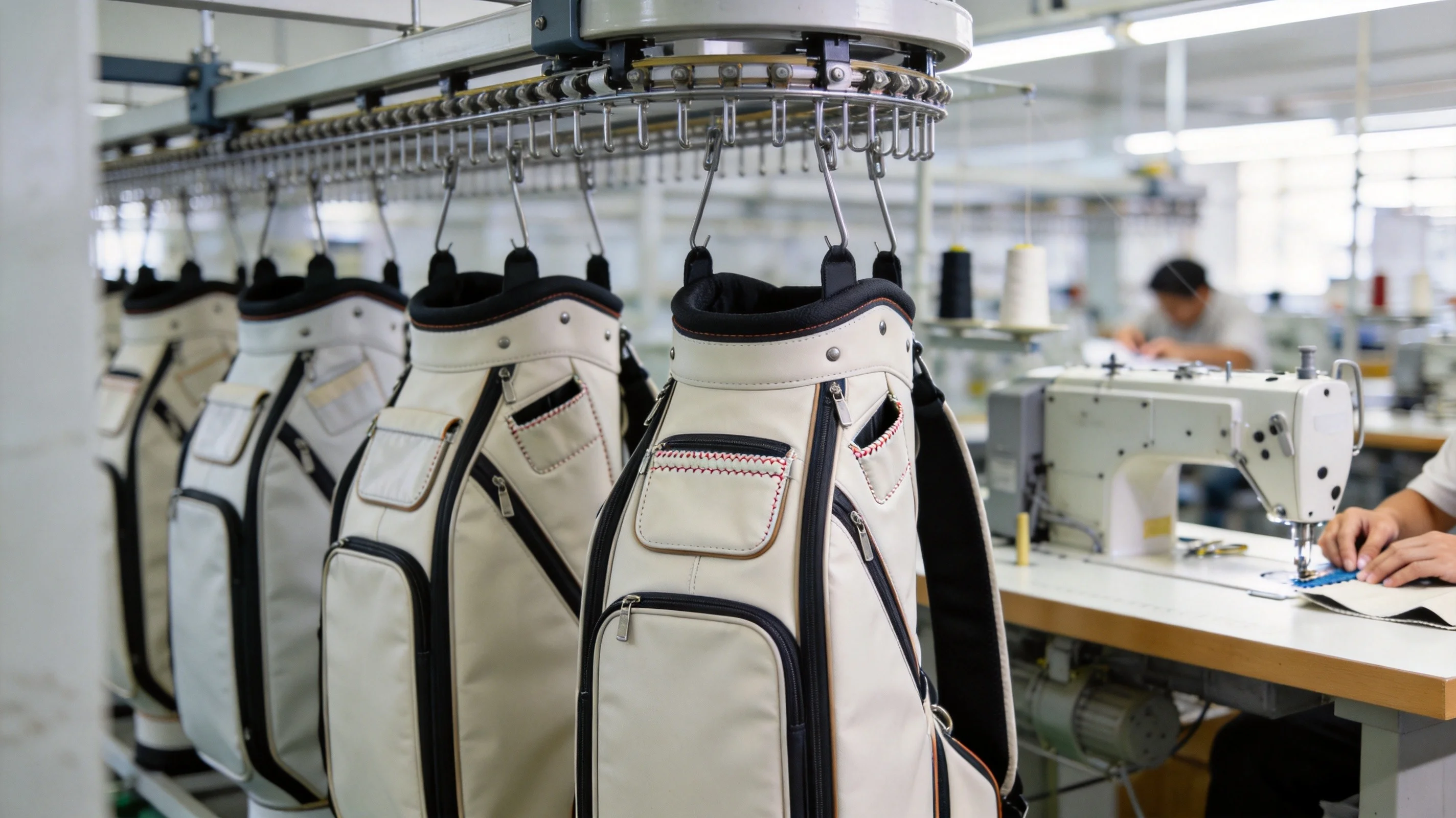
A realistic custom golf bag order runs 10-20 days for sampling, then 45-60 days of bulk production after sample approval, before freight — a total programme of roughly 70-90 days, so planning one full quarter ahead with a 15% buffer protects seasonal launches from slippage. This guide breaks down the timeline stage by stage and shows how to control it.
Why Golf Bag Lead Time Matters
Golf is deeply seasonal. Demand for bags peaks around spring launches, tournament seasons and holiday gifting, and missing that window is expensive — product arrives for a market that has already moved. Understanding the true lead time lets you schedule production so your inventory lands when your customers are buying, not after. For any brand, the production timeline is the foundation of the entire launch plan.
Lead time also shapes cash flow and inventory choices. A clear, realistic timeline lets you order with confidence, avoid emergency freight premiums, and negotiate delivery commitments with evidence rather than hope. Knowing exactly how long sampling, bulk production and freight take turns the timeline from a source of anxiety into a planning tool.
Phase 1: Design and Specification (At Kickoff)
The clock starts the moment you lock your design and specification. A complete brief — dimensions, construction, materials, hardware, decoration — lets the factory quote accurately and schedule promptly. Incomplete briefs waste the first weeks in clarification loops, effectively extending the timeline before sampling even begins.
Investing in a complete specification at kickoff is the cheapest time-saving decision in the whole project. Our OEM/ODM process guide provides a checklist that closes specification gaps before they cost you a sampling round, protecting the schedule you plan around.
Phase 2: Sampling (10-20 Days)
Sampling is the first fixed block of time: 10-20 days to deliver a physical prototype. The factory patterns the design, cuts the sample, sews and finishes it, and ships it for your review. Complex or new constructions — like an intricate staff bag or a first-time waterproof build — sit at the longer end of the range.
Your approval speed directly controls this phase. Responding decisively, comparing the sample to spec point by point and confirming in a single revision keeps sampling tight. A decisive approval avoids a second 10-day round, so a disciplined sample review is one of the most controllable parts of the entire timeline. Our sampling guidance tells you exactly what to check.
Phase 3: Bulk Production (45-60 Days)
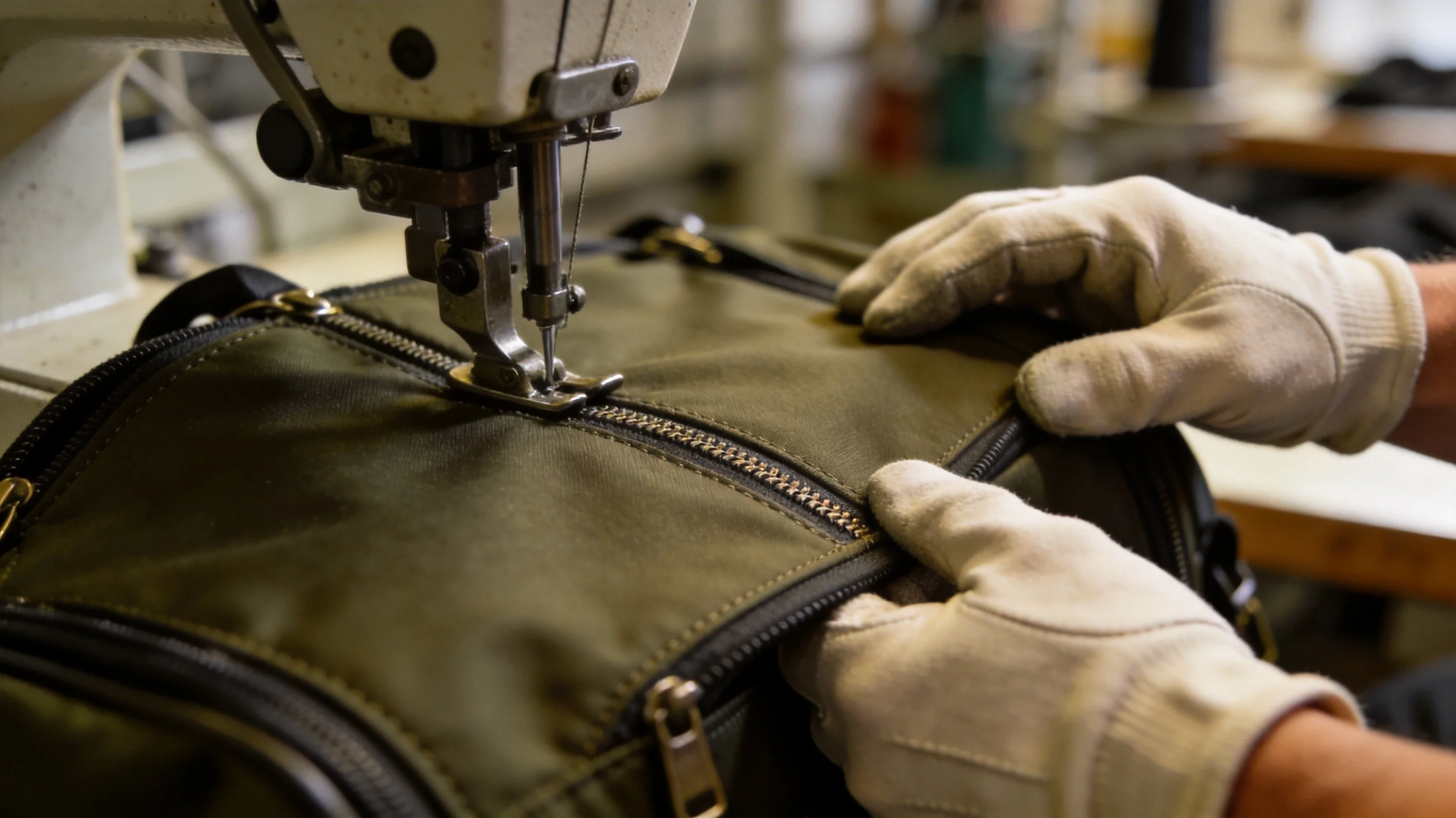
After sample approval, bulk production runs 45-60 days. This block covers material procurement and inspection, cutting, sewing and assembly of the full quantity, finishing and decoration, then AQL quality control and packing. Volume, complexity and current factory load move you within this range.
Bulk production is the largest and least flexible block, so it sets the real pace of your order. A 200,000-unit-per-month facility (ours runs 7 lines with 126 sewing machines and 137 employees) completes volume efficiently, but the physical process of sewing and finishing is inherently time-bound. Treating the 45-60 day block as fixed in planning is the safe assumption.
Phase 4: Freight and Delivery (Variable)
After production comes freight, which is variable by destination, mode and season. Sea freight to North America or Europe adds roughly 2-5 weeks depending on the route and port; air freight is faster but significantly more expensive. Seasonal capacity crunches in the industry can push freight times up, so this phase deserves its own planning attention.
Because freight is the most variable phase, it is where emergency costs hide. Booking sea freight with realistic transit assumptions, and understanding when the seasonal escalation begins, protects both your launch date and your margin. Including freight explicitly in the timeline — rather than folding it vaguely into "production" — gives you an honest total picture.
The Full Custom Golf Bag Timeline
Combining the phases gives a complete planning view. The 70-90 day production figure (sampling plus bulk) is the core commitment, before freight.
| Phase | Duration | Key Dependency |
|---|---|---|
| Design & spec | 1-2 weeks | Complete buyer brief |
| Sampling | 10-20 days | Decisive sample approval |
| Bulk production | 45-60 days | Approved sample, factory load |
| Freight | Variable | Destination, mode, season |
| Total (production) | 70-90 days | Plus freight buffer |
How to Plan a Seasonal Launch
The safest rule for a seasonal launch is to work backwards from your drop date and add a buffer. Take the 70-90 day production core, add your freight estimate, then add a 15% contingency for revision rounds, material hiccups and freight delays. In practice this points to kicking off roughly one full quarter ahead of the season.
Beyond the arithmetic, protect the launch by locking specifications early and approving the sample decisively. The two buffers you, the buyer, fully control — specification completeness and sample-approval decisiveness — are the strongest safeguards against the slippage that pushes products past their season. Being ready to act at each gate is often the difference between on-time and late.
Shrinking Lead Time: What Actually Works
If you need to compress the timeline, some levers work reliably and others do not. Starting from a proven ODM base design is the single biggest time-saver, because it removes most sampling iteration and manufacturability risk. Standardising materials, consolidating designs into fewer colourways and locking the spec early each cut days from the schedule.
Buyer decisiveness is the other real lever: approve samples in one round, answer questions promptly and provide complete artwork. These habits remove the waiting time that quietly extends every phase. A factory with solid capacity helps too — our facility can schedule volume without the queue delays that stretch smaller workshops. Air freight, while effective, is the expensive last resort and is rarely the right first choice.
Need a Timeline You Can Plan Around?
10-20 day sampling and 45-60 day bulk production from a 200,000-unit-month facility, ISO 9001 & BSCI certified. Let's map your launch calendar together.
Plan Your Production Timeline →MOQ and How It Affects Scheduling
The timeline assumes a 200-piece standard MOQ per design, with 100-piece test orders available. Smaller test quantities can sometimes move faster, but they still pass through the same sampling and production phases. Consolidating designs and colourways keeps the MOQ framework efficient and, by filling production runs, can help your order move through the schedule.
Scheduling a test order first — validating a new market with 100 pieces — also feeds knowledge back into the full production plan, smoothing the larger follow-up. For detailed volume and cost modelling that pairs with your timeline, our wholesale pricing guide is the companion tool.
Conclusion
A realistic custom golf bag timeline is sampling in 10-20 days, bulk production in 45-60 days, a core programme of 70-90 days, plus variable freight — so plan one full quarter ahead with a 15% buffer for seasonal launches. Control the parts you can: a complete specification, decisive sample approval and a proven base design. With an ISO 9001, BSCI certified, independently audited factory behind you, the timeline becomes a dependable commitment rather than a hopeful estimate.
Factors That Extend or Compress the Timeline
Several factors push a golf bag timeline toward one end of its range or the other, and knowing them lets you predict and control delivery. Design complexity extends sampling — a wholly new construction or an intricate layout needs more patterns and more sample iterations. Material availability matters too; standard, stocked materials cut days from the schedule, while bespoke or unusual materials add procurement time.
Factory capacity is another factor. A factory running near a 200,000-unit monthly ceiling has less scheduling slack than one with open capacity, so load at the time you order influences how quickly your order fits in. Order size matters as well: a 100-piece test or a 200-piece first run can slot in faster than a large seasonal order competing for line time.
Buyer responsiveness is the final, controllable factor. Every delay in your responses — answering questions, approving the sample, confirming artwork — moves the timeline. The decision speed of a buyer is often the difference between landing in the comfortable middle of the ranges and drifting to the far end. Recognising these levers lets you hold the ones in your control while budgeting realistically for the rest.
Planning for Freight, Customs and Retail
A complete delivery plan extends beyond the factory timeline to freight, customs and the retail schedule, and each adds its own block of time and risk. Sea freight varies with route and season, customs handling adds documentation and clearance time, and retail demands that product arrive when merchandising expects it — not just physically, but with the packaging and labelling ready for the shelf.
Because freight is volatile, smart planning keeps it explicit and generous. Booking well in advance, understanding your destination's seasonal peaks and allowing for customs variability prevent the emergency-air-freight spend that erodes margin. Retail-lining your packaging and labelling early ensures the product can actually go to market on arrival rather than sitting in a warehouse awaiting finishing touches.
Our factory supports this by packaging and labelling to your specifications and coordinating incoterms clearly, so the handoff from our timeline to your freight plan is smooth. Working backwards from your retail date through freight, customs and production — as our wholesale pricing guide model supports — is how a realistic schedule and a reliable launch are actually built. The factory timeline is the core, but a full plan completes it to the store shelf.
Managing Risk and Building Buffer Into the Schedule
Every golf bag production schedule carries risk, and the professional response is to build buffer in rather than assume perfection. The 15% contingency recommended for a 70-90 day programme is not pessimism; it is the honest acknowledgement that sample revisions, material shortages, machine breakdowns and freight delays are part of the landscape. Buffer turns those disruptions from launch-killers into absorbed bumps.
Buffer is most valuable where risk concentrates: the sampling revision loop and the freight phase are where slippage historically clusters, so they deserve the largest allowances. Spending the buffer wisely means using it to absorb real variance, not padding a sloppy schedule into seeming safety. A disciplined plan treats the buffer as insurance and protects it until genuinely needed.
At our facility, we publish realistic timings precisely so you can plan with a credible buffer around them. Combining our honest 10-20 day sampling and 45-60 day bulk with a buffer you control gives a schedule that survives contact with reality. Managing risk and building buffer is how a seasonal launch stays seasonal — and it is the professional difference between a plan that looks good and a plan that works.
The Realistic Project Plan for a First Order
For a first custom golf bag order, a realistic project plan makes the timeline concrete and protects a newcomer from unrealistic expectations. It begins with a complete specification, budgets roughly 10-20 days for sampling, a decisive sample-approval decision, then reserves the 45-60 day bulk production window. Adding the freight estimate and a 15% buffer produces a dependable total schedule.
A first order is the moment most of the timeline risk appears, precisely because every step is new to the buyer. Allowing generous time for the sampling revision loop, responding promptly to each factory request, and confirming details in writing at each gate smooths the process considerably. The discipline of a documented plan — rather than trusting a vague promise — is what keeps a first programme on course.
The 100-piece test order is designed for exactly this situation. It lets a new buyer validate the factory, the sample and the market with minimal exposure, shortening the meaningful first-commitment timeline and building confidence before scaling. With honest factory timings and a structured first-order plan, a new partner can move from brief to delivered product with clarity and control.
Coordinating Seasonal and Multiple-SKU Launches
Seasonal launches and multi-SKU programmes complicate the timeline and reward deliberate coordination. A seasonal launch works back from the drop date through freight and production, then fits sampling into the remaining window with buffer for revisions. A multi-SKU programme adds the complexity of consolidating several designs or colourways into MOQ-qualifying groups so each fits cleanly into the schedule.
Coordinating multiple SKUs also requires sequencing. Staggering sampling so each design clears its approval before its production slot, and batching productions to use line capacity efficiently, keeps the whole programme moving rather than queuing every SKU behind the first. This coordination is where a factory's scheduling capability shows, protecting the overall launch date even with several products in play.
Focusing the timeline around the SKU portfolio, rather than treating each as a separate mini-project, is how a coherent programme stays on schedule. Our wholesale pricing guide supports this by modelling how volume and design count interact, helping you structure a multi-SKU order that fits production. Coordinating your launch around a realistic total timeline is the difference between hitting the season and chasing it.
How to Start and What to Press for Early
To get a golf bag timeline moving with minimal friction, start with a complete specification and open a discussion with the factory before you are ready to commit in full. The earlier a factory can assess your design, materials and decoration, the earlier it can quote accurately and reserve capacity. Early, complete communication is the single best accelerant available to you.
There are a few things worth pressing for clearly and early: a written, itemised quotation; the factory's realistic sampling and production windows based on your exact design; and an honest statement of which factors could extend the timeline for your specific order. Confirming these upfront prevents surprises when you need speed most, and gives you the information to plan the freight and retail stages behind.
Our team responds to early enquiries with a concrete picture of timings for your specific staff bag or production design, because transparency about the schedule is part of the service. Whether you begin with a 100-piece test or move to a full run, pressing for early, concrete timing information turns the abstract ranges in this guide into a dependable plan. Starting rightly and probing early is how a custom programme ships on time.
Getting Started With a Qualified Partner
The most practical way to turn this groundwork into a reliable product is to engage a factory with verifiable credentials, proven output and transparent process. A qualified facility founded in 2014, staffed by a team whose founder entered the industry in 2004, brings more than twenty years of hands-on knowledge to every programme. That experience shows in faster sampling, fewer defects and sound advice at each decision point.
At our facility in China, seven production lines and 126 sewing machines support a 137-person team producing about 200,000 golf bags a month for 200+ brands sold to 100+ countries. Backed by SGS factory audits and BSCI-aligned practices, we combine real capacity with documented quality control, so you can validate us before committing. Whether you begin with a 100-piece test order or move straight to a full production run, the milestones you have read here are the milestones we apply to your order.
To start, bring a detailed specification and an honest sense of your volume and deadline, and we will map the stages, timings and costs for your exact programme. With direct contact to our export team, service@junyuanbags.com or +86 17750020688, you can begin a conversation that moves quickly into a structured plan. The process and standards described above are not theory; they are the operating reality you are welcome to verify before your first container ships.
The Impact of AQL Testing on Timeline Quality
The quality gates in a golf bag timeline do not lengthen the schedule arbitrarily; they are deliberately scheduled so they protect it. AQL pre-shipment inspection, for example, is completed before the container is booked and loaded, so a rejected lot is caught at a point where rework can still meet the freight window rather than after the cargo is already aboard. Correctly timed testing turns quality assurance from a schedule risk into schedule protection.
This is why a professional factory integrates its quality gates into the timeline rather than bolting them on at the end. Incoming-material testing happens before cutting begins; in-process checks run within the sewing schedule; finished-goods inspection precedes loading; and the final AQL report is issued while there is still corrective room. Each gate is placed where a failure can be absorbed without cascading delay.
At our facility, the 45-60 day bulk window is built to include these gates comfortably, and the testing standards under our documented ISO 9001-style system are applied within that window rather than outside it. By planning quality into the schedule, we deliver both speed and assurance. For a buyer, understanding how testing sits inside the timeline lets you trust the schedule even as you trust the product.
When to Plan Your First Order in the Calendar
An effective timeline begins with choosing the right moment to place a first order. For a seasonal launch — a spring or holiday line — working backward from the retail date through freight, production and sampling shows when to start; beginning early enough to absorb the buffer prevents last-minute air-freight costs. For a steady program, aligning the first order with available factory capacity gives the smoothest path.
Experience also argues for beginning a first order at a point where you have time to learn. First programmes move slower because every step is new to the buyer; starting with a 100-piece test order before a busy season, rather than at its peak, lets you validate the product and the factory calmly. The lessons of that first order improve every subsequent timeline.
Our team will advise you on the best timing for your volume and market when you discuss your plan. Because we produce about 200,000 golf bags a month, we can also tell you how current load affects your window. Planning the calendar as deliberately as the production steps themselves is the practical way to make a custom golf bag programme arrive when your market expects it.
Our Factory Profile and How It Shapes This Story
The figures and workflows discussed above reflect how QUANZHOU JUNYUAN BAGS actually operates. We build golf bags in a 4,950 sqm affiliated production facility, founded in 2014 by a founder who entered the industry in 2004 — more than twenty years of experience. Seven production lines and 126 sewing machines support a 137-person team, producing about 200,000 golf bags per month for more than 200 brands in over 100 countries.
For custom and OEM/ODM work our standard MOQ is 200 pieces, and a 100-piece test order is available to validate a design before scaling. Prototype sampling takes 10-20 days; bulk production runs 45-60 days. These timings are the real operating window, not a best-case estimate. The facility has completed SGS factory audits and runs its management system to the ISO 9001 standard, giving independent weight to the quality and delivery claims in this article.
If you would like these numbers mapped to your own product, our export team is available at service@junyuanbags.com or +86 17750020688. You can also see the practical expression of this capacity on our OEM/ODM services and OEM/ODM process guide pages. Either way, these are the operating facts behind the story this guide tells.
Sources
Frequently Asked Questions
- What is the lead time for a custom golf bag order?
- Sampling is 10-20 days and bulk production 45-60 days after approval, before freight. A full programme is roughly 70-90 days, so plan a buffer.
- Why does golf bag sampling take 10-20 days?
- A prototype must be patterned, cut, sewn and finished, and bespoke designs often need a revision round. Complex constructions sit at the longer end.
- Why does bulk golf bag production take 45-60 days?
- Materials are procured and inspected, panels cut, then thousands of units sewn, assembled, finished, decorated, AQL inspected and packed.
- How do I plan a seasonal golf bag launch without missing it?
- Work backwards from launch, add a 15% buffer to the 70-90 day programme, lock spec early and approve the sample decisively. Kick off a quarter ahead.
- Can I shorten the golf bag lead time?
- Yes - use a proven ODM base, standardise materials, consolidate designs, approve decisively and lock spec early, keeping bulk on the shorter end.