Golf Tournament Prize Bags: OEM Sourcing Guide
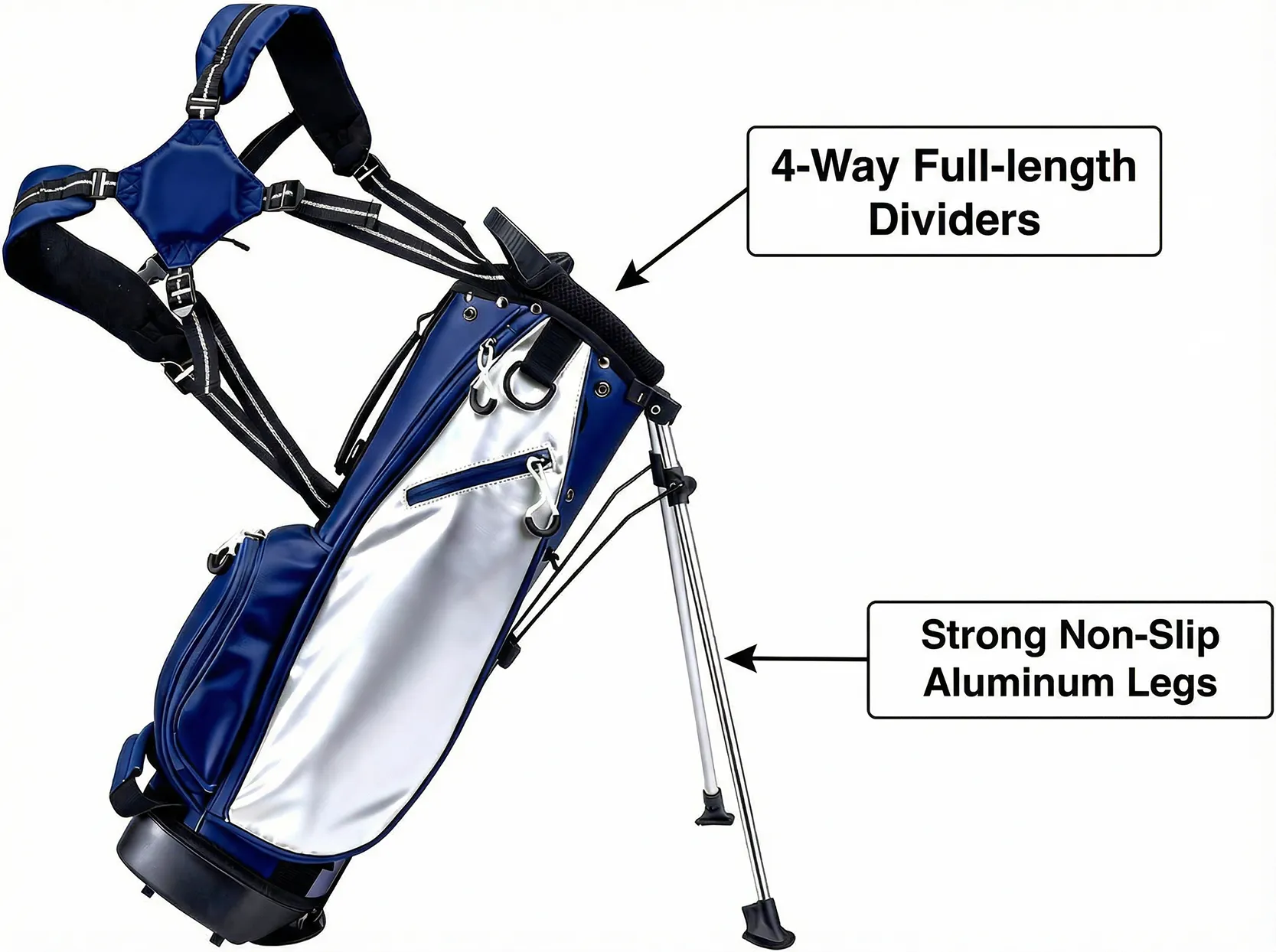
A tournament prize bag is bought against a fixed date, and that one constraint reshapes every other decision in the order: the value tier, the logo method, the packing, and how much slack stays between the ship date and the prize table. A prize bag is not a player bag. It is an award object that has to hold up through a presentation, look correct in a photograph and carry a mark that reads from three metres away. Across the orders we handle, the commercial frame is the same: 200 pieces to a colourway, 100 for a trial, samples in 6-10 working days, 35-50 days of bulk once the sample is signed, 30 per cent with the order and 70 against documents, FOB Xiamen, and inspection to AQL 2.5.
Related reading: Golf Gift Set Bulk Sourcing for Corporate Tournaments
Related reading: Custom Sunday Bags for Promotions and Giveaways
Why a Prize Bag Is Specified Differently From a Retail Bag
A retail buyer optimises margin per unit across a selling season. An event buyer optimises a single afternoon. On a prize table, three or four value bands sit within arm reach of each other, and the person holding the headline prize is standing beside the person holding the raffle item. That comparison is what the order has to survive, which is why the tiers need visible construction differences rather than one bag carrying three different prints.
Order shape is the second difference. A club may need 30 headline prizes, 60 runner-up bags and 150 draw items. Each of those splits sits below a custom colourway minimum on its own, so the workable route is a shared platform: one shell, one hardware set, one trim story, with top configuration, pocket count, fabric weight and presentation changing by tier. Shared components are what make a small event order economically sensible, and they also keep the prize table visually coherent.
The third difference is that presentation belongs to the product. The same bag reads as surplus stock in a plain poly bag and as an award in a printed sleeve with a numbered hangtag. Presentation is also the part of the schedule most often discovered late, because sleeve printing and hangtag assembly run on a different clock from bag production and cannot be compressed in the final week.
Prize Tiers and What Each Tier Should Cost
The bands below are indicative FOB ranges for orders in the 200-piece class, quoted FOB Xiamen at the time of writing; confirm current material and freight rates before budgeting. What moves a bag between bands is denier, top construction, hardware and pocket engineering, not the logo.
| Tier | Bag type | Indicative FOB (USD) | Typical quantity | Presentation |
|---|---|---|---|---|
| Headline prize | Cart bag, 9-10 in top, 14-way | 48-75 | 20-50 per colourway | Hangtag plus fabric sleeve |
| Runner-up | Stand bag, 7.5-8.5 in top, 6-7 way | 34-52 | 40-80 | Hangtag plus polybag |
| Draw or participation | Sunday bag or pencil bag | 12-24 | 100-200 | Printed header card |
| Sponsor or committee | Staff-style cart bag | 60-95 | 10-30 | Carton plus name card |
A 200-piece minimum covers one colourway of one model. Where an event needs three tiers, the usual arithmetic is a 200-piece run of the mid tier plus a 100-piece trial quantity of the headline bag in a single colour, with the cheap draw item purchased as an existing stock colourway and dressed with a printed card. Splitting a 200-piece order across three genuinely different models is not a 200-piece order in production terms; it is three setups, three sample rounds and three inspection events.
The clearest signal that a tier structure is unrealistic is a request for four tiers, four models and 40 pieces each. That is 160 pieces of work spread across 160 different construction decisions, and the cost per unit typically lands 20-35 per cent above what the buyer modelled from a single-model quote.
Within a band, four specifications decide whether a bag sits at the bottom or the top of the range. Fabric weight between 420D and 1680D polyurethane-backed polyester moves unit cost by roughly USD 3-6. A moulded top collar instead of a fabric-bound one adds USD 1.50-3.00 but gives the bag a firmer edge that survives being stacked six high on a table. Aluminium rather than nylon leg hardware, and a padded rather than plain strap, each add a dollar or two and are the details a winner touches first. Pocket engineering is the quiet one: every additional zipped pocket is 4-7 minutes of labour, and on a prize bag two well-placed pockets beat five shallow ones.
Logo Methods That Survive a Prize Table
Embroidery
Embroidery is the default for prize bags because it reads as value and tolerates handling. A chest-sized logo on 600D polyester runs 8,000-12,000 stitches, takes 3-5 minutes of machine time per position and adds roughly USD 1.20-2.60 per bag at 200 pieces. Two things decide the result: a digitised file drawn for the fabric rather than a converted vector, and the right backing. Without cut-away or tear-away backing behind a dense stitch field, woven polyester puckers and the panel distorts around the mark.
Placement matters as much as the file. On a cart bag the natural position is the front lower panel, 20-35 mm above the base seam, because that area sits flat against the cart and is not compressed by legs or a stand mechanism. On a stand bag, put the mark on the ball pocket or the side panel and keep it clear of the leg hinge by at least 40 mm.
Screen print
Screen print suits flat panels, large graphics and event names set in a typeface too fine for needles. Plastisol inks sit on the surface and hold colour well on dark fabric; water-based inks penetrate and feel softer but lose saturation on 1680D. Each colour needs its own screen and its own setup, typically USD 45-90 per screen, so a four-colour event logo carries USD 180-360 of one-time cost before a single bag is printed. On a 150-piece draw prize at USD 18, that setup is a meaningful share of unit cost.
The practical rule is one colour for the cheap tier and three or four for the headline tier, where the setup is spread across 30-50 units of high value and nobody questions the per-unit contribution.
Heat transfer and moulded badges
Heat transfer handles fine detail, gradients and multi-colour artwork in one pass and is the least expensive way to get a four-colour mark onto a small panel. Its weakness is adhesion over time on textured fabric, so specify a transfer rated for the actual substrate and run a wash plus abrasion check on the first article. A moulded PVC or TPU badge is the premium answer for a headline prize: a physical part 1.5-2.5 mm thick, stitched or riveted on, with tooling at USD 250-600. That tooling only makes sense when the same badge returns across seasons.
Field note on marks that fail. The most common logo failure on prize bags is not the print method, it is the contrast. A dark grey logo on black 600D looks correct on a monitor and disappears under marquee lighting. Ask for a physical strike-off on the actual fabric before approving colour, not a digital proof on white.
Presentation: Hangtags, Sleeves and Cartons
Presentation cost is small per unit and disproportionate in perceived value, which is why it is the first place to spend after the bag itself is settled. The four elements below cover almost every event brief we see.
| Element | Cost per unit (USD) | What it protects or signals | Ordering note |
|---|---|---|---|
| Printed hangtag, 300 gsm | 0.12-0.30 | Tier and year, sponsor credit | Print with the sleeves, never as a separate run |
| Fabric drawstring sleeve | 0.55-1.10 | Dust and scuffing in transit | Cut to the actual bag, not a generic size |
| Moulded handle carton | 0.70-1.40 | Crushing inside a mixed pallet | Headline tier only |
| Polybag with header card | 0.08-0.20 | Dust only | Recyclable LDPE where the venue requires it |
Assemble sleeves and hangtags at the destination where possible. Shipping them flat in a separate carton removes creasing risk, removes the labour from the bag line and lets a volunteer crew dress 200 bags in an afternoon with no training.
One detail that separates a competent prize order from a good one: number the headline prizes on the hangtag and give the club a matching list. Ties, sponsors and silent-auction items are resolved faster when the physical object carries an identifier that a committee member can read from a clipboard.
Counting Back From Delivery Day
The failure mode in event sourcing is rarely quality. It is arithmetic. Bulk runs 35-50 days from sample approval, but approval itself comes 6-10 working days after artwork is locked, and ocean transit adds 25-40 days door to door depending on routing. Add two weeks of buffer for a customs hold and the requirement is roughly 14 weeks between artwork sign-off and bags on site.
- Fix the date the bags must physically reach the venue, not the date of the event or the date at the club office.
- Subtract 14 days for domestic delivery, unpacking, sorting by tier and any re-packing by the club.
- Subtract 25-40 days for ocean freight and clearance, or price air freight for a partial shipment of the headline tier.
- Subtract 35-50 days for bulk production measured from sample sign-off.
- Subtract 6-10 working days for sampling, plus 3-5 days of courier transit and your own review time.
- Subtract 5-10 working days for artwork approval, digitising, screen making or badge tooling.
- Compare the resulting date with today. If the gap has closed, the tier that needs new tooling is the one to redesign.
When the arithmetic fails, three options exist and only one is comfortable. Air freighting the headline tier and shipping the rest by sea keeps the prize table correct at a freight premium that is usually 3-6 times the ocean cost per unit. Cutting a tier flattens the hierarchy and players notice. Moving to a stock colourway with a printed patch removes the sampling loop entirely but caps the logo at one or two colours.
Around 40 per cent of the event enquiries we quote arrive inside the 14-week window. Most of them are still solvable, but the solution is chosen by the calendar rather than by the brief, and that is worth knowing before the tier list is finalised.
The calendar itself is not theoretical. QUANZHOU JUNYUAN BAGS has run event programmes since 2014, with a team that entered bag production in 2004, and the 14-week figure is the one that keeps proving itself on orders that arrive late.
Inspection, Packing and Transit Damage
Inspection is set at AQL 2.5, drawing on the general level II tables in ISO 2859-1: a 200-piece lot is opened at 32 pieces and held once a third major defect appears. For a prize order the checkpoints that matter are the ones a recipient notices while holding the bag in front of other people: logo position within 3 mm of the agreed placement, stitch density at 9-11 per inch on load-bearing seams, hardware colour matched to trim, and a clean top edge with no adhesive bleed.
Transit damage is the more frequent complaint. Bags shipped loose abrade against each other, and bags folded at the top take a set that never recovers. Specify individual polybagging, top-to-toe alternation inside the carton, and a 1 m corner drop test on the packed carton before bulk. Grab strength on the shell and the strap webbing should clear 250 N when tested to ASTM D5034, while a tear test to ASTM D2261 is what catches the lightweight fabrics used on cheap draw tiers before they reach a table.
Packing instruction worth writing into the PO. One carton per tier, labelled on two faces, with the tier name and a piece count. Mixed cartons are cheaper to pack and much more expensive to unpack on the morning of an event, and every hour spent sorting is an hour not spent on the registration desk.
Volume Reality: Minimums, Trial Runs and Split Shipments
Event volumes sit awkwardly against production minimums, so it helps to know exactly which levers exist before negotiating.
- 200 pieces per colourway is the standard minimum, and it applies per colourway rather than per model on an established platform.
- 100-piece trial orders are workable on an existing shell with a stock fabric and a printed logo, which is the usual route for a first event.
- 500 pieces is the realistic threshold when a new shell, new top geometry or new tooling has to be developed for the order.
- Split shipments are possible, but each release carries its own inspection, packing and documentation, so a three-way split of 200 pieces rarely beats one shipment plus a local courier.
- Repeat orders in later years can usually follow the same pattern with a colour change, provided the base fabric is still in the mill range.
Where a club runs the same event annually, the strongest commercial move is a two-year order released in two shipments. It secures the colourway, holds the tooling in place and usually earns a better unit price than two separate 200-piece orders, without asking anyone to store 400 bags in a broom cupboard.
A Spec Sheet Checklist for Prize Bag Orders
Almost every dispute on an event order traces back to one of six fields being left open. Write them as measured values and the first article becomes a confirmation rather than a negotiation.
- Tier name, quantity and colourway per band, stated as separate lines with separate prices.
- Model, top configuration, divider count and finished weight for each tier.
- Logo file in vector, plus a placement drawing dimensioned from a fixed datum such as the base seam or the pocket edge.
- Presentation item per tier, with its print artwork and the point at which it is assembled.
- Delivery date at the venue, with a named receiving contact and a delivery window that the freight forwarder can actually hit.
- Inspection standard and acceptance criteria, written as tolerances and stitch counts rather than adjectives.
Two references worth reading alongside this piece: the bulk order process for what happens between PO and container, and the logo method comparison for the technical differences between the three marking routes above. If the event also carries sponsor gifting, the corporate gifting programme covers how bag and gift set quantities are combined into one run.
Send the event date, the tier structure and the logo file together and the build sheet that comes back will already be constrained by the calendar. That is a far better starting point than a beautiful brief that cannot land on the table in time.
Next steps: custom solutions, manufacturing capability, and a quotation request. Wholesale programme overview. Corporate golf gifting.
Sources and Standards Referenced
- ISO 2859-1:2022 Sampling procedures for inspection by attributes
- ASTM D5034 Breaking strength and elongation of textile fabrics (grab test)
- ASTM D2261 Tearing strength of fabrics (tongue method)
- ISO 105-B02 Colour fastness to artificial light
- ISO 9001 Quality management systems
Frequently Asked Questions
What is the minimum order for custom tournament prize bags?
The standard minimum is 200 pieces per colourway on a platform that already exists. A 100-piece trial order is workable where the shell, fabric and logo method are all settled. A new shell or new tooling for the order moves the threshold to 500 pieces, because development cost has to spread across a longer run.
How far ahead should we order prize bags before an event?
Allow about 14 weeks from artwork sign-off to bags on site. That covers 35-50 days of bulk production, 6-10 working days of sampling, 25-40 days of ocean freight and clearance, and a buffer for a customs hold. Inside eight weeks, plan on air freight for at least the headline tier.
Can we order different bag models within one 200-piece minimum?
Not on a single minimum. Each genuinely different model needs its own sampling, its own setup and its own inspection, so it is priced as a separate order. The workable approach is one shared shell with different top configurations and pockets, which reads as three tiers while staying one production run.
Which logo method is best for a prize bag?
Embroidery for anything that must look like an award, at USD 1.20-2.60 per bag for an 8,000-12,000 stitch mark. Screen print for large or multi-colour graphics, with USD 45-90 of setup per colour. Heat transfer for fine detail at low setup. Moulded badges only where the same part will be reused across seasons.
How much does a prize bag cost?
Indicative FOB Xiamen bands: USD 12-24 for a Sunday or pencil bag draw prize, 34-52 for a six or seven-way stand bag, 48-75 for a 14-way cart bag as a headline prize, and 60-95 for a staff-style bag. Denier, top construction and hardware move a bag between bands more than the logo does.
Can prize bags be packed individually for handing out?
Yes, and they should be. Individual polybags, one carton per tier and a label on two faces of each carton turn an unpacking job into a five-minute handover. Printed sleeves and hangtags are best shipped flat and assembled at the venue to avoid creasing and to keep labour off the bag line.
What happens if the shipment arrives after the event date?
There is no good recovery, which is why the timeline is built backwards from the venue date rather than the order date. The mitigation is to split the shipment: air freight the headline tier so the prize table is correct, and let the draw tier follow by sea for the next event or the following season.
Can the event name and year be printed on the bag?
Yes, and it is usually the right call for draw and participation tiers. Keep the typeface above 6 mm cap height for screen print and above 8 mm for embroidery, or the letters fill in. For headline prizes, a separate sponsor panel avoids dating a bag that the club may want to reuse.
Are prize bags inspected before they ship?
Every lot is drawn against ISO 2859-1 at AQL 2.5, general level II, so a 200-piece order is opened at 32 bags and held once a third major defect turns up. Prize-specific checks cover logo placement within 3 mm, stitch density at 9-11 per inch and hardware colour match.
Do you accept mixed colours across tiers?
Yes, within limits. A 200-piece run can usually be split across two colourways with a small upcharge, and the split is easier when both colours use the same thread and trim. Four colourways on 200 pieces is not a split, it is four short runs, and the price reflects that.
What payment terms apply to event orders?
T/T 30/70 is standard: 30 per cent with the order and 70 per cent against the shipping documents. Terms are quoted FOB Xiamen, so ocean freight, insurance and destination charges sit with the buyer. Event orders with a fixed date benefit from booking freight early rather than shopping it late.
How are prize bags shipped, and can a small order fly?
Cartons are palletised for FCL or LCL sea freight, which is the default above 100 pieces. Below that, or inside a tight event window, air freight is viable: a 30-piece headline tier usually fits a single air pallet, and the premium is 3-6 times the ocean cost per unit rather than a change of scale.
Plan a Prize Order
Send the event date and the tier structure, and a build sheet with per-tier cost and a realistic ship date comes back within two working days.
Request a Quote See Custom Solutions