Golf Gift Set Bulk Sourcing for Corporate Tournaments
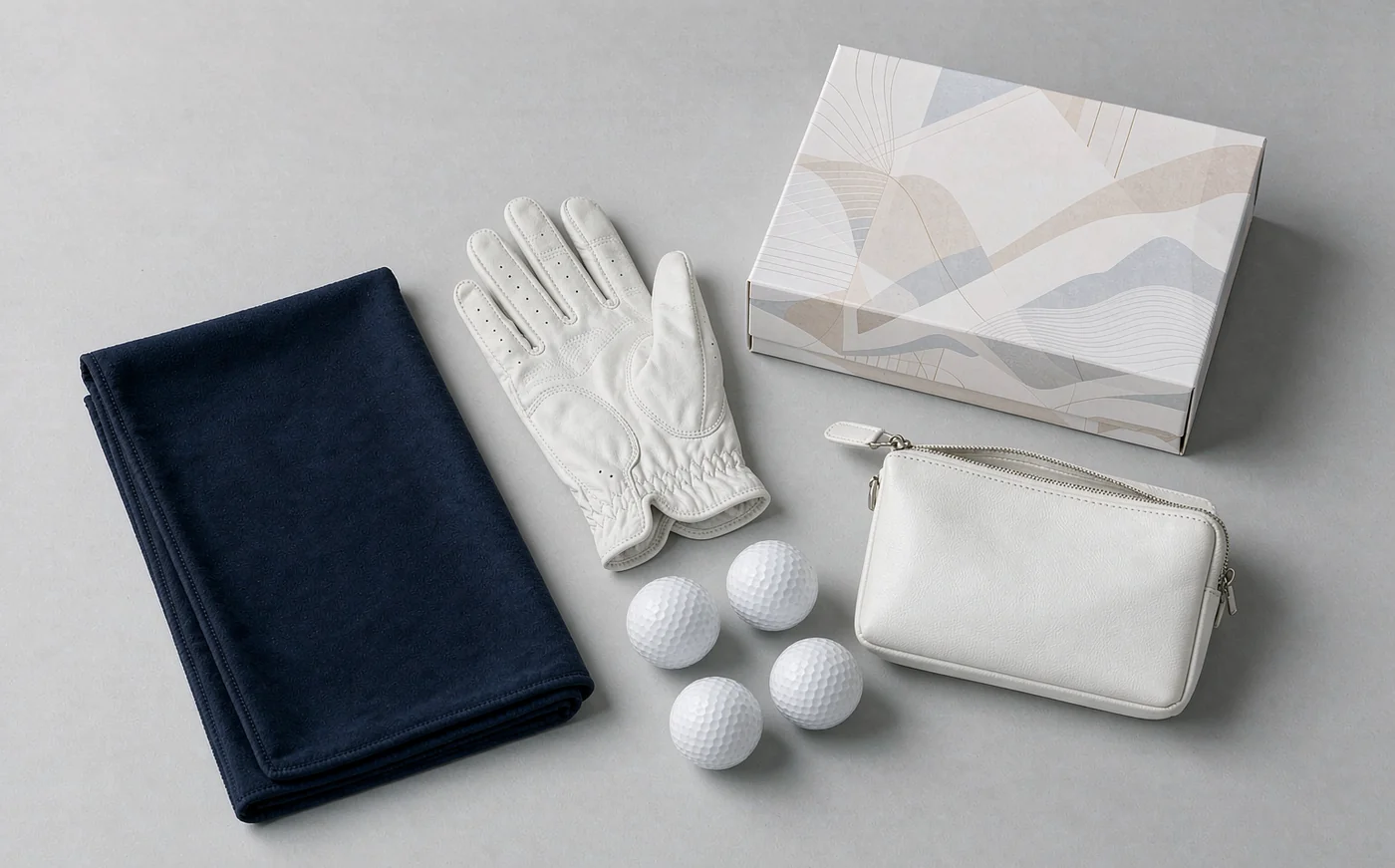
A gift set is judged in the nine seconds between the lid coming off and the guest looking up, and everything that decides those nine seconds happens in a kitting room, not on a sewing line. The bag or pouch is the largest cost line, but the box, the insert, the tissue, the name card and the order in which the items sit inside are what the recipient actually experiences. Sets are quoted in units of 200, trial quantities start at 100, sampling runs 6-10 working days, kitting and bulk production occupy 35-50 days from sample approval, and no component enters a box until it clears a 2.5 AQL check on the ISO 2859-1 scheme.
Related reading: Corporate Golf Bags: Best Custom Options for Business Gifts
What Goes in the Box, and Who Makes Each Part
A corporate set is assembled from two supply chains that behave nothing alike. Textile components — sunday bag, cart bag, valuables pouch, shoe bag, towel, headcover sleeves, cooler sleeve, umbrella sleeve — are cut and stitched in the same building and share fabric lots. Third-party components — balls, tees, ball markers, divot tools, bottles, caps, socks — are bought in from specialist suppliers and arrive with their own lead times, their own minimums and their own colour tolerances.
Two supply chains, one delivery date
The mistake buyers make is treating the set as one order. It is six to eleven purchase orders that must land in the same week. A towel supplier who runs two weeks late does not delay a bag, it strands 1,200 boxes that cannot be closed. Building a set therefore starts with a component availability check, not with a design brief.
Three set architectures cover most of the market. The bag-led set anchors on a sunday bag or a cart bag and adds two or three small items. The pouch-led set is a compact flat-lay of valuables pouch, towel, tees and marker in a rigid box, typically at the lower price points. The mixed set pairs a bag with a shoe bag and a cooler sleeve, which is what corporate event buyers gravitate to when the budget per head is above USD 60.
| Set architecture | Components | Typical FOB per set | Best fit |
|---|---|---|---|
| Pouch-led flat lay | Pouch, towel, tees, marker, rigid box | USD 14-24 | Guest favours, 200-500 sets |
| Bag-led sunday | Sunday bag, pouch, towel, carton box | USD 32-48 | Pro-am and charity days, 200-600 sets |
| Bag-led cart | Cart bag, shoe bag, towel, pouch, rigid box | USD 62-95 | Client hospitality, 100-300 sets |
| Mixed premium | Cart bag, shoe bag, cooler sleeve, headcovers, two-piece box | USD 96-140 | Sponsor gifting, under 200 sets |
Designing to a Price Point, Not to a Wish List
Corporate buyers arrive with a budget per head and a list of items they would like. The two rarely reconcile, and the fastest way to close the gap is to work down a cost stack rather than across a catalogue. In a mid-tier bag-led set at USD 38, the bag is roughly USD 24, the pouch USD 2.40, the towel USD 2.80, the box USD 2.60, the insert USD 0.90, kitting labour USD 1.20, packing and inspection USD 1.40, and the balance covers freight to port and margin.
Reading the cost stack
That stack tells the buyer where the leverage is. Removing the shoe bag from a mixed set saves USD 6-9 and changes the perceived value far less than removing the bag. Upgrading the box from a folding carton to a rigid board box with a magnetic closure costs USD 1.40-2.20 and is the single highest-return move in any set under USD 50, because the box is what the recipient photographs.
Two components are almost never worth cutting. The first is the insert. A die-cut EVA or moulded pulp insert holds the items in place through transit; without it, a pouch slides against a bag for 8,000 km and arrives scuffed, and the whole set reads as second-hand. The second is the tissue and the name card. Together they cost under 60 cents and they are the difference between an unboxing and a delivery.
If the budget cannot reach a bag, do not shrink the bag. Build a pouch-led set at a good standard rather than a bag-led set at a bad one. A USD 18 flat lay that is crisp, colour-matched and correctly boxed outperforms a USD 30 set with a thin bag, a mismatched pouch and a flimsy carton every time.
Colour Match Across Four Materials
This is the technical problem that separates a professional set from an amateur one, and it is invisible on a computer screen. The same "navy" reads differently on 600D polyester, on cotton terry towelling, on PU trim and on printed board, because each substrate absorbs and reflects light differently. A set built from four nominally identical navy references will show four different navies in daylight.
| Material pair | Achievable ΔE | Practical note |
|---|---|---|
| 600D polyester to 600D polyester, same lot | ≤ 1.0 | Cut both from one roll where volume allows |
| 600D polyester to PU trim | ≤ 1.5 | PU reads darker; specify trim one step lighter |
| 600D polyester to cotton terry towel | ≤ 2.5 | Terry cannot hold a deep navy; use a contrast band instead |
| Fabric to printed box board | ≤ 2.0 | Print on uncoated stock to avoid a plastic sheen |
| Fabric to moulded badge or PVC patch | ≤ 1.5 | Match to the badge, then adjust the fabric dip |
The practical fix is not to chase a perfect match but to design a set where an exact match is not required. A contrast band, a stripe or a two-tone scheme removes the problem entirely and usually looks more considered. Where a match is unavoidable, the towel is the component to move, because terry has the narrowest dye range and the least light fastness.
Approval should happen physically, under two light sources. A set approved under warm showroom light will look wrong in a marquee at midday. Standard practice is a visual check under D65 and a second check under a warm source at 2,700-3,000 K, with the ΔE values in the table as the numerical backstop. Retain the signed standard swatch; it is the only thing that resolves a dispute six months later.
Where garments or third-party items are dyed to match, add a tolerance clause to the purchase order. A supplier who has not been given a numeric ΔE target will deliver to their own standard, which is usually judged at two metres and rarely holds up at 300 mm, and a gift set is examined at 300 mm.
Kitting: The Step That Decides Whether the Set Ships
Kitting is assembly, not manufacturing, and it is priced by the second. A pouch-led flat lay takes 60-90 seconds per set: box erected, tissue laid, insert dropped, components seated, card placed, lid closed, shrink or belly band applied. A bag-led cart set with five components and a two-piece box takes 150-220 seconds because the bag must be stuffed, the straps folded to a fixed profile and the box squared before the lid seats.
At 1,000 sets, that difference is 25 to 40 additional labour hours, which is real money but not the main risk. The main risk is sequencing error. Every component must arrive at the kitting table in the exact quantity needed, in the right colour, with the right name card, and any mismatch produces a box that must be opened again — and a reopened box never closes as well as one closed once.
- Component receipt and quarantine. Every line is counted in, checked against the approved standard, and held until the last line lands. Nothing is kitted on a partial delivery.
- Pre-assembly of sub-units. Bags are stuffed and strap-folded, pouches are filled with tissue, towels are folded to a fixed dimension and banded. This runs ahead of the table so the table itself never waits.
- Line layout by set, not by component. One table per set architecture, with bins in the order the hand reaches for them. Re-laying a table for a different set costs 30-45 minutes and is the reason mixed orders are quoted higher.
- Build and check at the table. The kit builder places each component and ticks a printed pictogram card, which stays in the box as the packing list. Two people never build the same box.
- Close, band and weigh. Lid closed, belly band or shrink applied, then every box is weighed. A weight outside ±3% of the standard triggers an open-and-recount, which catches a missing component faster than any visual check.
- Carton packing and drop test. Boxes are packed upright with corner protection, then a sample carton is drop tested before the run continues.
Field note. The weight check is the cheapest quality control in kitting and the one buyers never ask for. On a 900-set run it catches missing tee packs, missing cards and double-packed pouches, and it costs one gram scale and four seconds per box.
Named sets need a sequence, not a stack
For named sets — where each box carries an individual recipient name — kitting becomes a sequencing exercise rather than a repetition exercise. Boxes must be built in the same order as the name list, bagged in blocks, and marked with the sequence number on the outside of the master carton. Getting this wrong means 400 people at a dinner looking for their own box on a table.
A kitting run also needs an allowance for spoilage. Standard practice is 2-3% overage on boxes and printed cards, and 1-2% on textile components, because a crushed lid or a mis-stitched pouch discovered at the table cannot be sent back to the line quickly enough. Build the overage into the purchase order rather than discovering it at 11 pm the night before the event.
Names, Numbers and Variable Data
Personalisation is where corporate sets diverge from retail. Two formats dominate: an embroidered name on a pouch or bag panel, and a printed or laser-marked name card inside the lid. Both are variable-data processes, and both fail in the same way — at the interface between the list and the machine.
Embroidery handles names at 7 mm cap height and above, in one or two lines, at roughly USD 0.80-1.60 per name depending on stitch count. The constraint is not the machine, it is the artwork: long surnames, hyphens and accented characters need a thread path that survives trimming, and a 14-character name at 7 mm will run wider than a 60 mm pouch panel. Ask for a name-length limit and a fallback size before the list is collected.
Laser marking on PU or leatherette gives a sharper, more formal result and handles long names better, at USD 1.10-2.20 per item. It is a one-colour process, so it suits a monochrome scheme and fails on light colours where the burn mark reads brown rather than tonal.
The operational rules that avoid a disaster: collect the list as a CSV with a fixed column order and a maximum character count; run one proof set of ten names before the full run; keep the sequence number on every component and every box; and add 2% blanks so a late addition does not require a reprint. On a 500-name run, expect 1-3% of names to contain an error in the source list itself. The buyer should own that check, not the supplier.
Working Backwards From the Event Date
Corporate sets are deadline products. The event date does not move, and every upstream decision has to be dated from it. The timeline below is what the calendar looks like for a 600-set order shipped by sea to a US or European venue, and it assumes artwork is approved at the start rather than discovered along the way.
| Stage | Duration | What has to be true to start |
|---|---|---|
| Artwork and component freeze | 5-10 days | Box dieline, logo files, name list format agreed |
| Sampling and approval | 6-10 working days | Stock fabric and trim; 12-15 days if a new die or screen is needed |
| Component procurement | 10-25 days | Third-party items ordered the day the PO is signed |
| Bulk production | 35-50 days | Sample signed, deposit received |
| Kitting and boxing | 5-8 days | All components on site, name list locked |
| Sea freight to US West Coast | 30-38 days | Booked 10 days before cargo ready |
| Total, port to port | 85-115 days | Add 10 days of buffer for customs |
Read backwards from that table and the practical rule appears: a sea-freighted set needs to be ordered about four months before the event, and an air-freighted set about ten weeks. Air freight on a boxed set is expensive because gift boxes are volumetric — a 600-set order can cube out at 12-16 cubic metres, and air is charged on volume above 167 kg per cubic metre.
Where the date is tight, split the shipment. Send the first 150 sets by air for the VIP table and the balance by sea, or send flat-packed boxes and kitting materials ahead and kit at the venue. The second option sounds clever and usually fails, because kitting at a hotel needs a clean floor, four hours, two people per 100 sets and a place to store empty cartons.
The one date buyers most often miss is the artwork freeze. Every week of late artwork approval moves the whole chain, and a box that is not approved by week three cannot be printed, die-cut and shipped in time for a bulk run that starts in week six. Lock the box, the logo size and the name format before the deposit is paid.
Cartons, Customs and the Hand-Carry Problem
A gift box is a poor shipping container. It is designed to be looked at, not stacked, and its corners crush under loads that a polybag shrugs off. Master cartons therefore need corner protection, a double-wall flute and a stack limit printed on the side. Five to ten boxed sets per carton is typical, with the carton sized so it can be lifted by one person at the venue.
The hand-carry scenario deserves its own specification. Roughly a third of corporate orders end up being carried by an organiser through an airport, a taxi and a hotel lobby. That means no carton heavier than 18 kg, a carry handle on the master carton, and a printed contents label on two sides so a box can be found without opening three others.
Customs treatment is the least understood part of the purchase. A boxed set of a bag, a towel and a pouch is not three separate articles for classification purposes in every jurisdiction; the tariff treatment can follow the component that gives the set its essential character, which is usually the bag. Declaring the set as a single line at the bag value, or splitting it into components, produces very different duty outcomes. Confirm the treatment with a broker before the invoice is issued rather than after, and read how golf bags are classified and assessed for US duty for the underlying code structure.
Two documents prevent most clearance delays: a commercial invoice that describes each component and its value, even where the set is declared as one line, and a packing list with the carton count, gross weight and box count per carton. Sets shipped as "promotional materials" without a value will be held, and a held shipment arriving after the event is worth nothing.
Minimums, Trial Runs and the Reorder Rhythm
Sets are quoted at 200 units minimum because that is where box printing, die-cutting and kitting setup stop dominating the price. A trial of 100 sets is workable on a stock box with a printed label rather than a printed lid, since the label route avoids the print setup. Full custom box tooling — a new die, a new print plate and a foam insert cut — lands at 500 sets unless the die and plate carry their own invoice line.
Reorder behaviour is where corporate sets differ most from retail. Events repeat annually with the same buyers, so the second order is usually 60-80% of the first, in the same architecture, with a refreshed colour and a new date on the card. Buyers who keep the dieline, the insert drawing and the standard swatch on file can reorder with a two-week artwork cycle instead of a six-week one.
Terms are 30% on order with the balance on the bill of lading, FOB Xiamen. Production planning, capacity and audit records sit with a partner established in 2014 whose founding team has worked in this industry since 2004, and capacity open to third-party audits on request at the Quanzhou site covers both the bag lines and the accessories floor that a set requires.
- Freeze the box before the bag. Print and die lead times are longer than sewing lead times on a 200-set run.
- Order third-party components first. Balls, tees and bottles have the longest and least predictable lead times in any set.
- Budget 2-3% overage on boxes. A crushed lid at the kitting table has no recovery path.
- Weigh every box. It is the fastest and cheapest missing-component check available.
- Keep the dieline and the swatch. They turn next year reorder into a two-week exercise.
For sets built around a cooler or a bag rather than a pouch, the corporate golf gifts range shows the architectures already tooled, and the cooler bag event programme covers the insulation and capacity decisions that come with a cool-weather or summer event brief.
Related reading: Why Golf Tournaments Use Custom Cooler Bags as Gifts
Next steps: custom solutions, manufacturing capability, and a quotation request. Corporate Golf Gifts. Bulk Order Process.
Sources and Standards Referenced
- ISO 2859-1:2022 Sampling procedures for inspection by attributes
- ISO 105-B02 Colour fastness to artificial light
- ISO 9001 Quality management systems
- ECHA REACH regulation on restricted substances in textile articles
- US Customs and Border Protection trade guidance on classification and entry
Frequently Asked Questions
What is the minimum order for a corporate golf gift set?
Two hundred sets, because box printing, die-cutting and kitting setup dominate the price below that level. A trial of 100 sets works when the box carries a printed label instead of a printed lid. Where a new box die, plate and foam insert are all required, plan on 500 sets or pay the tooling as a separate line.
How far ahead should a tournament gift set be ordered?
About four months before the event for a sea-freighted order, or ten weeks for air. Bulk runs 35-50 days after the sample is signed, kitting adds 5-8 days, and sea freight to a US or European venue runs 30-38 days. Artwork must be frozen in the first three weeks.
What does a corporate gift set cost per unit?
A pouch-led flat lay runs USD 14-24 FOB per set, a bag-led sunday set USD 32-48, a bag-led cart set USD 62-95, and a mixed premium set USD 96-140. The box upgrade from a folding carton to a rigid magnetic box adds USD 1.40-2.20 and is the highest-return change under USD 50.
Why do colours look different across components in the same set?
Each substrate absorbs light differently. Polyester, cotton terry, PU trim and printed board all render the same nominal colour differently, and terry has the narrowest dye range. Numeric targets are ΔE 1.0 within one material lot and up to 2.5 between fabric and terry, with a contrast band a better design answer than a forced match.
How many seconds does kitting take per set?
A pouch-led flat lay takes 60-90 seconds and a bag-led cart set with five components takes 150-220 seconds. At 1,000 sets that difference is 25-40 labour hours, which is why mixed architectures quote higher than single ones.
Can each gift set carry an individual recipient name?
Yes. Embroidery works at 7 mm cap height and above at roughly USD 0.80-1.60 per name, and laser marking on PU runs USD 1.10-2.20 and handles longer names better. Collect names as a CSV with a fixed column order, run a ten-name proof set, and add 2% blanks for late additions.
How are gift sets packed for shipment?
Five to ten boxed sets per master carton, upright, with corner protection and a double-wall flute. Keep each carton under 18 kg with a carry handle, because about a third of corporate orders are hand-carried through airports and hotels rather than palletised.
How is a boxed golf gift set classified for customs?
Often as a single set following the component that gives it essential character, which is usually the bag, rather than as separate articles. The outcome varies by jurisdiction, so confirm the treatment with a broker before the invoice is issued. Describe every component and its value on the commercial invoice regardless.
What inspection standard applies to gift sets?
ISO 2859-1 sampling at 2.5 AQL, level II, applied twice: to each component before kitting and to the closed box afterwards. The component check covers dimensions, stitching, zip function and colour; the closed-box check covers presence, position, name card and lid condition.
Is a rigid box worth the extra cost over a folding carton?
For sets under USD 50, usually yes. A rigid board box with a magnetic closure adds USD 1.40-2.20 but changes the perceived value more than any other component at that price. Above USD 90 the box should already be rigid, and the budget should move to the insert and the tissue.
What are typical payment and shipping terms?
Thirty per cent on order, seventy per cent against the bill of lading, FOB Xiamen. Sets are volumetric, so air freight is charged on volume above 167 kg per cubic metre; a 600-set order can cube out at 12-16 cubic metres, which is why sea is the default.
Can the set be reordered the following year?
Yes, and it is far faster if the dieline, the insert drawing and the signed standard swatch are kept on file. A repeat order in the same architecture with a refreshed colour and a new card date takes about two weeks of artwork instead of six.
Plan My Event Set
Send the guest count, event date and budget per head and we will return three set architectures with a cost stack and a dated production calendar.
Request a Set Proposal See Corporate Gifts