Golf Range Bag Manufacturing for Practice Range Operators
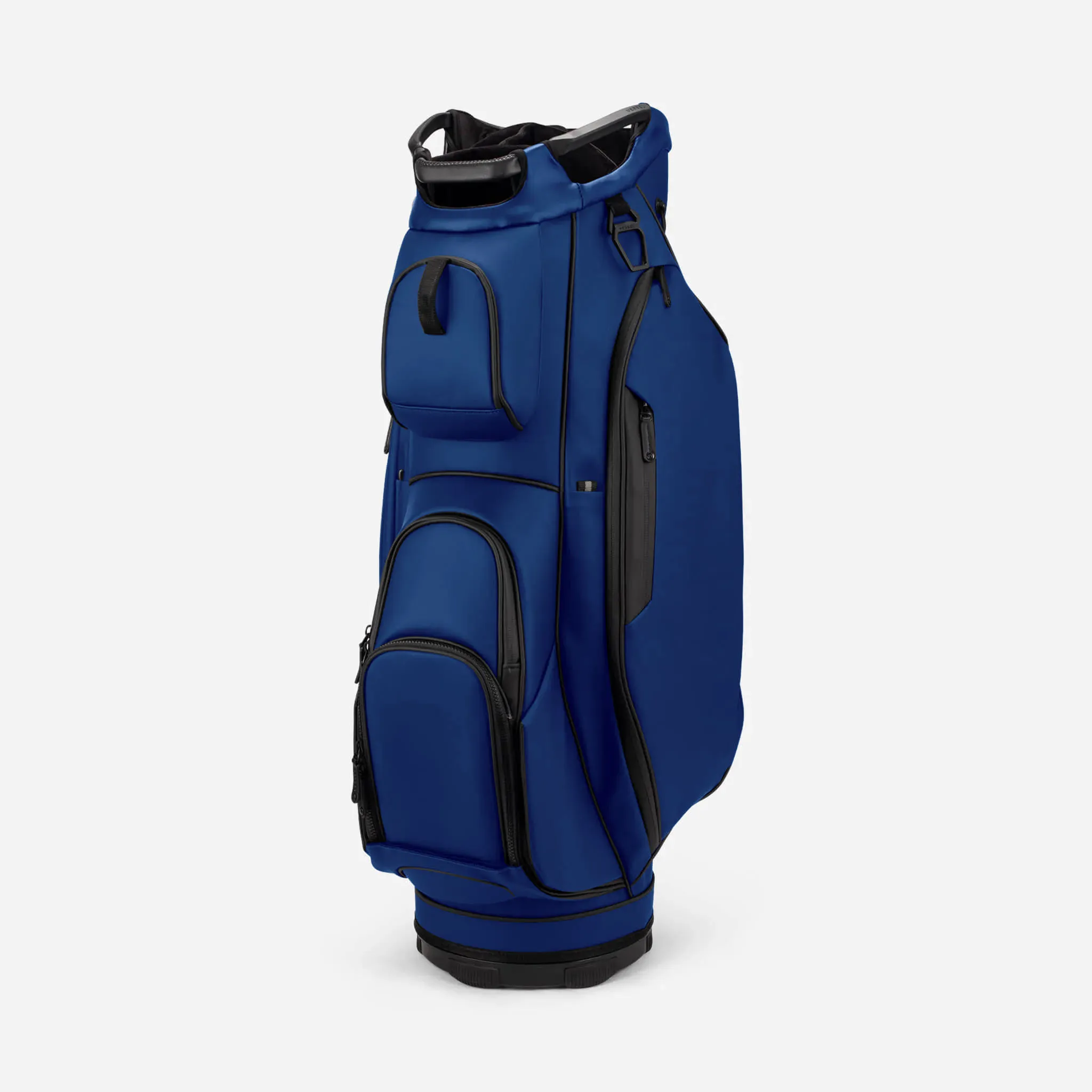
A range bag is the only golf bag bought by the thousand and used by the hundred, which means it is specified for abuse rather than for ownership. Driving ranges, teaching academies and indoor studios buy two different products under that name: ball bags that carry 80-150 balls between the picker and the dispenser, and fleet club bags that a different stranger drags around the property every hour of the day. Both are priced against a replacement cycle, not against a retail margin. Colourway minimums are 200 pieces, trial quantity 100, sampling 6-10 working days, bulk production 35-50 days from sign-off, and every lot judged at 2.5 AQL under the ISO 2859-1 scheme.
Related reading: Golf Duffel Bag Manufacturing for Onsite Crew
Two Products Sold Under One Name
The first is the ball bag: a soft, open-mouthed sack with a reinforced base, a heavy handle and often a shoulder strap, used to move practice balls from the picker to the washer to the dispenser. It is loaded and emptied dozens of times a day, dropped on concrete, stored wet, and expected to survive two to three seasons.
The second is the fleet club bag: a stand or cart bag issued to paying customers who have no stake in its condition. It is dragged by the strap, over-filled, left in the rain, stood on the ground next to a ball dispenser and returned with the legs bent. Its life is measured in months of front-line service, not in rounds of careful ownership.
The commercial logic differs too. A ball bag is bought in batches of 50-200 as a consumable and expensed. A fleet club bag is capital equipment, often numbered, and bought in a single order of 40-150 units to cover a bay count plus a spare pool. A 40-bay range typically runs 1.5 bags per bay, so 60 in service and 10-15 spare.
| Product | Typical capacity | Dry weight | FOB per unit | Expected service life |
|---|---|---|---|---|
| Mesh ball bag, drawstring | 80-100 balls | 180-260 g | USD 4.50-7.50 | 12-18 months |
| Ball bag with webbing handle and base panel | 120-150 balls | 260-380 g | USD 7.00-12.00 | 18-30 months |
| Fleet stand bag, numbered | Full set, 6-way top | 2.6-3.1 kg | USD 26-38 | 12-20 months |
| Fleet cart bag, numbered | Full set, 14-way top | 3.0-3.6 kg | USD 32-46 | 18-26 months |
Ball Bags: Payload, Mesh and the Handle That Gives Way
A golf ball weighs no more than 45.93 g under the equipment rules published by the USGA, so 150 balls is roughly 6.9 kg of payload. That number is the whole design brief, because a bag rated for 7 kg will be lifted by one hand at full extension, swung onto a cart, and set down hard several hundred times a week.
The failure is almost never the fabric. It is the handle root. A 25 mm polypropylene webbing stitched to a 420D shell with a single row of lockstitch at 10 stitches per inch will tear the shell along the stitch line at around 40-60 kg of static pull, which sounds generous until the dynamic multiplier of a swinging lift is applied. Every ball bag that fails in service fails within 30 mm of where the handle meets the body.
The construction that survives is unglamorous: 38 mm webbing rated at 1.4 kN breaking strength, carried down the full height of the bag as a continuous loop rather than stitched on as a short tab, box-X reinforced at each junction, and a 600D patch behind every attachment point so the load spreads across 60 x 60 mm of shell instead of 20 mm. That adds roughly USD 0.45 to a ball bag and doubles its service life.
Mesh, base and drainage
Mesh choice matters for a different reason. A 420D polyester mesh with a 4 mm hexagonal aperture drains and dries fast, which is why it is used for bags that get washed with the balls. The mesh must be hot-knife cut, not scissor cut, because an open weave unravels from any cut edge and a bag that sheds fibres into the washer contaminates every ball in the drum.
The base is the second stress point. A ball bag is set down on concrete with 7 kg inside, and a single-layer mesh base abrades through in weeks. Specify a 600D PU-backed base panel, bound and double-stitched, or a moulded HDPE base insert of 2-3 mm. A drain grommet at the lowest point prevents the bag from holding water after a wash, which is the actual cause of most mildew complaints.
Field note. Ask a range operator what broke last, and the answer is almost always the handle or the base, in that order. Neither is a fabric cost problem; both are a stitching and reinforcement problem worth less than 60 cents per bag.
Fleet Bags: What a Stranger Does to a Shell in a Month
A rental bag meets every failure mode in the book within its first month. It is lifted by the top handle when fully loaded, which puts 12-14 kg through a seam designed for 8. It is dragged across tarmac by the strap. It is over-filled with 16 clubs and a ball retriever. It is left standing in the rain because nobody owns it.
That reality drives three specification decisions. First, shell fabric moves up to 600D or 1680D, carrying a PU coating rated to 1,000 mm minimum; a 420D shell that would last a private owner five years looks tired after one season of fleet use. Second, the base plate becomes a 3 mm HDPE or PP moulding rather than a fabric base, because a fabric base on a bag that is dragged will be through to the lining in a month. Third, the top handle is bar-tacked at 6 points and load-tested at 3 times the loaded bag weight.
Legs, hubs and workshop repair
Legs deserve separate treatment. On a fleet stand bag, the leg mechanism is the highest-wear assembly on the product: the hinge pin wears, the spring fatigues, the leg tip cracks. Specify a 4-5 mm spring-steel leg with a moulded nylon hub, a replaceable leg tip, and a hinge pin that can be driven out with a punch if it needs replacing in the workshop. Non-replaceable hubs turn a 40-cent part into a scrapped bag.
Zips on a fleet bag should be #8 or #10 nylon coil with a metal slider, not a #5 with a plastic slider. The pocket that fails first is the ball pocket, because it is opened and closed with one hand while the bag is being carried, which twists the coil. A storm flap over the zip adds little cost and takes the load off the coil when the pocket is over-stuffed.
| Component | Private-use spec | Fleet spec | Why it changes |
|---|---|---|---|
| Shell fabric | 420D PU 600 mm | 600D or 1680D PU 1,000 mm | Abrasion and drag on tarmac |
| Base | Fabric base, bound | 3 mm HDPE plate, bolted | Dragging, standing in water |
| Top handle | Single row, 4 bar-tacks | Double row, 6 bar-tacks, 3x load test | Lifted at full load by one hand |
| Legs | 3.5 mm steel, fixed hub | 4.5 mm steel, replaceable tip and pin | Workshop repair instead of scrap |
| Zip | #5 nylon, plastic slider | #8 nylon, metal slider | One-handed operation under load |
| Numbering | None | Screen print 60 mm, both sides | Loss control and bay allocation |
Building a Fleet Order: From Site Survey to Bulk
Fleet buyers are not buying a product so much as a replacement rate, and the sequence below is the one that keeps a range operating through the changeover rather than discovering a shortage in week six.
- Count the fleet and the spares. Bays in service, bags per bay, current failure rate per month, and the number of bags held as spares. A range replacing 20% of its fleet annually needs a reorder every two quarters, not one large annual buy.
- Survey the actual use. Trolley type, whether bags are stored indoors or in a shed, whether balls are washed in the bag, whether the property has tarmac or gravel paths. Each answer moves one line of the specification.
- Fix the numbering scheme. Bay numbers, sequential serials or a prefix plus number. Screen print holds 60 mm characters cleanly; embroidery does not at that size across a curved panel.
- Approve a sample on the floor, not in an office. Issue one sample bag to a bay for two weeks and inspect it afterwards. The wear pattern tells you more than any lab test.
- Run the order in one colourway. Fleet bags are not a fashion item, and a single colourway keeps the price at the 200-piece level even when the total order is 90.
- Order spares in the same lot. Legs, tips, base plates and straps from the same production lot avoid colour mismatch when a repair is done eight months later.
- Stage the delivery. Ship 60% at the start of the season and 40% eight weeks later, so the changeover never leaves bays without bags.
Sample approval needs 6-10 working days where fabric and legs come from stock, and 12-15 where a new base plate mould or leg hub must be cut and measured first. Bulk runs 35-50 days from sign-off, and the upper end of that range is almost always caused by leg hardware or a custom base plate rather than by sewing capacity.
Sampling follows ISO 2859-1 at inspection level II with a 2.5 acceptance quality limit: out of 200 units, 32 are drawn and no more than two major defects are tolerated. On a fleet order the critical checkpoints are the handle pull test, base plate fasteners, leg deployment and retraction, zip function under load, and that the printed number matches the allocation sheet.
Tests That Predict Two Years of Range Life
Lab testing cannot reproduce a stranger with a cart, but four tests correlate well with field survival and take under a week to run.
| Test | Method | Acceptance value |
|---|---|---|
| Handle static pull | Loaded bag, handle only, 60 seconds | 3x loaded weight, no seam distortion |
| Base drop | 7 kg ball bag, 1 m, flat onto concrete, 20 cycles | No base breach, no grommet loss |
| Drag abrasion | Loaded bag dragged 200 m on asphalt | No shell breach; base scuff only |
| Leg cycle | Deploy and retract 5,000 times | No hub crack, spring returns fully |
| Zip cycle | Open and close under 3 kg pocket load, 2,000 cycles | No coil separation, slider intact |
| Seam strength | Grab test to ASTM D5034 | 250 N minimum at handle and base |
Two additional checks matter for outdoor storage. Colour fastness to light should be verified to ISO 105-B02, because a bag left beside a bay for a full summer will fade measurably at 300-500 hours of exposure, and a fleet that fades unevenly looks older than it is. Tear strength to ASTM D2261 should be run on the shell after 500 abrasion cycles, since coated fabric loses 20-30% of its tear resistance once the coating is scuffed.
The most useful test is not in the table: it is the two-week bay trial described in the build sequence. A bag that comes back with a scuffed base and a working handle is a good bag. A bag that comes back with a bent leg and a stretched handle told you something no lab could, at the cost of one unit.
Numbering, Signage and Loss Control
A range with 60 rental bags loses 3-8 a year to the car park, the shed and the neighbouring club. Numbering is the cheapest control available and it costs almost nothing at the production stage, but it has to be specified correctly.
Screen print at 60 mm character height, on both sides plus the top collar, in a colour with a ΔE of at least 20 against the shell, is the standard. A printed number that matches the shell tone is invisible from three metres, which defeats the purpose. Reflective or high-contrast print costs USD 0.30-0.60 more per bag and cuts the time a marshal spends identifying a stray bag.
If the range uses a bag-management system with a barcode or an RFID tag, the tag needs a pocket, not a stitch-through. A stitched-through RFID inlay is destroyed by the needle; a 40 x 60 mm clear vinyl window on the inside of the top pocket, or a sewn label pocket with a hook-and-loop closure, keeps the tag readable for the life of the bag.
Signage on the bag itself is worth a line in the spec. A 200 x 40 mm printed panel with the range name, the bay rule and a return instruction is seen by every customer who uses the bag. It costs less than a dollar at 200 pieces and it is the only advertising the range gets inside its own fleet.
Repair, Replace and the Cost Per Bay Year
Fleet economics are decided by whether a bag can be repaired in-house. A bag with a replaceable leg tip, a bolted base plate and a strap that attaches with two screws can be kept in service for a second season at a repair cost of USD 3-6. A bag with glued or riveted components goes to landfill at the first failure.
The arithmetic per bay year
The arithmetic is simple enough to put in front of a finance manager. A fleet cart bag at USD 38 with an 18-month life costs about USD 25 per bay year. The same bag with a replaceable leg set and base plate, repaired once at USD 5, runs 30 months and costs about USD 17 per bay year. On 60 bags that is roughly USD 480 a year, which is two thirds of a replacement batch.
Two specification lines unlock that saving and cost almost nothing at the factory: mechanical fasteners instead of adhesive at the base plate, and a leg assembly that is sold as a spare part with the original order. Buyers who ask for a spare-parts pack at the time of the bulk order get it at component cost; buyers who ask a year later pay for a minimum production run of the part.
- Ask for the spare-parts list with the quotation. Legs, tips, base plates, straps and zip sliders, priced per unit at the bulk-order stage.
- Specify mechanical fasteners at the base. Four bolts and a plate beat any adhesive in a wet shed.
- Keep one bag per 20 as a cannibalisation unit. A dead bag in the workshop supplies legs, straps and sliders for a season of repairs.
- Record the failure reason, not just the count. Handle, base, leg and zip tell you which specification line to change next order.
Seasonality, Minimums and the Reorder Pattern
Range demand is seasonal in most markets, and the buying pattern follows it with a lag. Northern-hemisphere operators order fleet bags in late winter for a spring season, and ball bags twice a year because the mesh fails faster in the wet months. Southern-hemisphere and indoor operators flatten the curve, which is why a supplier with year-round capacity is worth more to a fleet buyer than a marginally lower price.
Minimums are 200 pieces per colourway, which suits fleet buyers because a fleet order is usually one colour. Trial quantities start at 100 for a single-bay pilot. A genuinely new development — a new base plate mould, a new leg hub, a bespoke shell — lands at 500 pieces, or the tool is invoiced as a separate line and stays with the buyer so it can be reused next season.
Terms run 30% on order and 70% on the bill of lading, FOB Xiamen, with 35-50 days for bulk from sample approval. The operator behind these programmes began in 2014 with a team that has worked in golf bag production since 2004, and capacity at the Quanzhou site, open to third-party audits on request, covers moulding, cutting and sewing under one roof, which is what makes a spare-parts programme practical rather than theoretical.
For operators comparing a rental fleet against a retail-grade bag, the quality standards guide sets out the inspection points that matter, and the wholesale stand bag quality standards explains why a retail bag specified for private ownership usually fails a fleet duty cycle in its first season.
Related reading: Wholesale Stand Bag Quality Standards for Bulk Buyers
Next steps: custom solutions, manufacturing capability, and a quotation request. Golf Bag Quality Standards. Custom Solutions.
Sources and Standards Referenced
- USGA equipment standards for golf balls and clubs
- ISO 2859-1:2022 Sampling procedures for inspection by attributes
- ASTM D5034 Breaking strength and elongation of textile fabrics (grab test)
- ASTM D2261 Tearing strength of fabrics by the tongue method
- ISO 105-B02 Colour fastness to artificial light
Frequently Asked Questions
What is a golf range bag and how is it different from a retail bag?
Two products carry the name. A ball bag moves 80-150 practice balls between the picker, washer and dispenser and is treated as a consumable. A fleet club bag is issued to paying customers and dragged, over-filled and stored outdoors. Both are specified for abuse and a replacement cycle rather than for a private owner who looks after the product.
How much weight does a range ball bag carry?
A golf ball weighs no more than 45.93 g, so a 150-ball bag holds about 6.9 kg. The bag is lifted by one hand at full extension and set down hard several hundred times a week, which is why the handle root rather than the fabric is the component that fails first.
Where do range ball bags usually break?
At the handle root, within about 30 mm of where the webbing meets the shell, followed by the base. Both are stitching and reinforcement problems rather than fabric problems, and fixing them costs less than 60 cents per bag at the production stage.
Why must mesh be hot-knife cut?
An open weave unravels from any cut edge. A scissor-cut or die-cut mesh sheds fibres into the ball washer and contaminates every ball in the drum, and the bag loses shape at the seam within weeks. Hot-knife cutting seals the edge as it separates it.
How long should a range fleet bag last?
Twelve to twenty months for a stand bag and eighteen to twenty-six months for a cart bag under daily rental use. A fleet bag with replaceable leg tips, a bolted base plate and a mechanical strap attachment can be repaired once for USD 3-6 and returned to service for a second season.
What is the minimum order for a range bag programme?
Two hundred pieces per colourway, which suits fleet buyers because fleets are usually one colour. A single-bay pilot of 100 pieces is possible. A new base plate mould, leg hub or bespoke shell moves the floor to 500 pieces unless the tool sits on its own invoice line.
How long does production take for a fleet order?
A sample takes 6-10 working days with stock fabric and stock legs, stretching to 12-15 when a new base plate mould or leg hub has to be cut. Bulk then runs 35-50 days from that approval; the long end of the range is leg hardware, not sewing.
Should range bags carry numbers?
Yes. Screen printing at 60 mm character height on both sides and the top collar, in a colour at least ΔE 20 away from the shell, is the standard. A number that matches the shell tone is invisible from three metres and does nothing for loss control.
How should spare parts be ordered?
With the bulk order, at component cost. Legs, tips, base plates, straps and zip sliders requested at the time of the production run come at unit price; the same parts requested a year later require a minimum production run of that component.
What inspection standard applies to a fleet order?
Level II of ISO 2859-1 at a 2.5 AQL. A 200-unit lot draws 32 units, with two major defects accepted, and the critical checks are handle pull, base fasteners, leg deployment, zip function and number accuracy.
Which tests best predict fleet survival?
A handle static pull at three times the loaded weight for 60 seconds, a 1 m base drop with 7 kg inside for 20 cycles, a 200 m drag on asphalt, 5,000 leg deployment cycles, 2,000 zip cycles under a 3 kg pocket load, and a grab strength of at least 250 N to ASTM D5034.
Can one order cover ball bags and fleet club bags?
Yes, and it usually should. Both products share shell fabric, webbing and thread, so a combined order keeps colour consistent and often lands on better pricing. Keep them as separate SKUs with separate inspection criteria, but book them on one production slot.
Spec a Fleet Order
Send your bay count, current failure rate and storage conditions, and we will propose a fleet specification with a cost-per-bay-year comparison and a spare-parts list.
Request a Fleet Quote View Custom Options