Golf Duffel Bag Manufacturing for Onsite and Crew Golf
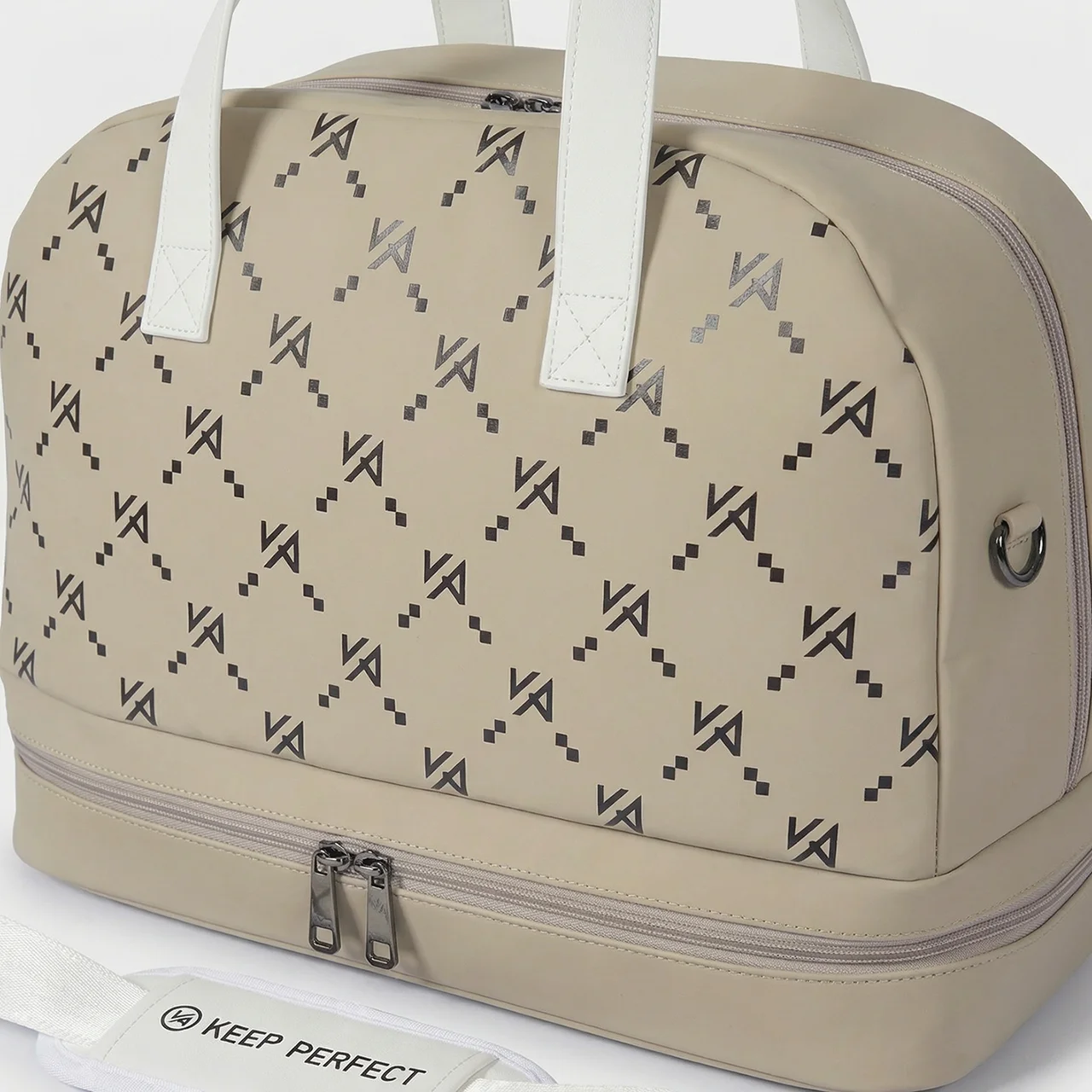
A crew duffel is judged on two things that never appear on a retail page: whether it survives a 30 kg overload by two people pulling opposite handles, and whether a marshal can read the name on it from four metres away. Tournament operations teams, starters, marshals, volunteers and club staff load these bags with caps, gloves, water, radios, scorecards and first aid, then throw them into the back of a cart and forget about them for eight hours. That use case produces a very specific specification, closer to workwear than to luggage: a tarpaulin base, a number 10 zip, bar-tacked handle anchors rated well above the intended load, and an identification panel sized for embroidery rather than print. Programme terms: minimum 200 units in a colourway, 100 for a trial run, six to ten working days per sample, 35 to 50 days on the line, and the ISO 2859-1 plan at AQL 2.5 applied before the container is packed.
Related reading: Custom Golf Bags for Academies, Teams and Schools
What an Onsite Crew Actually Carries
The kit list for a tournament day is heavier and bulkier than most buyers expect. A typical marshal or starter bag holds two dozen caps, a dozen gloves, six to eight 500 ml bottles, two radios with spare batteries, sunblock, insect spray, scorecards and pencils, a small first aid pouch, a spare pair of shoes and a rain jacket. That list weighs 11-15 kg and occupies 40-55 litres before anything is compressed.
The shape of the load matters as much as the weight. Bottles are rigid and concentrate load at the base corners; radios need a padded pocket that is reachable without opening the main compartment; caps and gloves need a top-access opening so a crew member can restock without unpacking the bag in front of a player. A duffel designed as luggage fails all three tests, which is why the crew product is specified separately from a travel duffel of the same volume.
The three access points that make or break the design
A crew bag needs three ways in. A U-shaped top opening of 420-480 mm for bulk restocking, an end pocket of 3-5 litres for radios and paperwork that stays shut all day, and a flat front pocket of 2-3 litres for scorecards and pens. Bags with a single top zip and no end pocket get used with the zip permanently open, which is how the contents end up on a cart path.
The access question also drives the zip specification. A curved U-opening needs a number 10 coil zip with a two-way slider so the bag can be opened from either end, and it needs a zip guard at both curves to stop the tape from being pulled out of the seam under a full load. A number 8 zip on the same opening will fail at the curve within a season, and the failure is always at the same point.
Smaller details separate a bag that a crew keeps using from one that ends up in a storage room. A key clip and a radio loop inside the end pocket, a flat sleeve for a laminated roster, and a webbing loop on the top panel for hanging the bag on a cart rail. Each costs 8-15 cents at volume and each removes a daily annoyance for the person carrying the bag.
Size Tiers and the Load Each One Takes
Four sizes cover the crew and event market, and the volume figure on a spec sheet should always be the internal usable volume rather than the external envelope. A 60-litre external duffel in 600D with a padded base delivers 54-56 litres of usable space, and that gap is what buyers discover when a sample arrives and the bottles do not fit standing up.
| Tier | External size | Usable volume | Empty weight | Working load | Typical use |
|---|---|---|---|---|---|
| Compact | 550 x 280 x 260 mm | 33-35 L | 0.95-1.25 kg | 8-10 kg | Starter kit, gift pack, coach bag |
| Standard | 600 x 300 x 300 mm | 42-45 L | 1.15-1.45 kg | 12-15 kg | Marshal and volunteer kit |
| Crew | 650 x 330 x 330 mm | 55-58 L | 1.35-1.75 kg | 15-18 kg | Tournament operations, full day kit |
| Operations | 700 x 350 x 350 mm | 68-72 L | 1.55-1.95 kg | 18-22 kg | Multi-day events, club storage runs |
The standard and crew tiers carry most of the volume in this category, and the jump between them is not just fabric. A 45-litre bag can use 25 mm webbing and a single-row handle anchor; a 55-litre bag at 18 kg needs 38 mm webbing, a wrapped handle, and a bar-tack plus box-X at each anchor. Buyers who scale a 45-litre pattern up to 60 litres by adding 50 mm of length usually keep the lighter hardware and then wonder why the handles fail first.
Weight targets should be set with the load in mind rather than as an absolute. A 55-litre crew bag at 1.5 kg empty is reasonable, because the hardware that makes it survive 18 kg is heavy. Chasing 1.1 kg on that volume means thinning the base panel and the webbing, and the product fails at the handle rather than at the fabric, which is the more dangerous of the two failure modes because it happens under load.
Why the base is the first thing to specify
The base of a crew duffel is set down on gravel, wet grass, concrete and the metal floor of a cart trailer, dozens of times a day. A 600D shell with a 1.5 mm HDPE board and a tarpaulin outer panel at 500-600 g/m² is the minimum that survives a season. A bag with a fabric-only base abrades through at the corners in six to ten weeks of daily event use, and once the board is exposed the base deforms and the bag stops standing up.
Corner reinforcement is the second detail. A 60 mm radius at the base corners, a double-stitched tarpaulin wrap and a bar-tack at the seam intersection add 25-40 g and roughly 90 seconds of labour, and they are the difference between a bag that returns for a second season and one that does not. Where a programme wants a lighter product for gift use, the honest move is to drop to the compact tier rather than to thin the base of the crew bag.
Handles, Straps and the 30 kg Question
Handle anchors are where a duffel fails, and the failure is almost always a stitch tear rather than a webbing break. Two people lifting a 20 kg bag by opposite handles put a dynamic load of 30 kg or more through each anchor when the bag swings, which is why the test is a 30 kg static hang rather than the working load.
The construction that passes is consistent: 38 mm woven polyester or nylon webbing, a wrapped handle with a 180-220 mm grip length, anchor patches of 600D or tarpaulin on both faces, a box-X with a stitch count of 8-10 per inch through a reinforcement patch, and a bar-tack across the webbing end. One plain row of lockstitch into the shell, which is what a luggage pattern normally specifies, fails this test at around 12-15 kg.
Shoulder straps are a separate decision. A removable 38 mm strap with a 12 mm closed-cell pad and swivel clips adds 90-140 g and lets the bag be carried hands-free across a staging area, which crews value. A fixed strap sewn into the top seam saves weight but cannot be replaced when the pad compresses, so the removable option is worth the cost on anything that will be used for more than one event.
Field note. Test the handle with the bag loaded to 1.5 times the working load and lifted by one handle only. That single-hand lift is what actually happens when a crew member drags a bag out of a cart, and it puts the entire load through one anchor instead of two.
Fabric, Hardware and the Event Environment
Shell fabric for this product sits at 600D for a standard tier and 1,680D for anything that will be dragged. Both take a PU backer at 600-1,000 mm, and both should carry a water-repellent finish, because a bag that sits on wet grass for eight hours will wick water through a plain fabric at the base seam. The tarpaulin base panel is doing most of the work here, and it should be a welded or double-stitched 500-600 g/m² PVC or TPU sheet rather than a coated fabric.
Hardware should be metal where it takes load and moulded where it does not. Die-cast zinc D-rings at the strap anchors, acetal buckles on the compression straps, and nylon coil zips with metal sliders on the main opening are the durable combination. Metal sliders on a curved zip need a slightly heavier tape to avoid pull-through, and the tape is where cheap bags fail within weeks.
Event environments add two requirements that a luggage spec ignores. The first is stacking: bags get piled in a trailer, so the top panel needs a reinforced handle and enough structure to sit under two or three others without collapsing. The second is visibility: a dark bag in a dark trailer at 5 am is a bag that gets left behind, which is why most crew programmes use one high-visibility accent panel, a reflective strip, or a contrasting base.
There is also a compliance dimension for corporate and sponsor programmes. Bags given to volunteers or sold to clubs often carry a sponsor mark, and the artwork has to be cleared for the territories where the event takes place. Keeping the identification panel a standard 90 x 50 mm and the embroidery density at 8,000-12,000 stitches keeps the artwork interchangeable between events without re-setting the machine for every order.
- Shell: 600D polyester with PU backer for standard tier, 1,680D for operations tier, both with a water-repellent finish.
- Base: 500-600 g/m2 tarpaulin over a 1.5 mm HDPE board, double-stitched with a 60 mm corner radius.
- Main zip: number 10 nylon coil, two-way metal sliders, zip guard at both curves of the U-opening.
- Webbing: 38 mm woven polyester at handles and shoulder strap, 25 mm on compression straps.
- Anchors: box-X plus bar-tack through a reinforcement patch on both faces of the shell.
- Identification: 90 x 50 mm panel for embroidery, plus an optional 60 x 35 mm clear window for a name card.
Identification: Names, Numbers and Club Marks
Identification is the feature that turns a generic duffel into a crew product, and it is routinely under-specified. A 90 x 50 mm embroidery panel takes a club crest, a three-line name and a two-digit number at 8,000-12,000 stitches. Anything smaller forces the artwork down to 4 mm letter height, which is unreadable at the four metres that matters on a staging area.
Embroidery beats print for this use for a simple reason: it survives washing, abrasion against cart frames and the UV load of an eight-hour day outdoors. A heat transfer on a 600D shell will lift at the edges within a season, and a screen print on a tarpaulin base will crack at the fold. Where a programme needs individual names per bag, embroidery is also the only method that handles one-off personalisation at a sensible cost.
Numbering deserves its own decision. Patch numbers, embroidered numbers and a sewn-on webbing tab with a printed number all work, but they fail differently: patches peel, embroidery is permanent, and printed tabs fade. For a bag that will be reissued across seasons, embroidery is the right call even at 20-30 seconds of extra machine time per bag. For a one-event giveaway, a printed tab at a third of the cost is defensible.
Where the bag carries a sponsor mark as well as a club mark, plan the panel layout before sampling. A 90 x 50 mm panel fits one primary mark and one line of text; two marks need a 120 x 60 mm panel, which changes the front pocket position and therefore the pattern. Sorting that out on the drawing costs nothing, while sorting it out after the first sample costs a re-cut.
Test Protocol for a Bag That Gets Thrown
The tests that matter for a crew duffel are load, abrasion and closure, in that order. None of them is expensive to run, and all of them should be run on the first article rather than on a bulk sample pulled at random after production.
| Test | Method | Acceptance | Failure it catches |
|---|---|---|---|
| Handle hang | 30 kg static, 24 h, single anchor | No stitch pull, no more than 2 mm extension | Under-specified anchor stitch |
| Dynamic lift | 20 kg, 200 lifts at 1 m/s by two handles | No tearing at patch edge | Patch too small, wrong thread |
| Base abrasion | 500 cycles on 80-grit drum, loaded | No board exposure | Thin tarpaulin, single stitch |
| Zip cycle | 1,000 open and close at the U-curve, loaded | No tape pull-out, no skipped teeth | Number 8 zip on a number 10 opening |
| Drop | 1 m onto concrete, 6 orientations, 15 kg load | No seam burst, contents intact | Corner construction |
| Stack | 3 bags on top, 24 h | Top panel deflects under 15 mm | No top reinforcement |
Handle anchors and base seams must pass a grab test at 250 N under ASTM D5034; shell fabric is torn to ASTM D2261, the test that exposes a 600D fabric delivered at the bottom of its tolerance. Where an embroidered panel or a printed accent is used, light fastness is proven to ISO 105-B02 before the artwork is approved.
The audit runs at AQL 2.5 of ISO 2859-1, general level II, drawing 32 bags out of 200 and allowing a ceiling of two major defects. The crew-specific checkpoints inside that sample are handle anchor stitch pattern, base panel bond, zip slider function at the curve, embroidery position against the panel centre, and finished weight per carton.
Spec tip. Ask for a loaded sample to be photographed hanging by one handle for ten minutes. It sounds crude, but it exposes an under-stitched anchor faster than a laboratory report, and the photograph is a useful reference for the line supervisor during bulk.
From Sample to Container: The Order Path
A crew order moves through seven steps, and the two that decide the delivery date are artwork approval and embroidery scheduling rather than fabric. Buyers who treat the identification panel as a detail to be sorted out late are the ones whose bags arrive after the first event of the season.
- Kit review. The kit list, crew count per event and identification layout are agreed, and the tier is chosen against the heaviest expected load rather than the average.
- Sample. A single bag is made in the chosen tier with a blank identification panel, in 6-10 working days where the pattern and hardware already exist.
- Load test. The sample is hung at 30 kg for 24 hours, loaded and lifted by one handle, and checked on a cart trailer floor before approval.
- Artwork and stitch file. The crest is digitised to 8,000-12,000 stitches, a sew-out is approved on the actual fabric, and the panel position is confirmed against the pattern.
- Bulk cutting and sewing. Panels are cut in the approved colourway, handle anchors are stitched at a dedicated station so the box-X pattern is consistent, and bases are bonded before the body is closed.
- Embroidery and finishing. Names and numbers run at the embroidery station, then the bag goes through final trim, hardware check and weighing.
- Inspection and packing. AQL 2.5 at general level II, then light stuffing, polybag, carton and the loading plan for a full or shared container.
Where a crew order loses time
The most common delay is a crest that arrives as a low-resolution image and has to be redrawn before digitising, which costs three to five days. The second is a colourway chosen from a photograph rather than a physical swatch, which forces a lab dip and a second approval round. Neither is a production problem, and both are avoidable with a vector file and a posted swatch.
The third is a per-bag name list delivered in a spreadsheet with inconsistent formatting. An embroidery station running 600 bags with individual names needs the list in a fixed column order and a clear naming convention, otherwise the operator stops to query every twentieth line. Sending the list in the same format as the sample approval sheet removes that stop-start from the schedule.
Packing, Freight and Container Maths
Duffels pack well because they are soft, and that is a genuine commercial advantage in this category. A 55-litre crew bag folds to roughly 380 x 300 x 120 mm in a polybag, and 30-40 units fit a 600 x 400 x 400 mm export carton at 22-28 kg gross. A 40ft high-cube container takes 2,200-2,800 units depending on carton optimisation and how much the bags are compressed.
That density changes the economics of a seasonal order. A crew programme for a tournament series is often 400-1,200 pieces across two or three colourways, which loads a partial container rather than a full one. Sharing a container with another product line is normal, and it is worth planning carton dimensions so the duffels can be stacked on top of rigid goods rather than beside them, since a soft carton will crush under a pallet load.
Packing detail also affects the customer experience at the event. Bags shipped flat and individually polybagged arrive creased, and a crew opening a carton at 5 am does not have time to reshape forty bags. Shipping lightly stuffed with kraft paper holds the shape, costs 6-9 cents per unit and removes a step that nobody budgets for.
Orders placed with QUANZHOU JUNYUAN BAGS ship FOB Xiamen, which suits this product because the cartons are light for their volume and the port handles partial containers without repacking. Payment runs thirty percent on order and seventy percent against the bill of lading copy.
Production takes 35 to 50 days from sample sign-off. A single-colourway crew order with stock webbing and a standard tarpaulin base sits near 35 days; a four-colourway programme with individual names embroidered per bag, which is common for volunteer kits, sits at the top of the range because the embroidery station becomes the bottleneck rather than the sewing line.
The accessories range that sits alongside this product is listed under golf accessories, and the bulk order process covers what happens between purchase order and container. Buyers planning freight for a multi-product season can size the load with the container loading calculator guide.
Next steps: custom solutions, manufacturing capability, and a quotation request. Golf Accessories and Pouches. Bulk Packaging and Shipping Notes.
Sources and Standards Referenced
- ISO 2859-1:2022 Sampling procedures for inspection by attributes
- ASTM D5034 Breaking strength and elongation of textile fabrics (grab test)
- ASTM D2261 Tearing strength of fabrics (tongue method)
- ISO 105-B02 Colour fastness to artificial light
- US Customs and Border Protection, trade and import guidance
Frequently Asked Questions
What size duffel bag does a tournament crew need?
Between 45 and 58 litres of usable volume for a full-day kit. A marshal bag with caps, gloves, bottles, radios, scorecards and a rain jacket weighs 11-15 kg and occupies 40-55 litres. The 55-58 litre tier is the safest default because it leaves room for a jacket and a spare pair of shoes.
How strong should the handles be?
Each anchor should survive a 30 kg static hang for 24 hours with no stitch pull. The working load is 15-18 kg, but two people lifting by opposite handles put a dynamic load well above that on each anchor, so the test is set at 30 kg rather than at the working load.
What fabric is best for a golf crew duffel?
600D polyester with a PU backer for standard tiers and 1,680D for bags that get dragged, both with a water-repellent finish. The base is the critical zone and should be 500-600 g/m2 tarpaulin over a 1.5 mm HDPE board rather than the same fabric as the body.
Why does the base wear out first?
Because the bag is set down dozens of times a day on gravel, wet grass, concrete and metal trailer floors. A fabric-only base abrades through at the corners in six to ten weeks of daily event use. A tarpaulin panel with a 60 mm corner radius and double stitching is the minimum that lasts a season.
What zip should a duffel use?
A number 10 nylon coil with two-way metal sliders on the main U-opening, and number 8 on pockets. A number 8 zip on a 450 mm curved opening fails at the curve within a season, because the tape is pulled out of the seam under a full load. Zip guards at both curves are part of the specification.
How much does an empty crew duffel weigh?
A 45-litre bag runs 1.15-1.45 kg, a 55-litre bag 1.35-1.75 kg and a 70-litre operations bag 1.55-1.95 kg. Cutting below those figures usually means thinning the base panel or the webbing, which moves the failure from the fabric to the handle.
Can the bag carry individual names?
Yes. A 90 x 50 mm panel at 8,000-12,000 stitches takes a crest, a three-line name and a number. Embroidery is the right method for individual names because it survives washing and abrasion, and it handles one-off personalisation at a sensible cost per bag.
Is embroidery better than printing for club marks?
For anything used outdoors and repeatedly, yes. A heat transfer on 600D lifts at the edges within a season and a screen print cracks at folds on a tarpaulin base. Embroidery adds 20-30 seconds of machine time per bag and is permanent.
What is the MOQ for a custom crew duffel?
Two hundred units per colourway, or 100 in one colour and one identification layout as a trial. A new body shape lifts the entry point to 500 units, because a fresh pattern has to be cut and graded before production can start.
What is the lead time for a crew order?
Allow 35 to 50 days from sample sign-off on a single colourway with stock webbing. Embroidery per bag or a four-colourway programme pushes toward 50, since the embroidery station becomes the constraint rather than the sewing line.
How many duffels fit in a container?
A 55-litre bag folds to roughly 380 x 300 x 120 mm, and 30-40 units fit a 600 x 400 x 400 mm carton at 22-28 kg gross. A 40ft high-cube container takes 2,200-2,800 units depending on carton optimisation and compression.
How is a crew order inspected before shipping?
ISO 2859-1 at AQL 2.5, general level II: 32 bags pulled from every 200, with a two-defect ceiling before a lot can be rejected. Crew-specific checks are handle anchor stitching, base panel bond, zip function at the curve, embroidery position and carton weight.
Spec a Crew Kit Bag
Send the kit list, the number of crew per event and the identification layout, and the reply will name the tier, the handle construction and the embroidery position.
Send the Kit List View Accessories