Golf Bag Stand Leg Mechanism: Engineering and Testing
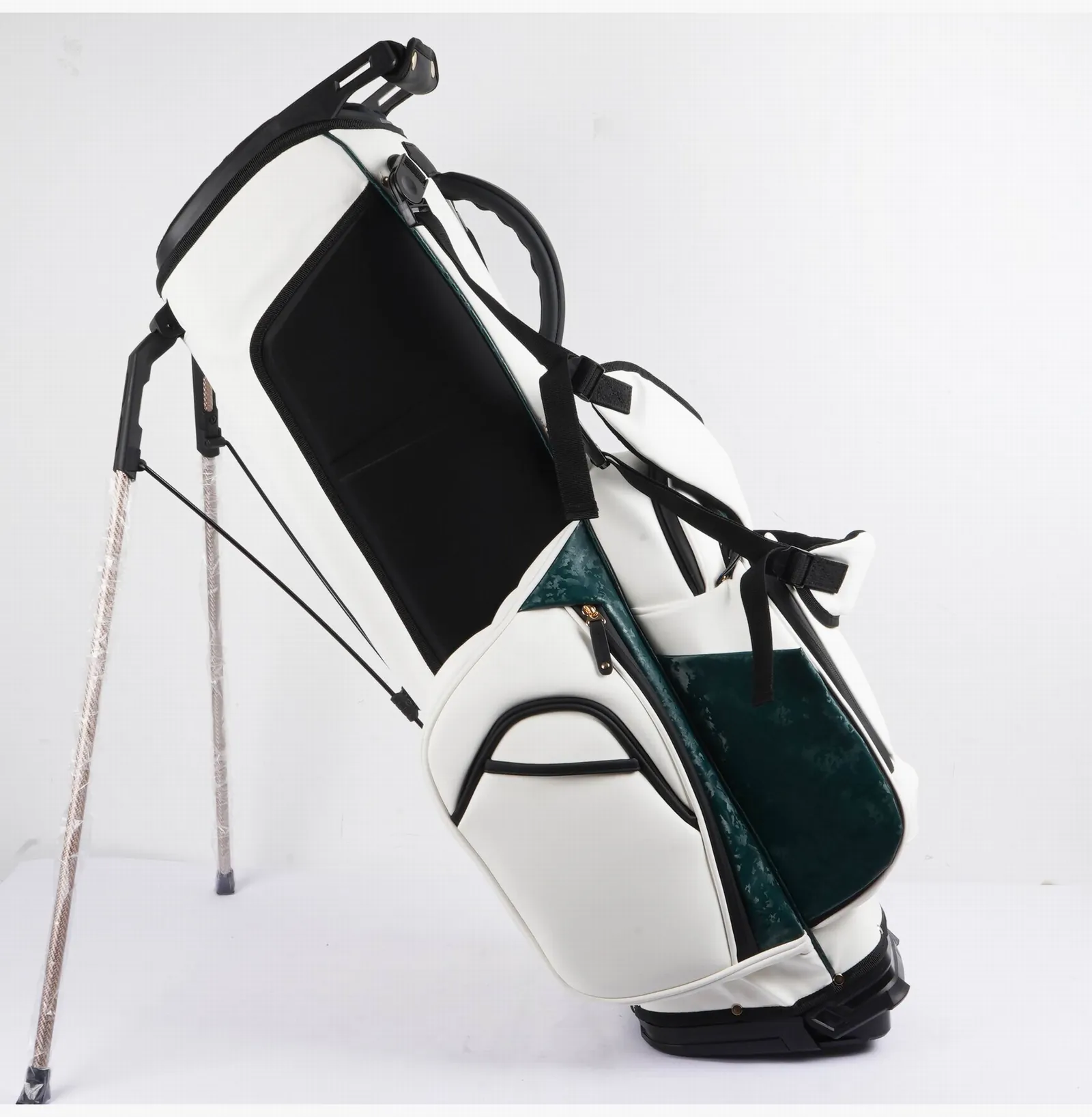
The stand mechanism on a golf bag does its whole job in about half a second, then repeats it forty times a round for eight seasons. It has to release when the bag is set down, hold a loaded bag steady on uneven ground, retract cleanly when the bag is lifted, and do all of it without a rattle, a squeak or a leg that splay out at a different angle from its partner. That is a mechanical engineering problem disguised as a bag feature, and it is usually specified with a drawing and a single sentence. The mechanism deserves better: spring type, pivot geometry, material choice and a defined cycle test decide whether the stand works in year one and whether it still works in year six. Runs begin at 200 pieces per colourway, first articles arrive in 6-10 working days, bulk is 35-50 days, and lots pass through AQL 2.5 sampling under ISO 2859-1.
What the Mechanism Actually Has to Do
A stand bag carries 12-14 clubs, a dozen balls and whatever else lives in the pockets, so the mechanism is holding 12-18 kg on two thin legs at a splay of 20-25 degrees. It has to deploy from a stored position without the user doing anything except lowering the bag, and it has to retract fully when the bag is lifted so the legs do not catch on a cart, a car boot or a playing partner. Those two requirements pull in opposite directions: a spring strong enough to deploy reliably is also strong enough to resist retraction, and a mechanism tight enough to stop rattle is a mechanism that binds when sand gets into the pivot.
Add the environmental load. The bag stands in dew, rain, sand and fertiliser, is stored in a garage that swings from -5°C to 40°C, and is thrown into a car boot several times a week. Glass-filled nylon hubs absorb moisture and change dimension slightly. Spring steel loses tension at a predictable rate. Plated pins corrode at the ends where the plating is thinnest. None of these effects is dramatic on its own, and together they explain why a mechanism that feels perfect in the showroom can feel tired after two seasons.
The engineering brief, therefore, is not "make the legs open". It is "open reliably, hold steady, retract fully, stay quiet, and keep doing it for a defined number of cycles across a defined temperature range". That brief is testable, and everything below is about how to test it.
Related reading: Golf Stand Bag vs Cart Bag: Which Is Better for Regular Use
The Two Architectures in Production Today
Almost every stand bag on the market uses one of two mechanisms, and the choice shapes the rest of the design. Both are simple, both are cheap to make, and both fail in characteristic ways.
Hub with a torsion spring
In the hub design, both legs pivot on a single moulded bracket at the top of the bag body, and a torsion spring coiled around the pivot axis pushes them outward. The base of the bag carries a plate or a linkage that pulls the legs open as the bag is set down, and the same spring returns them when the load is removed. The architecture is compact, protects the spring inside the hub, and gives a symmetrical splay that is easy to control. Its weakness is the hub itself: a glass-filled nylon bracket takes the whole bending moment, and a crack at the spring pocket is the classic failure.
Wire legs with an external pivot block
The second design uses two bent wire or aluminium legs, each pivoting in its own block sewn or riveted to the side of the bag, with a spring wire or an elastic element providing the return force. It is cheaper to tool, easier to replace in the field, and spreads the load across two separate anchors. The trade-off is asymmetry: two independent pivots can drift apart in angle, and a block that loosens by a millimetre produces a visible difference in splay. It also exposes the spring to abrasion from the bag fabric and to sand carried up the leg.
Neither architecture is better in the abstract. A hub suits a compact stand bag where the mechanism must disappear into the silhouette. Independent blocks suit a larger bag where field replacement matters and where the leg length can be tuned. What matters is that the chosen architecture gets a test plan matched to its specific failure points, rather than a generic "legs open and close" check.
Geometry: Splay, Trip Angle and Ground Clearance
Geometry is where most of the perceived quality lives, and it is fixed at the drawing stage rather than on the line. Three angles and one length do most of the work.
Splay is the angle between each leg and the vertical when fully deployed, and 20-25 degrees is the usual range. Too little and the bag is tippy in wind; too much and the legs skate outward on a smooth floor or push the base forward. The two legs must match within about 2 degrees, or the bag sits with a lean that the user notices immediately even if the numbers are within tolerance.
Trip angle is the forward tilt at which the base actuator releases the legs. It is set by the shape of the base plate and the length of the linkage, and it determines how far the user has to lean the bag before the stand engages. A trip angle that is too shallow makes the legs pop out while the bag is being carried on a shoulder; too deep and the bag has to be almost laid down before the stand releases, which feels broken. The usable window is narrow, typically 10-15 degrees of tilt, and it should be measured on the assembled bag rather than assumed from the mould.
Ground clearance and leg length work together. The leg tips must reach the ground with the base just clear of it, so that the bag rests on two legs and the base rim rather than balancing on the legs alone. If the legs are 10 mm short, the base takes the load and the bag rocks; if they are 10 mm long, the base lifts and the bag becomes a tripod on a narrow footprint. Matching leg pairs within 2 mm, and matching the pair to the base geometry, is a specification item rather than a trimming detail.
Measure splay on the bag, not on the jig. A hub that gives 22 degrees on a bare bracket can give 25 degrees once the fabric body and a loaded pocket pull against it. Always measure the finished, loaded bag on a flat floor with the legs deployed under 10 kg. The jig number is useful for the mould, not for the customer.
Load Cases the Mechanism Must Survive
A mechanism designed only for its own weight will pass a sample review and fail in service. The table below lists the load cases that actually matter, with the level a production specification should carry.
| Load case | How it happens | Design target | Where it shows up |
|---|---|---|---|
| Static stand load | Loaded bag resting on legs | 30 kg total, 24 hours, no permanent set over 2 mm | Base rim contact, leg bow |
| Deploy cycle | Bag set down and lifted | 20,000 cycles, still deploying and retracting | Spring fatigue, pivot wear |
| Lateral push | Bag nudged or leaned on | 15 kg sideways at the top, no collapse | Hub crack, pivot pin shear |
| Drop | Bag dropped from a car boot | 1 m onto concrete, 3 orientations | Leg bend at the insert, block loosening |
| Cold deploy | Winter round, -10°C | Deploys within 1 second, no cracking | Hub brittleness, grease stiffness |
| Corrosion | Wet season, repeated soaking | 96 hours salt spray, no functional loss | Pin corrosion, spring wire pitting |
| Sand ingress | Pivot packed with sand | Deploys and retracts without binding | Clearance at the pivot bush |
The lateral push case is the one most often omitted and most often the cause of a cracked hub. A bag standing on a slope, or a player leaning a club against it, applies a bending moment the hub was never sized for if the drawing only considered vertical load. A 15 kg push at the top of a 900 mm bag is a substantial moment at the bracket, and a hub with a thin spring pocket will find it.
The cold case matters for a different reason. Glass-filled nylon becomes noticeably more brittle below -5°C, and a grease that feels smooth at room temperature can stiffen enough to delay deployment by half a second. Testing at -10°C is not exotic; it is a Tuesday morning in Scotland in February, and a mechanism that fails there will generate returns from exactly the market that buys stand bags.
Materials and Tolerances at the Joint
The pivot is where engineering becomes tolerance. A 5-6 mm stainless or plated steel pin running in a nylon or POM bush needs 0.1-0.2 mm of clearance: enough to move freely with a grain of sand present, tight enough that the leg does not wobble. Below 0.1 mm the joint binds when the bag is wet and the bush swells. Above 0.25 mm the leg rocks visibly and the splay angle drifts as the hole wears oval.
Legs are usually 8-10 mm aluminium tube or solid fibreglass rod. Aluminium is stiffer and takes a bend without shattering, but it dents and then binds. Fibreglass springs back from a knock, weighs less, and fails by splintering at the insert rather than by bending. Whichever is chosen, the insert that joins the leg to the pivot is the stress concentration, and it should be a moulded sleeve with a generous radius rather than a rivet through the tube wall.
The spring itself deserves a specification rather than a part number. A torsion spring of 2-3 N·m at the deployed position, made from oil-tempered or stainless wire, with a fatigue life beyond the cycle target, is the normal range. Springs are the cheapest component in the assembly and the one that determines whether the stand still works in year five, so a supplier change on the spring without a re-test is a risk that should be written out of the agreement.
| Component | Typical specification | Why the number matters |
|---|---|---|
| Pivot pin | 5-6 mm stainless or plated steel | Corrosion at the cut end is the first sign of wear |
| Pivot bush | Nylon or POM, 0.1-0.2 mm clearance | Binding below, rattle and oval wear above |
| Leg | 8-10 mm aluminium tube or fibreglass rod | Sets whether it dents or splinters on impact |
| Leg insert | Moulded sleeve with radius, not a rivet | The stress concentration in every drop test |
| Spring | 2-3 N·m torsion, oil-tempered or stainless | Decides retraction at year five, not year one |
| Hub | Glass-filled nylon, thickened at spring pocket | The bending moment under a lateral push lands here |
The Test Protocol
A stand mechanism test is a sequence, not a single rig run. The order matters because a cycle test on a mechanism that has already corroded tells a different story from a cycle test on a new one, and both stories are useful.
Running the rig at a realistic pace
- Measure splay, trip angle and leg length on five samples from the first lot, and record them against the drawing.
- Run a static load of 30 kg for 24 hours with the legs deployed, then re-measure for permanent set.
- Run 20,000 deploy and retract cycles on a rig at 20 cycles per minute, checking every 2,000 for binding, noise and retraction time.
- Repeat 2,000 cycles at -10°C and at 40°C to cover the seasonal extremes.
- Drop the loaded bag from 1 m onto concrete in three orientations and inspect the hub, blocks and leg inserts.
- Expose a set to 96 hours of salt spray, then repeat 200 cycles to confirm the mechanism still functions.
- Cut open one sample per lot to inspect spring condition, bush wear and pin surface, since these are invisible from outside.
Cycle rate is worth stating because it changes the result. Running at 20 cycles per minute approximates real use closely enough; running at 60 heats the pivot and hides a binding problem that appears at walking pace. Retraction time should be measured, not just observed: a mechanism that returns in 1.2 seconds when new and 2.8 seconds after 20,000 cycles has lost most of its margin even though it still technically closes.
The salt spray step is the one most often skipped on cost grounds, and it is the one that predicts the second-season complaint. A plated pin with a thin coating at the cut end will pit within a wet month, and a pitted pin wears the bush quickly. Stainless pins cost a few cents more and remove the whole failure path.
Failure Modes and What They Tell You
Each failure mode points at a different part of the design, which is why a returned bag is worth dissecting rather than simply replacing. The list below covers what actually comes back.
- Legs will not retract fully: spring tension lost, or the return path fouled by fabric, sand or a bent leg tip.
- Legs deploy while the bag is carried: trip angle too shallow, or the base actuator worn enough to release early.
- Uneven splay between the two legs: one pivot block loose, one pin worn oval, or legs mismatched in length.
- Rattle while walking: pivot clearance above 0.25 mm, or a spring that has lost preload and sits loose in its pocket.
- Crack at the hub spring pocket: hub wall too thin for the bending moment, or a cold-impact failure at the bracket.
- Leg bent at the insert: impact load transferred through a rigid joint with no radius, rather than a sleeve that spreads it.
- Stiff deployment in cold weather: grease viscosity, bush clearance at the tight end of tolerance, or moisture frozen in the pivot.
Two of these are design errors and five are process errors, which is a useful ratio to keep in mind. A hub that cracks under a lateral push was under-designed and no inspection will fix it. A pin that wears oval because clearance was set at 0.3 mm is a process problem that a gauge at goods-in would have caught. Sorting a complaint into design or process before acting is the difference between a permanent fix and a recurring one.
Inspection, Sampling and the Specification
Routine inspection of the mechanism is mostly functional rather than dimensional, because the critical dimensions are inside the joint. Each finished bag should be deployed and retracted twice on the line, checked for full retraction within 1.5 seconds, listened to for rattle, and checked for splay symmetry against a template. That takes about fifteen seconds and catches the assembly errors that dimensional sampling misses.
Lot inspection then applies AQL 2.5 under ISO 2859-1, with the mechanism-specific critical defects defined as: a leg that fails to retract, a hub or block crack, a missing spring, or splay asymmetry beyond 3 degrees. Major defects cover rattle, retraction slower than 2 seconds, and leg length mismatch beyond 2 mm. Minor covers cosmetic marks on the leg finish. As with every other component, the classification has to be agreed before the first lot is inspected, not after a rejection.
The specification itself should fit on one page: architecture, spring rate and material, pin diameter and clearance, bush material, leg material and length, splay and trip angle with tolerances, cycle target, temperature range, corrosion requirement, and the functional check at the end of the line. That page is what a new mould or a new supplier is measured against, and it is what makes a second production run match the first.
Sampling a new stand mechanism runs 6-10 working days once the drawing is agreed, and a new hub mould or a revised bracket adds 12-15 working days. New development starts at 500 pieces, with trial orders of 100 available once the tooling exists, and bulk production runs 35-50 days. Terms are a 30% deposit with the balance before shipment, quoted FOB Xiamen. QUANZHOU JUNYUAN BAGS has built stand bags since 2014 with a team that has worked in the trade since 2004, and the leg mechanism is treated as a tested assembly rather than a purchased accessory.
The stand bag weight limits and carry loads article explains how the mechanism rating interacts with what the bag is expected to carry, and the durability test on stand bags sets the mechanism inside the wider wear picture. Get the geometry and the spring right, test to a defined cycle count at both temperature extremes, and the stand will still work when the fabric around it has started to look tired.
Next steps: custom solutions, manufacturing capability, and a quotation request. Golf bag stitch count QC. Stand bag weight limits.
Sources and Standards Referenced
- ASTM D5034 Breaking strength and elongation of textile fabrics (grab test)
- ISO 2859-1 Sampling procedures for inspection by attributes
- ISO 9001 Quality management systems
- USGA equipment rules and club and ball conformance
- ECHA REACH regulation on chemicals in consumer articles
Frequently Asked Questions
How do stand bag legs open?
The bag body carries a base actuator that is compressed when the bag is set down. That movement is transferred through a linkage or a plate to the leg pivots, which swing the legs outward against a spring. When the bag is lifted, the actuator releases and the spring returns the legs to the stored position. The whole action is mechanical and passive; there is no lock or button, which is why trip geometry matters so much.
How many cycles should a stand mechanism survive?
A reasonable production target is 20,000 deploy and retract cycles with no loss of function, plus 2,000 cycles at -10°C and at 40°C. Twenty thousand cycles is roughly eight to ten years of twice-weekly golf with several deployments per round. Testing to 5,000 cycles, which some catalogues quote, proves only that the mechanism works when new. Retraction time should be recorded through the run, not just pass or fail.
Why do my stand bag legs stay out when I pick it up?
The return spring has lost tension, or something is fouling the return path. Common causes are a stretched or fatigued torsion spring, sand packed into the pivot, fabric caught in the hinge, or a leg tip that has bent and is dragging. On older bags the spring is usually the answer. On new bags, check that the pivot clearance is not at the tight end of tolerance, which binds when the bush swells in damp weather.
What spring is used in a golf stand bag?
Most hub designs use a torsion spring coiled around the pivot axis, rated around 2-3 N·m at the deployed position and made from oil-tempered or stainless wire. Block designs often use a bent spring wire or an elastic element instead. The specification that matters is the torque at deployment plus a fatigue life beyond the cycle target. A spring change without a re-test is a common cause of field failure.
How much weight can a stand bag leg take?
A loaded stand bag applies roughly 15 kg to each leg when deployed, and the mechanism should be designed for a 30 kg total static load held for 24 hours with no permanent set beyond 2 mm. The legs also see a lateral component when the bag is pushed or leans, so a 15 kg sideways load at the top is a sensible design case. Rating only for vertical load under-sizes the hub.
Why do the legs splay unevenly?
Uneven splay comes from asymmetry somewhere in the assembly: one pivot block loosened, one pin worn oval, legs cut to different lengths, or one spring weaker than its partner. On a new bag, check leg length first, since a 3 mm difference is visible as a lean. On a used bag, check pin wear and block tightness. Two degrees of difference is the practical tolerance before a user notices.
Do stand bag legs bend easily?
Aluminium legs dent and bend under a hard impact, usually at the insert where the leg meets the pivot. Fibreglass rods spring back from knocks but splinter at the same point if overloaded. Both are improved by a moulded sleeve with a generous radius at the joint, rather than a rivet through the tube wall. A leg that bends at the insert is a joint design issue more than a material issue.
Does cold weather affect the mechanism?
Yes, in two ways. Glass-filled nylon becomes more brittle below about -5°C, so a hub that survives a drop at room temperature can crack at -10°C. Grease also thickens, which slows deployment and can make the legs feel sticky for the first few cycles. Testing at -10°C is the practical way to catch both, and a low-temperature grease plus slightly generous pivot clearance removes most of the problem.
How is the mechanism tested before shipment?
Sampling covers splay and trip angle measurement, a 24-hour static load, 20,000 cycles with periodic checks, temperature extremes, a 1 m drop test and 96 hours of salt spray. Production inspection is functional: each bag is deployed and retracted twice, timed for full retraction, listened to for rattle, and checked for symmetry. Lots are then sampled to AQL 2.5 under ISO 2859-1 with mechanism defects classified in advance.
Can the legs be replaced?
On a block design, usually yes: the leg and block are separate parts and a replacement leg can be fitted with basic tools. On a hub design, the legs are often moulded or pinned into a single assembly, so replacement means changing the hub. That difference is worth deciding at the design stage, because field serviceability is a selling point for clubs and resorts that maintain a fleet of bags.
What is the trip angle and why does it matter?
Trip angle is the forward tilt at which the base actuator releases the legs. If it is too shallow, the legs deploy while the bag is being carried and catch on everything. If it is too deep, the user has to lay the bag almost flat before the stand engages, which feels broken. The usable window is around 10-15 degrees, and it must be measured on the assembled, loaded bag rather than on a bare bracket.
What tolerances matter on the leg hub?
Four numbers do most of the work: pivot clearance of 0.1-0.2 mm, splay symmetry within 2-3 degrees, leg length matched within 2 mm, and spring torque within about 10% of nominal. Hub wall thickness at the spring pocket is the fifth, and it is a design value rather than an inspection value. Everything else is cosmetic. Gauge the first four at goods-in and the field failure rate drops sharply.
Send Your Mechanism Drawing
Send the leg drawing, target carry load and cycle requirement, and a mechanism specification with spring, pivot and test protocol comes back within two working days.
Get a Mechanism Spec See Custom Solutions