Golf Bag Sample Approval and Color Difference Tolerance
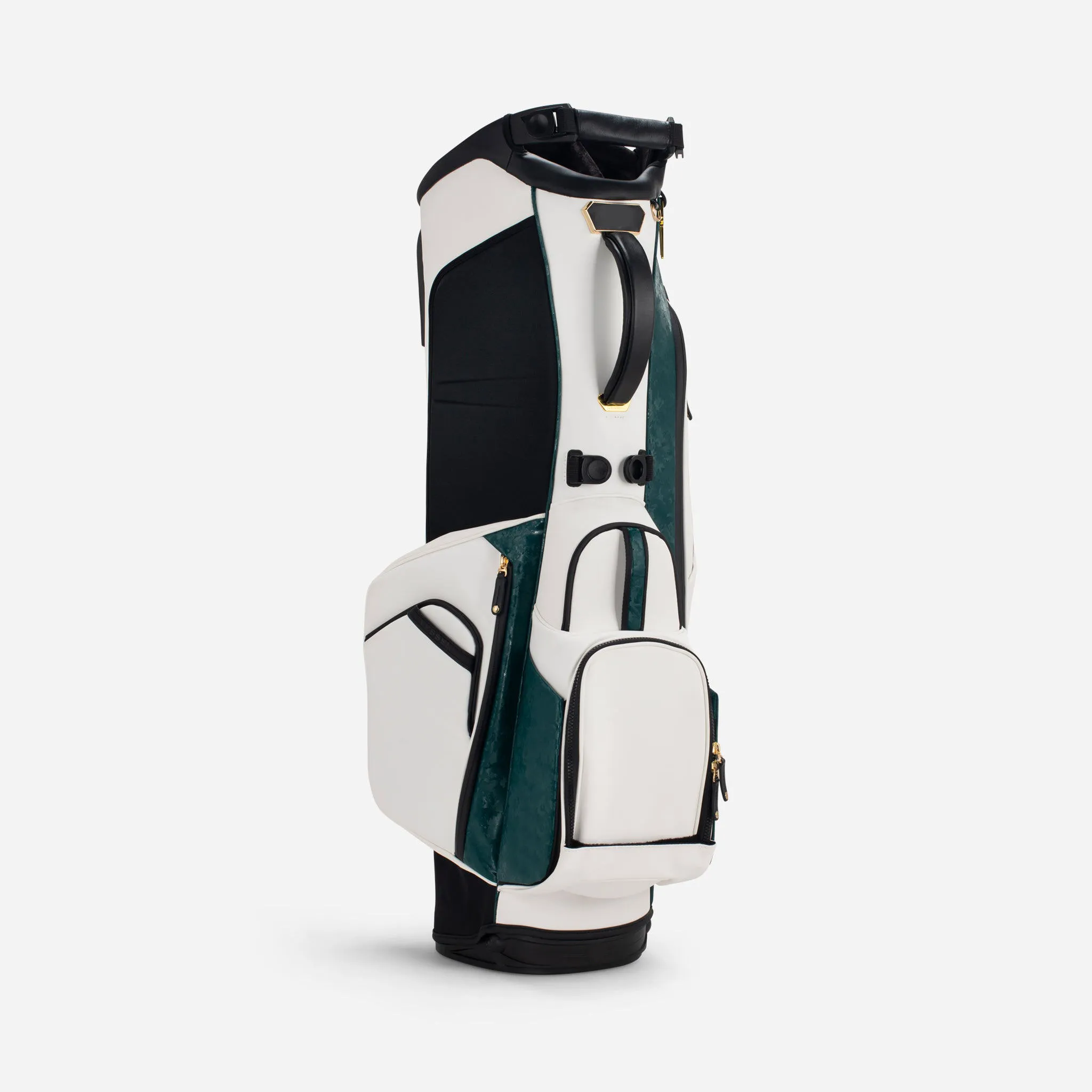
Sample approval is not a yes-or-no decision on one bag; it is a sequence of five approvals, each of which closes a different risk, and colour is the one that keeps reopening after the paperwork is signed. The stages run lab dip, prototype, salesman sample, pre-production sample and production check sample, and each has its own lead time and its own signature. Colour is judged against a number rather than an opinion, normally Delta E to a stated formula under a stated light source, with limits that change depending on whether the surface is woven fabric, PU trim, moulded plastic or thread. Get the sequence and the numbers into one sign-off sheet and most of the arguments that follow a bulk delivery never happen.
Related reading: How to Judge a Sample Beyond the Photograph
Five Sample Stages and What Each One Approves
Buyers routinely talk about "the sample" as though there were one. There are five, and confusing them is the most common cause of a bulk delivery that matches nothing in particular. Each stage answers a more specific question than the one before it, and each should be signed by a named person rather than by a department.
| Stage | Question it answers | Typical lead time | Who signs |
|---|---|---|---|
| Lab dip and material swatch | Is the colour and hand achievable in this material? | 4-7 working days | Design lead |
| Prototype | Does the construction work at all? | 6-10 working days | Product manager |
| Salesman sample | Does it look right for the range and the price? | 8-12 working days | Commercial lead |
| Pre-production sample | Will the line build it to spec, at tolerance? | 6-10 working days, 12-15 with a new mould | Technical lead |
| Production check sample | Is the running lot consistent with the approved unit? | 2-4 working days into the run | Quality lead |
The prototype exists to fail. Send it to a caddie, load fourteen clubs into it, open and close the stand fifty times, and put it on a cart. A prototype that survives a week of that treatment is worth the freight; one that only looks correct on a table is a photograph with a zipper.
The pre-production sample is the stage that binds. It must be built with production tooling, production thread, production lining and the actual dye lot that will run, on the actual line that will run it. Anything less and you are approving a cousin of the product rather than the product itself.
The lab dip is a decision, not a delivery
A lab dip arrives as a small square of dyed fabric and is usually approved by eye in thirty seconds. It deserves longer, because it is the cheapest point in the entire programme to change course. Hold it against the trim, against the lining and against the thread under two light sources, and measure it if the surface is flat enough to read. A dip that reads 1.8 against a 1.5 limit will read worse once the fabric is coated, laminated and sewn into a panel.
Approve the dip with a written note of which illuminants were used and which components it was compared against. That note becomes the reference when the bulk dye lot arrives eight weeks later and somebody asks what exactly was agreed.
Building a Sign-Off Sheet That Settles Arguments
A sign-off sheet is not a formality. It is the document that defines the standard for every future delivery, and it is written once per colourway per programme. Twelve fields cover almost everything that goes wrong later.
- Programme code, colourway name, sample stage and version number, with the date of issue.
- Dimensional record: top oval, height, base footprint, pocket openings, strap anchor positions.
- Weight of the empty bag, and the weight of each major sub-assembly where it has been specified.
- Material identification by supplier code, not by trade description, plus the colour reference for each component.
- Colour measurement record: instrument, geometry, illuminant, observer, number of readings, Delta E value and formula.
- Construction details that must not drift: stitch density, thread type, bartack positions, seam allowance, binding width.
- Hardware list with finish and plating reference, since two finishes can share a name and differ by two shades.
- Artwork placement dimensions and the approved print or embroidery proof reference.
- Packing specification: polybag, hangtag, carton count, carton dimensions and shipping mark.
- Tolerance table for the parameters that will be measured at bulk inspection.
- Photographic set: six angles under consistent light, plus close-ups of every seam junction.
- Signature blocks for buyer and supplier, with a statement that the sheet supersedes all earlier versions.
Two fields are usually missing and both cause trouble. Weight is the first: a bag that arrives 180 g over target cannot be fixed by adjusting a strap, because the excess sits in the divider, the padding and the base plate. The second is the tolerance table, which turns vague expectations into measurable acceptance criteria and gives an inspector something to hold.
Issue the approved sheet as a controlled document with a version number. When something changes, reissue the whole sheet rather than amending a paragraph in an email, and state clearly which version is current. Suppliers work from whichever document is nearest the sewing floor, and that is rarely the newest one unless the old one has been withdrawn in writing. The same discipline applies to the request itself, which the sample request walkthrough covers step by step.
Measuring Colour Instead of Arguing About It
Colour disputes consume more time in this category than any other single issue, and almost all of them are caused by measuring with adjectives. A spectrophotometer removes the adjectives. It does not remove judgement, because the limit still has to be chosen, but it makes the conversation numerical.
The measurement itself has variables that must be fixed in the specification. Use a 45/0 or integrating sphere instrument, D65 illuminant and the 10-degree observer, and average three readings per sample. Fold fabric to at least four layers so the backing does not influence the result, and keep the same orientation relative to the warp, because a twill or a brushed finish reads differently along and across the grain.
Then choose the formula. Delta E CMC(2:1) has been the textile convention for decades and weights differences in hue, chroma and lightness to match how the eye judges fabric. Delta E00 is more uniform across the colour space and is now common in automotive and plastics work. Whichever you choose, name it in the specification, because the same pair of samples can differ by 30-40% in number between the two formulas.
Practical limits for golf bags, measured on the finished component rather than on a flat swatch:
| Surface | Within a lot | Lot to lot | Watch out for |
|---|---|---|---|
| Woven shell fabric (600D-1680D) | Delta E00 1.0 | Delta E00 1.5 | Shade banding across a roll; pile direction |
| PU or PVC trim | Delta E00 1.5 | Delta E00 2.0 | Batch-to-batch gloss change, not just hue |
| Moulded PP or nylon parts | Delta E00 1.5 | Delta E00 2.5 | Masterbatch variation; regrind content |
| Embroidery thread | Delta E00 2.0 | Delta E00 2.5 | Sheen differs from fabric at the same number |
| Coated or waterproof fabric | Delta E00 1.5 | Delta E00 2.0 | Coating thickness alters apparent depth |
Those limits are tighter than many suppliers will offer by default and looser than a lab instrument can achieve. The reason is that they are set for the eye at retail distance, in daylight, on a finished bag — not for a swatch on a bench. Setting a limit of 0.5 across different substrates is a guarantee of rejected lots that nobody can actually see.
Spec tip. Write the tolerance against the finished assembly, not the greige fabric. A black PU trim and a black 600D shell read as the same colour only when the sheen is matched, and sheen is not captured by a Delta E number at all. Add a visual check on the assembled bag under two light sources.
Tolerance by Material, and Why One Number Cannot Cover a Bag
A golf bag is a stack of different surfaces within 30 cm of each other: woven shell, coated fabric, PU trim, moulded collar, metal hardware, embroidery thread. Each reflects light differently, and each is coloured by a different process. A single tolerance across the whole bag guarantees either a rejected lot or a standard nobody follows.
The assembly is where the eye actually judges. Two panels can each sit inside their own tolerance and still look wrong together, because one is 1.2 units light and the other 1.4 units dark, and the difference compounds at the seam. Specify a panel-to-panel limit for surfaces that touch: usually Delta E00 1.5 for fabric against fabric, and 2.0 where fabric meets PU or moulded plastic.
Within-lot versus lot-to-lot
These are different risks and need different limits. Within-lot variation is what a customer sees on one bag or across a carton, so it must be tight — shade banding on a single panel is a visible defect at any price point. Lot-to-lot variation is what a repeat buyer sees between shipments, and it drives whether a second order can sit on the same shelf as the first. A programme can pass the first and fail the second, which is why both limits belong in the sheet.
Where visual assessment still belongs
Instruments measure a 10 mm aperture. Iridescent coatings, brushed nylons, metallic threads and pearlescent PU finishes shift colour with angle in ways a single reading misses. For those surfaces, pair the number with a visual assessment in a light booth under D65 and a second source such as F11 or horizon, using a grey scale rating of 4-5 as the pass line. The number and the eye should agree; when they disagree, the eye wins at retail.
Metamerism: The Problem That Appears in the Shop, Not the Lab
Two samples can match perfectly under D65 and separate under the warm light of a pro shop or the fluorescent tubes of a warehouse. That is metamerism, and it happens when the two colours are built from different pigment systems — a dyed polyester against a pigmented PU, for instance. The instrument says pass; the customer says the trim is green.
The fix is procedural rather than technical: specify two illuminants for approval, normally D65 plus one warm source, and require the supplier to submit the lab dip for both. Record both readings on the sign-off sheet. Where a programme has a history of metameric complaints, ask for a pigment system match at the dip stage rather than correcting it at bulk.
One more environmental factor is easy to ignore. Coated fabrics and PU trims yellow with UV exposure and with age, and two materials yellow at different rates. A bag that leaves the line matched can look mismatched after a season in a shop window. Light fastness to ISO 105-B02, at a stated rating for each component, is the control, and it belongs in the material specification rather than the sample approval. The material selection guide sets out which substrates are most exposed to this drift.
Retail lighting is the final variable. Warm LED in a pro shop, cool fluorescent in a warehouse and daylight through glass produce three different impressions of the same bag. If your channel includes display windows or counter lighting, photograph the approved sample under the closest match to that source and keep the image with the sheet. It settles arguments about which light was used in an approval, years after the fact.
What Changes After Approval, and What It Costs
Approval is not the end of change; it is the point after which change has a price. Buyers who understand the price negotiate better and change less.
A colour change after pre-production approval usually requires a new dip and, where the fabric is dyed to order, a new dye lot. Dye-house minimums commonly sit at 300-500 metres per shade, so a late colour change can strand several hundred metres of fabric and add 10-15 days to the schedule. A construction change is worse: it reopens sampling, which means 6-10 working days, or 12-15 where a tool is affected, and it pushes the bulk start accordingly.
A logo or artwork change after approval is the cheapest and most common. It costs a new proof and a print screen, generally 3-5 days, provided the placement dimensions do not move. Moving the placement means new panels and, for embroidery, a new digitised file, which is where the cost jumps.
The commercial consequence is straightforward: every change after approval consumes part of the 35-50 day bulk window. Three small changes across a programme is normal. Six changes usually means the delivery date moves, and the blame sits with the approval sequence rather than with production.
Sampling Timeline and the Places It Slips
Sampling is quoted at six to ten working days for a standard construction from stock materials, extending to twelve to fifteen when a mould is new and first article must be measured. Those numbers assume a complete tech pack, materials in stock and one revision round. Real programmes usually need the revision round, so plan for it.
- Day 0: tech pack, artwork and material references received and confirmed complete by both sides.
- Days 1-3: material check, lab dip request or swatch pull, pattern and marker preparation.
- Days 4-7: cutting, sewing, hardware setting and first assembly.
- Days 8-10: measurement against the sheet, colour reading, photographic set, internal review before dispatch.
- Days 11-14: freight to the buyer, buyer review and comment consolidation.
- Days 15-24: one revision round, re-measurement and re-approval.
The slip points are predictable. Material that is out of stock adds a week before cutting begins. Artwork arriving after the sample is sewn adds a second sample rather than a revision. A buyer who reviews by photograph rather than in hand usually requests a change that would have been obvious on the bench, which costs a round.
Approval authority is the fourth slip. Where three people have to agree and only one of them travels, the sample sits in an office for a fortnight. Name one approver and one deputy in the sign-off sheet, and let the deputy act if the approver is away.
Bulk follows the sealed sample at 35-50 days, with inspection to the 2.5 AQL of ISO 2859-1, general inspection level II, sampling a 200-unit lot at 32 units. Payment runs T/T 30/70 against FOB Xiamen. Sampling itself is scheduled against the same capacity that runs bulk, which is why a late approval does not just delay the start — it can move the whole slot.
Sealing the Standard: Golden Samples and Their Care
An approved sample that lives on a shelf and is handled weekly is not a standard; it is a reference that drifts. The golden sample should be sealed, labelled with programme, colourway, version and date, and stored flat in the dark. Keep two: one with the buyer, one with the supplier, sealed identically and photographed at the moment of sealing.
Replace the golden sample on a defined cycle, typically every 24 months or whenever a material change is approved, because PU and coated fabrics shift with age and a standard that has aged becomes easier to pass. Record the replacement in the programme file so a later delivery is not measured against a standard that no longer represents the product.
The programmes we support run two hundred units per colour in bulk, a hundred on trial, and five hundred where a new development is opened, which means most buyers see three approvals before a repeat order. Keeping the three sealed units — prototype, pre-production, production check — gives a physical history of what was agreed at each step, and that history is what makes a repeat order boring in the best sense. Production sits in Quanzhou on dedicated capacity, with third-party factory audits available on request under the QUANZHOU JUNYUAN BAGS name, with a team in bag engineering since 2004 and a company history from 2014.
A short checklist closes the loop. Before the first bulk lot ships, confirm that the sealed sample and the running lot were measured with the same instrument, that the instrument certificate is current, that the light booth has a known lamp age, and that the person doing the measuring understands which formula is being quoted. Four checks, ten minutes, and the colour argument that would otherwise occupy a fortnight of emails simply does not arise.
Related reading: Colour, Materials and Trim in a Tech Pack
Next steps: custom solutions, manufacturing capability, and a quotation request. See the Sampling Process. Quality Standards.
Sources and Standards Referenced
- ISO 105-B02 Colour fastness to artificial light (xenon arc)
- ISO 2859-1:2022 Sampling procedures for inspection by attributes
- ISO/TC 38 textiles standards — test methods index
- ASTM D5034 Breaking strength and elongation of textile fabrics (grab test)
- ISO 9001:2015 Quality management systems — requirements
Frequently Asked Questions
How many samples should I approve before bulk production?
Four, in most programmes: prototype, salesman sample, pre-production sample and the production check sample drawn from the running lot. A lab dip precedes all of them. Each closes a different risk, and skipping the pre-production stage is the most expensive shortcut in the sequence.
How long does sampling take for a golf bag?
Six to ten working days for a standard build off stock materials, twelve to fifteen when tooling is new and first article needs measuring. Add 3-5 days for freight and 7-10 days if one revision round is needed, which it usually is.
What Delta E tolerance should I specify for fabric?
Delta E00 1.0 within a lot and 1.5 lot to lot is a workable standard for 600D-1680D woven shell fabric. For PU trim allow 1.5 and 2.0, and for moulded plastic parts 1.5 and 2.5, because masterbatch variation is harder to control than dyeing.
Should I use Delta E CMC or Delta E00?
Either works if the formula is named in the specification. CMC(2:1) is the textile convention and weights hue, chroma and lightness for fabric. Delta E00 is more uniform across the colour space. The same pair of samples can differ by 30-40% between the two, so never quote a number without the formula.
Why do two samples match in the lab and differ in the shop?
Metamerism. Two colours built from different pigment systems can match under D65 and separate under warm or fluorescent light. Require approval under two illuminants, normally D65 plus one warm source, and record both readings on the sign-off sheet.
What is a panel-to-panel tolerance and why does it matter?
It is the limit for two surfaces that touch on the finished bag, typically Delta E00 1.5 for fabric against fabric and 2.0 where fabric meets PU or moulded parts. Two panels can each pass their own tolerance and still look wrong together at the seam.
How much does a colour change after approval cost?
A new dip plus, where fabric is dyed to order, a new dye lot. Dye-house minimums of 300-500 metres per shade can strand material and add 10-15 days. A construction change reopens sampling entirely at 6-10 working days, or 12-15 with a tool.
Who should sign the sample approval?
One named approver with one named deputy, stated on the sign-off sheet so the deputy can act in the approver absence. Three-person sign-off without a deputy is the most common reason a sample sits in an office for two weeks.
How should a golden sample be stored?
Sealed, labelled with programme, colourway, version and date, stored flat and in the dark, with an identical unit held by the supplier. Replace it every 24 months or after any approved material change, because coated fabrics and PU age and a faded standard is easier to pass.
Does embroidery thread need the same tolerance as fabric?
No. Thread reads looser, so Delta E00 2.0 within a lot and 2.5 lot to lot is realistic. The bigger risk is sheen: a thread that matches the fabric numerically can still look different under directional light, so add a visual check on the assembled bag.
What happens if the pre-production sample fails?
It is re-made, not patched. A failed pre-production sample usually means a tool, a pattern or a material lot is wrong, and those are corrected before the second unit is built. Budget 6-10 working days for the re-make, or 12-15 if a mould is re-cut.
How does colour get inspected at bulk?
Colour is judged inside the ISO 2859-1 acceptance plan, 2.5 AQL, general level II, with shade banding on a single panel classified as a major defect. A 32-unit sample is taken from a 200-unit lot. Instrument readings are taken on a sample of those units rather than on the whole lot.
Send a Sample for Review
Share the sign-off sheet you are using or a sample photograph set, and we will flag which tolerances are unmeasurable before bulk begins.
Ask About Sampling See Custom Solutions