Golf Bag Pricing Tiers: Budget, Mid and Premium Explained
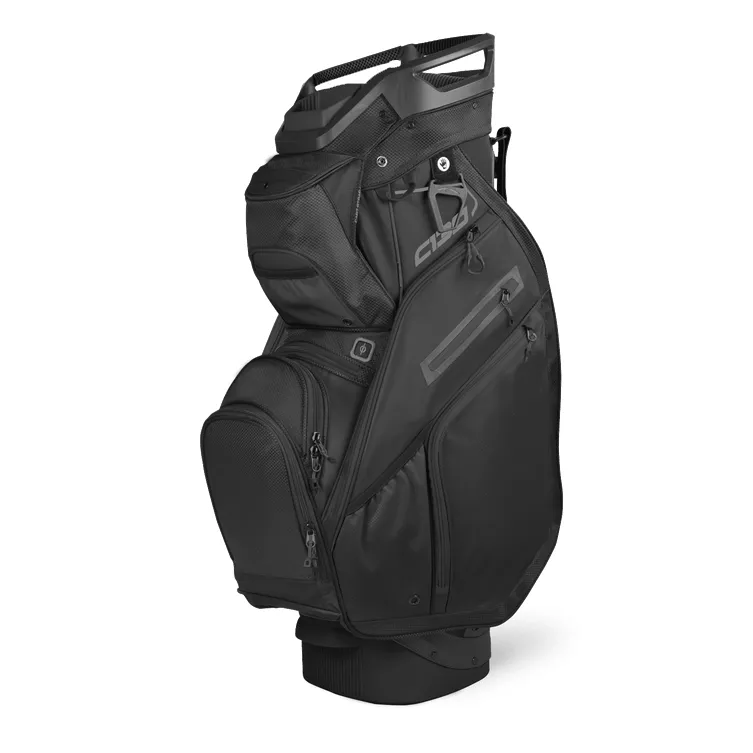
Golf bag prices at the factory gate fall into three bands, and what separates them is the bill of materials rather than the badge on the front. A USD 30-40 FOB cart bag and a USD 75-120 cart bag often share the same silhouette, the same assembly routing and frequently the same export carton. They part company in fabric denier and coating, divider construction, hardware grade, base plate thickness and the hours of hand work in the trim. The bands below are indicative FOB Xiamen figures at MOQ 200 per colourway, with trial orders from 100 pieces and a full new development at 500.
Related reading: How to Negotiate Pricing for Wholesale Golf Bag Orders
What Separates a USD 32 Cart Bag From a USD 95 One
Two cart bags can leave the same building in the same week and reach retail 300 per cent apart. Almost none of the difference is visible from a metre away. It sits in the fabric specification sheet, the divider construction, the hardware part numbers and the amount of hand work in the trim and the piping. A buyer who can read those four layers can estimate the FOB price of a bag from a photo plus a spec line, and can tell whether a quotation is low because the product is efficient or low because something quiet has been removed.
Fabric is the biggest single lever. A 600D polyester with a 600 mm hydrostatic head and a thin PU backer is the entry standard. An 840D to 1680D weave with a 1,500-3,000 mm coating and seam tape is the premium standard. At typical consumption of 1.4-1.8 running metres per cart bag, that fabric step alone is roughly USD 3.50-9.00 per bag before coating and before the extra handling that a heavier, stiffer cloth demands at the sewing station.
The second lever is the top assembly. A sewn 5-way or 6-way top with a thin moulded ring costs a fraction of a full 14-way moulded grid with an EVA-lined collar, and it changes the labour content as well as the material cost. The third is the base: a 2.0 mm polypropylene plate glued into a fabric pocket behaves very differently from a 3.0-4.0 mm plate with moulded thread inserts and six screws, and the difference shows up in cart fit and in warranty claims, not on the showroom floor.
The fourth lever is invisible in a photograph and obvious in the hand: trim quality. Entry bags use single-fold binding tape, plastic sliders and a printed logo patch. Premium bags use multi-layer piping, metal sliders, embossed or debossed logo plates, edge-painted pocket flaps and bar-tacked stress points at every strap anchor. That trim delta is 8-14 per cent of FOB, and it is the fastest way to make a mid-priced bag look expensive without changing its structure.
The Three Tiers Defined by Bill of Materials
Buyers talk about tiers as retail positions. Suppliers talk about them as bill-of-materials positions, because that is what can be quoted, audited and repeated. The three bands below hold for cart bags, stand bags and staff bags, with the absolute numbers shifting by construction rather than by brand.
Entry band: USD 26-40 FOB
A 600D PU-backed shell, a sewn or lightly moulded top, five to seven pockets with coil zips, a 2.0 mm glued base plate and a two-colourway range. Labour is kept low by simplifying the pocket stack and by using stock hardware. This band is where promotional, corporate and house-brand volume lives, and it is the band where a 100-piece trial order is realistic. The engineering risk is not cost, it is consistency: a USD 5 saving per bag is easy to find and very hard to hold across four repeat orders.
Mid band: USD 42-68 FOB
840D shell with a 1,000-1,500 mm coating, a hybrid 14-way top, a 2.5-3.0 mm screwed base plate, YKK or equivalent zips on the load-bearing openings, padded strap with a moulded buckle and a real colour-blocking programme. This is the volume band for pro-shop and green-grass programmes, and it is where most first-time private label buyers should aim, because the specification is robust enough to survive a season of retail handling without a redesign.
Premium band: USD 75-125 FOB
1680D or high-tenacity weave with a 1,500-3,000 mm coating and taped seams, a fully moulded 14-way grid, a moulded base with replaceable feet, metal hardware, leather or microfibre touch points, embossed logo plates and hand-finished binding. Tooling content is highest here because the top and base are bespoke, and inspection is tighter because a single visible defect at this price is a returned bag rather than a discounted one.
| Tier | FOB cart bag | Shell and coating | Top | Base plate | Typical retail |
|---|---|---|---|---|---|
| Entry | USD 26-40 | 600D, 600 mm hydrostatic | Sewn 5-6 way | 2.0 mm PP, glued | USD 79-129 |
| Mid | USD 42-68 | 840D, 1,000-1,500 mm | Hybrid 14-way | 2.5-3.0 mm PP, screwed | USD 139-229 |
| Premium | USD 75-125 | 1680D, 1,500-3,000 mm, taped | Moulded 14-way, EVA lined | 3.0-4.0 mm, replaceable feet | USD 249-399 |
The retail columns assume a 2.4-3.2 times wholesale multiple, which is the normal spread for a bag sold through a golf retailer who has to carry stock and take markdown risk. A brand selling direct can run a higher multiple, and a distributor selling to green-grass accounts runs a lower one. Neither changes the FOB number, which is why pricing conversations should always start at FOB and work outward.
Where the Money Goes Inside a Quotation
Auctioning a bag price without knowing the cost stack is guesswork. The stack below is indicative for a cart bag at MOQ 200, expressed as a share of FOB. The shares move with the tier because material content rises faster than labour as the specification improves.
| Cost element | Entry share | Mid share | Premium share |
|---|---|---|---|
| Shell fabric and coating | 26% | 28% | 31% |
| Trim, webbing, PU and leather | 9% | 11% | 14% |
| Zips and hardware | 8% | 10% | 13% |
| Top, divider and base components | 6% | 8% | 10% |
| Direct labour and assembly | 20% | 20% | 18% |
| Overhead, tooling recovery and margin | 31% | 23% | 14% |
Two things in that table surprise buyers. First, labour barely moves as a share of price, because the number of operations in a premium bag is not much higher than in an entry bag; what rises is material. Second, the overhead line falls as a share of price even though the absolute margin usually rises, because premium volume is lower and tooling recovery is concentrated in fewer units. A supplier quoting 40 per cent overhead on a premium bag either has a very small order or is padding the number.
Reading the share columns. Ask for the stack as percentages of FOB, not as a costed sheet. Percentages let you compare two suppliers on the same basis without exchanging confidential cost data, and they expose a quote that is cheap in material and expensive in overhead, which usually means a stock shell and a bespoke price.
How Volume and Tooling Move the Unit Price
Price does not move in a straight line with quantity. Between 100 and 200 pieces the movement is mostly in the fabric minimum: below 200 per colourway, mills charge a short-run premium or force the buyer onto a stock colour that may not match the lab dip. From 200 to 500 the curve is steeper, because cutting, sewing line set-up and the sampling overhead of a new style are spread across more units.
Tooling behaves differently. A moulded 14-way grid, a bespoke base plate and a logo embossing die are one-time costs, and they land on the first order or are amortised across an agreed quantity. On a 200-piece run, USD 8,000 of tooling adds USD 40 per bag if it is fully loaded into the first order, which is the difference between a mid and a premium FOB. On a 2,000-piece run the same tooling adds USD 4. This is why the honest comparison is not price per bag but price per bag plus tooling ownership terms.
The practical thresholds on the programmes we run: 200 pieces per colourway is the standard minimum, 100 pieces is workable as a trial on stock constructions, and 500 pieces is the entry point for a genuinely new shape with fresh moulds. Stock materials sample in 6-10 working days, a fresh tool pushes that to 12-15, and the run to bulk sits at 35-50 days counted from the signed sample. None of those timings shorten because the bag is cheap.
One more volume effect is easy to miss: colourway count. Three colourways of 200 units each is a 600-piece order, but it carries three fabric minimums, three cutting spreads and three sets of thread and trim. Suppliers price that differently from a single 600-piece colourway, and a buyer who splits an order into five small colourways should expect a 6-12 per cent uplift against the single-colour quote.
Retail Multiples and Why Channels Price Differently
The same FOB bag supports three different retail prices depending on who sells it and what they have to fund. A green-grass pro shop carrying six units on the floor has rent, staff and markdown risk against each unit. An online brand holding stock in a third-party warehouse has advertising cost per acquisition, returns and pick fees. A corporate buyer ordering 300 units with a logo has no retail function at all and prices against the promotional budget instead of the shelf.
- Specialty retail: 2.4-2.8x FOB, with markdowns absorbed by the retailer and a return rate of 2-5 per cent in the first season.
- Online direct-to-consumer: 2.8-3.6x FOB, but 25-35 per cent of the price is acquisition cost, not margin.
- Distributor to green grass: 1.6-2.0x FOB outbound, with the pro shop applying its own 1.5x on top.
- Corporate and event: priced per unit against a budget line, often 2.0-2.5x FOB with a hard deadline premium for air freight.
The multiple matters to a supplier only in one respect: it tells the sampling and inspection teams how much visible quality the buyer needs. A bag that will retail at USD 349 has to pass a critical-defect standard of zero at the top collar and the logo, because a returned premium bag costs the brand more than the bag. A bag that will retail at USD 99 can tolerate a minor thread end inside a pocket. Both are inspected at AQL 2.5 under ISO 2859-1, but the defect classification inside that standard is written by the buyer.
Specification Moves That Jump a Tier
Most brands do not move tiers by rebuilding a bag. They move by choosing six or seven upgrades that buyers can see and feel. Each of the following changes the FOB price by a measurable amount, and the cumulative effect is usually one full tier.
- Shell upgrade from 600D to 840D with a 1,000 mm coating: plus USD 1.80-3.20 per bag, plus a slightly heavier carton.
- Full 14-way moulded top instead of a sewn or hybrid top: plus USD 2.40-4.60 plus tooling, and plus 90-160 g.
- Screwed base plate with replaceable feet instead of a glued plate: plus USD 1.20-2.40 and a longer assembly step.
- Metal zip sliders and taped seams on the two load-bearing openings: plus USD 1.10-2.30.
- Padded, contoured strap with a moulded buckle rather than a flat webbing strap: plus USD 1.40-2.90.
- Embossed or debossed logo plate instead of a printed patch: plus USD 0.60-1.50 plus a die.
- Edge-painted or folded pocket flaps and bar-tacks at every anchor: plus USD 0.90-1.80 in labour.
Adding those seven moves takes a USD 34 bag to roughly USD 45-50 FOB, which is a mid-tier price with a mid-tier structure. What it does not do is make the bag durable in the way a premium buyer expects, because durability comes from the base, the top and the seam construction rather than from finishes. Buyers who chase the look without the structure end up with a bag that photographs at USD 249 and fails at USD 249.
Reading Three Quotes Side by Side
Three quotations for the same tech pack rarely differ by accident. Before comparing totals, normalise five things: the Incoterm, the payment term, the inspection standard, the packaging and the colourway count. A FOB Xiamen quote against a CIF quote is not a price comparison. A 30/70 T/T quote against an L/C at sight quote carries different bank cost and different risk. A quote that assumes one poly bag per unit against one that assumes a non-woven dust bag is a USD 0.40-0.90 per unit difference.
Then check what is excluded. Tooling, logo dies, lab dips, courier of samples, third-party inspection fees and carton marking are the five items most often left outside a headline price. On a 500-piece order those exclusions can add 4-9 per cent to the landed cost, which is more than the spread between the two cheapest quotes in a typical tender.
The remaining differences are usually explained by one of four things: a lighter shell than specified, a substituted zip brand, a smaller top assembly, or an optimistic labour assumption that will be recovered later through a price increase on the repeat order. A supplier who will not itemise those four points in writing is telling you something useful about how the repeat order will go.
The Pricing Traps That Cost Buyers Most
The first trap is comparing a sample against a bulk price. A hand-built sample with a technician spending two hours on the piping is not the bag that will come off a line at 300 units a day. Ask what the bulk construction changes, and get it in writing on the approval sheet. The second trap is accepting a price with no colourway limit; three colourways later, the fabric minimums appear as a surcharge.
The third trap is tooling that is not owned. If a bespoke top or base is paid for inside the unit price, the buyer usually has no title to it, which means a change of supplier costs the tool a second time. The fourth is a quotation that holds for 30 days in a market where coated fabric moves quarterly. Treat any price older than a quarter as indicative, and ask for the validity window in writing.
A fifth trap sits outside the quotation entirely: freight arithmetic. Cart bags ship 6-10 per carton depending on size, and a premium bag with a rigid moulded top packs less efficiently than an entry bag of the same nominal dimensions. On a 20ft container the difference between 8 and 10 units per carton is a five-figure sum across a full load, which can wipe out a USD 2.00 per bag saving negotiated on the unit price. Ask for the packed carton dimensions and the unit count before the price is agreed, not after the inspection is booked.
For the surrounding commercial steps, the wholesale pricing guide sets out how quantities, terms and freight interact, and cost factors that move a custom bag quote breaks the same stack down by component. Both are worth reading before a second round of negotiation, because the cheapest lever is almost always the specification, not the supplier.
Sources and Standards Referenced
- ISO 2859-1:2022 Sampling procedures for inspection by attributes
- ASTM D5034 Breaking strength and elongation of textile fabrics (grab test)
- ASTM D2261 Tearing strength of fabrics (tongue method)
- AATCC / ISO textile test method index, ISO TC 38
- ASTM textile standards catalogue
Next steps: custom solutions, manufacturing capability, and a quotation request.
Frequently Asked Questions
What is a realistic FOB price for a custom golf cart bag?
At MOQ 200 per colourway, indicative FOB Xiamen bands are USD 26-40 for an entry cart bag, USD 42-68 for a mid specification and USD 75-125 for a premium one. The spread comes from shell denier, coating, top construction, base plate and trim labour rather than from the brand on the bag.
Why is one quotation half the price of another for the same tech pack?
Usually four reasons: a lighter shell than the spec calls for, a substituted zip and hardware brand, a smaller or sewn top instead of a moulded one, or an optimistic labour assumption that will be recovered on the repeat order. Ask each supplier to itemise those four points in writing.
How much of the price is fabric?
Roughly 26-31 per cent of FOB depending on tier. At 1.4-1.8 running metres per cart bag, moving from 600D with a 600 mm coating to 1680D with a 1,500-3,000 mm coating is about USD 3.50-9.00 per bag before the extra handling cost.
Does a higher FOB price mean a better made bag?
Not automatically. Price follows material and finishing, while durability follows base plate thickness, top construction, seam reinforcement and bar-tacking at strap anchors. A bag can be expensive in trim and weak in structure, which is why the quote should be read as a bill of materials.
What retail multiple should I apply to a wholesale bag price?
Specialty retail runs 2.4-2.8 times FOB, online direct-to-consumer 2.8-3.6 times, and distributors selling to green grass 1.6-2.0 times before the pro shop adds its own margin. The multiple reflects the cost of holding stock and taking markdown risk, not the quality of the bag.
How much does order quantity change the unit price?
Between 100 and 200 pieces most of the change is fabric minimums, because short runs carry a mill premium. From 200 to 500 the curve is steeper as sampling and line set-up spread across more units. Splitting an order into several small colourways typically adds 6-12 per cent against a single-colour quote.
How does tooling affect the price per bag?
Tooling is a one-time cost. USD 8,000 of moulds spread across a 200-piece order adds USD 40 per bag; spread across 2,000 pieces it adds USD 4. That is why the honest comparison is price per bag plus tooling ownership terms, not the headline unit price alone.
What is the cheapest way to make a mid-priced bag look premium?
Trim, not structure. Multi-layer piping, metal sliders, an embossed logo plate, edge-painted pocket flaps and bar-tacks at every anchor add USD 3.00-6.00 per bag and change how the product reads in the hand. Structural upgrades cost more and are less visible.
Is a 100-piece trial order more expensive per unit?
Yes, typically 10-18 per cent above the 200-piece price on stock constructions, mainly from fabric minimums and line set-up. It is still worth doing on a first style, because a trial exposes construction problems before a 500-piece commitment.
What should be excluded from a headline FOB price?
Tooling, logo dies, lab dips, sample courier and third-party inspection fees are the five items most often left outside a quote. On a 500-piece order those exclusions can add 4-9 per cent to landed cost, which often exceeds the gap between the two cheapest bids.
How long does a price quotation stay valid?
Treat anything older than a quarter as indicative, because coated fabric and hardware pricing moves with mill schedules. Ask for the validity window in writing, and expect a supplier to re-quote rather than absorb a material increase silently.
Do premium bags take longer to produce?
The run to bulk is 35-50 days counted from the day the sample is signed, across all three tiers. Premium bags tend toward the top of that range because taped seams and hand-finished binding slow the line, and sampling itself takes 6-10 working days on stock materials or 12-15 with new tooling.
Get a Tier-by-Tier Quote
Send a tech pack or a photo plus target retail price, and you will receive three costed options at entry, mid and premium specification with the tooling position stated separately.
Request Pricing See OEM Services