Golf Academy Team Bags: Bulk Uniform Programme Design
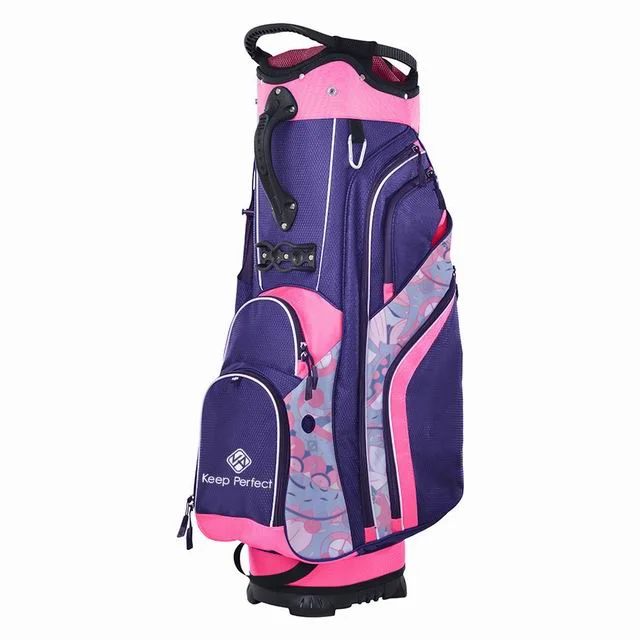
A team bag programme behaves like a uniform, not like a purchase: one platform has to fit a squad containing four height bands, carry individual names on every unit, and still read as a single kit when twenty-four players stand on the first tee. That is a different engineering problem from a retail order, where a buyer picks one size and one colourway. It also changes the commercial structure, because a squad order is usually one colourway at 200 pieces with ten to twenty name variants inside it, which is why name personalisation, colour consistency across a multi-year programme and a replacement mechanism matter more than any single specification. Programme numbers that hold for every squad order: a 200-piece colourway minimum, 100-piece trials, a sample inside 6-10 working days, 35-50 days for production, AQL 2.5 to ISO 2859-1, 30/70 T/T, FOB Xiamen.
Related reading: Custom Golf Bags for Academies, Teams and Schools
Related reading: Junior Golf Bags Private Label Manufacturing Guide
What Separates a Team Programme From a Stock Order
Three things. The first is a roster: a squad list with names, numbers, heights and handedness that changes between the day it is submitted and the day the bags ship. The second is a hierarchy inside one design, because the head coach, the assistant and the players all need to look related without looking identical. The third is a calendar that runs on academic terms rather than on seasons, which means delivery dates are set by enrolment and not by retail weather.
Those three facts drive every technical decision downstream. A roster means names must be embroidered on a unit-by-unit basis without breaking the batch flow. A hierarchy means at least two builds from one shell. A term calendar means a shipment that arrives in week nine is nearly worthless, so the schedule carries more risk than the specification.
The budget structure is different as well. A school or academy usually buys from a capital or programme budget approved once a year, which means one invoice, one delivery address and often a purchase order that requires a formal quotation before it can be raised. Orders split across three suppliers to save a few dollars per bag are an administrative cost that nobody in the finance office thanks you for.
Squad Sizing: One Platform, Several Builds
A single shell in two lengths covers almost every squad. Junior players from about 130 cm to 160 cm take a 32-34 inch bag with a 7.5 inch top and a shorter stand leg; older juniors and adults take a 35-36 inch bag with an 8-8.5 inch top. The shell pattern, the pocket layout and the trim are shared, so the visual identity holds and the tooling cost does not double.
| Build | Bag length | Top diameter | Divider | Empty weight | Typical user |
|---|---|---|---|---|---|
| Junior A | 32 in | 7.5 in | 5-way | 1.35-1.55 kg | Under 145 cm |
| Junior B | 34 in | 8 in | 6-way | 1.55-1.75 kg | 145-160 cm |
| Senior | 35-36 in | 8-8.5 in | 6-7 way | 1.75-2.05 kg | 160 cm and above |
| Coach | 36 in | 9 in | 14-way | 2.20-2.60 kg | Staff, cart use |
Weight is the specification that matters most and is discussed least. A 1.35 kg empty bag with fourteen clubs and a water bottle lands near 9 kg on a small player shoulder, and the difference between 1.35 kg and 1.75 kg is the difference between a bag that gets carried and a bag that gets dragged. Where a squad spans both bands, splitting the order 60/40 between Junior A and Junior B is normal, and the split is priced as one colourway with two builds rather than as two orders.
The coach build is the one place to spend. A 14-way top, a cart-compatible base and a larger cooler pocket cost more per unit but survive five seasons of daily use, and a coach bag that fails in year two is visible to every parent on the range.
Individual Names at Squad Scale
Direct embroidery
Names are where a team order stops being a batch and becomes a list. Embroidery handles them well because a name plate is a short stitch run, but the workflow has to be built for it: a roster locked at a cut-off date, a digitised file per name, and a check that the correct bag goes into the correct sleeve. On a 24-player squad, name work adds two to four days to the schedule on top of the standard 35-50 day bulk window.
| Method | Unit cost (USD) | Added lead time | Appearance | Best use |
|---|---|---|---|---|
| Embroidered name, direct | 1.20-2.00 | 2-4 days | Textured, premium | Standard for squad bags |
| Woven name tape, sewn | 0.60-1.10 | 5-7 days | Crisp, uniform | Large squads, tight budget |
| Printed name panel | 0.45-0.90 | 1-2 days | Flat, lower durability | Short programmes, one season |
| Heat transfer name | 0.50-1.00 | 2-3 days | Fine detail | Long names, small panels |
Three rules prevent almost every name error. Lock the roster seven working days before the name run and treat later changes as a priced variation. Ask for the name list back as a proof sheet with spellings in capitals, matching how they will appear on the bag. And never allow a name to be applied until the bag it belongs to has its own labelled sleeve, because a swap at packing is the failure that parents notice first.
Woven tapes versus printed panels
Below about sixty names, direct embroidery is the simplest route. Above that, a woven name tape starts to win on consistency: the tape is produced in one pass with a uniform typeface, then sewn into the panel, so every name sits at the same height and the same density. A printed name panel is the cheapest option and appropriate only for a one-season squad, because the print edge lifts after repeated handling in a bag room.
Numbering is worth pairing with the name. A small two-digit number on the shoulder pad, 20 mm high, gives a coach a way to call a bag without reading a name across a range, and it costs almost nothing when it is digitised into the same file as the crest.
Placement follows the same logic as the build. On a junior bag, put the name on the front lower panel at 20-30 mm above the base seam where it stays flat, and keep the academy crest on the side panel or the ball pocket. On a coach bag the crest moves to the front panel and the name sits on the side, since the front is what appears in team photographs.
Field note on roster cut-offs. The single largest cost in a team order is not the embroidery, it is a late roster change after the name run has started. One reworked panel costs the same as eight new names. Set the cut-off date in the purchase order, not in an email, and hold the squad list in one document with one owner.
Durability Under Daily Academy Use
Academy bags live harder than retail bags because they are carried by teenagers six days a week, dropped on range mats, stacked in a minibus and stored in a bag room with no ventilation. The wear pattern is predictable: base corners first, then the stand leg hinge, then the zipper at the ball pocket, then the strap attachment.
Specifying against the wear pattern
- Base: a moulded PP base plate with a 12-15 mm abrasion-resistant skirt rather than a fabric base, because fabric bases wear through at the corners inside one season.
- Legs: fibreglass or aluminium legs with a spring mechanism rated for 10,000 cycles, and a hinge block that is bolted rather than riveted so it can be tightened.
- Zippers: size 8 or 10 coil with a moulded pull, since a size 5 coil on a pocket that opens 40 times a day fails at the slider first.
- Strap: a padded dual strap with a bar-tacked attachment at both ends; the attachment is the highest-stress point in the whole bag.
- Fabric: 600D polyurethane-backed polyester as the floor. 420D saves 60-90 g but abrades through at the base corner within two seasons of daily academy use.
Testing should reflect that wear pattern rather than a retail protocol. A 1 m drop onto each base corner, 10,000 open and close cycles on the ball pocket zipper, 1,000 leg deploy and retract cycles, and a 15 kg static load on the strap attachment for an hour will find the failures that matter. Load-bearing seams are pulled to ASTM D5034, 250 N grab minimum, and torn to ASTM D2261.
Serviceability matters as much as the initial build on a programme that runs three years. Legs, base plates and strap assemblies should be replaceable with hand tools and a stock part, because a squad bag with a snapped leg is otherwise written off. Ask at quotation stage which components can be supplied as spares and at what price; a leg set at a few dollars extends the life of a bag that cost ten times that to replace.
Warranty expectations should be written before the order, not after the first failure. A one-season structural warranty on seams, base, legs and zippers is normal for a school programme. Wear items such as the strap pad, the towel loop and the rain hood are usually excluded, and saying so at quotation stage prevents a difficult conversation in month fourteen.
Colourways, Trim and Sponsor Panels
A team identity is carried by two colours and one trim story, and the temptation to add a third accent is what makes a kit look assembled rather than designed. School colours are supplied as references that rarely match a fabric range exactly, so the first production step is converting them to the nearest available yarn or coated fabric and approving a physical swatch.
Colour consistency across a multi-year programme is the part buyers underestimate. Two runs of the same nominal colour, dyed a year apart, can differ visibly, and a squad that receives 20 replacements in year two next to 24 original bags will see it immediately. The practical controls are: keep the same fabric reference rather than a colour name, approve a master swatch that both sides retain, hold repeat lots to a 1.5 tolerance on the standard colour-difference scale, and keep a small buffer of the original fabric if the programme is expected to run three years or more.
Sponsor and club crest panels belong on a separate applied panel, not printed directly onto the shell. An applied woven or embroidered panel can be omitted from a replacement bag, changed between seasons without re-cutting the shell, and replaced if a sponsor changes. On a five-year academy programme that modularity is worth more than the small cost premium, which runs about USD 0.40-0.80 per bag.
Legibility is the last check. A crest at 60 mm on a navy panel reads at ten metres; the same crest at 40 mm does not. Ask for a sewn-out crest at final size before approving, and look at it from across a room rather than at arm length.
Procurement Paperwork for Schools and Academies
Institutional buyers need documents as much as they need bags. A quotation that cannot be turned into a purchase order will stall for weeks, and a shipment that arrives without the right paperwork can sit in a customs warehouse while a term starts.
- Formal quotation on headed paper with unit price, quantity, build, colourway, name personalisation and validity period stated separately.
- Purchase order reference quoted on every document, since finance will not pay an invoice that does not match.
- Delivery address and receiving window, which for a school is usually a staffed office between set hours rather than a loading dock.
- Commercial invoice and packing list with HS classification, country of origin and the declared value per unit.
- Inspection report at AQL 2.5, which many institutions now request as a condition of payment.
Payment terms are normally T/T 30/70, with the deposit released against the purchase order and the balance against shipping documents. Institutions sometimes prefer a single payment on delivery, which is workable but usually prices in the cost of carrying the order for 35-50 days of production plus transit. Terms are quoted FOB Xiamen; where a school expects a delivered price to campus, the freight and duty component should be quoted as a separate line so the budget office can see what it is approving.
Staged Delivery Across a Season
A squad rarely needs every bag on day one. New intake arrives in waves, and a programme that ships everything at once leaves a store room full of bags that will not be issued for three months. Staged delivery solves that, at the cost of additional documentation and inspection per release.
- Confirm the squad list and split it into intake groups with a date for each group.
- Fix one colourway and one fabric lot for the whole programme, so staged bags match the first release.
- Produce the full quantity in one bulk run and hold the later groups in finished-goods storage rather than re-running the line.
- Release each group as a separate shipment with its own packing list and inspection record.
- Deliver to a named contact with a signature requirement, and reconcile piece counts on arrival.
- Hold 3-5 per cent of the run as a buffer for late intake and damage in the first month.
Holding finished goods is cheaper than re-running a short batch, because a 30-piece re-run carries the same setup, the same colour-matching risk and a much higher unit cost. The exception is a programme that expects to add players across several years, where the right answer is to hold fabric and trim rather than finished bags.
Programme work of this shape is what QUANZHOU JUNYUAN BAGS was set up to do in 2014, drawing on a team whose bag experience starts in 2004: squad lists, name runs and staged releases rather than single-carton orders.
Replacement Bags and Top-Ups
A squad of 24 will lose or damage two to four bags a year. That number is far below any production minimum, which is why replacement policy belongs in the original agreement rather than in a panicked email before the next fixture.
The three workable mechanisms are a buffer held by the academy, a buffer held in production, or a priced small-run top-up. A buffer of 3-5 per cent produced in the original run is the cheapest and the only one that guarantees a colour match, because it comes from the same fabric lot. A top-up of 20-30 pieces is possible as a small-run surcharge, typically 15-25 per cent above the original unit price, and it needs the original fabric reference plus the name files retained.
Retain the digitised name files and the crest artwork with the order record. Re-digitising a crest is a small cost; re-drawing one because nobody kept the vector is a week. The same applies to the specification sheet, which should list every component by reference so that a bag produced in year three is the same bag as year one. For the wider view of what bulk quality standards look like on stand bags, the bulk buyer quality guide is the reference document, and the programme rollout process describes what happens between a signed purchase order and a delivered carton.
Next steps: custom solutions, manufacturing capability, and a quotation request. OEM and ODM services. Low MOQ custom bags.
Sources and Standards Referenced
- ISO 2859-1:2022 Sampling procedures for inspection by attributes
- ASTM D5034 Breaking strength and elongation of textile fabrics (grab test)
- ASTM D2261 Tearing strength of fabrics (tongue method)
- ISO 105-B02 Colour fastness to artificial light
- The R&A participation research on junior golf growth
Frequently Asked Questions
What is the minimum order for academy team bags?
The floor sits at two hundred units for a single colourway, which usually covers a full squad plus a 3-5 per cent buffer. A 100-piece trial is workable for one squad on an existing platform. Where a new shell or a new crest tool is needed, the realistic threshold is 500 pieces.
Can each player have their own name on the bag?
Yes. Embroidered names cost USD 1.20-2.00 per bag and add two to four days to the schedule on a 24-player squad. Woven name tapes are cheaper at USD 0.60-1.10 but add five to seven days. The roster must be locked seven working days before the name run starts.
What bag weight suits junior players?
Aim for 1.35-1.55 kg empty for players under 145 cm and 1.55-1.75 kg for 145-160 cm. A 1.75 kg bag with fourteen clubs and a bottle reaches about 9 kg on the shoulder, and the extra 400 g is often the difference between carrying and dragging.
Should an academy buy stand bags or cart bags?
Stand bags for players, cart bags or a 14-way staff build for coaches. Junior squads walk most rounds and carry their own clubs, so a light stand bag with a stable leg mechanism matters more than pocket count. Coach bags get daily cart use and should be built heavier.
How many bag sizes does a squad need?
Two for players plus one for staff. A 32 inch bag with a 7.5 inch top covers players under 145 cm, a 34 inch bag with an 8 inch top covers 145-160 cm, and a 35-36 inch senior build covers older players and adults. Sharing the shell keeps the identity consistent.
How long does a school team bag order take?
Production takes 35-50 days once the sample is approved, sampling itself 6-10 working days, and names add two to four days. Add 25-40 days of ocean freight, so a term-start delivery needs the order placed about 14 weeks ahead. Air freight cuts that to roughly nine weeks.
Will a mid-season top-up match the squad colour?
Only from the same fabric lot. Two dye runs of one nominal colour, twelve months apart, can differ visibly. Keep the fabric reference plus a master swatch, and produce a 3-5 per cent buffer in the original run if the programme runs three years or more.
Can we add a sponsor panel that changes each season?
Yes, and it should be an applied woven or embroidered panel rather than a direct print. That adds about USD 0.40-0.80 per bag and lets you change a sponsor, or omit the panel on a replacement bag, without re-cutting the shell.
What paperwork does a school or academy need?
A formal quotation with unit price and validity, a purchase order reference on every document, a commercial invoice and packing list with HS classification, and usually an AQL 2.5 inspection report as a condition of payment. A named receiving contact avoids failed deliveries.
Do you offer staged delivery across terms?
Yes. The full quantity is produced in one run so the fabric lot matches, then released in groups with separate packing lists and inspection records. Holding finished goods is cheaper than re-running a 30-piece batch, and it protects colour continuity across intakes.
How are team bags inspected before delivery?
Lots are drawn to ISO 2859-1 with an AQL of 2.5 at level II general. From 200 pieces, 32 are examined and 2 majors is the acceptance number. Team-specific checks cover name spelling against the proof sheet, crest placement, base corner abrasion and leg cycle function.
What warranty applies to an academy programme?
A one-season structural warranty covering seams, base plate, legs and zippers is standard. Wear items such as the strap pad, towel loop and rain hood are normally excluded. Writing that split into the quotation prevents disputes in month fourteen of a multi-year programme.
Build a Squad Specification
Send the squad list with heights and roles, and a two-build specification with name pricing and a term-by-term delivery plan comes back within two working days.
Request a Programme Quote See Team Options