Lightweight Golf Stand Bag Features That Improve Portability
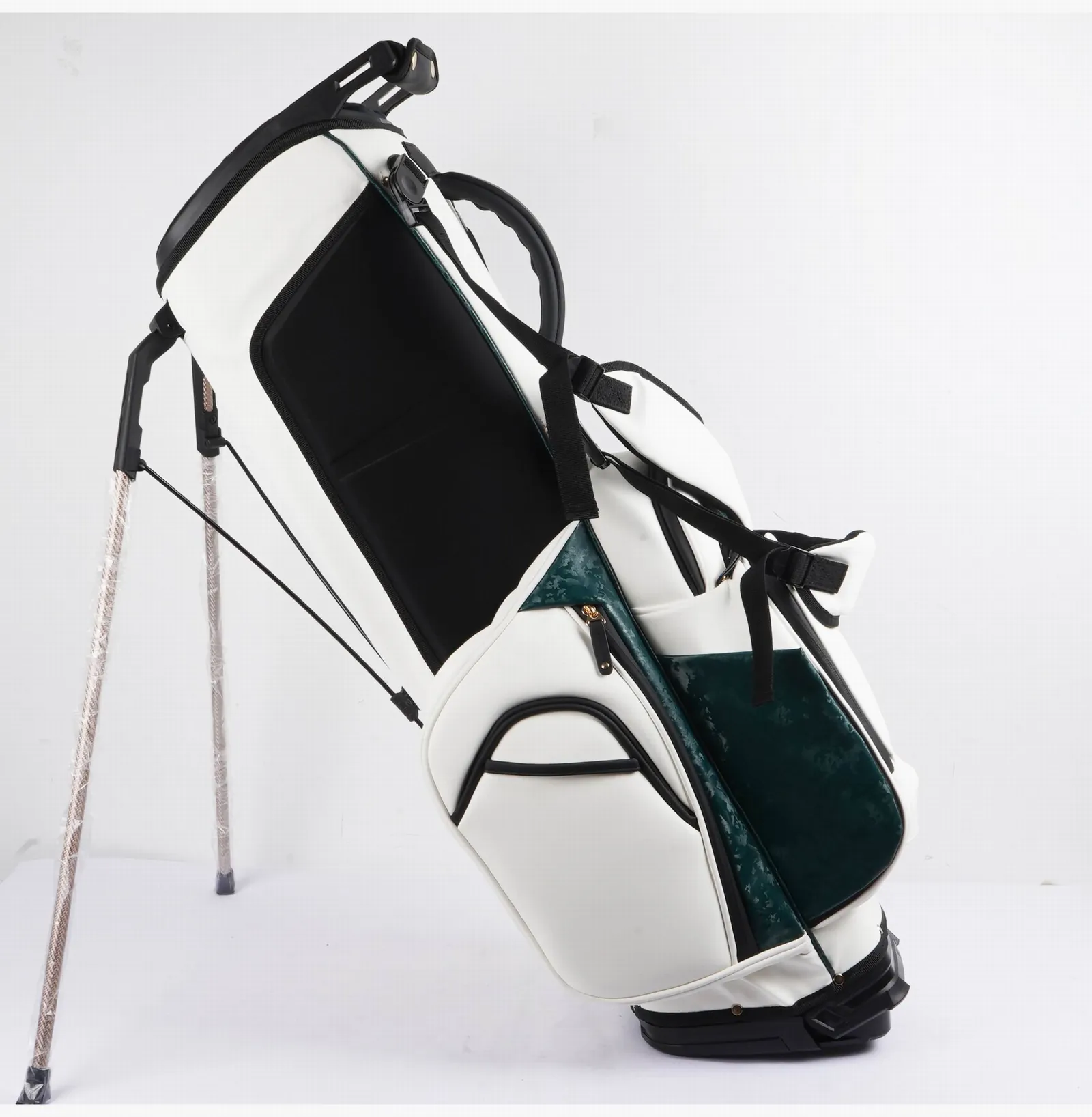
A lightweight golf stand bag improves portability by pairing a light empty shell — typically 1.5-2.2 kg and at most about 2.6 kg for a durable full-kit bag — with full-length light dividers, a balanced dual-strap harness and a low centre of gravity, so the loaded bag around 10-14 kg rides closer to your body and feels lighter over 18 holes. Portability is not just the number on the scale; it is the sum of weight, balance, harness and how the bag carries once packed. This guide from QUANZHOU JUNYUAN BAGS (founder entered the industry 2004, company established 2014, serving 200+ brands across 100+ countries) breaks down every feature that makes a stand bag genuinely portable.
What Actually Makes a Bag Light?
Understanding where weight comes from is the first step to choosing a genuinely portable bag. The empty weight of a stand bag is the product of four things: the shell fabric, the divider system, the frame and stand mechanism, and the harness and pockets. A factory reaches a target weight by making deliberate choices in each.
Shell fabric is the biggest lever. Lighter nylon and ripstop polyester weigh substantially less than heavy ballistic nylon and leather or PU-trimmed panels, at a small trade in ruggedness. Divider systems matter next: a full-length but minimal 5-way layout separates clubs while an elaborate 14-way separator adds material and grams. The frame and stand use lightweight aluminium or alloy legs instead of heavier steel, and the base trades some heft for rigidity.
Pockets are a quiet source of weight. Each pocket adds fabric, zips and liners, so a lean layout with only the pockets a golfer uses is noticeably lighter than a bag bristling with unused ones. This is why designers now curate pockets rather than multiply them. Our storage arrangement guide shows how lean layouts stay functional.
The honest summary: a lightweight bag is a set of disciplined engineering choices, not a single trick. Recognising that helps you spot a genuinely light but durable bag versus a fragile one that merely shaved everything down.
The Right Weight for Your Game
Choosing the right weight class for a lightweight stand bag depends on how you play. A minimalist walker carrying 7-8 clubs and little else can enjoy an ultra-light bag under 1.5 kg. Most full-round walkers carrying 14 clubs and a normal kit prefer a durable light bag around 1.8-2.2 kg. Golfers who also use a push trolley and carry only sometimes can accept a slightly heavier 2.2-2.6 kg bag that trades a little weight for more durability and storage.
There is a real balance between lightness and robustness. Ultra-light bags shed grams, but some become fragile — thin fabric that tears, dividers that deform, a stand that flexes. A quality light bag saves weight through smart materials and full-length dividers without going fragile, which is why the sweet spot for most golfers is the lightest bag that still feels solid. Our weight and portability analysis examines this durability-weight relationship in detail.
Remember that the empty bag is only part of the load on your back. Two walkers with identical bags can differ by several kilograms simply through packing, so a light empty bag plus disciplined packing together deliver the lightest round. Your loaded comfort, not the empty kg, is the real score.

Dividers: Light but Full-Length
Portability and organisation would seem to conflict — cutting divider material lightens the bag but risks tangled clubs. The solution is a full-length but minimal divider layout, typically five or six ways, which separates every club for its full depth using the least possible material.
Full-length dividers are non-negotiable on a portable stand bag, because the bag tips on its stand constantly and grips will tangle without them. But a designer reaches the light weight by using efficient full-length geometry rather than over-building. The result is a bag whose clubs stay quiet and tangle-free without the weight penalty of a heavy 14-way tower.
When you test a lightweight bag, pull the driver in and out repeatedly on a tipped bag. If it moves smoothly and never tangles, the dividers are doing their job despite being light. Put clubs in and out of the full set to check the layout handles your bag's real contents. Our divider comparison guide explains the trade-offs between layouts.
The deeper point is that a light bag fails its purpose if organising it becomes a chore. The best lightweight designs preserve full-length separation, proving that portability and organisation can coexist.
Harness and Balance: Where Comfort Really Lives
Beyond the empty weight, the single biggest factor in how light a bag feels on your back is how it carries. A bag with a balanced dual-strap harness and a low, centred centre of gravity distributes the load across both shoulders and keeps it close to the spine, so even a loaded bag feels lighter than its raw weight.
The harness deserves as much attention as the kilogram figure. Padded, contoured, breathable straps spread pressure instead of digging into the neck, and an adjustable harness lets you fine-tune the fit so the bag rides high and snug. The strap adjustment guide explains how to tune this for your body.
Weight distribution beats absolute weight every time. An awkward bag with a high centre of gravity sways as you walk, making you work to control it, while a well-balanced bag feels calm and light even when packed. This is why a slightly heavier but well-balanced bag can carry better than a nominally lighter one that swings awkwardly. For the physiology involved, our ergonomic benefits guide and posture guide are useful reads.
In practical terms: always test a lightweight bag fully packed and walked, because the loaded carry — not the shop-floor lift — reveals whether it truly feels light.
A Low Centre of Gravity Keeps the Load Close
A low centre of gravity is a defining trait of a portable stand bag. When the heavier items — the base, stand hinges and lower pockets — sit low, the bag's mass stays low on your back and close to your spine. That makes it feel far more stable and lighter to control than a bag whose weight sits high and sways with every stride.
Factories achieve a low centre of gravity through design: weighting the base, using lightweight materials higher up, and placing heaviest storage low. When you swing a loaded lightweight bag onto your shoulders, the low, central mass settles naturally instead of flopping or rolling. This is a big part of why a well-designed 2.2 kg bag can outperform a poorly balanced 1.8 kg one.
Transport is part of portability too. A low-profile, balanced bag is easier to lift into a car and carry from locker to cart path. Many lightweight bags include a convenient top handle and a stable foot so they stand upright indoors as well as on the course, adding to the everyday ease of moving them around. For the wider picture of carrying convenience, our portability analysis covers how balance and handling affect the walk.
Stand and Base: Light but Stable
Portability does not end when the bag is shouldered. A lightweight stand bag still needs a stable stand so that setting it down is effortless and it stays upright. Lightweight aluminium or alloy legs deliver that without the heft of heavier steel, and a five-legged base spreads wide for stability on uneven ground.
The trade is to keep the stand mechanism light while ensuring it locks firmly and retracts cleanly. A stand that opens easily with a firm click, holds the bag still on a slope, and tucks out of the way when you pick the bag up, makes every practice and playing round smoother. Our durability guide covers how the hinge and base withstand a season of set-downs.
Because the base takes the whole load on every set-down, a well-designed lightweight base balances rigidity with minimal material. The best lightweight bags achieve a firm, stable footing without the bulk of a heavy cart-style base, proving again that lightness and stability are compatible when engineered thoughtfully.
Packing Light Doubles the Portability
The cheapest weight a golfer can shed is already sitting in the bag. Packing light is the fastest lever to a genuinely portable round, and it multiplies the value of a lightweight bag. Before upgrading to a lighter bag, an honest sort-out usually drops several kilograms off the carried load for free.
- Trim the ball stock: carry half a dozen, not a dozen heavy balls.
- Leave the extra clubs and heavy unmade spares at home.
- Pack one light layer, not a full change of clothes.
- Fill the bottle when you need it, not pre-loaded and unused.
- Consolidate pockets: one range finder, one glove, no duplicates.
Taking 2 kg of unnecessary weight off your back feels exactly like upgrading to a bag 2 kg lighter, at no cost, and it reduces wear on the bag's frame and straps too. For more on the lighter build, our weight optimisation guide digs into how grams are saved.
Lightweight vs Standard Stand Bag
| Feature | Lightweight Stand Bag | Standard Stand Bag |
|---|---|---|
| Empty weight | 1.5-2.2 kg | 2.2-2.8 kg |
| Dividers | Full-length, minimal 5-way | Full 7-14 way possible |
| Frame/legs | Lightweight alloy | Heavier alloy/steel |
| Pockets | Curated, essential only | More, higher capacity |
| Best for | Walkers wanting light carry | Full-kit players |
| Trade-off | Less storage for less weight | More storage, more weight |
How a lightweight stand bag trades storage for carrying ease.
The table makes the central trade instinctive: a lightweight stand bag saves grams by curating dividers, frame and pockets, so it carries easier but stores a little less. For golfers who find themselves hauling unused capacity, the lightweight trade is almost always worth it. For those who genuinely pack a full kit, a standard durable bag that carries well may be the better choice.
Building a Lightweight Line for Brands
For brands planning a lightweight product, the weight target is an engineering decision set on the pattern table. Choosing fabric denier, divider layout, frame material and pocket count together determines the final weight, so a clear target spec before prototyping is essential. Sampling lets you confirm the loaded carry and durability before committing to a run.
At QUANZHOU JUNYUAN BAGS we produce lightweight stand bags on an affiliated 4,950 m² factory that entered the industry in 2004 and was established as a company in 2014. The facility runs 7 production lines with 126 sewing machines and 137 staff, supporting a monthly capacity of up to 200,000 units for 200+ brands across 100+ countries, audited by SGS in March 2026. Sampling takes 10-20 days, bulk production 45-60 days, standard MOQ 200 pieces per design and colorway and 100 for test orders. Contact service@junyuanbags.com or WhatsApp +86 17750020688.
Wholesale buyers can review stand bag quality standards and custom stand bag factors before briefing a lightweight line.
Frequently Asked Questions
- What makes a golf stand bag lightweight?
- Lightness comes from material choices and construction: lighter nylon and ripstop fabric, a minimal but full-length divider layout, a lightweight frame and stand, and only the pockets a walker actually uses.
- How much should a lightweight stand bag weigh?
- A genuinely portable lightweight stand bag typically weighs about 1.5-2.2 kg empty. Ultra-light models go under 1.5 kg, while durable mid-weight bags sit at 2.0-2.6 kg for golfers who carry a full kit.
- Does a lighter bag feel different to carry?
- Yes, in a good way when built well. A lighter empty bag means every gram is not on your shoulders for four hours, but the bag's balance and harness still matter more than the raw number.
- Are ultra-light stand bags less durable?
- Not necessarily, but very light bags can cut corners. The best lightweight bags save grams through smart materials and full-length dividers without thin fabric or fragile parts, so check quality rather than just the weight figure.
- What is the best lightweight feature for portability?
- The most valuable portability features are a balanced dual-strap harness, a low centre of gravity, a stable stand, and packing discipline — together these make even a mid-weight bag feel light on your back.
- How long does a custom lightweight stand bag take to produce?
- At QUANZHOU JUNYUAN BAGS, sampling a custom lightweight stand bag takes about 10-20 days and bulk production 45-60 days, with a standard MOQ of 200 pieces per design and colorway, and 100 for test orders.

The Material Science Behind Lighter Builds
Material choice is the deepest lever in lightweight design, and a little understanding helps you judge a light bag's quality. High-tenacity nylon and ripstop polyester achieve strength at a much lower weight than heavy woven fabrics, because the fabric's strength comes as much from how it is woven as from how thick it is. Ripstop grids, for example, stop tears from spreading in a fabric that is still very light.
Coatings add performance without bulk. A water-repellent DWR finish or a thin waterproof membrane adds minimal weight while protecting the contents, so a lightweight bag can still shrug off morning dew and passing showers. Our waterproof materials guide and material science guide explain these builds.
Hardware is a sleeper source of weight. Lightweight buckles, zips, D-rings and stand hinges made from light alloys or high-grade composites save surprising amounts compared with heavy metal hardware, without sacrificing the strength of the points that take real load. When you handle a good lightweight bag, the light, quality hardware is part of the barely-there feel.
The test of a light bag's materials is time on the course, not the shop lift. A bag that stays light and survives a season of set-downs, rain, cart ladders and locker rooms has gotten the material balance right.
Sizing, Proportions and Personal Fit
Portability is also about proportional fit. A bag scaled to the golfer's frame carries better simply because it overreaches less. Shorter and lighter-framed golfers, including many women and juniors, benefit from a bag whose proportions, strap span and divider reach suit their body, so the load rides closer and steadier. Our junior stand bag guide and sizing and fit guide cover matching a bag to body type.
For a smaller golfer, a slightly lighter bag matters even more, because the same absolute surplus feels proportionally larger on a smaller frame. Choosing a leaner pocket layout and a minimal full-length divider cuts both weight and visual bulk, making the bag easier to manage as well as carry. For competitive players, a genuinely engineered ultra-light bag under 1.8 kg with just the right features is the practical end of the portability spectrum.
Regardless of size, the uniformity of weight matters: a bag whose heavier items sit low and close to the spine carries best. When you swing a candidate bag on, notice whether the load settles naturally against your back or rolls to one side. That one observation predicts the whole round's comfort better than any spec sheet.
Portability Beyond the Course
Portability extends past the fairway to every step of moving a bag around. A lightweight stand bag is easier to lift into and out of a car, easier to carry from the locker room to the cart, easier to pack for a golf trip, and easier to hang in storage. Those everyday conveniences compound across a season and are part of why golfers find lightweight bags genuinely change how the game feels.
On travel days, a light stand bag is far kinder to your shoulders when you walk through parking lots and terminals, and it leaves more of your weight allowance for the rest of your kit. Complementing it with a good travel bag or cover protects the clubs without adding a heavy second bag to manage.
Storage matters too: a bag that stands upright on its own base, fits neatly into a locker or cupboard and is easy to pick up and move is simply less of a daily hassle. Quietly, these non-course moments account for a meaningful share of the portability benefit a lightweight stand bag delivers.
Portability Is a System, Not a Number
The clearest takeaway from every feature in this guide is that portability is the result of a whole system working together. The empty weight sets the starting point; the harness and low centre of gravity determine how that weight is carried; the stable stand and curated pockets decide how easy the bag is to live with; and packing discipline controls the final load on your shoulders.
A brilliant lightweight bag is one where every decision contributes to a lighter, easier round — light enough to forget, balanced enough to vanish, sturdy enough to trust and organised enough to keep your game calm. That is the standard worth aiming for, whether you are buying for yourself or building a line for a brand.
If you are still deciding, remember the three practical checks that summarise this guide. First, set a weight target that matches how much you actually carry and how you play, favouring the lightest bag that still feels solid. Second, give the harness and balance as much weight in your decision as the kilogram figure, because a well-balanced bag is the one your back will thank you for across a season. Third, pair a light bag with disciplined packing, trimming ball stock and extras so the load stays in the comfortable ~10-14 kg range. A golfer who does those three things gets the full portability benefit of a lightweight stand bag, round after round, with less fatigue and a bag that stays as easy to move on the last hole as it was on the first.
Contact QUANZHOU JUNYUAN BAGS at service@junyuanbags.com or WhatsApp +86 17750020688 to brief a lightweight stand bag, or browse the product range.
Build a Lightweight Bag for Your Brand
Prototype a lightweight stand bag to your target weight and durability. Test orders from 100 pieces, sampling 10-20 days, bulk production in 45-60 days.
Request a Bulk Quote →