Junior Golf Bags Private Label Manufacturing Guide
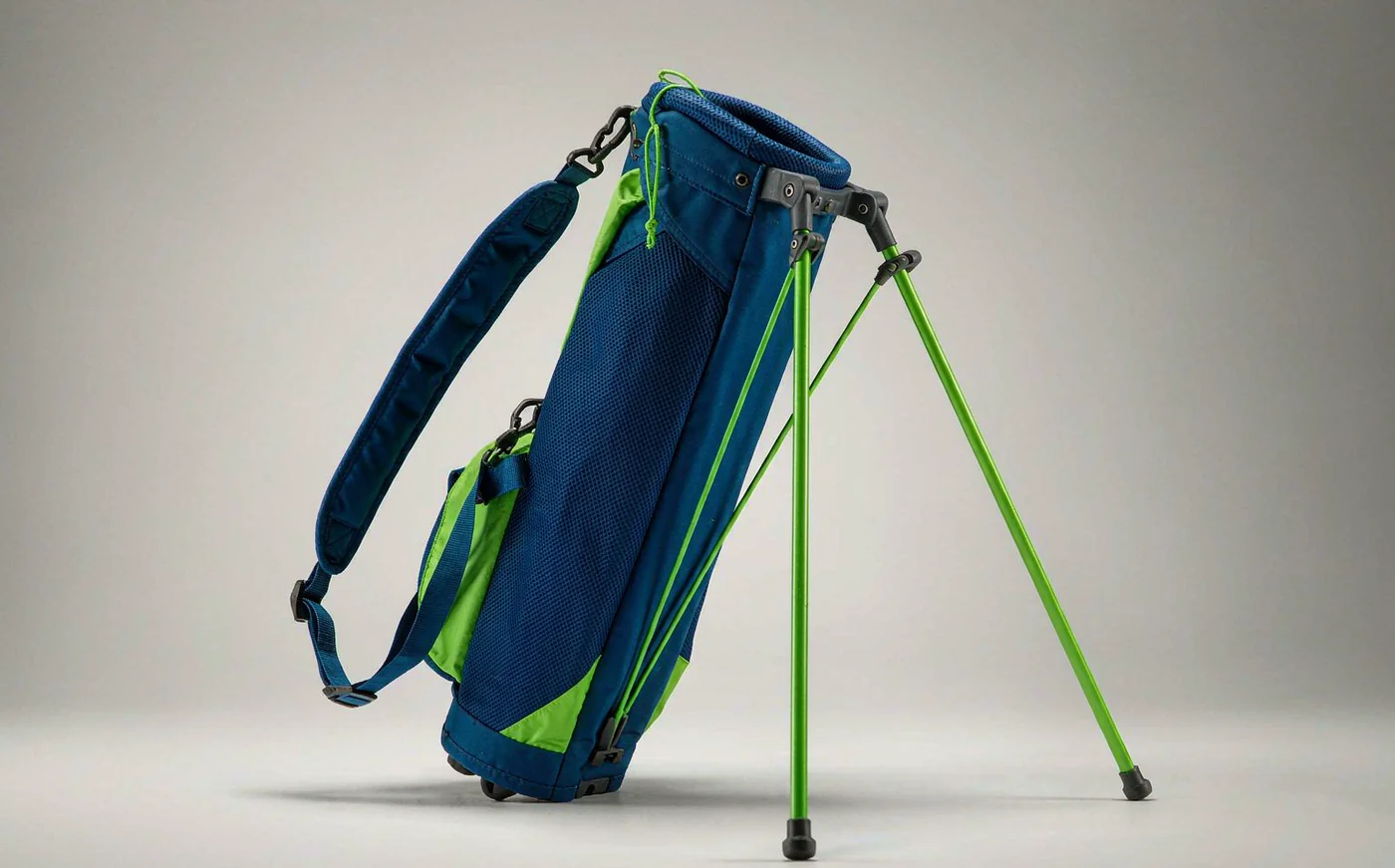
Scaling a stand bag down for a child changes the load case, not just the dimensions, and most junior programmes fail at exactly that point. A nine-year-old dragging a bag across a car park puts a different stress into the base, the leg hub and the strap anchor than an adult walking eighteen holes. The product also crosses into children's goods regulation, which brings material limits and record-keeping that do not apply to an adult bag. This guide covers height-based sizing, the structural changes that matter, the compliance file, and the commercial structure: 200 pieces per colourway counted across the size run, a 100-piece trial on stock fabric, sampling in 6-10 working days, bulk in 35-50 days, and AQL 2.5 inspection to ISO 2859-1.
Sizing by Height, Not by Age
Age bands are the least reliable specification in the category, because a tall seven-year-old and a short ten-year-old need the same bag. Height of the player, and therefore length of the longest club, is what drives the product. A bag has to be 40-70 mm longer than the longest club in the set so the heads clear the base when the bag is standing, and so the grips sit proud of the mouth when the bag is lying on its side.
| Player height | Typical set length | Bag height | Top opening | Target finished weight | Ways |
|---|---|---|---|---|---|
| 95-110 cm | 26 in | 690 mm | 140-150 mm | 1.00-1.20 kg | 4 |
| 110-125 cm | 28 in | 740 mm | 145-155 mm | 1.10-1.30 kg | 4-5 |
| 125-140 cm | 30 in | 790 mm | 150-160 mm | 1.25-1.45 kg | 5 |
| 140-155 cm | 33 in | 840 mm | 155-165 mm | 1.40-1.60 kg | 5-6 |
Well diameter is the number buyers most often copy from an adult bag by mistake. An adult well runs 38-45 mm to clear a midsize grip plus a gloved hand. On a junior bag the correct internal diameter is 33-38 mm, because the grips are standard size but the hands are small, and a well that is too wide lets clubs rattle and the heads knock together. Specify the assembled diameter after lining, not the cut diameter: 1.5-2 mm of build-up is normal and it closes the mouth of every well. The golf bag types guide sets out how the junior carry silhouette compares with adult stand and Sunday shapes.
The height bands in the table are also a manufacturing constraint. Patterns for the two smaller sizes nest inside each other on a marker, which is why a three-size range can be cut at close to the fabric cost of two adult bags. The largest size in the range does not nest with the others and has to be cut on its own marker, so it carries a small material penalty that buyers should expect to see reflected in the unit price.
What Actually Changes Structurally
Junior bags are usually developed from an existing adult stand bag pattern, and the first version is almost always wrong in three places: the leg geometry, the hub, and the strap yoke. Everything downstream, from pocket volume to handle position, follows from those three.
Legs and hub
Adult legs run 640-720 mm with a splay of 24-28 degrees from vertical. Junior legs are 480-560 mm with a splay of 20-24 degrees, and the hub spring force has to drop with them. Scale a hub down linearly and the deployed geometry changes: a leg that is 12% shorter moves the ground contact point inward, and the bag then tips forward when a child leans on the top. The fix is either a shorter hub lever arm or a wider foot pad, and the second is cheaper. It also solves the second problem, which is that small feet press the bag into soft ground and a narrow pad sinks.
The hub is the highest-risk part on the whole product from a safety angle. Any scissor action between the leg arm and the body, any gap between 5 mm and 12 mm, is a finger trap on a bag that gets folded and unfolded by a child. Rounded covers, an enclosed hub body and a minimum 12 mm gap at every closing point remove the risk at a cost of roughly USD 0.20-0.35 per bag.
Top ring and divider
The top ring on a junior bag is shorter in the vertical wall, 38-50 mm against 55-70 mm on an adult bag, which reduces the stiffness of the mouth considerably. That is why a 5-way junior top needs a slightly thicker ring section or an internal rib, even though the opening is smaller. A ring carried over unchanged from the adult pattern will flex when a child lifts the bag by the top handle, which is exactly how most children carry it.
Strap, handle and pockets
A dual strap on a junior bag needs a shorter yoke and a wider adjustment range than the adult version, roughly 300-450 mm of adjustment, because the bag is worn over a waterproof jacket in winter and a polo in summer. The top handle should be positioned so a small hand can reach it with the bag standing, which usually means moving it 20-30 mm forward of the adult position. Pocket zips get larger pulls, not smaller ones: a 30-40 mm pull tab with a moulded grip is easier for a child in gloves than a cord loop.
Safety and Material Compliance Buyers Underestimate
A golf bag made for a child is a children's product in the United States and falls under the Consumer Product Safety Improvement Act, which is a different regime from the one applied to adult sporting goods. The practical consequences are material limits, a permanent tracking label, and a certificate of conformity supported by third-party test reports from an accredited laboratory.
| Requirement | Market | Limit or obligation |
|---|---|---|
| Total lead, accessible substrate | United States | 100 ppm |
| Lead in surface coatings | United States | 90 ppm |
| Restricted phthalates, plasticised parts | United States | 0.1% each, eight substances |
| Permanent tracking label | United States | Producer, location, date, batch |
| Lead in articles | European Union | 0.05% by weight |
| Phthalates in plasticised material | European Union | 0.1% each, restricted entries |
| Nickel release, skin-contact metal | European Union | 0.5 µg/cm²/week |
Two things surprise buyers at this stage. The first is that the limits apply to every accessible component, which includes zip pulls, cord ends, piping, the rubber foot caps and the printing ink, not only the shell fabric. The second is documentation: a certificate of conformity has to be based on a test report from an accredited lab, and the supporting records are expected to be retained for several years after the shipment. A supplier that cannot produce a test report per material, per colour, is a supply-chain risk rather than a paperwork inconvenience.
Design-level compliance is cheaper than testing-level compliance. Specify lead-free PVC alternatives for piping, use nickel-free plating on any metal that touches skin, avoid azo dyes on any component that a child may chew, and keep every decorative attachment either welded or double-stitched so it cannot be pulled free. Where a buyer wants a novelty element, such as a moulded character badge on the pocket, the same use-and-abuse logic that applies to toys is worth applying: a 70 N pull test on the component before the design is signed off.
- No gaps between 5 mm and 12 mm anywhere on the leg hub, folding mechanism or handle brackets.
- No cord or webbing loop longer than 220 mm that hangs free at the top of the bag, to remove any entanglement risk.
- All edges on moulded parts radiused at 1 mm minimum, with no flash line that can cut a hand.
- Every attached component either welded, riveted with a washer, or stitched with a box-X and a reinforcement patch.
- Colour fastness to rubbing verified on dark shells, because junior bags are dragged, dropped and wiped with a wet cloth.
Minimums Across a Three-Size Range
The commercial structure of a junior programme is where most first-season plans break. A brand wants three sizes, three colourways and a low opening order, and those three wishes cannot all be met at once. The 200-piece minimum is set per colourway and counted across the size run, so a colourway split 60/70/70 across three sizes is one order, not three. A 100-piece trial is available when the shell fabric is stock and the size split is limited to one or two sizes.
Where a new top ring, a new hub or a new base plate is needed, the opening quantity moves to 500 pieces, because the tool has to be cut and proven. That is the point at which buyers should decide whether the junior line is a genuine range or a single hero SKU with a colour variation. In practice the second option launches faster and costs less to prove.
| Structure | Quantity logic | Sampling | Comment |
|---|---|---|---|
| Single size, stock shell | 100 pcs trial | 6-10 working days | Colour split by trim only |
| 3 sizes, 1 custom colourway | 200 pcs total, split by size | 6-10 working days | Most common first order |
| 3 sizes, 3 colourways | 600 pcs total | 6-10 working days | Dye lot per colour |
| New hub, ring or base tool | 500 pcs minimum | 12-15 working days | Tooling quoted separately |
Fabric consumption is favourable and worth putting in front of a finance team. A 26-inch junior bag uses roughly 0.60-0.75 linear metres of 1.5 m shell fabric including pockets and cut loss, against 1.2-1.5 m for an adult cart bag. One 300 m roll therefore covers 350-450 junior units, so a 200-piece colourway sits well inside a single roll and the material risk of a small order is low.
Field note. Three colours in three sizes produces nine SKUs before any retail-specific labelling. Distributors rarely take nine; they take four to six. Launching with two sizes and two colourways, then adding the third size once the sell-through is visible, keeps the first order at 200-400 pieces and avoids a warehouse full of the size nobody ordered.
Building a Brand Label Into a Kids Programme
Buyers often arrive searching under the trade term private label, and what they usually need is narrower than the term suggests: their own artwork and labelling on a pattern that is already proven, with the option to own the pattern later. It is worth separating those two purchases at the start, because the first is a labelling exercise quoted at 200 pieces and the second is a development project quoted at 500 with tooling attached.
Labelling a junior bag has more components than an adult bag, because the product is sold into schools, academies and club junior sections where personalisation is expected. A full package normally includes a woven main label in the front seam, a size label inside the mouth, a name window on the spine or the top pocket, a woven tab on the strap pad, and either a heat transfer or embroidery on the apparel pocket. Reflective piping along the base and the shoulder strap is a low-cost addition that parents notice, at roughly USD 0.25-0.45 per bag.
The name window deserves its own decision. A clear PVC window with a card insert lets an academy write a student name and reuse the bag across a season, and it costs 0.15-0.35 USD to add. A printed name is cheaper per unit but locks the bag to one child, which matters when a club is buying twenty bags for a junior section and wants them to survive two intakes.
- Artwork and placement drawing. Every label position fixed in millimetres from a named reference point, because a 10 mm drift on a small panel is visible at retail.
- Label specification. Weave type, yarn, backing, cut style and colour references for each label, matched against the shell to ΔE ≤ 1.5.
- Compliance check on the label itself. Ink, thread and backing are all accessible components and fall inside the same material limits as the shell.
- Sample with labels applied. Approve the physical label on the physical panel; a digital mock hides the scale problem on a 690 mm bag.
- Bulk label release. Labels are produced in a separate lot from the bags, so the label delivery date has to sit inside the 35-50 day bulk window, not after it.
Test Protocol for a Bag That Gets Dropped, Dragged and Sat On
Junior bags fail differently from adult bags. The failures we see most often are a torn strap anchor, a bent or seized leg, a base seam that splits at the rim, and a zip that loses its pull because the cord was chewed. A test protocol should map onto those failures rather than copy an adult protocol wholesale.
A workable set: 2,000 open-close cycles on the leg mechanism with a 1 kg load in the bag, a 500 mm drop onto each corner and onto the base, a 300 N static pull on each strap anchor held for 60 seconds, 1,500 zip cycles with the bag loaded, a 70 N pull on every attached component, and shell grab strength to ASTM D5034 at 200 N minimum. Colour fastness to light follows ISO 105-B02 where the shell is a saturated colour, and colour fastness to rubbing is checked on any dark shell that will be dragged across grass and tarmac.
The acceptance plan is AQL 2.5 to ISO 2859-1, general level II: thirty-two bags out of every two hundred, with no more than two major defects inside that draw. The draw is checked for stitching at the strap anchors and base, leg function through a full open-close cycle, hub gap, label placement and the presence of the tracking label. Defect classes belong in writing before production starts, and the tracking label sits in the critical class rather than the major one, because its absence blocks import.
Sampling, Bulk and the Season Calendar
Junior programmes are seasonal by nature: school terms, club junior sections and spring pro shop resets all cluster. Working backwards from a shelf date is more useful than working forwards from a purchase order. Sampling takes 6-10 working days when materials are stock, and 12-15 when a hub, ring or base tool has to be cut and proven. Bulk runs 35-50 days from sample approval, and sea freight to the US East Coast or Northern Europe adds roughly 25-40 days door to door at the time of writing, so current rates and transit times should be confirmed with the forwarder before the calendar is fixed.
The pattern of failure in this category is a buyer approving a sample in week one, adding a second colourway in week three, and then discovering that the added colour pushed the fabric order past the dye house cut-off and moved the whole shipment by three weeks. Lock the colourway count before sampling, not after.
Capacity for this work sits in Quanzhou, Fujian, on dedicated production lines with third-party factory audits available on request, and the company handling it has been operating since 2014 with a team that entered bag production in 2004. Payment terms are T/T 30/70 with the balance against the bill of lading copy, and terms are FOB Xiamen. For buyers building a first junior range, the fastest route to a realistic plan is to send the height bands, the colourway count and the target retail price together, so the size split, the tooling position and the label package can be costed as one project rather than three.
Related reading: Bulk Bags for Academies, Teams and Schools
Sources and Standards Referenced
- U.S. Consumer Product Safety Commission (CPSIA requirements for children's products)
- ECHA, Understanding REACH (restrictions on lead and phthalates in articles)
- ISO 2859-1:2022 Sampling procedures for inspection by attributes
- ASTM D5034 Breaking strength and elongation of textile fabrics (grab test)
- ISO 105-B02 Colour fastness to artificial light
- The R&A, reporting on junior participation growth in global golf
Next steps: custom solutions, manufacturing capability, and a quotation request.
Frequently Asked Questions
What sizes do junior golf bags come in?
Bag height is driven by the longest club, not by age. The working bands are 690 mm for a 26-inch set, 740 mm for 28 inches, 790 mm for 30 inches and 840 mm for 33 inches, which covers players from roughly 95 cm to 155 cm tall. A bag should run 40-70 mm longer than the longest club so heads clear the base.
What is the smallest order you will accept for a junior bag?
200 pieces per colourway, counted across the size run rather than per size, so a split of 60/70/70 across three sizes is a single order. A 100-piece trial is possible with stock shell fabric. A new hub, top ring or base tool raises the opening quantity to 500 pieces.
How much does a junior golf bag weigh?
Targets run 1.00-1.20 kg for the smallest size up to 1.40-1.60 kg for a 33-inch set. The child then carries clubs on top of that, so the bag is the part of the load a brand controls. Weight tolerance is normally ±5% of target, and hardware choices move the number more than fabric does.
Is a junior golf bag regulated as a children's product?
In the United States, yes. It falls under CPSIA, which sets 100 ppm total lead in accessible substrate, 90 ppm in surface coatings, 0.1% for each of eight restricted phthalates, and requires a permanent tracking label plus a certificate of conformity based on accredited laboratory testing.
What are the EU limits for junior golf bags?
Lead in articles is restricted to 0.05% by weight and phthalates in plasticised material to 0.1% each under REACH Annex XVII. Metal hardware in prolonged skin contact also has to meet a nickel release limit of 0.5 µg/cm²/week. Documentation is the buyer's responsibility as importer, so test reports per material are essential.
Why do junior bag legs bend or seize?
Usually because an adult leg and hub were scaled down without re-checking geometry. A 12% shorter leg moves the ground contact point inward and loads the hub differently under a child's uneven handling. Shorter legs with a wider foot pad, plus a hub rated for the new splay angle, are the standard fix.
Can a junior bag use an adult 14-way top?
It can, but it should not. Adult wells at 38-45 mm are too wide for small hands and let clubs rattle, and the adult top ring wall is heavier than a 690-840 mm bag needs. A 4-6 way top with 33-38 mm assembled well diameter is the right specification for this product.
How long does a junior bag order take?
A stock-material sample is ready in six to ten working days, and a fresh tool stretches that to twelve to fifteen. Bulk follows the approved sample in 35-50 days. Sea freight of roughly 25-40 days to the US or Northern Europe sits on top, so confirm current transit times with the forwarder before fixing a shelf date.
Can we put our own brand label on a junior bag?
Yes, and it is usually the sensible first step: your artwork, labels and colourway on a proven pattern, at 200 pieces per colourway. Buying the pattern outright is a separate development project quoted at 500 pieces with tooling. Separating the two purchases keeps the first order small and the artwork moving.
What labelling does a junior bag normally carry?
A woven main label in the front seam, a size label inside the mouth, a name window or printed name panel, a woven tab on the strap pad, and a logo on the apparel pocket by heat transfer or embroidery. A clear name window with a card insert costs about USD 0.15-0.35 per bag and lets academies reuse bags across intakes.
What tests should a junior bag pass?
2,000 leg open-close cycles with a 1 kg load, a 500 mm drop onto each corner and the base, a 300 N static pull on each strap anchor for 60 seconds, 1,500 zip cycles when loaded, a 70 N pull on every attached component, and grab strength to ASTM D5034 at 200 N minimum.
What inspection standard applies?
Level II sampling to ISO 2859-1 at AQL 2.5 draws thirty-two bags from a lot of two hundred and tolerates two majors. Checks cover strap anchor stitching, base seam, leg function, hub gap and label placement, plus the tracking label, which sits in the critical class because a missing one stops the shipment at the border.
Do junior bags need a different carton or packaging?
They usually ship at 12-18 pieces per carton rather than 20-25, because the bags are shorter and the carton is cut to the retail-ready pack. That changes the freight calculation per piece, which is worth running before the FOB price is finalised.
Plan a Junior Range
Send your height bands, colourway count and retail target, and we will return a size split, a tooling position and a labelled sample plan within two working days.
Start a Junior Programme See Custom Solutions