Golf Sunday Bag Weight and Folding Design for OEM Manufacturing
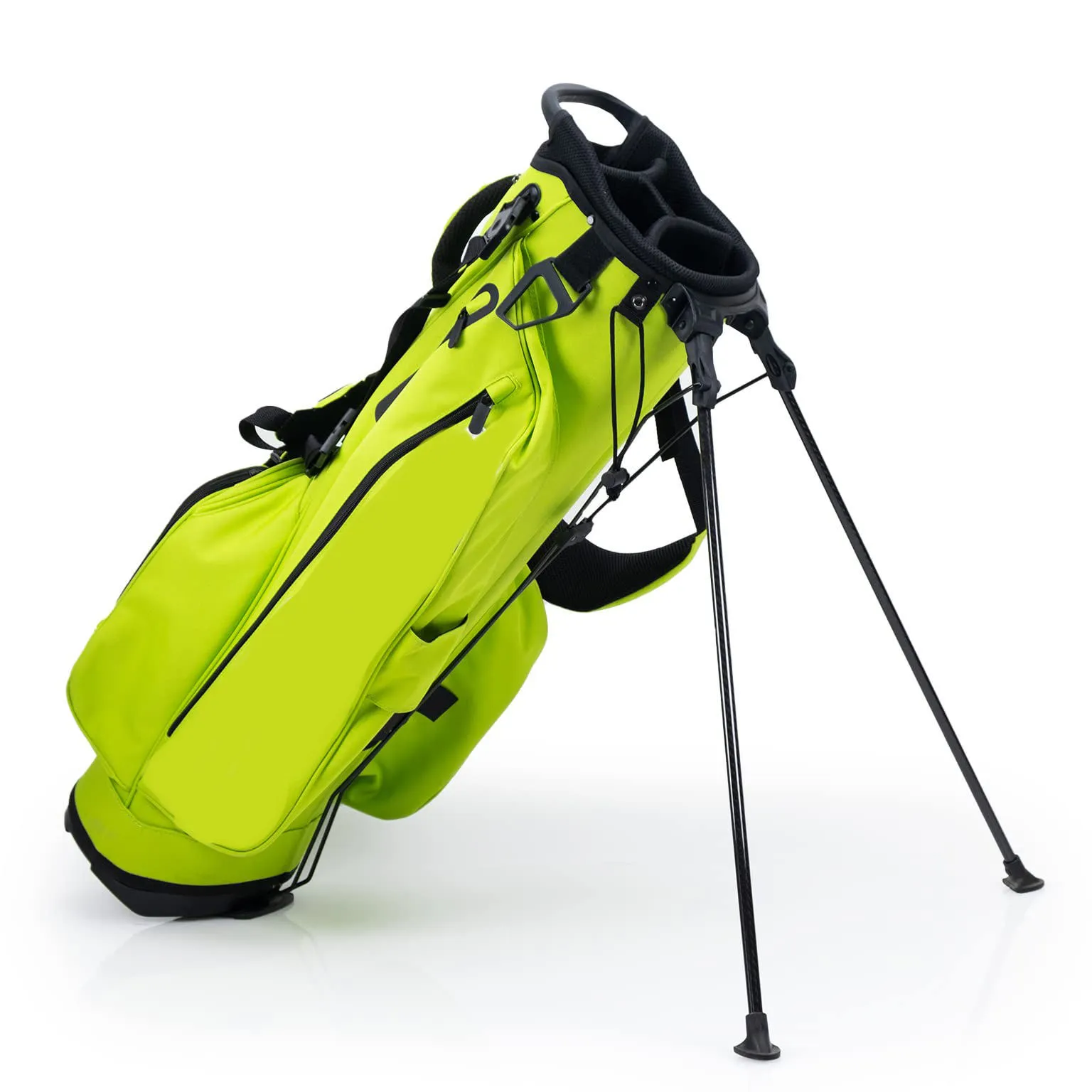
Every gram removed from a Sunday bag comes out of one of four places, the frame, the base, the fabric or the hardware, and the order in which a designer takes them decides whether the product lasts a season or three. The category spans 0.55 kg for a legless single-strap sack with a three-way top up to 1.85 kg for a folding stand model with five dividers and four pockets, and the two ends are different products that happen to share a name. What buyers need is a target weight, a folded length and a cycle life, written together, because optimising one of the three silently breaks the other two. Order terms: 200 units per colourway, one hundred as a trial order, a prototype in six to ten working days, 35 to 50 days per run, and an AQL 2.5 audit against ISO 2859-1.
Related reading: Sunday Bag vs Stand Bag: Which Is More Practical
What the Weight Figure Actually Includes
Published weight is a marketing number until it is defined. A 0.9 kg Sunday bag that excludes the strap, the rain hood and the base stiffener is a different product from a 0.9 kg bag that includes all three, and the gap between those definitions is 120-180 g. Any specification worth signing states the weigh condition: empty, with strap attached, without hood, on a calibrated scale, tolerance plus or minus 3%.
The second ambiguity is the club load. A Sunday bag is designed for a short set, typically seven to ten clubs, and its structure is sized for that. Load 6-7 kg of clubs into a bag built around an 8 mm fibreglass rod and the rod bows, the base panel creeps and the strap anchors start to pull. Buyers who intend the product for a full fourteen-club set should be steered toward a stand bag instead, and that conversation belongs before the pattern is cut rather than after the first sample.
Empty weight versus carry weight
Carry weight is what the customer feels, and it includes the bag, the clubs, a dozen balls, a bottle and a jacket. On a seven-club Sunday set that total lands around 5.5-6.5 kg, so a 250 g saving on the bag is a 4% improvement in what hangs off a shoulder for four hours. That is real but modest, which is why the folding behaviour and the strap geometry often matter more to satisfaction than the last 100 g.
Where weight does pay is in the hand. A bag lifted in and out of a car boot twenty times a week at 1.6 kg feels materially different from one at 1.9 kg, and retail customers notice that in the shop within seconds. Design targets in this category are usually set at round numbers, 1.2 kg or 1.5 kg, and the pattern work then chases the target rather than the target following the pattern.
Four Folding Architectures and What Each Saves
Folding in this category means one of four things, and the names get used loosely. Each architecture buys a different packed size at a different structural cost, so the choice should follow the use case: a locker, a car boot, a cart, or a cabin bag.
| Architecture | How it folds | Folded length | Empty weight | Best use |
|---|---|---|---|---|
| Legless sack | Rolls or folds flat, no frame | 420-520 mm | 0.55-0.85 kg | Short rounds, range sessions, giveaways |
| Hinged spine | Centre hinge closes the frame in half | 560-620 mm | 0.95-1.25 kg | Locker storage, cabin-size travel |
| Folding legs only | Legs fold flat against the body | 880-940 mm | 1.15-1.45 kg | Walking rounds with a cart or caddie |
| Folding legs plus hinge | Both, with a zip-off base panel | 600-660 mm | 1.35-1.65 kg | Travel plus walking, premium compact |
The hinged spine is the architecture buyers ask about most and understand least. A centre hinge on the frame lets the bag halve its length, but it also introduces a discontinuity in the one member that carries the club load. That is solvable: a 3.5-4.0 mm stainless pin through a nylon bushing, a 1.5 mm steel reinforcement plate on each side of the joint, and a fabric gusset at the hinge that folds inward rather than creasing outward. What is not solvable is doing it with a 2.5 mm pin and no bushing, which is how most cheap versions are built and why the category has a reputation for hinges that fail in a year.
Where the folding geometry costs weight
Folding hardware is heavy relative to its size. A hinge assembly with pin, bushing, two plates and four rivets weighs 45-70 g, and a folding leg mechanism with springs and brackets adds 90-130 g. That is why a folding legless sack at 0.7 kg and a folding stand model at 1.4 kg are not the same product with different marketing: the mechanism alone accounts for a fifth of the heavier bag.
The other hidden cost is fabric. A hinge needs slack, so the panel around it is cut 8-12 mm longer than a rigid equivalent, and that slack has to be controlled with a gusset or it puckers when the bag is open. Puckering is cosmetic until it starts pulling the stitch line at the hinge, at which point the bag develops a tear exactly where it flexes most.
Folded Length, Cart Fit and Travel
Folded length is the number that decides which use cases a product can serve, and it should be chosen before the frame is drawn. Under 520 mm fits most airline cabin allowances and most club lockers. Under 620 mm fits a car boot shelf and the space behind a cart seat. Under 660 mm fits overhead bins on larger aircraft but not the smaller regional ones.
Cart fit is a separate constraint. A Sunday bag with folding legs still has to sit on a trolley cradle, and a bag whose folded leg brackets protrude beyond the base will rock on the cradle or catch on the strap. Setting the leg brackets 5-8 mm inside the base perimeter solves it at no cost, and it is the kind of detail that only shows up when a sample is tested on three different carts rather than one.
Travel users add a third constraint: the folded bag has to protect the clubs it is carrying, or it needs a cover. A hinge bag at 600-660 mm with a padded spine will survive a car boot but not an aircraft hold. Brands selling the product as travel-friendly usually pair it with a lightweight cover and sell the two together, which also lifts the average order value without changing the bag itself.
| Target use | Folded length | Legs | Top size | Typical weight |
|---|---|---|---|---|
| Cabin carry | Under 560 mm | None or detachable | 3-way, 190-200 mm | 0.55-1.05 kg |
| Locker and boot | 560-620 mm | Folding, integrated | 4-way, 200-215 mm | 0.95-1.30 kg |
| Walking round | 880-940 mm | Folding, sprung | 4-5 way, 210-230 mm | 1.15-1.50 kg |
| Travel plus walking | 600-660 mm | Folding plus hinge | 5-way, 215-230 mm | 1.35-1.70 kg |
Hinge, Leg and Strap: The Three Failure Points
Almost every warranty return in this category traces to one of three components, and all three can be specified to a cycle life before the first sample is made. The numbers below are the ones used on current programmes and are worth putting into a purchase order verbatim.
The hinge fails in two ways. The pin wears through the bushing and develops play, which shows as a bag that will not stand straight when open; or the fabric gusset tears at the fold line, which shows as a split at the back of the hinge when the bag is loaded. A 4 mm stainless pin in a nylon bushing, tested to 2,000 open and close cycles under a 5 kg load, will outlast the fabric. A 2.5 mm pin in a punched hole will not survive 400 cycles.
Legs fail at the spring and at the bracket. A sprung leg mechanism should be tested to 10,000 deployment cycles, and the bracket should be a moulded nylon or glass-filled PP part rather than a folded metal plate, because a folded plate fatigues at the bend within a season of use. The leg itself is usually a 9-11 mm aluminium or fibreglass tube with a plastic foot; the foot wears first and should be a replaceable push-fit part.
Straps fail at the anchor and at the pad. A single-strap Sunday bag puts the full 6 kg load through two anchors, so each anchor needs a box-X at eight to ten stitches per inch through a reinforcement patch, not a single row of lockstitch into the shell. The pad fails by compression rather than abrasion: 8-10 mm of closed-cell foam holds up, 5 mm of open-cell foam compresses flat in a month and the strap starts cutting into the shoulder.
Field note. Test the hinge with the bag loaded, not empty. An empty bag cycles happily for thousands of open and close movements because there is no load path through the joint. With 5 kg of clubs inside, the same hinge sees a bending moment at every fold, and that is where the pin and the gusset actually earn their specification.
Fabric Choice at 210D, 300D and 420D
Fabric is the largest single lever on weight and the easiest to get wrong. A Sunday bag shell in 210D polyester weighs roughly 40% less than the same pattern in 420D, but it also abrades through at the base corner in a season if the bag is set down on cart paths. The usual answer is a split: light fabric on the body, heavier fabric or a coated panel at the base and the strap rub points.
Coating matters as much as denier. A 300D with a 600 mm PU backer is water resistant and stays soft; the same fabric with a 1,000 mm coating is stiffer, heavier by 25-40 g/m², and creases at the hinge. For a folding product, the softer backer is almost always the right call, because a stiff coated fabric will crack along the fold line within a few hundred cycles.
Colour and print add a constraint that buyers forget. Sublimated panels need a polyester face and cannot be applied to a PU-coated surface without a primer, and light colours show dirt at the base within weeks. Where a brand wants a pale colourway on a bag that will be set on wet grass, the practical answer is a dark base panel and a light body, which also happens to look deliberate.
Trimming decisions that move the number
Trimming is where the last 60-100 g hides. A Sunday bag does not need a moulded collar, a metal zipper pull or a padded valuables pocket. Replacing a moulded ABS collar with a bound fabric top saves 90-120 g, and switching from metal sliders to moulded nylon saves 15-20 g per pocket. Those two changes alone can take a 1.35 kg bag under 1.2 kg without touching the frame.
Testing a Folding Bag Before Bulk
The test set for a folding bag is shorter than for a cart bag but more specific, because the product is judged on movement rather than on storage. Five checks cover the failure modes that matter, and all five run on the first article rather than at bulk.
- Cycle the hinge. 2,000 open and close cycles with a 5 kg load in the bag, at 20 cycles per minute, checking for pin play over 0.5 mm and for gusset tearing at the fold.
- Cycle the legs. 10,000 deployments and retractions on a rig, checking spring return, bracket play and foot retention. A leg that fails to retract fully will not fit the folded length.
- Drop the folded bag. 1 m onto concrete, six orientations, folded, with a 4 kg load inside, checking frame straightness and hinge alignment afterwards.
- Hang the loaded bag. Suspend by the strap anchor for 24 hours at 10 kg, then inspect for stitch pull and shell distortion at both anchors.
- Measure the folded length. Three samples from the same lot, folded by hand, measured to the nearest 5 mm against the drawing. A 15 mm spread across a lot means the gusset tolerance is wrong.
Strap anchors and base seams are grab-tested to ASTM D5034 at a 250 N floor, and shell fabric is torn to ASTM D2261, which matters more on a 210D fabric than on a 420D one. Fading is checked to ISO 105-B02 on pale colourways, since a Sunday bag spends its life in the open.
The club count is worth stating in the tech pack as a design load rather than a marketing line. The rule set issued by the USGA caps a player at fourteen clubs, but a Sunday bag is built for seven to ten and its frame is sized accordingly. Writing "design load 8 kg, typical set 7-10 clubs" removes the ambiguity that otherwise surfaces as a warranty claim from a customer who loaded a full set.
Spec tip. Photograph the folded bag next to a tape measure in the approval sheet. Folded length drifts by 10-20 mm between lots as gusset tolerance and fabric shrinkage move, and a photograph with a scale is the only record that settles a freight or locker-fit dispute later.
Sampling, Tooling and Order Quantities
A Sunday bag is the fastest product in the range to sample, because most of it is cut and sewn from patterns rather than moulded. Where the hinge, leg brackets and base panel already exist, a colourway change samples in 6-10 working days. A new hinge plate, a new leg bracket or a folding base with a zip-off panel needs a mould, which pushes sampling to 12-15 working days and adds tooling of USD 1,200-3,800 depending on the number of cavities.
Production takes 35 to 50 days from sign-off. The lower end is achievable on a single colourway with stock fabric; the upper end appears when a programme runs four colourways and the print queue backs up. Because the bag is small and light, packing density is good: 40-55 units per carton at 0.9-1.4 kg each, which keeps freight per unit low and makes smaller initial orders viable.
The floor is 200 units per colourway, and 100-unit trials are accepted in a single colour. A new folding mechanism or a new body shape is a development rather than a colour change, and moves to 500 pieces so the tooling can be amortised. For brands testing the category, the sensible first order is 100 pieces of the legless sack at the lowest price point, which validates demand before committing to a folding mechanism that costs more to tool and more to build.
- Weigh condition, stated as empty, strap attached, hood excluded, on a calibrated scale with a 3% tolerance.
- Folded length and its tolerance, measured on a folded sample rather than calculated from the pattern, since gusset slack changes the result.
- Cycle life for hinge and legs, with load and rate, so the mechanism is specified rather than assumed.
- Design club load, expressed in kilograms and in typical club count, so the frame diameter follows the use case.
- Fabric split by zone, naming denier and coating separately for body, base and strap rub points.
- Cart fit check, with the leg brackets set inside the base perimeter and tested on at least three trolley models.
The range currently in production is listed on the Sunday carry bag pages, and the club capacity guide covers how top size and divider count interact with a short set. Buyers comparing a compact Sunday bag against a full stand bag will find the trade-offs set out in the compact bag comparison.
Next steps: custom solutions, manufacturing capability, and a quotation request. Sunday Carry Bags. Sunday Bag Use Cases.
Sources and Standards Referenced
- ISO 2859-1:2022 Sampling procedures for inspection by attributes
- ASTM D5034 Breaking strength and elongation of textile fabrics (grab test)
- ASTM D2261 Tearing strength of fabrics (tongue method)
- ISO 105-B02 Colour fastness to artificial light
- USGA Rules of Golf, Rule 4.1b (14-club limit)
Frequently Asked Questions
How much does a Sunday bag weigh?
Between 0.55 kg for a legless single-strap sack and 1.85 kg for a folding stand model with five dividers. The common retail targets are 1.2 kg and 1.5 kg. Always confirm the weigh condition, because a figure that excludes the strap, the hood and the base stiffener is 120-180 g lighter than a complete bag.
What is the lightest useful Sunday bag?
A legless bag in 210D polyester with a bound fabric top, two pockets and a single strap can be built at 0.55-0.85 kg. Below that, the fabric and the strap become the limiting factors and the product stops surviving regular use on wet ground.
Why does a folding mechanism add so much weight?
A hinge assembly with pin, bushing, plates and rivets weighs 45-70 g, and a sprung folding leg set adds 90-130 g. That hardware is why a 0.7 kg sack and a 1.4 kg folding stand bag are different products rather than the same bag with different trim.
How short can a Sunday bag fold?
A hinged spine gets a bag to 560-620 mm, and folding legs plus a hinge with a zip-off base reaches 600-660 mm. Under 560 mm usually means no frame at all. Choose the folded length against the locker, boot or cabin allowance before the frame is drawn.
How many clubs does a Sunday bag hold?
Seven to ten is the design range. The frame, base panel and strap anchors are sized for roughly 8 kg total, so a full fourteen-club set will bow the frame and creep the base. State the design load in the tech pack to avoid warranty claims from customers who overload it.
What fails first on a folding Sunday bag?
The hinge, then the leg brackets, then the strap anchors. A 4 mm stainless pin in a nylon bushing tested to 2,000 loaded cycles outlasts the fabric gusset. A 2.5 mm pin punched through the frame typically fails before 400 cycles.
What fabric is used for a lightweight Sunday bag?
210D polyester on the body with 420D or a coated panel at the base and strap rub points is the usual split. A 600 mm PU backer keeps the fabric soft enough to fold without cracking, while a 1,000 mm coating is stiffer and adds 25-40 g/m2.
Can a Sunday bag be used as cabin baggage?
Only if the folded length is under roughly 560 mm and the bag is packed inside a cover. A hinge bag at 600-660 mm will not fit most cabin gauges. Brands selling the product as travel-friendly usually pair it with a lightweight travel cover.
What is the MOQ for a custom Sunday bag?
Two hundred units in one colourway is the floor, and a 100-unit trial in a single colour is possible. A new hinge plate, leg bracket or folding base panel needs a mould, which raises the minimum order to 500 units since the mould cost has to be spread across a longer run.
How fast can a folding bag be sampled?
Six to ten working days where the hinge, brackets and pattern already exist, twelve to fifteen where a mould is cut, because the tool has to be sampled and measured before a bag can be sewn onto it.
What is the lead time for a Sunday bag run?
Thirty-five to fifty days after sign-off, with fabric and print queue setting the top of the window rather than the bag construction. A single-colourway order in stock fabric sits near the bottom, and a four-colourway programme with a printed panel sits at the top.
What tests should a folding Sunday bag pass?
Two thousand loaded hinge cycles at 5 kg, ten thousand leg deployments, a 1 m drop test in six orientations while folded, a 24-hour hang at 10 kg on the strap anchors, and a folded length check on three samples from the lot.
Does a Sunday bag need a stand mechanism?
Not necessarily. Legless bags sell well to range users, trolley players and corporate giveaways, and they avoid the heaviest hardware in the product. A sprung leg set is worth its 90-130 g only if the buyer expects the bag to be set down repeatedly on grass.
Set a Weight Target
Send the club count, the folded length you need and the retail price, and the reply will name the architecture, the fabric split and the hinge specification that reaches it.
Discuss a Weight Target View Sunday Bags