Golf Stand Bag Leg Thickness Engineering for OEM Programmes
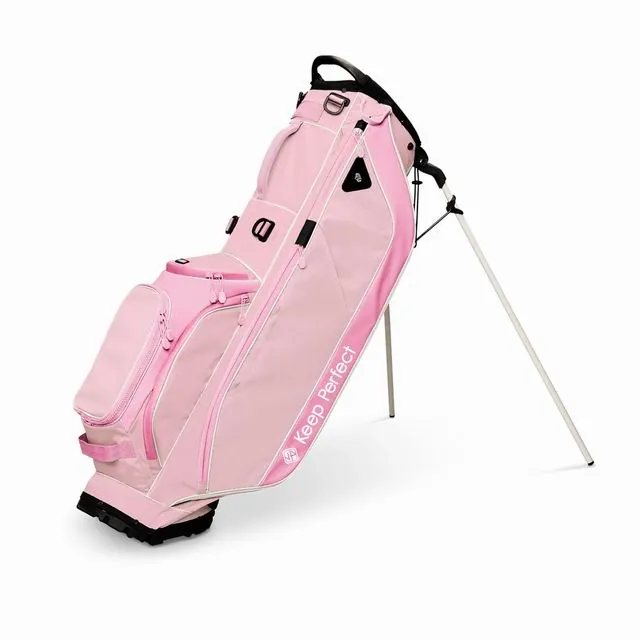
Leg thickness is the quietest number on a stand bag specification and the loudest one in the warranty file. Wall thickness decides whether a leg springs back after a hundred rounds or takes a permanent set, and it decides whether the bag weighs 1.8 kg or 2.1 kg before a single club goes in. Buyers rarely specify it, because the number sits inside a tube they never see, so the decision defaults to whatever the last project used. This page works through the diameter-and-wall arithmetic, the four materials in use, the joints where legs actually break, the geometry that keeps a loaded bag from toppling, and the test values worth writing into a tech pack. Order structure is the usual one: two hundred units to a colourway, one hundred for a trial run, five hundred when a bracket tool is fresh, samples in six to ten working days or twelve to fifteen with new moulding, and production in 35-50 days, with checks at AQL 2.5 against ISO 2859-1.
Three Numbers Describe a Leg, and Buyers Specify One
A leg is defined by outside diameter, wall thickness and free length, plus the material those three sit in. Sellers quote the diameter because it is visible and sounds technical; 16 mm reads stronger than 13 mm. The number that controls stiffness, however, is not diameter alone but the section it creates, and the number that controls weight is the material wrapped around that section.
For a thin-walled tube, bending stiffness scales roughly with the cube of diameter multiplied by wall thickness, while mass scales with diameter multiplied by thickness. That single relationship explains most of the engineering decisions in this product category, and it is the reason a thinner wall on a larger tube usually beats a thicker wall on a smaller one.
| Tube | Section index (d³ x t) | Relative mass (d x t) | Relative stiffness | Comment |
|---|---|---|---|---|
| 16 mm x 1.0 mm | 4,096 | 16.0 | 1.43 | Default for aluminium stand bags |
| 13 mm x 1.3 mm | 2,859 | 16.9 | 1.00 | Older pattern, heavier and softer |
| 14 mm x 1.0 mm | 2,744 | 14.0 | 0.96 | Lightweight, acceptable at 700 mm |
| 18 mm x 0.9 mm | 5,248 | 16.2 | 1.84 | Premium, stiffer, wider fold |
| 12 mm x 1.2 mm | 2,074 | 14.4 | 0.73 | Short junior legs only |
Read the first two rows together and the argument for a bigger, thinner tube becomes clear: the 16 x 1.0 leg is about 5% lighter than the 13 x 1.3 leg and roughly 43% stiffer. Mass is not quite the only cost, because a larger tube needs a larger bracket and a slightly wider fold, but on a 640-720 mm leg the penalty is a few grams at the hub rather than a visible change in the bag.
There is a floor to this logic. Below 0.8 mm wall on aluminium, the tube dents at the first impact and the dent becomes a hinge point that cracks within a few hundred cycles. Below 12 mm diameter, the leg cannot carry the bracket insert with enough wall around it, and the insert works loose. So the practical window is 13-18 mm diameter with 0.8-1.1 mm wall for aluminium, and anything outside it should be justified by a specific reason rather than by a target weight.
Four Materials and What Each Buys
The material decision is usually made on price and then defended on weight, when it should be made on the failure mode the brand is prepared to handle. Each option fails differently, and the difference shows up in returns rather than in inspection.
| Material | Typical section | Mass per 700 mm leg | Failure mode | Cost index |
|---|---|---|---|---|
| Aluminium 6061-T6 | 16 x 1.0 mm | 85-95 g | Dents, then cracks at the dent | 100 |
| Carbon fibre | 14 x 1.0 mm | 45-60 g | Splits longitudinally, no warning | 260-380 |
| Pultruded fibreglass | 14 x 2.0 mm | 95-110 g | Frays at the bracket insert | 130-165 |
| Steel, powder coated | 14 x 0.8 mm | 170-200 g | Bends, then rusts at the coating breach | 70-85 |
Aluminium: a visible failure mode
Aluminium is the default for good reasons: it dents visibly before it fails, it takes an anodised or powder-coated finish well, and it tolerates the slight misalignment that comes from a hinge riveted by hand. A dented leg is a complaint; a split carbon leg is an injury risk, because carbon gives no plastic warning before it goes. That is why carbon belongs on premium bags with a tested bracket and a torque-controlled assembly, not on a value programme.
Carbon and pultruded fibreglass
Pultruded fibreglass sits between the two on cost and has one specific advantage: it does not corrode and it damps vibration, so a fibreglass leg set is quieter on a hard path. Its weakness is the cut end, which frays and must be sealed or capped, and the insert joint, which needs a longer bond length than aluminium to reach the same pull-out strength.
Steel at the bottom of the range
Steel is heavier than the alternatives by a factor of two and is used mainly where a very low unit cost matters more than weight, which on a stand bag is almost never. The realistic case is a promotional bag at a very low price point where a 1.9 kg finished weight is acceptable. Even there, the coating has to be specified properly, because a chip at the foot becomes a rust line within a season.
Spec tip. Put the tube specification on the drawing as diameter, wall and alloy, not as a part number. Suppliers change tube sources between orders, and a 16 x 1.0 mm tube in a lower alloy will dent at the same load but crack sooner.
The Joint Is Where the Leg Actually Fails
Very few legs fail in the middle of the tube. They fail at the bracket insert, at the hinge rivet or at the foot. The tube is a commodity; the joint is where the engineering lives, and it is the part buyers never see in a quotation.
At the top, the leg sits in a bracket either by an insert bonded and riveted into the tube end, or by a swaged and flattened end that is drilled and pinned. The insert route is stronger and more consistent, provided the insert depth is 40-60 mm and the adhesive is a toughened two-part epoxy rather than a hot melt. A 300 N pull-out test on the insert is the minimum, and it should be run on the first article and again at the start of each bulk run.
At the hinge, the leg pivots on a 5-6 mm stainless pin or a rivet through the hub. Play develops here first: 0.5 mm of wear at the pin becomes 3-4 mm of movement at the foot, which the player feels as a wobble and hears as a rattle. A nylon or POM bushing at the pivot costs a few cents and keeps play under 1.5 mm after 5,000 cycles, which is the value worth specifying.
At the foot, a TPU cap at 70-85 Shore A protects both the leg and the putting surface. The cap has to be a push-fit with an internal rib or a mechanical lock, because a cap that relies on friction alone is the single most common missing part in a returned bag. Cap diameter of 25-32 mm gives enough bearing area to stop the leg sinking into soft ground, which is also what keeps a loaded bag standing on a wet fairway.
- Cut and deburr. Tube cut square within 0.5 mm and deburred inside and out, because a burr prevents the insert seating to full depth.
- Bond the insert. Toughened two-part epoxy, 40-60 mm insertion, cured at controlled temperature rather than in ambient shop air.
- Cross-pin or rivet. One mechanical fixing through insert and tube as a backup to the bond, never as the only fixing.
- Assemble the hub. Bushings fitted dry, pin set to torque, then cycled ten times to seat the bushings before final tightening.
- Fit the foot cap. Push-fit with internal rib, checked by a 100 N pull test on every sampled bag.
- Function test. Full open and close ten times, measuring leg tip position and checking that both legs contact the ground within 5 mm of each other.
Geometry: Splay, Length and the Toppling Moment
Leg thickness is only half the stability story. A stand bag stands because the two legs and the base form a tripod, and the tripod is stable only while the centre of mass sits inside the triangle it describes. Change the splay and the triangle shrinks or grows; change the leg length and the apex moves.
The working range for an adult stand bag is 24-28 degrees of splay from vertical with legs of 640-720 mm. Under 24 degrees the bag stands tall and looks tidy but topples forward when a heavy cart-style pocket is loaded. Over 28 degrees the bag is stable but sits low, and the top becomes awkward to reach without bending. Junior bags sit at 20-24 degrees with 480-560 mm legs, which is a different triangle entirely and cannot be derived by shortening an adult leg set.
Two details matter more than the headline angle. The first is the base contact: the bag rests on the base plate and the two feet, so a base plate that is 5 mm proud of the fabric changes the effective splay and can make a stable bag rock. The second is the hinge height, measured from the base to the pivot; raising the pivot by 20 mm shortens the effective leg and reduces stability more than most buyers expect.
- Splay angle measured from vertical, on a flat floor, with 12 kg loaded in the bag.
- Leg tip alignment within 5 mm between left and right, or the bag stands with one foot carrying the load.
- Hinge height recorded on the drawing, because it changes the effective leg length without changing any other number.
- Spring force at 30-50 N for an adult bag, enough to deploy the legs under a bag weight of 1.8-2.2 kg without feeling stiff.
- Base clearance of 5-10 mm between the plate and the floor, so the bag does not rock on the plate edge instead of the feet.
Testing That Reproduces Field Failure
The tests that matter are the ones that reproduce what happens in a car boot, not the ones that look impressive on a spec sheet. A stand bag leg set lives through thousands of open-close cycles, dozens of drops and a season of being dragged by one leg when the player is in a hurry.
| Test | Condition | Acceptance | What it catches |
|---|---|---|---|
| Lateral deflection | 15 kg at the tip, leg horizontal | ≤ 25 mm at 700 mm | Under-specified wall or alloy |
| Fatigue | 5,000 open-close cycles, 2 kg load | Hinge play ≤ 1.5 mm | Pin wear, bushing absence |
| Insert pull-out | 300 N axial, 60 seconds | No movement, no bond failure | Short insert, hot-melt adhesive |
| Drop | 1 m onto each foot, hard floor | No dent through wall, cap retained | Thin wall, friction-fit cap |
| Static stand | 12 kg loaded, 24 hours deployed | No permanent set in leg | Yield in low-alloy tube |
| Corrosion | 96 hours neutral salt spray | No base metal corrosion at breach | Coating quality, cut-end sealing |
Fabric enters the test plan at the bracket. The leg bracket is riveted through the shell, and that patch of fabric carries the whole leg load during deployment. A 600D polyester reinforcement patch behind each bracket, plus a bar-tack at the rivet line, is what stops the fabric tearing out at the rivet after a season. Grab strength on the patch fabric follows ASTM D5034 at 220 N minimum, with tear strength to ASTM D2261.
The inspection plan is AQL 2.5, level II of ISO 2859-1: a lot of two hundred produces thirty-two sampled bags with a two-major limit, and the leg checkpoints sit inside that draw: tube diameter and wall at the cut end, insert depth, pin presence and seating, bushing presence, cap retention under a 100 N pull, splay angle on a floor gauge, and leg tip alignment within 5 mm.
Matching Leg Specification to Price Band
Leg specification follows the price band more tightly than any other component, because it is one of the few places where a brand can remove 60-100 g without changing the visible design. That makes it the first target in a cost-down exercise and the first source of warranty claims afterwards.
At an entry price band, 16 x 1.0 mm aluminium with a simple riveted bracket and a push-fit cap is the sensible specification; it is durable, quiet enough, and costs the least to assemble. At mid band, the same tube with a bushed hinge, an epoxy-bonded insert and a TPU foot delivers a materially better feel for a small increment. At premium, carbon or 18 mm aluminium with a machined bracket and a torque-controlled assembly is defensible, but only with the fatigue and pull-out tests actually run rather than assumed.
The cost-down trap is a supplier proposing 13 mm tube at 1.0 mm wall to save weight and money. It is lighter on paper and softer in bend by roughly a third, which shows up as a bag that leans when a bottle pocket is full. Buyers who receive that proposal should ask for the section index rather than the weight, because the weight looks like progress.
Commercially, the leg set is developed alongside the hub and the bracket, so it follows the tooling logic: a new bracket or hub mould runs USD 3,000-7,000 with 15-25 days to first article, sampling is twelve to fifteen working days when a bracket tool is new and six to ten where the tube and bracket already exist, and goods leave the line 35-50 days after the sample is signed off. Minimums are 200 pieces per colourway, 100 for a trial on existing tooling, and 500 where a new bracket is cut. Payment is T/T 30/70, terms FOB Xiamen, and the production base in Quanzhou is open to third-party audits on request for capacity.
One last point on ownership. Leg performance is a system property of tube, insert, hinge, bushing, cap and bracket together, and buyers who source the tube from one supplier and the bracket from another inherit every tolerance mismatch between them. Keeping the leg set as one purchased assembly, with one party responsible for the deflection and fatigue numbers, is worth more than the few cents saved by splitting it. That is the arrangement under which QUANZHOU JUNYUAN BAGS builds stand programmes, a company operating since 2014 with staff who have worked in bag production since 2004.
Related reading: Golf Stand Bag Leg Mechanism: Engineering and Testing
Related reading: Durability Testing for Long-Lasting Stand Bags
The quality standards guide sets out how these acceptance values fit into a wider inspection plan, and the sampling process is where a leg set gets proven on a loaded bag rather than on a bare frame.
Sources and Standards Referenced
- ISO 2859-1:2022 Sampling procedures for inspection by attributes
- ISO 9001 Quality management systems (process control at the assembly site)
- ASTM D5034 Breaking strength and elongation of textile fabrics (grab test)
- ASTM D2261 Tearing strength of fabrics (tongue method)
Next steps: custom solutions, manufacturing capability, and a quotation request.
Frequently Asked Questions
What leg thickness should a golf stand bag use?
For aluminium, 0.8-1.1 mm wall on a 13-18 mm tube, with 16 x 1.0 mm as the default. Below 0.8 mm the tube dents and the dent becomes a crack initiation point; below 12 mm diameter the bracket insert has too little wall around it to hold.
Is a thicker leg wall stronger?
Not necessarily. For thin-walled tubes, bending stiffness scales with diameter cubed times wall thickness, so a 16 x 1.0 mm tube is about 43% stiffer than a 13 x 1.3 mm tube and slightly lighter. Diameter does more work than wall thickness until the tube becomes too wide for the bracket.
How much does each stand bag leg weigh?
85-95 g in 16 x 1.0 mm aluminium, 45-60 g in carbon, 95-110 g in pultruded fibreglass and 170-200 g in steel, measured on a 700 mm leg. A complete leg set including brackets, pins and feet runs 330-420 g, which is the largest single block in a stand bag weight budget.
Which material is best for stand bag legs?
Aluminium 6061-T6 for most programmes: it dents visibly before failing, takes a good finish and tolerates hand assembly. Carbon is 40-50 g lighter per leg but splits without warning, so it needs a tested bracket and controlled torque. Fibreglass is quiet and corrosion-free but needs a longer bonded insert.
Where do stand bag legs usually break?
At the joints, not the tube. The insert pulls out if the bond length is short or a hot-melt adhesive was used, the hinge develops play as the pin wears, and the foot cap goes missing because it relied on friction alone. A 300 N pull-out test, a bushed hinge and a ribbed push-fit cap address all three.
Why does my stand bag wobble when it is standing?
Usually hinge play or unequal leg tips. Half a millimetre of wear at the pin becomes several millimetres of movement at the foot, and legs that do not contact the ground within 5 mm of each other make one side carry the load. Check tip alignment on a flat floor with 12 kg loaded first.
What splay angle should a stand bag have?
24-28 degrees from vertical for an adult bag with 640-720 mm legs. Under 24 degrees the bag stands tall but topples forward when a heavy pocket is loaded; over 28 degrees it sits low and the top becomes awkward to reach. Junior bags use 20-24 degrees with 480-560 mm legs.
How many cycles should a leg mechanism survive?
5,000 open-close cycles with a 2 kg load is the working acceptance test, followed by a hinge play check of 1.5 mm or less. That represents several seasons of twice-weekly play. Bushing the pivot in nylon or POM is what keeps play inside that limit.
How large must an order be before a leg tool is worth cutting?
Two hundred units to a colourway inside the bag order, and a hundred-piece trial is possible if the tube and bracket already exist. A new bracket or hub mould moves the opening quantity to five hundred pieces, and the tool itself runs USD 3,000-7,000 with 15-25 days to first article.
What is the sample turnaround when a new hub is tooled?
6-10 working days where the tube, bracket and foot already exist and only the finish or length changes. Where a bracket or hub tool is cut, allow 12-15 working days, since first article has to be moulded, assembled and run through a full open-close cycle before approval.
Do stand bag legs need a corrosion test?
For any market with road salt or coastal humidity, yes: 96 hours of neutral salt spray with no base metal corrosion at a coating breach. Powder coating quality and sealed cut ends decide the result, and a chip at the foot is where corrosion starts.
Can I mix leg suppliers to reduce cost?
It usually costs more than it saves. Leg performance is a system property of tube, insert, hinge, bushing, cap and bracket, and splitting the purchase transfers every tolerance mismatch to the buyer. Keeping the leg set as one assembly with one party accountable for deflection and fatigue is the safer structure.
Review a Leg Specification
Send the current tube, wall and bracket drawing, and we will come back with a deflection estimate, a fatigue position and the tolerance calls that need to be on the drawing before tooling.
Ask for a Leg Review See OEM Services