Velcro vs Zipper Pocket Design in Golf Bag Manufacturing
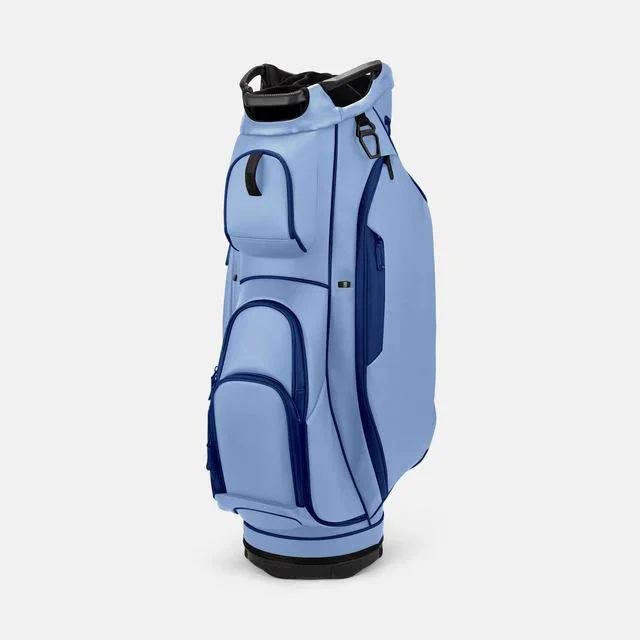
Hook-and-loop is bought for speed of access and paid for in lifespan; a zipper is bought for sealing and paid for in trim cost and sewing minutes. Neither closure is wrong, but the decision belongs to the pocket pattern rather than to the trim sheet, because the panel shape, the stiffener and the seam allowance all change once the closure is fixed. A four-pocket bag that mixes both is not indecision, it is the correct answer for four different jobs. The order floor is 200 per colourway, samples land in 6-10 working days, bulk occupies 35-50 days, lots clear at AQL 2.5 under ISO 2859-1, and 100-unit trials are accepted when the closures are stock items.
Related reading: Which Zipper Construction Actually Survives a Golf Season
One Decision Per Pocket, Taken at Pattern Stage
A golf bag typically carries five to nine openings, and each one has a different access pattern. A glove patch is operated with one hand while the player is walking. A ball pocket is opened at the turn, often in the rain, with a wet glove. A valuables pocket is opened twice a round and needs to be closed properly every time. Treating all of them as "pockets" and specifying one closure produces a bag that is irritating in three places and overbuilt in two.
The pattern consequence is immediate. A hook-and-loop flap needs a facing wide enough to carry the hook tape at full width, plus a stiffener so the flap does not curl, plus a stitch line that will not be cut by the tape edge. A zipper pocket needs a zip opening 8-12 mm narrower than the finished opening, a seam allowance that accommodates the slider sweep, and a gusset or a boxed base if the contents are bulky. Change the closure after the pattern is cut and the pocket either loses 10 mm of usable depth or gains a crease where the fabric folds.
There is also a closure-to-accessibility rule that experienced pattern makers apply without saying it out loud. Anything the player reaches for while the bag is on the shoulder or the cart should open in one movement with a gloved hand. Anything that holds value or must stay dry should require two movements. That single rule sorts most pockets before cost enters the conversation.
The third variable is the fabric substrate. Hook tape stitched to a 600D PU-backed polyester holds well; stitched to a thin 210D nylon lining it will pull the panel out of shape under repeated peel load unless a woven interlining is added behind it. A zipper tape spreads its load along its length better, but a curved zip on a soft panel needs a stay tape or the seam ripples.
Hook-and-Loop: Reading the Cycle Rating
Hook-and-loop, sold under the Velcro trade name and dozens of generics, is a two-part tape: a hook face of monofilament loops cut to barbs, and a loop face of brushed or knitted yarn. The performance numbers that matter are peel strength, shear strength and closure cycles, and only the third one predicts how the pocket behaves in year three.
A decent nylon-on-nylon tape at 25 mm width delivers roughly 6-11 N of peel per 25 mm and 40-70 N of shear per 25 mm. Peel is what a player feels when opening the flap; shear is what holds the pocket shut when the bag is compressed in a car boot. Cheap polypropylene hook tape can feel similar on day one and lose half its peel after 2,000 cycles, because the barbs deform rather than spring back.
Cycle ratings in the trade run from 1,500 cycles for the cheapest tape to 20,000 for a quality nylon set, tested by machine at 1 Hz with a 90-degree peel. A glove patch opened 30 times a round, 40 rounds a year, sees 1,200 cycles a season. A ball pocket opened twice a round sees 80. The same tape is therefore adequate in one place and marginal in another, which is why the cycle rating should be specified per pocket, not per bag.
Grit is the real enemy, and it does not appear in any cycle rating. Sand, grass seed and range-mat fibre lodge in the hook face and stop the barbs engaging. Once a hook face is contaminated, peel strength falls by half or more and no amount of brushing restores it fully. Bags used on sandy courses or in links conditions show this within one season, and it is the single strongest argument for a zipper on any pocket that sits low on the bag.
Field note. Specify the loop face on the flap and the hook face on the pocket body, not the other way round. Hook facing outward on a flap catches knitwear, towel loops and the cart strap, and it abrades the panel it rests against. Reversing the pair costs nothing and removes a whole category of complaint.
Zippers: Coil, Moulded and Coated Tape
Three zipper families cover almost every golf bag pocket, and they differ in cost, in how they fail and in how much water they let through.
Coil zippers, sizes 5 and 8
A continuous nylon or polyester coil sewn to a fabric tape. Size 5 is the workhorse for apparel and accessory pockets; size 8 carries the slider and chain strength needed for a ball pocket or a shoe compartment. Coil is flexible enough to follow a curve, cheap, and light. It is also the least resistant to grit: a single grain of sand trapped in the chain will jam a slider, and forcing the slider shears the coil.
Sliders matter as much as the chain. An auto-lock slider holds position under vibration, which is what you want on a cart bag that spends an hour on a moving trolley. A non-lock slider opens progressively under the same vibration and is the reason bags arrive at the first tee with the ball pocket half open. Specify auto-lock on anything that hangs vertically, and accept non-lock only on horizontal pockets where the slider rests at the end of its travel.
Moulded plastic zippers
Individual moulded teeth on a tape, size 8 or 10. Stronger in lateral crush, tolerant of a slightly misaligned seam, and much better than coil when the pocket is packed hard. The trade-off is stiffness: a moulded zip will not follow a tight curve, so it suits straight or gently curving pocket mouths and reads as a more utilitarian detail. Cost is roughly double a coil zip of the same size.
Water-resistant zippers with coated tape
A coil or moulded chain on a PU-coated tape, usually paired with a storm flap. This is the only family that keeps a pocket dry in sustained rain, and even then the flap does most of the work: the chain alone resists splash, not pressure. Cost lands at USD 1.60-3.20 per pocket against USD 0.28-0.55 for a standard size 5 coil, and sewing time roughly doubles because the flap, the tape and the slider garage all need handling.
Curves deserve their own line in the specification. A size 5 coil will run a radius of about 90 mm before the tape puckers; below that the seam has to be clipped, which weakens the tape edge and shortens slider life. If the design calls for a tight curved pocket mouth, either increase the radius, switch to a lighter coil, or reshape the pocket so the curve sits on the body panel rather than on the opening.
What Each Closure Costs in Trim and Sewing Time
Trim cost is the number buyers negotiate and sewing time is the number that actually moves the price. On a pocket, the labour difference between a hook-and-loop flap and a standard zipper is larger than the trim difference, and on a curved or waterproof zip it is larger again.
| Closure | Trim cost (USD) | Sewing time | Closure cycles | Water resistance | One-hand access |
|---|---|---|---|---|---|
| Hook-and-loop, 25 mm | 0.08-0.18 | 1.8-2.4 min | 8,000-20,000 | None | Best |
| Hook-and-loop, 38 mm | 0.14-0.28 | 2.2-3.0 min | 8,000-20,000 | None | Good |
| Coil zip #5, standard tape | 0.28-0.55 | 3.6-4.6 min | 3,000-6,000 | Low | Poor with a glove |
| Coil zip #8 | 0.55-0.95 | 4.2-5.4 min | 3,000-6,000 | Low | Poor with a glove |
| Moulded zip #8 | 0.70-1.30 | 4.4-5.6 min | 4,000-8,000 | Medium | Poor with a glove |
| Water-resistant #8 with flap | 1.60-3.20 | 5.8-7.5 min | 3,000-5,000 | High | Poor with a glove |
Put a labour rate of USD 0.14 per minute on those figures and the arithmetic becomes blunt. A hook-and-loop pocket costs roughly USD 0.33-0.56 fully made; a standard size 5 zip pocket about USD 0.78-1.19; a waterproof zip pocket USD 2.41-4.25. Switching four pockets from hook-and-loop to standard zip therefore adds somewhere between USD 1.80 and 2.50 per bag, and switching one of them to a waterproof zip adds another USD 1.90-3.70.
That is the whole cost argument, and it fits in one line: a zip pocket is roughly two to three times the cost of a hook-and-loop pocket, and a waterproof zip pocket is roughly seven to nine times. Anyone quoting a smaller gap is either using tape too narrow to hold or has not priced the extra handling the slider garage requires.
Volume barely changes those numbers because there is no tooling on a pocket. The savings at 500 units come from fabric cutting efficiency and from buying zippers in 200 m rolls rather than cut lengths, worth perhaps 6-9 % on the trim line. Pocket closure is one of the few places in a golf bag where the unit economics are almost flat from 100 units to 2,000.
Water and Grit: The Test That Predicts Field Failure
Two tests separate a pocket that survives a season from one that comes back as a complaint, and neither needs a laboratory. The first is a closure cycling rig; the second is a contamination test, which is the one most programmes skip.
- Baseline cycle test. Open and close the closure 5,000 times at 1 Hz by machine, with the pocket loaded to its intended weight. Measure peel or slider effort every 1,000 cycles and record the loss.
- Contamination exposure. Work 2 g of fine sand and 1 g of chopped grass into the closure, cycle 500 times, then measure again without cleaning. A hook face that loses more than 40 % of its peel fails this step.
- Wet cycling. Soak the pocket, cycle 300 times, dry at 40 °C for 24 hours, then check for tape shrinkage, coil distortion and stitch elongation.
- Load test. Fill the pocket to its rated volume and hang the bag by the hanger loop for 24 hours. Zipper tape seams should show no more than 1 mm of seam slip at the ends.
- Slider retention. Apply 150 N laterally to a closed slider and confirm it does not part or jump the chain. Repeat with the slider parked 20 mm from the end stop, which is where failure usually starts.
- Salt spray on metal sliders and pulls. 48 hours for zinc-plated pulls, 96 hours for nickel-plated, before accepting a hardware set for a coastal market.
The contamination step is the one that changes designs. Bags sold into links and heathland markets see airborne sand constantly, and a hook-and-loop pocket mounted 150 mm above the base is directly in the grit path when the bag is set down. Moving that pocket up by 80 mm, or switching it to a zip with a flap, is usually cheaper than accepting the return rate.
Testing also settles the argument about tape width. A 25 mm hook-and-loop closure on a large flap concentrates peel load at the edges; going to 38 mm spreads it and roughly doubles the shear capacity for USD 0.06-0.10 of extra trim. On any flap wider than 120 mm, 25 mm tape is underspecified and the corners will lift first.
Seven Failure Modes and the Construction Fix
Pocket complaints cluster into a small number of physical causes, and each one has a fix that costs less than the complaint.
| Symptom | Cause | Fix |
|---|---|---|
| Flap corners lift after a month | Peel load concentrated at the tape ends on a wide flap | Bar-tack both ends, 38 mm tape, 1.5 mm stiffener in the flap |
| Hook face stops gripping | Grit and lint packed into the barbs | Raise the pocket, add a storm flap, or switch to a zip |
| Flap curls upward when open | No stiffener, or stiffener cut across the grain | Add 1.2-1.5 mm PE board, cut on the straight grain |
| Slider jams mid-travel | Coil contaminated, or seam allowance fouling the chain | Trim allowance to 8 mm, add a slider garage, use size 8 coil |
| Slider opens under vibration | Non-lock slider on a vertical pocket | Auto-lock slider, or a two-way slider on long openings |
| Pocket mouth ripples | Curved zip sewn without stay tape | 20 mm stay tape along the seam, radius 90 mm minimum |
| Water pools in the pocket base | Unsealed seam at the gusset, zip without flap | Taped or welded gusset seam, flap over the chain, drain eyelet |
Two of those fixes involve the pattern rather than the trim, which is why they get missed in a trim-only review. Rippling on a curved zip is a stay-tape problem, and it appears the first time the bag is loaded; the pocket looks correct on a flat sample table and wrong on a full bag. Similarly, a flap curl is a grain-direction problem that only shows after a week in a warm room.
The stitch specification does the rest. Hook tape should be attached with a double row of lockstitch at 8-10 stitches per inch, with the tape edge captured, plus a bar-tack at each end of every tape run. Zipper tape takes a single row at 10-12 stitches per inch, but the seam must be sewn in one pass from end to end: stopping and restarting mid-run is what produces the 2 mm jog that later becomes a slider jam.
Thread choice is quietly decisive for both. A bonded polyester at 60-80 tex holds up to abrasion and UV; a cheap spun polyester loses 30-40 % of its strength after a season in the sun. On a hook-and-loop flap, thread is the part that fails after the tape has already lost its grip, so it looks like a tape failure and gets diagnosed wrongly.
A Pocket-by-Pocket Specification Matrix
The most useful deliverable for a buyer is a single page that names the closure for every opening, with the reason. It removes the ambiguity that otherwise gets resolved by whoever is sewing that day.
| Closure | Typical opening | Why this works | |
|---|---|---|---|
| Glove patch | Hook-and-loop, 25 mm | 90 x 60 mm | One-handed, opened 30 times a round, no sealing requirement |
| Rangefinder pocket | Hook-and-loop, 38 mm | 120 x 90 mm | Quick access with a gloved hand, padded walls absorb peel load |
| Ball pocket | Coil zip #8, auto-lock | 200-240 mm | Heavy contents, opened in rain, needs to stay shut in transit |
| Valuables pocket | Water-resistant #5 with flap | 150 mm | Sealing plus deliberate two-movement access |
| Apparel pocket | Coil zip #8, two-way slider | 300-360 mm | Long opening, bulky contents, slider parks at one end |
| Cooler pocket | Water-resistant #8 with flap | 220 mm | Condensation and ice water; flap keeps the chain clear |
| Umbrella sleeve | None, elasticated or drawcord | 60 mm | No closure needed; hardware would abrade the shaft finish |
| Scorecard window | None, open with a retention tab | 110 x 160 mm | Must be readable without opening; a closure would obscure it |
Two entries in that matrix are routinely got wrong on first programmes. The apparel pocket gains nothing from a waterproof zip and loses a great deal of usable length to the flap and tape; a standard size 8 coil with a two-way slider is lighter, cheaper and easier to pack. Conversely, the valuables pocket is the one place where a coated-tape zip and a flap justify their cost, because that is the pocket whose failure becomes a customer service incident rather than an annoyance.
Where the bag is aimed at a wet market, the whole matrix shifts: waterproof zips move from one pocket to three, and the base of every zip pocket gets a drain eyelet. That change adds USD 4-6 per bag, which is easy to absorb on a USD 180 retail bag and hard on a USD 90 one. It is worth deciding the market position before the pocket list is drawn, because retrofitting sealing after the pattern is cut means re-cutting every affected panel.
- Usable depth, not cut size. A 150 mm zip opening yields about 130 mm of usable depth once the slider sweep and the seam allowance are taken out. Measure the opening the player sees.
- Radius on every curve, checked against the 90 mm minimum for a size 5 coil before the pattern goes to the cutting room.
- Grain direction on every flap, because a flap cut across the grain curls within a week and no amount of pressing holds it flat.
- Slider and pull finish, matched to the rest of the hardware set and salt-spray tested if the bag is sold into a coastal market.
- One test per closure type, not per pocket. Six identical zip pockets need one cycle test, not six, but the sample must be drawn from each sewing line that makes them.
Inspection follows the same logic: AQL 2.5 at level II puts thirty-two of a 200-unit shipment on the bench, and a third major closes the lot. The pocket checks inside that draw are specific: five pieces go on the closure rig, seam grab strength is held at 250 N by ASTM D5034, tear strength by ASTM D2261, plus a visual pass on tape alignment, bar-tack presence and slider function.
For buyers building a pocket list from a competitor sample, the fastest route is to open every pocket, note the closure, measure the opening and cycle it twenty times by hand. That five-minute exercise predicts more about the bag than any specification sheet, and it usually reveals that the sample itself uses three closure types across six pockets. Pocket lists like this one have been daily work at QUANZHOU JUNYUAN BAGS since the company began in 2014, with staff in the trade since 2004. The surrounding construction questions live in the compartment design guide, and the trim-level standards are set out in the quality standards guide.
Sources and Standards Referenced
- ASTM textile standards collection, seam and closure test methods
- ISO 2859-1:2022 Sampling procedures for inspection by attributes
- ASTM D5034 Breaking strength and elongation of textile fabrics (grab test)
- ASTM D2261 Tearing strength of fabrics (tongue method)
- ISO 105-B02 Colour fastness to artificial light
Next steps: custom solutions, manufacturing capability, and a quotation request.
Frequently Asked Questions
Is velcro or a zipper better for a golf bag pocket?
It depends on the pocket. Hook-and-loop wins wherever the player needs one-handed access with a glove on, such as a glove patch or rangefinder pocket. A zipper wins on ball pockets, apparel and valuables, where contents are heavy, must stay dry, or must stay closed while the bag rides on a cart.
How many open and close cycles does velcro last?
Quality nylon-on-nylon tape is rated 8,000-20,000 cycles. Cheap polypropylene hook tape falls to 1,500-3,000 because the barbs deform instead of springing back. A glove patch cycled 30 times a round over 40 rounds uses about 1,200 cycles a season, so the tape choice matters far more there than on a ball pocket.
Why does velcro stop holding after a season?
Contamination, not wear. Sand, grass seed and lint pack into the hook face and stop the barbs engaging, and peel strength drops by half or more. Once contaminated the tape cannot be fully restored by brushing. Pockets mounted low on the bag, close to the grit path when it is set down, fail first.
What does a zipper pocket cost compared with velcro?
Fully made, a hook-and-loop pocket runs about USD 0.33-0.56, a standard size 5 zip pocket USD 0.78-1.19, and a water-resistant zip pocket with a flap USD 2.41-4.25. Trim is only part of it: a zip adds roughly 1.8 to 2.2 minutes of sewing per pocket.
Which zipper size should a golf bag pocket use?
Size 5 coil suits apparel and accessory pockets. Size 8 is the right choice for ball pockets, shoe compartments and anything packed hard, because it carries a stronger chain and a larger slider. Water-resistant versions are specified at size 5 or 8 with PU-coated tape and a storm flap.
What is the minimum radius for a curved pocket zipper?
About 90 mm for a size 5 coil. Tighter than that, the tape puckers and the seam has to be clipped, which weakens the tape edge and shortens slider life. If the design needs a tighter curve, reduce to a lighter coil or move the curve onto the body panel instead of the opening.
Do golf bag pockets need waterproof zippers?
Only where contents must stay dry: a valuables pocket, and on bags sold into wet markets a cooler pocket and ball pocket. A coated-tape zip with a flap keeps splash out but is not pressure-tight, and it doubles sewing time. Standard pockets gain little from it and lose usable opening length.
How much sewing time does a zip pocket add?
A standard size 5 zip adds 1.8-2.2 minutes over a hook-and-loop flap; a size 8 coil 2.4-3.2 minutes; a moulded zip 2.6-3.4 minutes; a water-resistant zip with a flap 4.0-5.3 minutes. At USD 0.14 per minute, that labour gap is larger than the trim gap on every pocket.
Should the hook tape go on the flap or the pocket body?
Put the loop face on the flap and the hook face on the body. Hook facing outward catches knitwear, towel loops and cart straps, and it abrades whatever panel it rests against. Reversing the pair costs nothing and removes a whole class of snag complaint.
What stitch density should pocket closures use?
Hook-and-loop tape takes a double row of lockstitch at 8-10 stitches per inch with the tape edge captured, plus a bar-tack at each end of every run. Zipper tape takes a single row at 10-12 stitches per inch, sewn in one continuous pass, because a stop and restart leaves a 2 mm jog that later jams the slider.
How are pocket closures tested before bulk?
A 5,000-cycle machine test at 1 Hz with the pocket loaded, a contamination step using 2 g of sand and 1 g of chopped grass followed by 500 cycles, a wet-then-dry cycle, a 24-hour hang test and a 150 N lateral pull on a closed slider. Metal pulls also get 48-96 hours of salt spray.
Does order volume change pocket closure cost?
Very little, because there is no tooling in a pocket. Moving from 100 to 500 units saves perhaps 6-9 % on trim through roll purchase and cutting efficiency. Pocket closure is one of the few areas of a golf bag where unit economics stay almost flat across the whole volume range.
Get a Pocket Spec Review
Send the pocket layout or a competitor sample photo and you will get a closure recommendation per opening, with trim cost, sewing minutes and the test that proves each one.
Review My Pocket List Explore OEM Services