Insulated Pocket and Cooler Lamination Process for Golf Bags
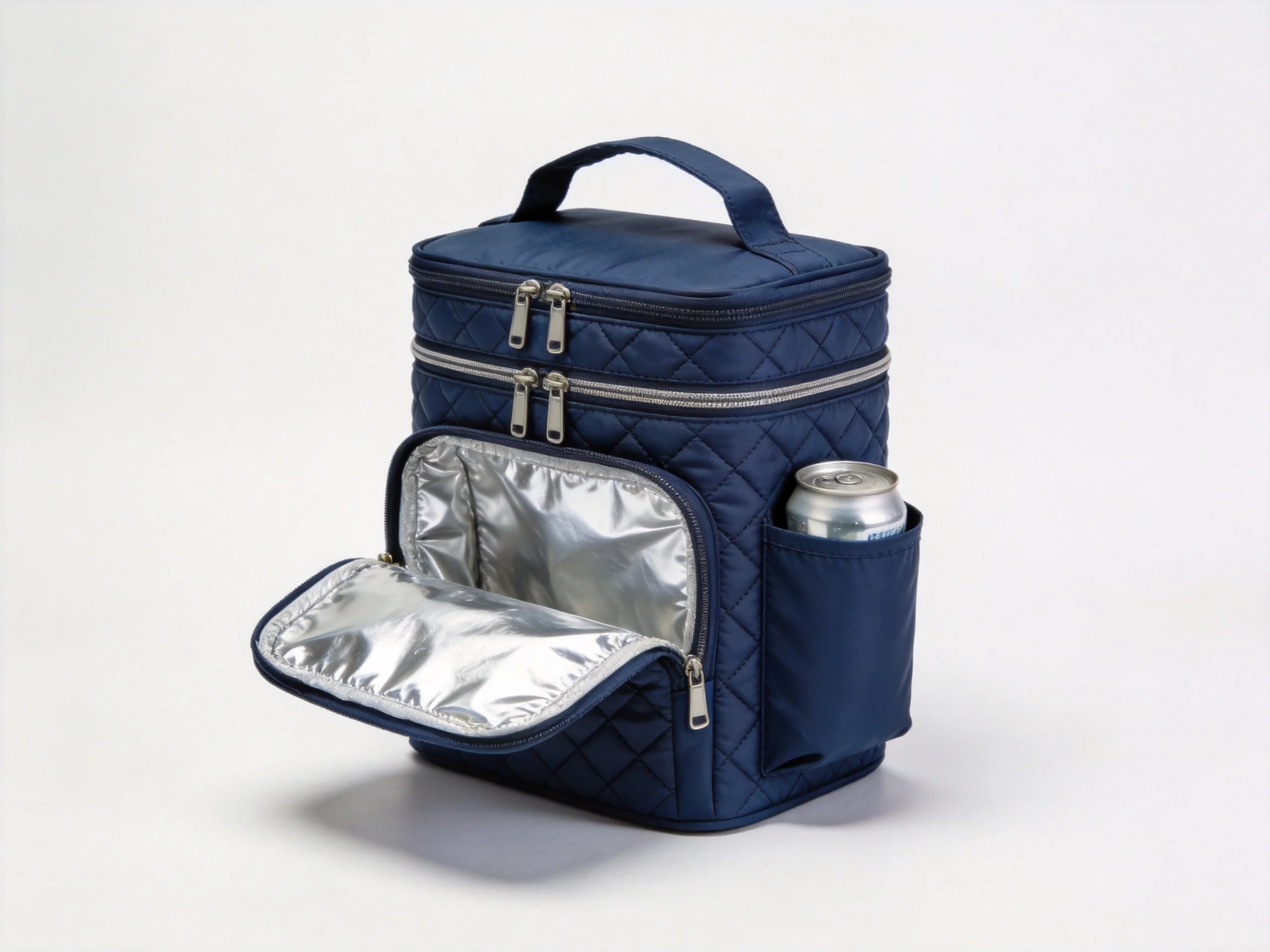
An insulated pocket is decided by its seams and not by its foam: a 10 mm stack joined with a plain sewn gusset loses more cold through needle holes and wicking than a 6 mm stack built around a welded bladder. Foam thickness is the visible specification and the least interesting one, because the difference between 6 mm and 10 mm of closed-cell polyethylene is roughly 9 percentage points of ice retained at four hours, while a welded bladder instead of a stitched gusset is worth 10-12 points, and unlike foam it also stops the leak. Sampling lands in 6-10 working days, stretched to 12-15 when a fresh welding jig has to be cut; bulk then runs 35-50 days; the order minimum is 200 per colourway with 100-piece trials; and sample lots are judged to AQL 2.5 against ISO 2859-1.
Related reading: How Long a Golf Ice Bag Actually Holds Cold
What an Insulated Pocket Is Actually Doing
A cooler pocket on a golf bag is a small box with four heat paths to defeat: conduction through the walls, convection through the zip opening, radiation from a black outer shell sitting in the sun, and latent heat carried in with meltwater. Foam addresses the first, a flap addresses the second, a reflective layer addresses the third, and the fourth is a drainage and lining question that almost nobody specifies.
The physics is unglamorous. A 220 x 150 x 90 mm pocket holds about 3 litres, which is four cans and a handful of ice. With 1 kg of ice at 0 °C inside and 25 °C ambient outside, the heat leak through 0.15 m² of wall at an effective U-value of 3.5 W/m²K is around 13 W, and melting 1 kg of ice takes 334 kJ. Divide one by the other and the theoretical hold is roughly seven hours before the ice is gone, which is why a good pocket keeps a bag of ice for most of a round and a poor one does not last nine holes.
Every design decision moves that number. Doubling foam thickness halves the conduction term but adds 40-60 g and 4-6 mm of wall, which eats pocket volume. Adding a reflective layer cuts the radiation term by perhaps 15-25 % but does nothing once the pocket is in shade. Sealing the seams removes the convection path through the stitching, which is the largest single leak in a sewn cooler pocket and the cheapest one to fix.
The last variable is behaviour, not engineering. A pocket opened six times a round exchanges its cold air for warm air each time; a pocket with a flap and an auto-lock slider opens 40 mm instead of falling fully open. That is why field reports so often contradict lab results: the lab closes the zip, and the player does not.
The Four Layers and What Each One Buys
A production cooler pocket is a stack, and each layer has one job. Removing a layer to save cost is a decision with a predictable consequence, which is worth knowing before the sample arrives.
| Layer | Typical material | Thickness | Job | Cost (USD/m²) |
|---|---|---|---|---|
| Inner lining | PEVA film, food-contact grade | 0.10-0.15 mm | Liquid barrier, wipe-clean, weldable | 0.55-1.10 |
| Inner lining, premium | TPU film, food-contact grade | 0.08-0.12 mm | Same, plus flexibility at low temperature | 1.80-3.20 |
| Reflective barrier | Metallised PET, aluminium coated | 12 µm | Cuts radiant gain through the shell | 0.35-0.70 |
| Insulation core | Closed-cell PE foam (EPE) | 6-10 mm | Conduction barrier, no water uptake | 1.10-2.60 |
| Outer shell | 600D polyester, PU backed | 0.55-0.70 mm | Abrasion, structure, colour | 1.40-2.20 |
| Bond layer | Hot-melt web or PU adhesive | 8-15 g/m² dry | Holds the stack together through washing | 0.15-0.30 |
- Is the core closed-cell? Ask for the foam designation, not the colour. An open-cell core undercuts the quote and fails in the first wet season.
- Which face carries the reflective layer? It belongs outside the foam, under the shell, or it does nothing measurable.
- Is the lining food-contact grade? A declaration should exist before the sample is approved, not after the container is booked.
- What is the bond strength after heat ageing? Anything below 3 N/25 mm after 72 hours at 60 °C will delaminate in a car.
- How is the gusset closed? Welded, taped or plain sewn is the single biggest variable in whether the pocket leaks.
Closed-cell foam is not optional. Open-cell polyurethane foam insulates slightly better per millimetre and costs less, but it absorbs water, and a cooler pocket is the one place in a golf bag where water is guaranteed. Once an open-cell core takes on meltwater it stops insulating, gains weight and grows mould in storage. Any quotation that undercuts the market by 30 % on a cooler pocket is usually an open-cell core.
The lining choice is a compliance question as much as a performance one. PEVA is cheap, welds well and is the default for a pocket that holds cans and ice. TPU is more flexible at low temperature, does not crack when the pocket is folded, and welds by hot air rather than radio frequency. Both are acceptable; PVC film is cheaper still and increasingly unwelcome in European programmes, so material declarations should be requested before the sample is approved rather than after.
The reflective layer is the most oversold item in the stack. Metallised PET at 12 µm is worth having for a dark-shelled bag used in direct sun, and it costs USD 0.35-0.70 per square metre, so the argument is not about money. It is about honesty: a metallised film facing inward with a foam core behind it reflects almost nothing useful, because the heat is already past it. The layer belongs on the outside of the foam, under the shell.
Lamination Routes: Flame, Hot-Melt and Adhesive
Three processes bond foam to fabric in production, and the choice is driven by the foam chemistry, the order volume and whether the finished panel will be washed.
Flame lamination
A gas flame passes over the foam surface, melting a 0.2-0.5 mm skin, which is pressed into the fabric under a nip roller. No adhesive is used, so the bond is dry, soft and cheap, and the process runs at 30-60 m/min. It only works with polyurethane foam, not with polyethylene, and the bond strength is modest: 2-4 N/25 mm peel, which is adequate for a bag panel and marginal for a pocket that flexes.
Hot-melt web lamination
A web adhesive, either a full sheet or a dot pattern, is laid between foam and fabric and passed through a heated calendar at 110-140 °C for 6-12 seconds. This is the standard route for an EPE cooler stack because it handles polyethylene, gives 4-7 N/25 mm peel and leaves the foam dry. Dot patterns preserve softness; full-web bonding gives a stiffer panel and better dimensional stability, which matters on a pocket that must hold a boxy shape.
Adhesive lamination
A solvent-based or water-based PU adhesive is coated at 8-15 g/m² dry, the layers are married and then cured for 24-48 hours in a warm room. Bond strength is the highest of the three at 6-10 N/25 mm, and it tolerates mixed substrates, which is why it is used where a metallised film has to be bonded to foam. The cost is time and floor space, plus solvent handling and recovery if the line is in a regulated region.
Whichever route is used, the laminated roll needs to rest before cutting. A hot-melt bond continues to crystallise for 12-24 hours, and panels cut immediately after lamination will show edge curl and delamination at the cut line within a week. Resting the roll flat, in a dry room, for at least 24 hours is the cheapest quality step in the whole process and the one most often skipped when a delivery date is tight.
- Stack build. Foam, barrier film and lining are cut to the pocket panel size with 8-10 mm trim allowance and laid in the correct order, reflective face outward.
- Bonding. Web or adhesive is applied and the stack is nipped under heat and pressure; the roll is marked with time, temperature and line speed for traceability.
- Rest and stabilise. 24 hours flat at 20-25 °C and below 60 % RH before any cutting, which prevents edge curl and latent delamination.
- Cut and weld the bladder. The inner lining is cut and radio-frequency or hot-air welded into a tray, with a 6-8 mm weld bead and no stitch perforation anywhere below the fill line.
- Insert and assemble. The welded tray is dropped into the laminated shell, the zip and flap are fitted, and the top edge is closed by welding or by a stitch line placed above the water line.
- Leak test. Fill with 3 litres of water, invert for 30 minutes over absorbent paper, and reject any pocket showing a mark wider than 10 mm.
- Thermal verification. One pocket per lot goes to the ice retention rig at 25 °C ambient, measured at 2, 4, 6 and 8 hours against the approved sample.
Seams Decide the Result, Not the Foam
A sewn seam through an insulated stack does three damaging things at once. It perforates the lining, creating a direct liquid path. It compresses the foam along the stitch line to near zero thickness, creating a thermal bridge. And it leaves a wick of thread running from the wet interior to the dry exterior. A 6 mm stack with good welds will outperform a 10 mm stack with ordinary stitching every time.
Three sealing methods cover production. Radio-frequency welding fuses PVC and PEVA under pressure with an electrode tool, producing a 6-8 mm bead that is stronger than the film itself; it needs a shaped electrode per pocket geometry, at USD 600-1,400. Hot-air welding does the same job for TPU with a nozzle and a roller, at lower tooling cost but with more operator skill. Ultrasonic welding works for both and is fast, but the tooling is more expensive and the process is less forgiving of film thickness variation.
Where a weld is impossible, the fallback is a sewn seam plus a taped or coated reinforcement. This is a compromise, not an equivalent: a taped seam survives splash and condensation but will wick under standing water. If the pocket is described as leak-proof, the specification has to say welded; if it is described as water-resistant, a sewn and taped seam is defensible.
The zip is the other half of the seam story. A standard coil zip on a cooler pocket leaks along the chain and through the tape, and no amount of foam compensates. A water-resistant zip with coated tape plus a flap reduces the loss substantially, and an auto-lock slider keeps the opening at 40-60 mm during play instead of letting the lid fall open. The combination adds USD 1.30-2.60 per pocket and changes the measured hold time by more than any foam upgrade.
Spec tip. Put the weld bead width and the leak test in the tech pack, not just the words "leak-proof". A 6 mm bead with a 30-minute inversion test is a specification; "leak-proof" is an argument that will be had after the container arrives.
Reading an Ice Retention Claim
Ice retention figures are only comparable when ambient temperature, starting ice mass, fill level and opening frequency are all stated. Marketing numbers usually omit at least two of the four, which is why a pocket rated at "24 hours" can fail before the ninth hole.
The test used across production programmes is simple enough to run on a bench: 1 kg of crushed ice at 0 °C, pocket half full, ambient held at 25 °C, lid closed except for a 30-second opening every hour, meltwater drained and weighed at 2, 4, 6 and 8 hours. What is reported is the percentage of the original ice mass remaining, which is more useful than a temperature reading because it accounts for latent heat.
| Configuration | Ice at 4 h | Ice at 8 h | Leak test | Added cost per pocket |
|---|---|---|---|---|
| 6 mm foam, sewn seams, standard zip | 50-54 % | 24-28 % | Wicks at the gusset | Baseline |
| 6 mm foam, welded bladder, standard zip | 60-64 % | 36-40 % | Passes | USD 0.90-1.40 |
| 10 mm foam, welded bladder, flap zip | 69-73 % | 44-48 % | Passes | USD 1.90-2.80 |
| 10 mm foam, metallised, welded, flap zip | 74-78 % | 50-54 % | Passes | USD 2.40-3.40 |
The table makes the trade visible. Moving from the cheapest build to the best adds roughly USD 2.40-3.40 per pocket and buys about 24 percentage points of ice at four hours. On a bag retailed at USD 160 with a cooler pocket as a headline feature, that is an easy decision. On a USD 80 bag where the pocket is a tick-box, the middle configuration is usually the right compromise and the top one is wasted money.
One caveat on the numbers: they assume the pocket is packed half full. A pocket crammed with cans and a little ice performs worse than the table because there is less cold mass and more contact area with warm contents. Field complaints about cooler pockets very often trace back to loading practice rather than construction, which is worth a line in the hangtag or the product copy.
Condensation, Mould and Delamination
The failures that reach customer service are rarely thermal. They are a wet bag, a smell, or a lining that peels away from the foam after a season in a garage. All three are predictable from the material stack.
Condensation on the outside of a cold pocket is normal physics and cannot be eliminated, only managed. A PU-backed shell resists penetration; an unbacked shell will show a damp patch within an hour of loading. The interior face is the more serious side: any water that gets behind the lining, through a pinhole or a stitch, sits against the foam and has nowhere to go. A drain eyelet at the lowest point of the gusset costs almost nothing and turns a puddle into a drip.
Delamination is an adhesive problem with a temperature signature. A bond that measures 5 N/25 mm at 20 °C can fall to 1.5 N/25 mm at 60 °C, which is what a pocket sees inside a car in summer or a container on a dock. The test that predicts it is a 72-hour oven soak at 60 °C followed by a peel test, and it takes three days rather than a season.
Mould is the signature of an open-cell core or a pocket stored wet. Closed-cell EPE cannot absorb water and does not support growth on its own, but a lining that traps condensation against a sewn seam will grow mould on the seam tape. Anti-microbial treatment on the lining is available and costs USD 0.10-0.25 per pocket; it treats the symptom rather than the water path, so it belongs after the seam question is settled, not instead of it.
Washing is where consumer expectation and construction collide. A cooler pocket marketed as wipe-clean survives; one that is machine washed at 40 °C will delaminate at the edges and distort the foam within five cycles, because the bond is designed for intermittent water contact rather than immersion. The care label is part of the engineering, and it needs to say wipe-clean in the same language as the market.
Cost Stack and Programme Parameters
A cooler pocket is the most material-dense component in a golf bag per unit of volume, and its cost breaks down differently from the rest of the bag: materials dominate and labour is comparatively small until welding enters.
| Cost element | At 200 units (USD) | At 500 units (USD) | Driver |
|---|---|---|---|
| Laminated stack, cut to size | 1.35-2.10 | 1.20-1.85 | Foam thickness, lining grade, reflective layer |
| Welding and assembly labour | 1.05-1.70 | 0.95-1.55 | Weld bead length, zip type, flap construction |
| Zip and hardware | 0.55-1.60 | 0.50-1.45 | Coated tape, auto-lock slider, pull finish |
| Leak and thermal testing | 0.25-0.45 | 0.20-0.40 | Sample rate, whether every unit is leak tested |
| Packaging and handling | 0.20-0.35 | 0.18-0.30 | Polybag, desiccant, carton configuration |
Total lands at roughly USD 3.40-6.20 per pocket at 200 units, which is 8-14 % of a mid-market bag cost. The volume effect is modest because there is little tooling and the labour is hand work; the savings between 200 and 500 come mostly from nesting efficiency on the laminated roll and from buying zip rolls rather than cut lengths.
Two programme parameters are worth restating because they are frequently assumed. New welding electrodes add 5-7 days to sampling, which is why a new cooler geometry runs 12-15 working days rather than the 6-10 that a re-coloured pocket needs. And on inspection, level II at AQL 2.5 means the inspector opens thirty-two of the 200 bags and rejects at the third major, with the cooler checks being the leak test on every sampled unit, a 5 N/25 mm peel minimum on a cut coupon, and a visual pass on weld bead continuity.
Material compliance should be handled at the same time rather than at shipment. A lining that touches drinks needs a food-contact declaration and, for European programmes, a statement against the restricted substance list under REACH. Requests for that paperwork after the order is placed are the most common reason a cooler pocket shipment sits at the port.
Seam strength on the shell is checked to ASTM D5034 at 250 N minimum grab strength, and the shell fabric itself is often the weakest link on a pocket that is loaded with ice and lifted by its zip. Buyers who test the weld but not the shell usually discover the distinction in the field. For the wider product context, the insulated cooler range shows how the pocket scales into a standalone bag, and the capacity and insulation guide covers volume planning. Cooler pocket work has sat inside the QUANZHOU JUNYUAN BAGS programme since 2014, handled by people who have been insulating bags since 2004.
Sources and Standards Referenced
- ECHA, Understanding REACH restricted substances
- ISO 2859-1:2022 Sampling procedures for inspection by attributes
- ASTM D5034 Breaking strength and elongation of textile fabrics (grab test)
- ASTM D2261 Tearing strength of fabrics (tongue method)
- ISO 105-B02 Colour fastness to artificial light
Next steps: custom solutions, manufacturing capability, and a quotation request.
Frequently Asked Questions
How long does a golf bag cooler pocket keep ice?
A 6 mm foam pocket with sewn seams holds roughly 50 % of its ice at four hours and 25 % at eight, under 1 kg of ice at 25 °C ambient. A 10 mm stack with a welded bladder, reflective layer and flap zip reaches 74-78 % at four hours and about 50 % at eight.
Why does my cooler pocket leak at the bottom?
Almost always a sewn gusset. Stitching perforates the lining and leaves a thread path that wicks water from the inside to the outside. A welded bladder with a 6-8 mm bead removes the path; a taped seam only resists splash. A drain eyelet at the low point also helps.
What foam is used in an insulated golf bag pocket?
Closed-cell polyethylene foam, usually EPE, at 6-10 mm. It insulates slightly less per millimetre than open-cell polyurethane, but it cannot absorb water, which matters in a pocket that holds melting ice. Open-cell cores are the usual reason a cheap pocket fails in its first season.
How thick should cooler pocket insulation be?
Six millimetres is the volume-efficient choice and holds about 50-54 % of ice at four hours. Ten millimetres reaches 69-78 % depending on the other layers but adds 40-60 g and 4-6 mm of wall thickness, which reduces usable pocket volume by roughly 15 %.
What is the difference between flame and hot-melt lamination?
Flame lamination melts the foam surface and presses it to fabric with no adhesive; it is cheap and fast but only works with polyurethane foam and gives 2-4 N/25 mm peel. Hot-melt web runs at 110-140 °C and bonds polyethylene foam at 4-7 N/25 mm, which is why it is standard for cooler stacks.
Should the cooler pocket zip be waterproof?
It should be water-resistant, which means coated tape plus a flap and an auto-lock slider. A standard coil zip leaks along the chain and the tape, and the measured hold time drops by more than any foam upgrade would recover. The upgrade adds USD 1.30-2.60 per pocket.
How is a cooler pocket leak tested?
Fill with 3 litres of water, invert for 30 minutes over absorbent paper, and reject any pocket that leaves a mark wider than 10 mm. Every sampled unit gets the test at final inspection, and the weld bead is checked visually for continuity at the same time.
Why does the lining peel away from the foam?
Adhesive creep at temperature. A bond reading 5 N/25 mm at 20 °C can fall to 1.5 N/25 mm at 60 °C, which a pocket reaches inside a car or a container on a dock. A 72-hour soak at 60 °C followed by a peel test predicts it in three days instead of a season.
Can a golf bag cooler pocket go in a washing machine?
No. The lamination is designed for intermittent water contact, not immersion, and a 40 °C cycle delaminates the edges and distorts the foam within about five washes. Wipe-clean is the correct care instruction, and it should appear in the same language as the target market.
What does a cooler pocket add to bag cost?
Roughly USD 3.40-6.20 per pocket at 200 units, or 8-14 % of a mid-market bag cost. Materials dominate at 40-45 % of that, welding and assembly at around 30 %. Moving from 200 to 500 units saves perhaps 8-10 % because there is little tooling involved.
How long does sampling take with a new cooler pocket?
Six to ten working days where the pocket uses an existing welding electrode and only the fabric or colour changes. A new geometry needs a new electrode, which adds 5-7 days, so allow 12-15 working days before bulk, then 35-50 days of production.
Is a metallised layer worth adding to a cooler pocket?
It is worth USD 0.35-0.70 per square metre and adds roughly 4-6 percentage points of ice retention at four hours, but only if it sits on the outside of the foam under the shell. Placed inside the foam it reflects nothing useful, which is a common and invisible specification error.
Request a Cooler Pocket Sample
Send the pocket volume, target hold time and retail band and you will get a stack recommendation with weld method, ice retention estimate and cost per pocket.
Request a Sample See Cooler Bag Range