Golf Bag Industry Trends 2026: A Buyers Guide
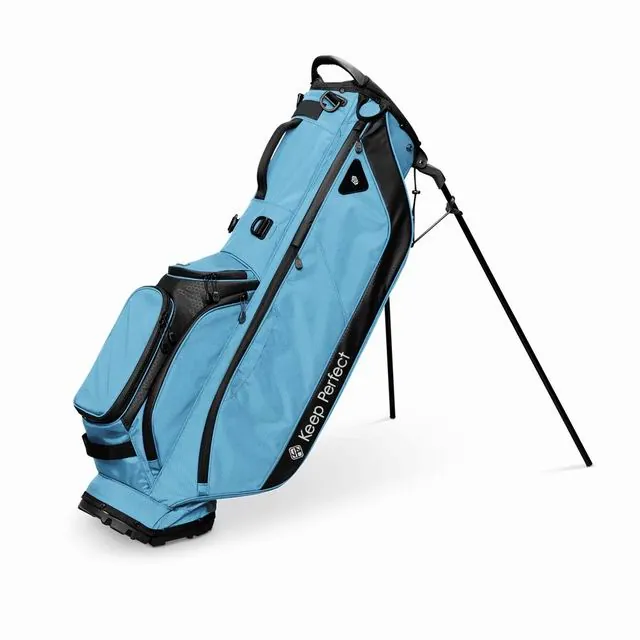
Four specifications, not four design fashions, will decide which golf bag ranges sell through in 2026: a carry weight under 1.8 kg, a shell that holds 3,000 mm of hydrostatic head or better, a recycled-content figure that can be documented on paper, and a first order small enough to test a market without stranding cash. Everything else in the category, from colour to pocket count to hardware finish, sits downstream of those four. This guide reads each shift against three questions a buyer can act on: what changes on the drawing, what it adds to the FOB price, and what it demands of a first order. The numbers used in every section below are a 200-piece floor per colourway, a 100-piece trial path, 500 pieces when a shape is built from the pattern up, six to ten working days at sample stage, five to seven weeks in bulk, and inspection under the AQL 2.5 regime of ISO 2859-1.
Related reading: Golf Bag Design Trends Through 2030
Six Forces Reshaping Golf Bag Orders in 2026
The 2026 order book differs from 2024 in one measurable way: average order size has fallen while the number of stock-keeping units per brand has risen. A mid-size label that placed two 1,200-piece orders three seasons ago now places five or six orders between 150 and 350 pieces, each tied to a colour drop or a single sales channel. That one change propagates into minimum colour runs, sampling load, fabric minimums and the amount of inventory risk a buyer carries on a seasonal bet.
- Weight as a printed specification. Carry bags are now quoted against a finished weight target, commonly 1.4-1.8 kg for a stand bag and 2.0-2.6 kg for a cart bag. A 150 g overrun is treated as a rejected sample rather than a note in the margin.
- Waterproofing above a price line. Shells rated at 3,000 mm hydrostatic head are now expected on mid-tier bags, and 5,000 mm plus sealed seams on anything sold as rain-ready.
- Documented recycled content. Buyers increasingly ask for 30-50% recycled polyester by weight of the shell fabric, with a certificate behind the number rather than a logo on the hangtag.
- Smaller drops, faster reorders. First orders of 100-300 pieces are normal, and replenishment inside 6-8 weeks is becoming a buying criterion in its own right.
- Cart and push-trolley formats. Trolley rounds have grown faster than walking rounds in most mature markets, pulling demand toward stable bases, larger pockets and 14-way tops.
- Hardware restraint. Novelty electronics are losing ground to magnetic closures, low-profile buckles and replaceable straps, because buyers have learned that warranty claims cluster around powered parts.
Read individually, none of these is new. What changed in 2026 is that they arrived at the same time, on the same purchase order. A bag that is 400 g lighter than its predecessor, sealed to 5,000 mm, built from recycled yarn and ordered in three colourways at 200 pieces each is a completely different manufacturing brief from the one the category ran five years ago. The tensions between those requirements, not the requirements themselves, are where programmes go wrong.
Weight Discipline: Where the Grams Actually Hide
A weight target only survives if it is budgeted before the fabric is chosen. A 1.6 kg stand bag is not a 2.0 kg bag made from lighter cloth; it is a different collar, a different divider, a different leg assembly and a thinner trim package. Buyers who send a target weight with no weight breakdown usually receive the same bag they had before, minus a pocket.
Frame, collar and base
The top collar and base plate are where mass is concentrated and where money is easiest to waste. A moulded nylon collar for a 14-way top typically runs 150-210 g; a carbon-look composite or a thickened ABS part can be 260-320 g with no functional gain beyond stiffness at the rim. Aluminium leg wires at 9.5-11 mm diameter weigh roughly 55-75 g each including the hinge block, against 85-110 g for 12.5 mm fibreglass. The base plate is the other anchor: 90-130 g of moulded HDPE does the job, while a padded or double-wall base adds weight that only pays off on tour-style products.
Fabric, lining and trim
Shell fabric is the visible lever, and the least understood. A 420D polyester at 180-200 g/m² gives a light bag with modest abrasion resistance; 600D at 230-260 g/m² is the volume standard; 1680D at 380-420 g/m² is a durability statement that costs 250-350 g on a full bag. The PU backer or coating adds 40-90 g/m² depending on grade, and a second laminate for waterproofing adds more. Lining weight is often ignored: a 70 g/m² taffeta versus a 110 g/m² brushed lining is a 60-90 g swing across a bag, invisible in a photo and very visible on a scale.
Hardware and straps
Straps, buckles and zip gauge are the quiet budget. A dual carry strap in 25 mm webbing with moulded foam pads lands at 150-200 g; a lightweight single strap at 90-120 g. Moving from a #8 to a #5 coil zip saves 30-50 g across a bag with four openings but narrows the teeth enough that a heavy pocket load will strain the slider. Every one of these decisions should be recorded against a gram allocation, not discovered at first article.
| Assembly | Weight budget (1.6 kg stand bag) | Common overrun |
|---|---|---|
| Shell fabric and backing | 260-320 g | Denier upgrade mid-programme |
| Lining and internal pockets | 90-130 g | Brushed lining specified late |
| Top collar and rim | 150-210 g | Thicker cosmetic shell |
| Divider insert | 140-190 g | Full-length walls added |
| Base plate | 90-130 g | Padded base for tour look |
| Legs, wires and hinge | 180-230 g | Oversized tube diameter |
| Straps and pads | 150-200 g | Extra foam density |
| Zips, pulls, buckles, webbing | 220-280 g | Metal instead of moulded |
Treat the table as a working budget rather than a guarantee. The point is that each line is owned by a decision, and a target weight can be defended line by line at sample review instead of argued about as a single number after the fact.
Waterproofing Has Moved From Feature to Baseline
Three years ago a waterproof golf bag was a specialist product. In 2026 it is a line item on mid-tier tech packs, and the rating language has become specific enough to test. Hydrostatic head, expressed in millimetres, is the number buyers now quote: 800-1,500 mm reads as shower-resistant, 3,000 mm as rain-ready for a full round, and 5,000 mm and above as storm protection for travel covers and wet-climate markets.
The engineering reality is that coating rarely fails first; seams and openings do. A 5,000 mm laminate joined with ordinary stitching leaks at every needle hole unless the seam is taped or welded. Specification should therefore cover the whole system: 18-20 mm seam tape on all shell seams, welded or water-resistant zips on exterior pockets, a storm flap behind the main opening, drain eyelets at the lowest point of every pocket, and a hood that actually seals around the collar rather than sitting on top of it.
Cost follows the system, not the coating alone. Moving a 600D shell from a 1,500 mm coating to a 5,000 mm three-layer laminate typically adds 60-110 g and USD 3-7 per bag at the material and seam-sealing stage, before the zip upgrade. There is also a compliance dimension: restrictions on some fluorinated durable-water-repellent chemistries are tightening in the EU, so a finish that passed three seasons ago may not be available in the same form now. Confirm current chemistry and documentation with the mill at the time of writing rather than assuming continuity.
Recycled Content: Reading the Numbers Behind the Label
Recycled polyester is the most over-claimed and least understood material trend in the category. Mechanically recycled rPET from bottle flake is a genuine industrial material, produced at 300D, 600D and 900D in the same constructions as virgin yarn, and it behaves predictably if the specification accounts for its differences: a breaking strength around 5-12% under virgin filament of the same count, a greater tendency to pill, and more shade drift between dye lots.
The claim is only as good as its paper trail. Under the Global Recycled Standard, content is tracked through a chain-of-custody system and declared through transaction certificates that reconcile input weight to output volume. Mass-balance accounting is legitimate and widely used, but it means the recycled content may be allocated across a production run rather than physically present in every metre. A buyer who needs a specific percentage in a specific shell should ask for the certificate covering that fabric lot, not a general programme certificate.
Wording matters as much as numbers. "Made with 50% recycled polyester in the shell, measured by weight" is defensible and specific. "100% recycled bag" is almost never accurate once zips, webbing, foam and hardware are counted, and it is the kind of statement that invites regulatory attention in the EU and UK. The full sourcing route, including certification and testing, is covered in our guide to recycled PET golf bag sourcing.
Three questions that separate a programme from a sticker
First, which component carries the recycled material, and what share of that component's weight? Second, which certificate covers the specific fabric lot, and who holds it? Third, has the finished bag been tested for the properties that matter, abrasion, seam strength and colour fastness, or has only the yarn been certified? A programme answers all three without hesitation. A sticker answers none of them.
Smaller First Orders and Faster Replenishment
The shift to smaller first orders is driven by fabric economics as much as by working capital. Piece-dyed fabric is normally sold in 500-1,000 metre minimums per colour, which at roughly 1.1-1.4 metres per bag lands close to the 200-piece-per-colourway threshold that has become the de facto MOQ in the category. Ordering below that does not avoid the fabric minimum; it merely moves the unused metres into the unit price of a smaller run.
Replenishment speed is a separate problem. Bulk production runs 35-50 days from sample approval, and sea freight to North America or Europe adds roughly 25-40 days door to door depending on port and season. That puts a realistic first delivery at 10-14 weeks from a signed tech pack, which is why brands with fast drop cycles increasingly split orders: a 100-200 piece air-freighted first drop to test a colour, then a sea-freighted bulk run once sell-through is visible. Air freight on a 200-bag order typically adds USD 6-11 per bag, which is tolerable on a test and ruinous as a permanent model.
The practical implication for buyers is to plan colourways around fabric minimums rather than around marketing calendars. Two colours sharing one 600D base cloth, differentiated by trim and print, is cheaper than three colours each demanding its own dye lot. This is also where a 100-piece trial earns its keep: it validates colour, weight and packaging before the bulk fabric commitment is made.
Cart Bags and Push Trolleys Reclaim Shelf Space
Trolley and cart rounds have grown faster than walking rounds across most mature golf markets, and the product mix is following. The cart bag that was treated as an older player's format has been redesigned around a younger buyer who pushes a trolley: a locking base plate that engages a trolley cradle, a 14-way top with full-length primary dividers, forward-facing pockets that stay accessible when the bag is strapped at an angle, and a cooler pocket sized for four cans rather than two.
Weight tolerance is different here. A cart bag at 2.2-2.8 kg is normal, which frees the designer to spend grams on structure: a wider base, a reinforced spine, a larger insulated pocket with 8-10 mm closed-cell foam. The mistake buyers make is specifying a cart bag to stand-bag weight targets and then wondering why it tips in the cradle or why the cooler pocket no longer holds ice for a full round. Format should set the weight budget, not the other way around.
The Cost of Adopting Each Trend
Trend decks rarely carry prices, which is why they get adopted enthusiastically and costed late. The table below gives the order of magnitude each shift adds at the FOB stage on a 600D cart or stand bag in the USD 30-60 band. All figures are ranges observed at the time of writing; confirm them against current mill, hardware and laminate quotes before building a price ladder.
| Trend | Change on the specification | Typical FOB effect | Hidden cost |
|---|---|---|---|
| Weight reduction | Lighter collar, thinner trim, 420D shell | +USD 2-6 | Higher defect sensitivity at seams |
| Waterproof upgrade | 5,000 mm laminate, taped seams, sealed zips | +USD 3-7 | Longer assembly time per bag |
| Recycled content 30-50% | rPET shell and lining, certified | +USD 1.5-4.5 | Colour approval cycles |
| Smaller order | 200 pieces per colourway instead of 800 | +8-15% per unit | Fabric offcut absorbed in price |
| Cart-bag structure | Wider base, spine, larger cooler pocket | +USD 4-9 | Freight cube per unit |
| Hardware restraint | Fewer powered parts, magnetic closures | -USD 1-3 | Sourcing consistency for magnets |
Read the table by column, not by row. A single 2026 programme that goes lighter, waterproofs the shell, adds recycled content and splits into three colourways is not carrying one cost increase; it is carrying four at once, and the last of them, the small-order premium, multiplies the other three because it is applied to every unit rather than to a component.
Turning a Trend Deck Into a Buy Plan
A trend only becomes useful when it is attached to a decision with a date and a number. The order of work below is what keeps a 2026 range from arriving late or over budget.
- Set the format and weight budget first. Decide stand, cart or hybrid per SKU, then allocate grams by assembly before any fabric is selected.
- Choose the waterproof tier per SKU, not per range. Not every bag needs 5,000 mm; a fair-weather carry bag at 1,500 mm saves weight and money that can go into the collar.
- Fix the colour count against fabric minimums. Two or three colourways sharing a base cloth is the difference between a 200-piece order that works and one that is priced as a pilot.
- Commit to a recycled-content percentage and a certificate type. Write both into the tech pack so the claim is auditable at inspection.
- Book sampling early. Standard sampling is 6-10 working days, and 12-15 where a new mould or a new laminate is involved; a February launch needs sampling in October.
- Agree the inspection plan before bulk. AQL 2.5 against ISO 2859-1, general level II, with weight, hydrostatic head and seam tape coverage added as specific checkpoints.
Spec tip. Put the finished weight and the hydrostatic head on the same line of the purchase order as the AQL level. When all three are contractual, a 180 g overrun or a 2,800 mm shell becomes a measurable non-conformance instead of a negotiation about how the bag feels.
The brands that navigate 2026 well are not the ones that adopt every trend. They are the ones that pick two per SKU, budget them in grams and dollars, and hold the rest of the specification stable so the factory has a chance to hit the target. If you are planning a range against these shifts, our materials guide maps fabric and trim options to weight and cost, and the low-MOQ programme explains how a first order can be structured without paying pilot pricing on every unit.
Next steps: custom solutions, manufacturing capability, and a quotation request. Waterproof golf bags. Golf bag types guide.
Sources and Standards Referenced
- ISO 2859-1:2022 Sampling procedures for inspection by attributes
- ASTM D5034 Breaking strength and elongation of textile fabrics (grab test)
- ISO 105-B02 Colour fastness to artificial light
- ECHA REACH regulation overview, substance restrictions in consumer articles
- USGA Equipment Rules, conformance and equipment standards
- ISO 9001 quality management systems
Frequently Asked Questions
What is the single biggest change in golf bag buying for 2026?
Order size. Brands that used to place two or three large seasonal orders now place five or six smaller ones, typically 150-350 pieces per colourway. That shifts the constraint from assembly capacity to fabric minimums, and it makes the 200-piece-per-colour threshold the practical planning unit for most programmes.
What finished weight should a 2026 stand bag target?
Most carry programmes now specify 1.4-1.8 kg finished. Hitting that requires a gram budget across collar, divider, legs, base, fabric and hardware before sampling. A 150 g overrun at first article is normally treated as a failed sample rather than accepted with a note.
Is 3,000 mm hydrostatic head enough for a golf bag?
For a full round in steady rain, 3,000 mm on the shell with taped seams and water-resistant zips is a workable specification. Below about 1,500 mm the bag is shower-resistant only. Travel covers and bags sold into wet-climate markets are usually specified at 5,000 mm or higher.
Does a higher waterproof rating always cost more?
Not linearly. Moving from a 1,500 mm coating to a 5,000 mm three-layer laminate typically adds USD 3-7 per bag plus 60-110 g, but most of the cost sits in seam sealing and zip upgrades rather than the coating itself. Sealing a cheap shell properly beats an expensive shell with open seams.
Can a golf bag be 100% recycled?
Rarely, and the claim is hard to defend. Zips, webbing, foam, thread and hardware are usually virgin or unspecified material. A precise statement such as half the shell weight coming from recycled fibre, backed by a transaction certificate for that fabric lot, is both accurate and commercially useful.
What does recycled polyester change in the bag?
The recycled yarn pulls about 5-12% less before breaking than a virgin filament of the same count, pills a little more readily, and varies in shade between lots. These are manageable with a slightly heavier denier, a tighter colour tolerance and an extra approval round, but they must be written into the specification.
What is the MOQ for a 2026 custom golf bag?
200 pieces per colourway is the standard threshold, driven largely by piece-dyed fabric minimums. A hundred pieces is possible on a construction that is already running, and a completely new development with fresh tooling or a new laminate typically needs 500 pieces to justify the set-up.
How long does sampling and bulk take?
Stock-material samples take 6-10 working days; a new mould or laminate pushes that to 12-15. Once a sample is signed off, the bulk run occupies 35-50 days, and the sea leg adds another 25-40 days door to door depending on port and season.
Are cart bags getting heavier or lighter in 2026?
Heavier in structure, lighter in trim. Cart bags at 2.2-2.8 kg are normal because a wider base, a reinforced spine and a larger insulated pocket all add mass. The weight budget is set by the trolley format rather than by a carry target.
Which trend should a first-time brand skip?
Powered accessories. USB ports, speakers and electronic locks generate a disproportionate share of warranty claims relative to their retail appeal. Magnetic closures and replaceable straps deliver most of the perceived premium without the failure modes.
How is a 2026 golf bag order inspected?
The scheme is AQL 2.5 against ISO 2859-1, general inspection level II, with finished weight, hydrostatic head and seam tape coverage added as specific checkpoints. From a 200-piece lot the sample is 32 pieces, and two major defects is the acceptance number.
Do these trends apply to low-volume buyers?
They apply, but the order matters. Weight and waterproofing are specification choices that cost the same per unit at any volume. Recycled content and small-order premiums are volume-sensitive, so a first order usually picks one of those and defers the other until the second production run.
Map Your 2026 Range
Send your SKU plan and target weights, and our team will return a gram budget, a waterproof tier recommendation and a costed colourway structure within two working days.
Request a Costed Proposal Review Custom Solutions