Golf Apparel Bag and Accessories Pouch OEM Sourcing
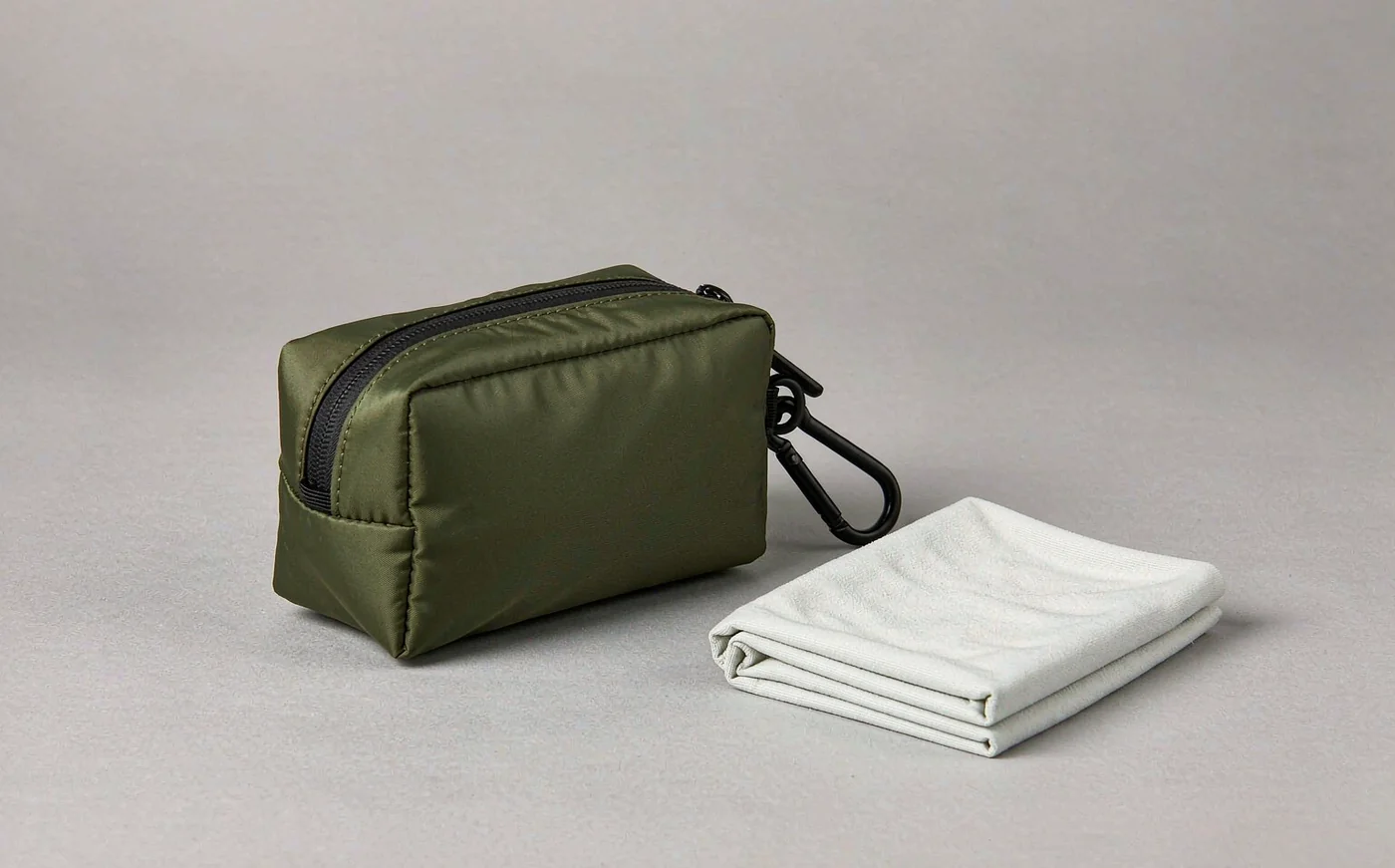
The accessories pouch is the cheapest line in a golf bag programme and the one most likely to produce a complaint, because a four-dollar item that fails reads to the buyer as a problem across the whole order. Shoe bags, apparel sacks, valuables pouches, ball-and-tee pouches and headcover sleeves are cut and sewn on the same floor as the bags, but they obey different rules: lighter shells, tighter seam allowances, and economics where five cents of trim decides whether the item is viable. Colourway minimums sit at 200 pieces, trial runs at 100, samples come back in 6-10 working days, bulk takes 35-50 days, and defect sampling runs at 2.5 AQL against the ISO 2859-1 scheme.
Related reading: Velcro vs Zipper Pocket Design in Golf Bag Manufacturing
Six Pouches, Six Patterns, One Purchase Order
A typical accessories range grows from one item to six within two seasons: a drawstring shoe bag, an apparel sack sized for a folded polo or a rain suit, a flat valuables pouch for wallet and keys, a small ball-and-tee pouch with a clip, a towel pouch, and a soft sleeve for headcovers. Each has its own pattern, its own trim card and its own failure point, yet buyers almost always order them together because the same carton, the same logo colour and the same inspection visit cover all six.
The commercial logic is straightforward. An accessories set adds perceived value at retail for a fraction of the cost of upgrading the bag itself. A shoe bag that costs USD 2.60 landed can support a USD 15 retail uplift in a boxed set, and it carries the brand into the customer car boot where the bag itself is not visible. That is why accessory attach rates at the mid-market level have risen steadily, and why the pouch line now often accounts for 8-14% of a bag programme invoice value.
What changes at production level is scale tolerance. A golf bag has roughly 90-140 minutes of labour in it and a tolerance budget measured in millimetres. A pouch has 6-12 minutes and a tolerance budget measured in single millimetres, because every error is proportionally larger. A 4 mm seam drift that would be invisible on a cart bag body twists a 200 mm pouch panel into a visible parallelogram.
The other difference is that pouches are usually bought as a range rather than a single SKU. Nine SKUs at 200 pieces each is 1,800 units, but it is nine pattern sets, nine trim cards, nine sets of strike-off artwork and nine line-changeovers. Buyers who understand this plan colourways across the range instead of treating each item as an independent order.
Shell Fabric: What Each Denier Actually Buys
Denier describes the linear mass of the yarn, not the weight of the finished cloth, but the mapping is predictable enough to quote from. The table below is the range our sampling team works to when a buyer asks for a pouch at a target FOB price.
| Shell | Finished weight | Coating | Hand | Typical pouch FOB |
|---|---|---|---|---|
| 210D polyester | 112-130 gsm | PU 600 mm, one side | Crisp, packs flat | USD 1.10-1.90 |
| 300D polyester | 148-172 gsm | PU 800 mm | Soft with body | USD 1.60-2.60 |
| 420D polyester | 192-218 gsm | PU 1,000 mm | Structured | USD 2.10-3.40 |
| 600D polyester | 262-296 gsm | PU 1,200 mm or PVC | Heavy, abrasion resistant | USD 2.80-4.60 |
| 600D ripstop with 3 mm rip grid | 275-305 gsm | PU 1,500 mm | Technical, matte | USD 3.40-5.60 |
Where 210D works and where it embarrasses
At 210D the fabric is light enough that a shoe bag folds into its own pocket, which is a genuine retail feature. The limit is abrasion and seam strength: a 210D shell with 10 stitches per inch and a 6 mm seam allowance will hold a 1.2 kg pair of shoes, but the same construction fails at the bottom corners within a season if the bag is dragged. If the brief calls for 210D, specify bound internal seams and a 600D abrasion panel at the base.
The 420D and 600D middle ground
Most branded pouches land at 420D for bags and 600D for shoe sacks, because those weights take embroidery and heat transfer cleanly and hold a boxy shape on a retail peg. The PU backer matters more than the face yarn: a 600D with a 1,200 mm coating resists a wet golf towel and a damp locker floor, while the same shell with a 400 mm coating wicks through the stitch holes within twenty minutes of contact.
Mesh, air-mesh and laminated foam
Mesh panels are specified for ventilation, not for strength. A 420D polyester mesh with a 3 mm hexagonal aperture lets a wet shoe dry without trapping moisture, but mesh has almost no tear strength, so it must never be used at a load-bearing seam without a woven tape behind it. Laminated foam, usually 3-5 mm EVA between a face fabric and a tricot lining, gives a valuables pouch the padded hand that premium buyers want and adds 40-70 g.
One specification mistake recurs: asking for a waterproof pouch. A pouch is not a dry bag. Coated fabric at 1,000-1,500 mm holds out rain and a wet towel, but the seams are sewn, not welded, and water passes through needle holes under sustained pressure. If the item must keep contents dry, the construction changes to welded seams or a roll-top closure, and the price roughly doubles.
Closures Decide the Warranty Rate
On a pouch, the closure is the component that fails first and the one buyers spend least time specifying. Zip specification alone covers tape width, coil size, slider type, end-stop method and whether a zip guard is required.
| Closure | Unit cost delta | Cycle life before failure | Dominant failure mode |
|---|---|---|---|
| #3 nylon coil zip, standard slider | baseline | 3,000-5,000 cycles | Tape pull-out at the top stop |
| #5 nylon coil zip, auto-lock slider | +USD 0.22-0.38 | 6,000-9,000 cycles | Slider spring fatigue |
| Drawstring, 4 mm braided cord, plastic lock | -USD 0.15 | unlimited cord, 800-1,500 lock cycles | Cord fray at the eyelet |
| Elasticated hem with cord lock | -USD 0.05 | elastic fatigue at 12-18 months | Loss of recovery, hood drops |
| Fold-over flap with magnetic snap | +USD 0.30-0.55 | snap plating wear | Plating corrosion in coastal air |
A #3 coil is adequate for a valuables pouch that opens twice a round. It is not adequate for a shoe bag opened and closed four times per round trip, where the tape sees a peeling load every time the bag is over-stuffed. The single most effective upgrade on a shoe bag is a #5 coil with a 25 mm tape and a locked slider, which costs about 30 cents and removes the most common warranty claim in the category.
Drawstring pouches avoid the zip problem entirely but move the stress to the eyelet. A brass or stainless eyelet set with a reinforcement patch behind it survives years; a bare punched hole in coated fabric tears out on the third or fourth pull because the coating acts as a crack initiator. Specify either a moulded eyelet or a 30 mm bar-tacked reinforcement patch, and never both omitted.
For clip-on pouches, the hardware matters as much as the closure. A 25 mm swivel snap with a spring gate is fine for keys; a carabiner-style gate is better where the pouch is clipped to a bag frame and swung around. Specify stainless steel or nickel-plated brass, not zinc alloy, if the product will be sold in coastal or humid markets where zinc blooms white within a season.
From Pattern to Packed Carton: The Build Sequence
Pouch production is short but has more handling steps per unit than bag production, which is why the labour share of cost is higher. The sequence below is the one used on the line, and each step is a control point where a defect is either prevented or locked in.
- Pattern and marker. Panels are digitised and nested on the marker. On a small item the marker efficiency determines fabric consumption per unit, so a 3% marker improvement is worth more than a 3% fabric price negotiation.
- Cutting. CNC knife or die cutting, with the face fabric, lining and any foam cut as a set and bundled by size. Face and lining must be cut to different allowances when the item is bagged out, typically 1.5-2 mm smaller on the lining.
- Edge finishing. Woven edges are hot-knifed or overlocked before assembly. Skip this on mesh or coated fabric and you will find fray dust inside every finished pouch at inspection.
- Sub-assembly. Zip set into the panel with a 20 mm binding or a lapped seam, drawstring channel turned, eyelets and patches applied, logo applied. These run as a batch ahead of final assembly.
- Bagging out and topstitch. The item is sewn inside out, turned through the gap, then topstitched at 10-12 stitches per inch. The topstitch is the visual signature of the item; uneven spacing is the first thing a buyer sees.
- Hardware and trim. Cord locks, clips, D-rings, labels and hangtags fitted. Every hardware item is pulled to check seating, because a loose D-ring will fall off in the carton.
- Pressing and folding. Steam press, then fold to the retail dimension and insert into a polybag with a size sticker.
- Final inspection and carton. AQL 2.5 sampling at general inspection level II, then flat-packed at 100 pieces per carton for pouches and 40-60 for shoe bags.
A drawstring shoe bag runs 6-8 minutes of direct labour; a zipped valuables pouch with binding, an internal card pocket and a woven label runs 10-14 minutes. In a 200-piece order those minutes are the difference between a viable and an unviable price, which is why changeover discipline matters more than hourly wage.
The step that most often derails a first order is step one. Buyers send a photograph of a competitor item and a logo file. That is not a pattern. Without a dimensioned drawing, the factory builds to its own default proportions, and the sample arrives at 240 mm when the retail peg and the gift box both assume 200 mm.
Tolerances and the Failure Modes That Reach the Customer
Pouch tolerances are quoted on the finished item, not on the cut part, because assembly absorbs or releases 2-4 mm depending on how the item is bagged out.
| Parameter | Production tolerance | Measured how |
|---|---|---|
| Finished length and width | ±5 mm | Flat, relaxed, 24 hours after pressing |
| Panel cut size | ±2 mm | On the cut bundle before assembly |
| Stitch density | 10-12 spi, ±1 | Counted over 25 mm at three points |
| Logo position | ±3 mm from datum | Template overlay against the tech pack |
| Zip length and alignment | ±2 mm, ends level within 1.5 mm | Both ends measured against the seam |
| Colour against standard, same lot | ΔE ≤ 1.0 | Spectrophotometer, D65, 10 degree |
| Colour against standard, across lots | ΔE ≤ 1.5 | Same method, retained standard swatch |
Zip tape pull-out. The tape separates from the panel because the stitch line sits too close to the coil or the tape is stitched through only one layer. Fix: 25 mm tape, stitch 3 mm from the coil edge, and a 20 mm binding that captures both layers.
Eyelet tear-out. Punched hole, no reinforcement, coating acting as a stress riser. Fix: reinforcement patch plus a moulded eyelet, and a bar-tack either side of the drawstring exit.
Base seam burst on shoe bags. The bottom seam takes the full load when the bag is lifted with shoes inside, and a single-row lockstitch at 8 spi will open. Fix: double-row lockstitch, 20 mm binding, and a box-X at each corner.
Coating delamination after folding. Pouches are folded flat for retail and stored in a warm warehouse. A PU coating applied at low add-on weight creeps and separates along the fold line. Fix: specify coating add-on in gsm, not just hydrostatic head, and require a fold-crease test on the first article.
Field note. The most expensive defect in this category is not a tear, it is a colour mismatch. When a pouch is packed against a bag in the same boxed set, a ΔE of 2.0 between the two is plainly visible. Always build the pouch from the same fabric lot as the bag, or accept a visible mismatch at retail.
Pre-production testing for a pouch line is light but not optional: a 6 kg sand load held for 30 minutes in a shoe bag, 500 open-close cycles on the zip, a 1 m drop on concrete in three orientations, a grab strength of at least 180 N to ASTM D5034, tear strength to ASTM D2261 in the warp and weft, and light fastness to ISO 105-B02 where the item is sold for outdoor use in strong sun.
Branding on a 60 mm Panel
A pouch gives the logo less room than any other item in the range, and the decoration method has to be chosen against the panel size rather than the brand guideline. On a 60 x 25 mm area, a four-colour embroidery with 1.2 mm lettering will not resolve; the needle cannot hold the counters in an e or an a.
Practical rules from the sample room: embroidery works from 7 mm cap height upward, with a maximum of nine colours before the stitch build makes the panel stiff; screen print holds 2.5 mm lettering and is the cheapest option above 500 pieces; heat transfer vinyl gives the sharpest small type and is the default for one-colour logos on dark shells; a woven label or a moulded PVC patch suits a crest with fine detail and adds a premium signal that costs USD 0.18-0.45 per piece.
Placement matters more than method. On a shoe bag the logo should sit 40-50 mm below the drawstring channel, not centred, because the fabric gathers when the bag is closed and a centred logo distorts. On a valuables pouch, a logo on the front panel is squeezed by the zip curve; move it to the lower third or use a small woven tab at the side seam.
For buyers building a full range, the screen print, embroidery and heat transfer comparison sets out the cost and durability trade-offs across all three methods. Consistency across the range matters as much as the method itself: if the bags carry an embroidered crest, the pouches should not carry a printed one at half the size.
Minimums, Sampling and Where the Money Goes
Accessories are quoted per colourway because the binding, thread and trim all change with colour, and because a 200-piece run is the smallest batch that can be cut and sewn without the changeover dominating the cost. Nine SKUs in one colour is a comfortable order; nine SKUs in three colours is three times the setup.
Where a new print screen, a new moulded badge or a new die-cut foam insert is involved, the practical floor moves to 500 pieces, or the tool is quoted as its own line and stays with the brand. A stock-fabric sample lands in 6-10 working days; 12-15 where a new mould, a new screen or a custom woven label sits in the critical path, since the label alone can take 10 days.
| Cost element | Share of pouch FOB | Lever available to the buyer |
|---|---|---|
| Shell fabric and lining | 38-48% | Denier, coating add-on, marker efficiency |
| Direct labour | 22-30% | Panel count, binding versus overlock, stitch density |
| Trim and hardware | 10-16% | Zip grade, slider, eyelet material, clip type |
| Branding | 4-9% | Method, colour count, placement complexity |
| Overhead, packing and inspection | 10-14% | Carton configuration, polybag or none, AQL level |
- Consolidate colours, not SKUs. Three colours across six items beats six colours across six items at the same total volume.
- Fix the zip grade in the tech pack. Leaving it to the factory default is how a 30-cent upgrade becomes a warranty claim.
- Ship flat, not folded. A pouch pressed and flat-packed at 100 per carton arrives with fewer permanent creases than one folded to retail size at the factory.
- Ask for the marker. A buyer who sees the marker can challenge fabric consumption, which is the largest single cost line.
- Keep a retained standard swatch. Colour disputes in month nine are settled by the swatch signed at first article, nothing else.
A 20-foot container holds roughly 40,000-46,000 flat-packed pouches at 100 per carton and 0.06 cubic metres per carton, which means accessories rarely drive freight decisions. They do drive customs classification, and a pouch shipped inside the same carton as a bag should be declared as a set or as separate lines with separate values, not lumped together.
Writing the Pouch Range Into a Tech Pack
A pouch tech pack can be one page per item if it carries the right fields. The eight that prevent almost every first-article argument are: finished dimensions with a stated measurement condition; shell and lining with denier, coating type and add-on weight; seam type and stitch density at each seam; zip or drawstring specification including tape width and slider; hardware with material and finish; logo artwork with method, dimensions and datum position; packing configuration including polybag and carton quantity; and the test list with acceptance values.
Add one field that is not standard: the retail presentation. Whether the item hangs on a peg, sits in a gift box or is packed loose inside the bag determines the fold, the hangtag position and whether a size sticker is needed. Buyers who skip this field receive a technically correct pouch that does not merchandise.
If you are assembling a pouch range around an existing bag, send the bag fabric swatch and the shell specification together. We can match the pouch to the same lot and confirm zip, binding and logo method within two working days, and the accessories range overview shows the constructions already tooled and available without new pattern development.
Related reading: Custom Headcover Manufacturing: Wholesale Sourcing Guide
Next steps: custom solutions, manufacturing capability, and a quotation request. Golf Accessories Range. Golf Bag Materials Guide.
Sources and Standards Referenced
- ISO 2859-1:2022 Sampling procedures for inspection by attributes
- ASTM D5034 Breaking strength and elongation of textile fabrics (grab test)
- ASTM D2261 Tearing strength of fabrics by the tongue method
- ISO 105-B02 Colour fastness to artificial light
- ECHA REACH regulation on restricted substances in textile articles
Frequently Asked Questions
What is the minimum order for a custom golf accessories pouch?
Two hundred pieces per colourway is the working minimum, because that is the batch size at which cutting, binding and changeover stop dominating the unit price. Trial orders of 100 pieces are possible on stock fabric and stock trim. Where a new print screen, moulded badge or die-cut insert is required, plan on 500 pieces or pay the tooling separately.
How long does pouch sampling take?
Six to ten working days when the shell, lining and trim are stock items. Allow twelve to fifteen working days if a custom woven label, a new print screen or a new mould is in the critical path, since a woven label alone usually needs ten days from artwork approval.
Which fabric should a golf shoe bag use?
Six hundred denier polyester with a PU backer of at least 1,200 mm is the standard choice, with a bound internal seam and a 600D abrasion panel at the base. Two hundred and ten denier works only if the bag is not dragged; the bottom corners fail within a season otherwise.
Is a zip or a drawstring better for a shoe bag?
A number five nylon coil zip with a locked slider adds about 30 cents and removes the most common warranty claim in the category. A drawstring is cheaper and cannot jam, but the eyelets become the failure point, so they need reinforcement patches behind them.
How many stitches per inch should a pouch have?
Ten to twelve stitches per inch on main seams, with double-row lockstitch at the base and box-X reinforcement at the corners. Below nine per inch the seam is weak; above fourteen the fabric is perforated and tears along the stitch line.
What tolerances are normal on a finished pouch?
Plus or minus 5 mm on finished length and width measured flat and relaxed 24 hours after pressing, plus or minus 2 mm on cut panels, plus or minus 3 mm on logo position, and colour within ΔE 1.0 against the standard in the same lot.
Can a pouch be made waterproof?
Not with sewn seams. A coated shell at 1,000-1,500 mm hydrostatic head sheds rain and wet towels, but water passes through needle holes under pressure. A genuinely dry pouch needs welded seams or a roll-top closure, which roughly doubles the cost.
What does a printed logo cost on a pouch compared with embroidery?
Screen print is the cheapest above 500 pieces and holds lettering down to about 2.5 mm. Embroidery needs roughly 7 mm cap height and adds cost with each colour; heat transfer vinyl gives the sharpest small type and suits one-colour logos on dark shells.
How are pouches packed for shipment?
Flat-packed, typically 100 pouches per carton at about 0.06 cubic metres, and 40-60 shoe bags per carton. Flat packing reduces permanent creases compared with folding to retail size at the factory, and a 20-foot container takes roughly 40,000-46,000 flat-packed pouches.
What inspection standard applies to accessories?
The ISO 2859-1 scheme at 2.5 AQL, inspection level II, the same as the bags. Thirty-two units come out of a 200-piece lot and up to two major defects are accepted, and the check covers dimensions, stitch density, zip function, logo position and hardware seating.
Do pouches need to match the bag colour exactly?
Yes if they ship in the same boxed set. A ΔE of 2.0 between pouch and bag is visible at retail. Build both from the same fabric lot where possible, and keep a retained standard swatch signed at first article to settle any later dispute.
Which tests should a pouch pass before bulk?
A 6 kg sand load for 30 minutes in a shoe bag, 500 open-close zip cycles, a 1 m drop in three orientations, grab strength of at least 180 N to ASTM D5034, tear strength to ASTM D2261, and light fastness to ISO 105-B02 for outdoor retail.
Price My Pouch Range
Send the six items, target FOB band and logo files, and get a per-item quotation with marker efficiency and zip options inside two working days.
Get a Quotation See Accessories Range