Custom Golf Headcovers Manufacturing and Wholesale Guide
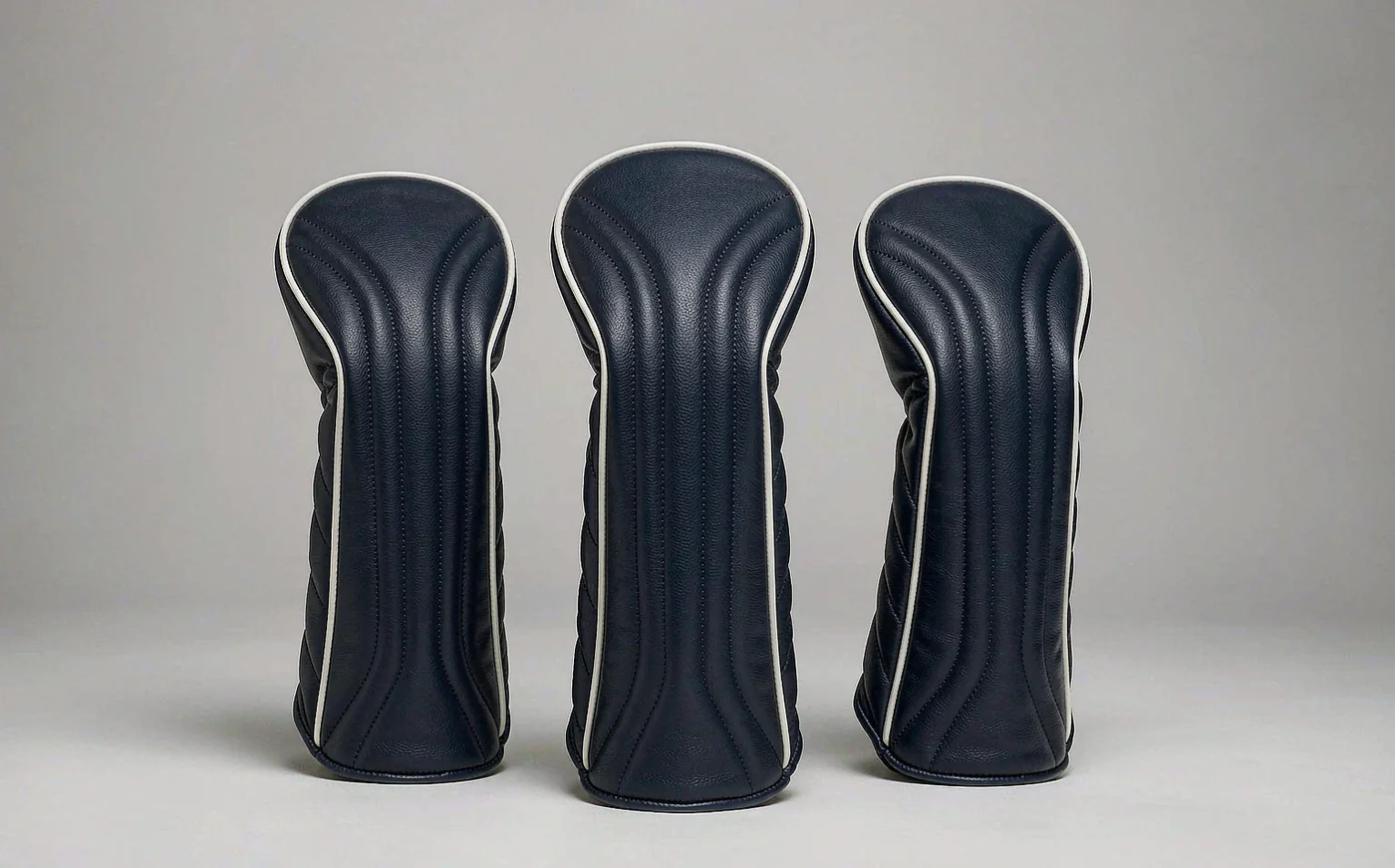
A three-piece headcover set is the smallest ticket item in a bag programme and the one that most often arrives wrong, because the specifications that decide fit, colour and durability are rarely written down. Get the clubhead fit, the material and the decoration method right and a set costs USD 3.20-12.50 at FOB; get them wrong and the returns arrive faster than the reorders. This guide covers the four headcover types a range needs, the materials that survive a season, where the cost and the failure modes sit, and how to structure an order around a 200-piece colourway minimum with 100-piece trials. Samples come back in 6-10 working days and bulk takes 35-50, with a further 12-15 days when a new mould tool is involved.
Related reading: Golf Gift Set Bulk Sourcing for Corporate Tournaments
The Four Headcover Types a Range Needs
Headcovers are sold as singles, as three-piece sets and as full sets that include iron covers. The commercial logic differs by market: North American green-grass accounts buy three-piece sets as an add-on at the counter, European pro shops lean toward knit singles and small sets, and corporate buyers want a logo-heavy set that photographs well in a gift box. A range that covers driver, fairway and hybrid in one visual family, plus a putter cover in the same language, covers most of the demand without exploding the SKU count.
Fit is the specification that generates the most complaints, because clubheads have grown. A modern driver head sits at 440-460 cc, and a cover built to a template from a decade ago will fit over the crown but pull tight at the hosel, which stresses the seam every time the club goes in. The measurements that matter are internal height from the crown to the cuff, the internal circumference at the widest point, and the cuff opening diameter, because the cuff is what the player pulls against fifty times a round.
| Cover type | Fits | Typical internal height | Cuff opening | Notes |
|---|---|---|---|---|
| Driver | 440-460 cc heads | 32-36 cm | 9-11 cm | Deepest body; check hosel clearance |
| Fairway | 3W, 5W, 7W | 26-30 cm | 7-9 cm | Tapered body; number patch common |
| Hybrid / utility | 2H-5H | 22-26 cm | 6-8 cm | Smallest of the wood family |
| Blade putter | Blade and wide-blade | 16-19 cm | 5-7 cm | Flat profile; magnetic or elastic closure |
| Mallet putter | Mallet and mid-mallet | 20-26 cm | 6-8 cm | Width matters more than height |
A practical check before tooling or sampling is to send the actual clubheads, or a dimensioned drawing of each, rather than a reference to a model year. Club manufacturers change crown geometry between generations without changing the model name, and a cover that fits one season's head can bind on the next. Where the buyer cannot supply heads, the supplier should quote a fit range and state the tolerance, so the risk is visible at the quotation stage.
Materials That Survive a Golf Season
The shell material decides the price band, the hand feel and the decoration options, and it also decides how the cover ages. Four families cover almost all production: knit acrylic, neoprene, coated polyester and synthetic leather. Each has a distinct failure mode, and the failure mode is more useful in a specification than the marketing name of the material.
Knit acrylic is the traditional look, soft, stretchy and cheap, and it fits a range of head shapes because the knit accommodates. Its weakness is pilling and stretch loss at the cuff after repeated use, and it offers almost no abrasion resistance where the cover rubs against the divider in the bag. Neoprene gives a snug, padded fit with good water resistance and a clean surface for printing, but it holds heat and moisture against the clubhead and can leave a mark on a painted crown in a hot car.
Coated polyester, usually 600D with a PU backer over 5-8 mm foam, is the workhorse for mid-market sets. It takes embroidery and screen print well, holds shape, and costs less than synthetic leather. Its failure mode is delamination at the crown seam when the coating is under-specified, and cuff fraying where the binding is only single-stitched. Synthetic leather, PU on a knit or non-woven backing, gives the premium look and the crispest embroidery, but it is the material most likely to transfer colour onto a light clubhead if the finish is not colourfast, and it cracks at flex points if the backing is too stiff.
| Material | Weight per cover | Water resistance | Decoration fit | FOB per 3-piece set |
|---|---|---|---|---|
| Knit acrylic | 25-40 g | Low | Woven label, jacquard | USD 3.20-5.00 |
| Neoprene | 40-60 g | Medium | Screen print, heat transfer | USD 3.80-6.50 |
| 600D coated polyester + foam | 60-90 g | Medium-high | Embroidery, print, patch | USD 4.50-7.50 |
| PU synthetic leather | 70-110 g | High | Embroidery, appliqué, moulded patch | USD 7.00-12.50 |
The weight column is not decoration. Headcovers ship by volume in cartons of 50-100 pieces, so a 110 g leather-look cover against a 30 g knit cover changes the freight per set by a few cents rather than dollars. Where a programme combines headcovers with bags in one container, the covers ride in the residual space and the weight is irrelevant; where they ship alone, the carton count is what matters.
Construction: Where Cost and Failure Sit
A headcover looks simple and is built from seven or eight operations. Each one carries a cost and a failure mode, and the two are usually in the same place: the tightest curve, the highest-stress seam, the point where a player's hand pulls hardest.
- Pattern and grading. The cover is built from four to six panels. Grading across driver, fairway and hybrid has to keep the visual proportion consistent, or the set looks like three unrelated products.
- Cutting. Knit and neoprene are cut on a CNC knife or die; PU leather is cut with a die to avoid edge discolouration. Grain direction matters on PU because the material stretches more across the roll than along it.
- Foam lamination. EVA or polyurethane foam at 5-8 mm is laminated to the shell under heat and pressure, then rested. Rushing the rest period is the usual cause of delamination after a few weeks in a warm warehouse.
- Seam assembly. The body seam is the highest-stress joint. Double-row lockstitch at 10-12 stitches per inch with a 3-4 mm seam allowance is the standard; a single row at 8 stitches per inch is the most common cost cut and the first thing to fail.
- Cuff and binding. The cuff takes the pull force. An elastic band inside a folded binding, bar-tacked at the seam junction, survives; a plain hem does not.
- Lining insertion. Plush fleece or microfiber lining is joined to the shell before the final seam is closed, and the lining seam must be flat-felled or bound so no raw edge touches the clubhead.
- Decoration. Embroidery, appliqué or a moulded patch is applied before final assembly where possible, because embroidering a closed three-dimensional cover is slower and less accurate.
- Final turn, press and inspect. The cover is turned, the lining checked for twists, the cuff checked for recovery, and the pair inspected against the approved sample.
The lining deserves more attention than it usually gets. A cover exists to protect a painted crown and a graphite shaft, and a raw lining seam or a coarse fleece will abrade both over a season. The best specification is a brushed microfiber or a soft tricot, joined with a flat-felled seam, with no exposed thread end longer than 3 mm inside the cavity. Buyers who specify only the shell material, and leave the lining to the supplier's default, are specifying the outside of a product whose job happens on the inside.
Why the small radius is the expensive curve
Every headcover has a tight curve where the crown meets the side panel. On a driver that radius can be under 40 mm, and on a mallet putter the corner can be tighter still. Fabric does not like tight concave curves: it puckers, the seam allowance bunches, and the embroidery that crosses the curve distorts. The production answer is a clipped and notched seam allowance, a smaller stitch length through the curve, and in difficult materials a separate gusset panel. Each of those adds labour, which is why a cover with a clean tight radius costs more than a cover with a soft rounded one, even when the material is identical.
Sizing and Fit Against Modern Clubheads
Sizing errors cluster in three places: the cuff, the hosel and the putter. The cuff has to be wide enough to pass over the widest part of the head but tight enough to stay on in a bag, and those two requirements conflict on oversize drivers. An elasticated cuff with a 9-11 cm relaxed opening typically stretches to 14-15 cm, which clears most 460 cc heads; a non-elastic cuff at the same dimension will not.
The hosel is the second trap. A cover cut to clear the crown can still bind where the shaft enters the head, and the symptom is a cover that sits at an angle, wears through at the hosel side, and looks wrong in a photograph. Allow 15-20 mm of clearance beyond the hosel on the finished pattern, and check it with the actual club rather than a drawing.
Putter covers need their own pattern family. A blade cover is essentially flat with a shallow cavity; a mallet cover is a box with rounded corners and often a magnetic flap. Quoting a mallet cover from a blade pattern produces a cover that fits only the smallest mid-mallet, and the correction comes after the sample, which costs another sampling round of six to ten working days and a second courier.
Spec tip. Put the three critical dimensions on the tech pack drawing, not in a note: internal height, internal circumference at the widest point, and cuff opening diameter relaxed and stretched. A cover that fails on any one of those cannot be fixed by changing the material.
Decoration: Embroidery, Patches and What They Cost
Decoration is where a headcover range becomes a brand asset, and where unit cost moves fastest. Four methods dominate: flat embroidery, 3D foam embroidery, appliqué with a stitched border, and a moulded patch in PVC or silicone. Each has a different minimum, a different tooling position and a different failure mode.
Embroidery stitch count and the small-radius problem
Embroidery is priced on stitch count and colour changes. A simple two-colour logo on a driver cover runs 3,000-5,000 stitches; a detailed crest with five colours and a satin border can exceed 10,000. At production volumes that translates to roughly USD 0.25-1.20 per cover in sewing time, plus a one-off digitising fee of USD 30-80 per logo. More than twelve colours in one design slows the machine and raises the defect rate, so a design that reads well at four to six colours is both cheaper and cleaner.
The technical constraint is the curve. Stitches laid across a tight radius pull the fabric and produce a pucker that no amount of pressing removes. The fix is to keep the logo inside a flat area, or to accept a slightly smaller mark placed above the curve rather than across it. On a 3D foam design the foam is cut 1-2 mm larger than the stitch field, and the edge is finished with a satin border; skip the border and the foam edge frays into the embroidery after a few months of handling.
Appliqué and moulded patches carry tooling. A PVC or silicone patch needs a mould at USD 300-800 with 12-15 working days to first article, which is why patch-based designs usually come with a 500-piece minimum. The advantage is a crisp, repeatable mark that survives abrasion better than embroidery on a knit surface, and it photographs well for e-commerce. For a corporate gift programme, the patch is often the element that makes a modest set look considered.
| Decoration | Setup cost | Unit cost added | Minimum | Best on |
|---|---|---|---|---|
| Flat embroidery | USD 30-80 digitising | USD 0.25-0.90 | 200 pcs | PU leather, coated polyester |
| 3D foam embroidery | USD 40-90 digitising | USD 0.60-1.40 | 200 pcs | Driver and fairway covers |
| Appliqué with border | Cutting die USD 120-300 | USD 0.90-2.00 | 200 pcs | Large marks, contrast panels |
| Moulded PVC / silicone patch | Mould USD 300-800 | USD 0.70-1.80 | 500 pcs | Corporate gifts, retail sets |
Order Structure: MOQ, Sets and Colourways
Headcover orders are structured in sets more often than in singles, and that changes how the minimum applies. The colour or print change threshold is 200 pieces per colourway, and a three-piece set counts as three pieces of that colourway. A 200-piece order therefore builds around 66 sets, which is a small counter display rather than a full range, and most first orders land between 300 and 600 sets to cover three colourways and two club types.
A 100-piece trial is workable on stock shapes and stock materials, which is the right way to test a colour or a logo placement before committing. A brand-new shape, a new mould for a patch, or a new foam profile is a development project rather than a repeat, and that normally needs 500 pieces to justify the tooling. Where the buyer pays for the mould outright and keeps ownership of it, the quantity threshold can be lower, because the supplier is no longer amortising the tool into the unit price.
Colourway planning matters more than it looks. A four-colour range across driver, fairway and hybrid and putter is twelve SKUs before any size variants, and each SKU needs its own carton label and its own line on the packing list. Three colourways is usually the point where a first order stays manageable; beyond that, the picking and packing labour starts to show in the unit cost even when the material cost does not change.
Sets versus singles
Singles exist for a reason: a player who loses a driver cover buys one, and a pro shop that wants an impulse item at the till wants a low price point. But the unit economics favour sets. A single cover carries the same cutting, sewing and packing labour as one third of a set, and the carton and hang tag cost is spread across one piece instead of three. In practice a set costs 15-25% less per cover than the same cover sold alone, which is why the wholesale catalogue is built around sets with singles as a top-up rather than the other way round.
Quality Control and Testing for a Soft Accessory
Headcovers are inspected under AQL 2.5 of ISO 2859-1, level II, the same scheme used for bags: from a 200-unit lot, 32 units are drawn and up to two major defects are accepted. The defect list is what makes that inspection meaningful, and for this product it is short and specific.
- Fit on a gauge or a real club: the cover must pass over the head and stay on when inverted and shaken, with no more than the specified pull force at the cuff.
- Seam integrity at the body seam and the cuff junction, checked visually for skipped stitches and by hand for a pulled seam at 30 N.
- Lining condition: no raw edges, no twists, no thread tails longer than 3 mm inside the cavity.
- Decoration registration: logo centred within 3 mm, no puckering across a curve, no foam edge exposed.
- Colour consistency against the approved swatch under D65 lighting, with ΔE ≤ 1.0 within a lot and ≤ 1.5 across lots.
- Elastic recovery after 100 stretch cycles, with no more than 5% permanent set at the cuff.
Two lab tests are worth running before bulk. Colourfastness to rubbing matters on PU leather, because a dark cover against a white clubhead in a hot car is a real transfer risk; colourfastness to light matters for knit covers that hang on a bag in the sun all season. Seam strength to ASTM D5034 and tear strength to ASTM D2261 give a number to hold a supplier to when a seam feels weak, and light fastness to ISO 105-B02 covers the fading question.
The most common defect in the category is not structural. It is a colour mismatch between the driver cover and the fairway cover in the same set, caused by dyeing the two panels in separate lots. The control is to cut a set from one lot and to check the set as a set at inspection, not each cover in isolation.
Building a Headcover Range Into a Bag Programme
Headcovers work best as an attachment to a bag programme rather than a standalone purchase, because the same colour card, the same trim and the same logo system can be carried across both products. A brand that orders 550 cart bags in three colourways can add 600 headcover sets in the same colours, ship them in the residual container space, and present a coordinated range without a separate sourcing exercise.
The scheduling works if the headcover is developed alongside the bag, not after it. Sampling on both runs 6-10 working days in parallel, and the bulk windows overlap, so a single approval cycle covers the pair. Leave headcovers until the bags are in production and the covers arrive a season late, which is the single most common timing failure in accessory programmes.
For a first range, the sensible structure is three colourways in a three-piece set, a stock shape with a custom embroidered logo, and a 300-600 set order that stays inside one container. That gives a retail account something sellable at a price band of USD 39-89, keeps tooling at zero, and leaves the moulded patch and the full iron-cover set for the second season, when the sell-through data justifies the investment. QUANZHOU JUNYUAN BAGS develops covers alongside the bag programme so the colour card, trim and logo system match across both products. Our custom solutions team builds that pairing regularly, and the accessories range shows the shapes that ship most often.
Next steps: custom solutions, manufacturing capability, and a quotation request. Essential golf bag accessories guide. Golf bag customization guide.
Sources and Standards Referenced
- ASTM D5034 Breaking strength and elongation of textile fabrics (grab test)
- ASTM D2261 Tearing strength of fabrics (tongue method)
- ISO 105-B02 Colour fastness to artificial light
- ISO 2859-1:2022 Sampling procedures for inspection by attributes
- ISO 9001:2015 Quality management systems
Frequently Asked Questions
What is the MOQ for custom golf headcovers?
200 pieces per colourway on stock shapes and stock materials, with 100-piece trial orders available to test a colour or logo placement. A new shape or a new moulded patch is a development project and normally needs 500 pieces, unless the buyer purchases the mould and holds ownership of it.
How much does a custom headcover set cost?
A three-piece set runs from about USD 3.20-5.00 in knit acrylic, USD 3.80-6.50 in neoprene, USD 4.50-7.50 in coated polyester with foam, and USD 7.00-12.50 in PU synthetic leather at FOB. Embroidery adds USD 0.25-2.00 per set depending on stitch count and colour changes.
How long does sampling take?
6-10 working days for a stock shape with stock materials, including the embroidery or print. A new moulded patch, a new foam profile or a new pattern family takes 12-15 working days, since the first article must be tooled, assembled and checked on a club before approval.
How do I make sure the cover fits my driver?
Specify internal height, internal circumference at the widest point and the cuff opening relaxed and stretched, and check the hosel clearance separately. A 460 cc head typically needs 32-36 cm internal height and a 9-11 cm elasticated cuff that stretches to 14-15 cm.
Which material is best for a premium headcover?
PU synthetic leather gives the crispest embroidery and the best shelf presence, provided the backing is flexible enough not to crack and the finish is colourfast. Coated 600D polyester with foam is the better value option and holds up well in daily use.
Can I use my own logo artwork?
Yes. Embroidery needs a digitised file, which costs USD 30-80 per logo, and the design should read at four to six colours. Artwork that crosses a tight curve will pucker, so the mark is usually placed on a flatter area of the cover.
Do headcovers need REACH testing for the EU?
Yes, as an article. The relevant checks are azo dyes on dyed textiles, phthalates in any soft PVC, PAHs in rubber or plastic trim, nickel release on metal fittings and a candidate-list screen above 0.1%. Test by material and colour, not by finished set.
What is the difference between a blade and a mallet putter cover?
A blade cover is flat with a shallow cavity and typically 16-19 cm tall; a mallet cover is a rounded box 20-26 cm tall where width matters more than height. Quoting one from the other's pattern produces a cover that fits only the smallest mid-mallet.
How are headcovers packed for shipment?
Normally one poly bag per cover, sets bagged together with a hang tag, and 50-100 pieces per double-wall carton. A three-piece set at 70-110 g per cover means cartons run 12-20 kg, so the shipment is volume-limited rather than weight-limited.
Why do my covers fade or transfer colour?
Usually dye lot variation or a finish that is not colourfast. Dark PU against a white clubhead in a hot car is the classic transfer case, and knit covers left in sun all season are the classic fade case. Specify light fastness to ISO 105-B02 and rubbing fastness on PU.
Can headcovers ship in the same container as bags?
Yes, and it is the most economical way to ship them. Six hundred sets occupy a small fraction of a 40HQ and ride in the residual space around the bag cartons. Plan the two products in parallel so sampling and bulk windows overlap.
What inspection standard applies to headcovers?
Inspection follows AQL 2.5, ISO 2859-1 level II: 32 units are drawn from a 200-unit lot, with two major defects allowed, checking fit, seam integrity, lining condition, decoration registration and colour consistency within the finished set.
Price a Headcover Set
Send a logo file and the club models you need to fit, and a three-piece set quote with material options, decoration cost and sampling dates comes back in two working days.
Request a Set Quote View Custom Solutions