Custom Golf Bags With No Minimum Quantity: Small Batch Reality
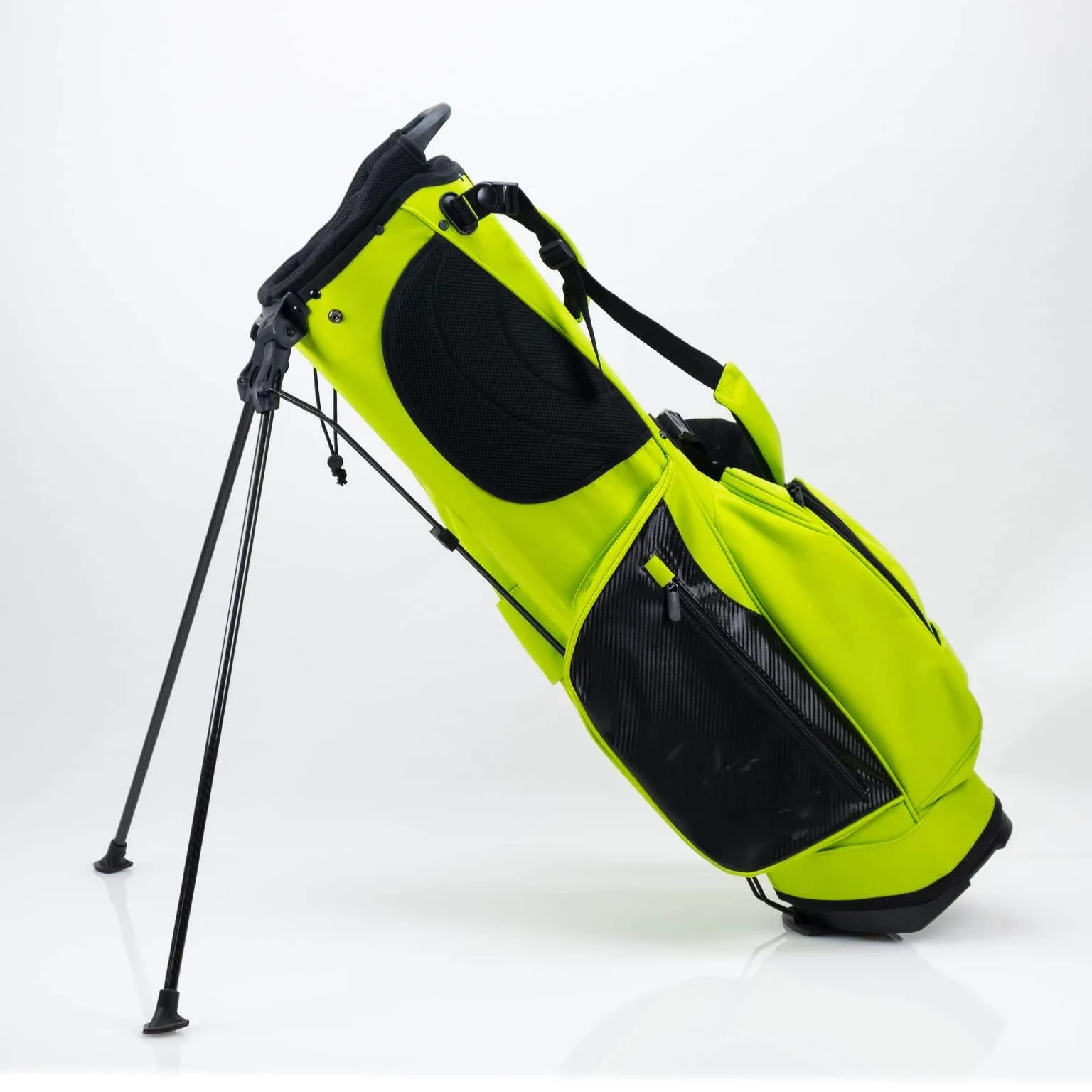
A custom golf bag with genuinely no minimum quantity does not exist at the quality end of the market, and the offers that advertise one are almost always selling something else: a stock blank with a logo added, a paid sample priced as a production unit, or a dealer passing through a bag it did not make. That is not cynicism, it is arithmetic. Fabric is dyed in lots, cutting tables need layers to be efficient, and a sewing line needs a run long enough to hold tolerance. What does exist, and works, is a low floor with clear rules: 200 pieces per colourway for a recolour or a print, 100 pieces for a trial on an established construction, and 500 pieces when a new shape, mould or laminate is needed. Six to ten working days covers sampling, five to seven weeks covers bulk, and inspection follows the AQL 2.5 band of ISO 2859-1.
Related reading: How to Negotiate MOQ With a Bag Supplier
What "No Minimum Quantity" Means in Practice
Search the phrase and you will find three kinds of seller. The first is a blank-bag decorator who holds imported stock and adds embroidery or a heat transfer. The second is a marketplace listing where the minimum applies to a generic bag and disappears the moment you ask for a different fabric, colour or pocket layout. The third is a sample-room service that will build one bag, charge for it as a development item, and then quote a real production minimum that was not on the landing page.
None of these is fraudulent on its face. Each is a legitimate business answering a different question from the one the buyer is asking. A decorator sells decoration, not bag development. A marketplace sells a stock product. A sample room sells a prototype. When a buyer reads "no minimum" as "I can develop my own bag in any quantity", the mismatch only becomes visible after money has moved.
The useful test is to ask what is fixed and what is variable. If the shell fabric, the colour, the top, the divider and the pocket layout are all fixed, you are buying decoration. If any of them is variable, you are buying development, and development has a floor because the set-up work is the same whether you make 20 bags or 200.
| Offer type | What is actually supplied | Where it breaks | Unit price signal |
|---|---|---|---|
| Stock blank plus logo | A finished imported bag, one or two colours, logo only | No spec control, identical product sold elsewhere | Low price, low margin |
| Marketplace low-MOQ listing | A generic bag, decoration included, options limited | Real minimum appears on any change request | Attractive headline, thin specification |
| Sample-room single build | One prototype, hand-made, development charged | Price is 2-4x production unit cost | Honest if labelled as a sample |
| Small-batch production run | 100-200 pieces on an established construction | Fabric minimum and colour count still apply | 10-20% premium over 500 pieces |
Three Ways a Zero-MOQ Offer Is Actually Built
Stock blank plus decoration
This is the most common model and the least dishonest. A supplier imports a container of one bag, holds it in a warehouse and decorates individual units on demand. The buyer gets a decent bag at a modest price with a logo in the right place. What the buyer does not get is control: the fabric, the divider count, the pocket geometry and the hardware are whatever the container held, and the same bag is available to every other buyer who calls.
The failure mode is not quality, it is differentiation. A pro shop that decorates a stock bag ends up with the same product as the club down the road, distinguished only by an embroidered crest. At that point the bag is a promotional item, not a brand asset, and the price competition is immediate.
The sample priced as a product
A second pattern quotes a very low minimum and then delivers a hand-built prototype at a price that reflects hand-building: two to four times the production unit cost is normal, because a single bag consumes pattern work, cutting, sampling labour and a courier label. This is a fair transaction when it is described as sampling. It becomes a problem when the buyer treats the sample price as the production price and builds a retail margin on it.
The tell is the second quote. Ask what 200 pieces of the same bag would cost. If the answer is dramatically lower than the sample price, you were buying sampling, not production. If the answer barely moves, you are being quoted a hand-made product dressed as a factory run.
The dealer passing through
The third pattern is an intermediary that takes your brief, orders from a workshop it does not control, and adds a margin for coordination. There is nothing wrong with coordination as a service, but the buyer should know which party owns the specification, the inspection and the warranty. When the answer is nobody in particular, the "no minimum" convenience is being paid for with accountability.
Where Zero-MOQ Supply Breaks Down
The failures cluster in four places, and all four are structural rather than accidental.
- Specification drift. With no volume commitment, the supplier has no reason to lock a fabric or a trim. A second order in the same colour can arrive in a different hand feel, a slightly different shade, or with a substituted zip.
- No meaningful inspection. AQL 2.5 under ISO 2859-1 is a sampling scheme for lots. A ten-piece order cannot be sampled in any statistically useful way, so defects are either accepted or discovered by the end customer.
- Colour without a dye lot. Small runs frequently use stock fabric or overdyed remnants, which means the colour is whatever was available that week. Matching it on a reorder six months later is luck, not process.
- No continuity of parts. Dividers, leg hinges, buckles and zip sliders are bought in batches. A tiny run may use whatever the workshop has on the shelf, and replacements for a warranty claim a year later may not exist.
There is also a compliance dimension that buyers rarely consider at the low end. A supplier shipping twenty bags may not provide a material declaration, a test report or a certificate of origin with any confidence, because the material was bought from stock and the paper trail stops at the warehouse. For a brand selling into the EU or through a retail chain, that gap is a bigger risk than the unit price.
Field note. If a supplier cannot tell you the fabric denier, the divider construction and the zip brand of the bag you are ordering, the minimum quantity is not the real problem. The specification is unknown, and no volume will fix that.
The Real Floor: 200, 100 and 500
The floor in this category is not a marketing decision; it comes from three physical constraints. Fabric is dyed in lots, typically 500-1,000 metres per colour for piece-dyed 600D, and a golf bag consumes roughly 1.1-1.4 metres of shell. Cutting is efficient in layers, not in tens. And a sewing line needs a run long enough for the operators to settle into the construction before the run ends, because the first fifty pieces of any run carry the learning curve.
The dye-lot constraint
At 200 pieces per colourway, a 1.2-metre shell consumption lands at about 240 metres of fabric, comfortably inside a standard dye lot once pockets, lining and offcut are counted. At 50 pieces the same colour needs 60 metres, which no mill will dye to order, so the workshop either uses stock or charges the full lot minimum. That is why 200 is the practical threshold for a genuine recolour rather than a decoration.
What 100 pieces changes
A 100-piece trial is viable when nothing new needs to be cut: an existing shell pattern, an existing divider, an existing top, with a new colour or a new print. In that case the set-up is mostly a colour approval and a print screen, and the run is long enough to sample properly under AQL 2.5 at a reduced lot size. It is not viable for a new shape, because the pattern, the mould and the first-article approval cost the same regardless of quantity.
When 500 is the honest number
A new development, meaning a new top geometry, a new divider mould, a new base plate or a new laminate, carries tooling and first-article work of roughly USD 3,000-9,000 for a moulded component plus 12-15 working days of sampling. At 500 pieces that cost is spread thin enough to be tolerable. At 100 pieces it would add several dollars to every bag, which is why the 500-piece development minimum is a cost statement rather than a sales tactic.
| Order size | What it supports | Unit price index | Set-up share |
|---|---|---|---|
| 100 pieces | Recolour or print on an existing construction | 112-118 | High per unit |
| 200 pieces | New colourway, new trim, same pattern | 106-110 | Moderate |
| 500 pieces | New shape, new mould or new laminate | 100 (base) | Low |
| 1,000 pieces plus | Full programme, multiple pockets | 94-97 | Minimal |
What a 100-Piece Trial Actually Buys You
A trial is not a discount on a small order; it is a decision tool. For roughly 12-18% more per unit than a 500-piece run, a buyer gets a physical product in market, real sell-through data, and a colour that has been approved against an actual bag rather than a lab dip. For a first season, that information is usually worth more than the premium.
What a trial does not buy is a custom shape. If the design needs a new top or a new divider, the trial becomes a development order at 500 pieces, or the buyer accepts a stock top with custom fabric and trim. Making that distinction early is the single biggest saver of time in a small-batch programme.
A well-run trial has four components: a locked specification sheet, an approved colour standard retained by both sides, a written inspection plan, and a stated reorder price. Without the fourth, the trial price becomes the anchor for every future conversation, and the buyer discovers at reorder that the "small batch premium" has quietly become permanent.
Designing a Small Batch That Still Reads Custom
The brands that look custom at 100-200 pieces are not spending more per unit; they are spending it in the places that show. A shared base cloth across two or three colourways, differentiated by trim, piping and print, reads as a full collection while spreading one dye lot across the range.
Five levers deliver most of the perceived customisation at low volume: a distinctive trim colour against a stock shell, a printed pocket panel rather than a printed body, a custom puller or zip tape, a woven label and a rubberised badge, and packaging that carries the brand rather than the bag. Each is a low-minimum item, and together they change the product from a stock bag to a branded one.
The mistake is spending the small-batch budget on a new moulded top. Tooling is the least visible per dollar at low volume, because the buyer sees a slightly different collar and pays several dollars a bag for it. Trim, print and packaging are seen immediately, cost a fraction, and survive a reorder without new set-up.
- Lock one shell fabric in one dye lot and build two or three colourways from trim, piping and print variations.
- Keep the top, divider and base from the existing tooling unless the product concept genuinely requires a new shape.
- Spend on the touch points: zip pullers, woven labels, a rubberised badge and a printed pocket panel.
- Approve colour in the same light box for every colourway, against a retained standard, before bulk cutting.
- Write the reorder price into the trial agreement so the second order is a volume conversation, not a renegotiation.
Lead Time, Freight and the Hidden Cost of Tiny Runs
A 100-piece order does not move faster than a 500-piece order; it moves at the same pace with less buffer. samples consume 6-10 working days, the bulk run takes 35-50 days after sign-off, and the ocean leg takes 25-40 days to North America or Europe. The difference is that a small run is usually shipped LCL or by air, and both carry a per-unit penalty that buyers forget when they compare FOB prices.
LCL consolidation typically adds 30-60% to the per-cubic-metre cost of sea freight against a full container, and it adds 5-10 days of handling at each end. Air freight on a 100-200 piece order adds roughly USD 6-11 per bag, and that band widens with distance and the time of year. Neither is fatal on a test order, but a business built entirely on small air-freighted runs will never reach a competitive landed cost.
The workable pattern is a small first shipment to prove the market, followed by a consolidated bulk run once a colour is validated. That sequence keeps the test cheap in working capital and keeps the repeat order efficient in freight. Rates move constantly, so confirm current LCL and air tariffs at the time of writing rather than budgeting from last season.
| Cost line | 100 pieces | 500 pieces | Note |
|---|---|---|---|
| FOB unit price index | 112-118 | 100 | Same construction, new colour |
| Sampling and colour approval | USD 300-800 | Amortised | Charged once, credited on bulk |
| Freight mode | Air or LCL | LCL or FCL | Air adds USD 6-11 per bag |
| Inspection | Reduced lot, AQL 2.5 | Full AQL 2.5 lot | 32 pieces sampled at 200 units |
A Realistic Path From 100 to 2,000 Pieces
Small batch is a stage, not a strategy. The buyers who scale start with one colourway, prove sell-through, then use the data to justify a volume commitment that removes the premium. The order of moves below is what keeps the unit price falling as volume rises.
- Season one: 100 pieces in one colour. Air or LCL, full price, real market data, one retail channel.
- Season one reorder: 200 pieces. Same construction, add a second trim colour if the first sold through.
- Season two: 500 pieces across two colourways. Now the fabric commitment is real and the unit price drops toward base.
- Season two add-on: a new pocket or print. Test one design change at a time so the sell-through signal stays readable.
- Season three: 1,000-2,000 pieces. Consolidate into a full container, negotiate payment terms beyond the standard 30/70, and consider a second construction.
At every step the constraint is the same: change one variable at a time. A buyer who moves from 100 to 500 pieces while also changing the shell, the divider and the colour has learned nothing about which change drove the result. Our low-MOQ programme is built around that sequencing, and the pricing tier guide explains where each volume band sits against retail price. For very small formats such as pencil and sunday bags, the small-order production notes cover the constructions that tolerate low runs best.
Next steps: custom solutions, manufacturing capability, and a quotation request. Sunday carry bags. Low MOQ custom bags.
Sources and Standards Referenced
- ISO 2859-1:2022 Sampling procedures for inspection by attributes
- ISO 9001 quality management systems
- ASTM D5034 Breaking strength and elongation of textile fabrics (grab test)
- US Customs and Border Protection, importer guidance
- US Federal Trade Commission, advertising and marketing basics
Frequently Asked Questions
Do any golf bag suppliers really offer no minimum order?
Not for genuinely custom bags. Offers described as no-minimum are usually a stock blank with a logo added, a marketplace listing that reverts to a real minimum on any change, or a paid sample priced as a development item. Decoration at low volume is real; development at low volume is not.
What is the smallest realistic custom golf bag order?
100 pieces is workable when nothing new needs to be cut: an existing shell, top and divider, with a new colour or print. A new colourway on the same pattern starts at 200 pieces per colour, and a new shape or mould needs 500 pieces to carry the set-up cost.
Why is 200 pieces the standard minimum per colourway?
Because piece-dyed fabric is sold in lots of roughly 500-1,000 metres and a bag uses 1.1-1.4 metres of shell. At 200 pieces the colour consumes a workable share of a dye lot. Below that, the mill minimum is priced into a short run rather than avoided.
Can I get my own logo on 20 bags?
Yes, if the bag is a stock construction and the customisation is decoration such as embroidery, a heat transfer or a woven label. That is a decoration service, not bag development, and the product will be identical to the stock bag sold to other buyers apart from the branding.
What goes wrong with very small orders?
Four things: specification drift on reorder, no statistically meaningful inspection, colour taken from whatever stock fabric was available, and no continuity of parts for warranty claims. Each is structural, so it cannot be fixed by choosing a different supplier at the same quantity.
How is a 100-piece order inspected?
Using a reduced lot under the same AQL 2.5 sampling scheme, which for 100 pieces means a smaller sample than the 32 pieces drawn from a 200-piece lot. Fewer units inspected means less confidence, which is one reason a trial is a market test rather than a quality guarantee.
Is a small batch more expensive per bag?
Yes. Expect roughly 12-18% above a 500-piece price at 100 pieces and 6-10% at 200 pieces, driven by fabric minimums, set-up and shorter runs. The premium buys market data and reduced inventory risk, so it is often worth it for a first season.
What is a realistic lead time for a small order?
Samples take six to ten working days, the bulk run 35-50 days from approval, and a sea shipment 25-40 days. Small orders do not move faster; they usually ship LCL or by air, which adds cost and, for LCL, another 5-10 days of handling.
How do I keep a small batch looking like a real collection?
Share one shell fabric across two or three colourways and differentiate with trim, piping, print and hardware. Spend on visible touch points such as zip pullers, woven labels and packaging rather than on a new moulded top, which is the least visible per dollar at low volume.
When should I move from 100 to 500 pieces?
When a colour has sold through in one channel and you can commit to two colourways. At 500 pieces the fabric commitment is real, the set-up is spread thin, and the unit price approaches base. Change one variable at a time so the sell-through signal stays readable.
What payment terms apply to small orders?
30% with the order and 70% on presentation of documents, settled by T/T, FOB Xiamen. Small first orders are sometimes paid in full before production because the exposure per order is low, and a buyer should expect that on a first trial rather than treat it as unusual.
Can I reorder the exact same colour six months later?
Only if a physical colour standard was retained by both sides and the fabric lot was recorded. Without that, a reorder is a new colour match. This is the most common and most expensive lesson in small-batch buying, and it costs nothing to prevent.
Plan a 100-Piece Trial
Send the construction you have in mind and the quantity you can commit, and our team will tell you plainly which parts can move at 100 pieces and which need a 500-piece development.
Start a Trial Order Compare Custom Options