Custom Golf Bags for Pro Shops: Building a Wholesale Program
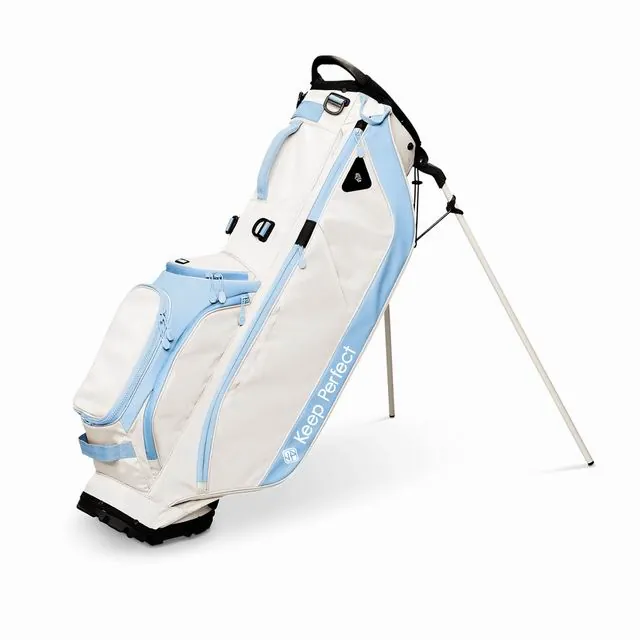
A pro shop is not a small retail chain; it is a membership service desk with 12 square metres of floor, and a bag programme succeeds or fails on whether it fits that reality. The shop needs three or four bags that sell, a crest option nobody else on the property offers, and a replenishment path short enough to cover a member who walks in on a Saturday. Everything else — tiered pricing, assortment ratios, reorder ladders, terms — exists to make those three things repeatable. Colourway minimums run at 200 pieces, trial orders at 100, sampling 6-10 working days, a bulk run of 35-50 days, and lots cleared at 2.5 AQL through ISO 2859-1 sampling.
Related reading: Resort Golf Club Branded Bags: Guest Programme Design
What a Pro Shop Actually Buys
Three buying motives sit behind almost every pro shop bag order, and they behave differently. The first is member identity: a bag carrying the club crest, sold to people who want to be seen carrying it. The second is rental and guest supply: bags that leave the shop and come back, usually numbered and specified for abuse. The third is event inventory: a batch tied to a member-guest day, a captain’s prize or a junior clinic, bought to a date rather than to a plan.
A programme that serves only one motive is a programme that stalls. Member-identity bags sell at full margin but in small quantities; rental bags sell in batches at thin margin but repeat predictably; event bags spike once a year and then sit. The shops that run bag programmes well carry all three, and they differentiate them by specification rather than by price alone.
The floor constraint is the one most suppliers ignore. Twelve square metres of retail space can display maybe six bags on stands plus a rack of eight to twelve folded or boxed units. A programme that ships 40 bags in one colourway will still only show six, and the other 34 sit in the stockroom consuming cash. Assortment design therefore starts with what can be displayed, not with what can be produced.
Staff capability matters too. A pro shop is run by a professional and one or two assistants who also handle tee times, lessons and memberships. Any programme that requires a trained sales conversation about divider count or fabric denier will underperform one that can be sold from a hangtag and a sample board.
Three Programme Tiers, Three Sets of Rules
The cleanest way to structure a pro shop offer is three tiers that differ in what is customised, not only in price. Each tier has a different minimum, a different lead time and a different role on the floor.
| Tier | What is customised | Minimum | Lead time | Role on the floor |
|---|---|---|---|---|
| Stock blank | Nothing; stock colours and trims | 24 units per colour | From stock, 2-3 weeks | Price entry, immediate fill |
| Crest programme | Logo, colourway, trim, pocket layout | 200 per colourway | Sampling 6-10 days, bulk 35-50 days | Member identity, main margin |
| Full custom | New shell, new top, new hardware, new moulds | 500 per model | Sampling 12-15 days, bulk 35-50 days | Differentiation, anniversary and event lines |
The stock blank tier exists to protect cash flow and to give a member something to buy on the day. It is not the margin line. The crest programme is where a shop makes money: 200 pieces in one colourway with a club crest, split across two or three models, is a realistic annual inventory for a 600-member club, and it prices at a level that supports a proper retail margin.
Full custom is used sparingly — a centenary bag, a captain’s bag, a limited line for a signature event. The 500-piece minimum and the mould cost mean it only works when the club is confident of selling through, or when the bag doubles as a sponsorship asset. Shops that attempt full custom at 100 pieces end up paying a per-unit price that cannot be retailed.
A fourth tier is worth mentioning because it is increasingly requested: the crest-only tier. The shop buys a stock bag in a stock colour and applies a crest through embroidery or a patch at a local decorator. It sits between tiers one and two, needs no production minimum, and is a useful bridge for a club that wants identity without inventory risk. Its limitation is that the crest sits on a generic bag, which weakens the differentiation the tier exists to provide.
Assortment: Filling Forty Bags Without Freezing Cash
A 40-bag opening order is the realistic first buy for a mid-sized club, and how it is split decides whether the programme sells through or stalls. The ratio that works most often is 60/30/10: sixty per cent in the two models that will actually sell, thirty per cent in a second colourway of the same models, and ten per cent in a statement piece.
| Slot | Units | Specification | Purpose |
|---|---|---|---|
| Core cart bag, black | 12 | 14-way top, 600D, crest on front pocket | The volume seller |
| Core stand bag, black | 12 | 6-way top, 2.4 kg, crest on side panel | Second volume seller |
| Core stand bag, club colour | 8 | Same build, club colourway, tonal crest | Colour choice for members |
| Core cart bag, club colour | 4 | Same build, club colourway | Colour choice, higher price |
| Statement piece | 4 | Premium shell, contrast trim, embroidered crest | Window and event display |
Two rules keep this honest. First, every slot must be reorderable within the season; a statement piece that cannot be replenished should be bought as a one-off, not as a slot. Second, the colourway split within a model must not exceed two, because three colours of one bag on a twelve-square-metre floor means each colour is represented by two units and none looks like a range.
Matching the mix to the membership
Size and model mix follows the members, not the market. A club with an older membership sells cart bags and larger stand bags; a club next to a walking course sells lighter stand bags and sunday bags. The quickest way to get this wrong is to copy a competitor’s assortment from a different property.
Why a sample board earns its keep
Display is part of the assortment decision. A sample board — six 200 x 200 mm swatches of shell, trim and lining, mounted with the crest — lets a member choose a colourway without the shop carrying every combination in stock. It costs very little to produce and it converts a stock decision into a custom conversation, which is where margin lives.
The wholesale programme overview sets out how these tiers map onto minimums and price bands, and the cart bag OEM specification guide covers the construction choices behind the core slots.
Margin Math From FOB to Shelf
Pro shop programmes fail on arithmetic more often than on product. A landed cost that looks reasonable per unit becomes unretailable once freight, duty, the distributor margin and the shop margin are stacked. The table below is a worked example at three price points, using a 1.28 landed multiplier (freight, duty and clearance) and a two-step channel.
| Line | Entry bag | Core cart bag | Statement bag |
|---|---|---|---|
| FOB Xiamen | USD 26.00 | USD 34.00 | USD 62.00 |
| Landed cost (x1.28) | USD 33.30 | USD 43.50 | USD 79.40 |
| Wholesale to shop (x1.35) | USD 45.00 | USD 58.70 | USD 107.20 |
| Shelf price (x2.05) | USD 92.00 | USD 120.00 | USD 220.00 |
| Shop gross margin | USD 47.00 (51%) | USD 61.30 (51%) | USD 112.80 (51%) |
What the multipliers tell you
Three things follow from that table. The multiplier between FOB and landed cost is not negotiable, so arguing a 40-cent fabric difference is usually worth less than fixing the freight assumption. A 2.05 shelf multiple is what a pro shop needs to carry the cost of a small floor and staff time, which means the FOB ceiling for a bag that must retail under USD 120 is around USD 34. And the statement bag only works if it sells at full price, so it should never be the item discounted in a member sale.
Mixed containers change the arithmetic. A shop that combines bags, accessories, hoods and towels into one shipment spreads the fixed freight and clearance cost across more units, which can move the landed multiplier from 1.28 down towards 1.20. On a 40-bag order that gain outweighs any discount a buyer will negotiate on 40 units.
Thirty per cent goes with the order and the balance against the bill of lading, FOB Xiamen. Clubs that buy through a distributor should ask what the distributor is charging for the same function, because the landed multiplier is where a 5% difference hides.
Crests, Names and Turnaround
A crest is the whole point of a club programme, and the technical constraint is the same one that sinks most club logo projects: crests are detailed, bags are curved, and embroidery at small scale loses detail. A crest with a motto, a shield outline and two figures needs roughly 8,000-14,000 stitches to read at 75 mm; at 50 mm the motto becomes a dotted line.
The practical answers are three. Embroider the crest at 75-90 mm on a flat panel — the front pocket of a cart bag or the side panel of a stand bag — and keep everything else tonal. Use a woven label or a moulded badge where the crest must be small, since both hold fine detail at 45 mm. Or use a single-colour line version of the crest, which reads better at 50 mm than a full-colour rendering and costs less to stitch.
Member names are the second personalisation request and the one that creates operational drag. Names at 7 mm cap height embroidered on a side panel or a valuables pouch run USD 0.80-1.60 each, but the real cost is sequence control: a name must reach the right bag, and a shop cannot accept a batch where two bags are swapped. The workable process is a name list in a fixed column order, one proof set of ten, sequence numbers printed on the bag label, and a 2% blank allowance for late additions.
Turnaround is the constraint that shapes the whole crest programme. Sampling takes 6-10 working days, bulk 35-50 days. A member who orders a named bag in April for a June event is inside the window; a member who orders in May is not, and a shop that promises otherwise ends up air-freighting a single bag. Publish the cut-off date in the shop and treat it as a hard line.
Embroidery placement and stitch density for crests on curved panels are covered in more detail in the staff bag logo and embroidery guide, which applies directly to cart and stand bags as well.
Replenishment Without Overstock
The difference between a programme that runs for five years and one that ends after two orders is the reorder mechanism. A shop that has to place a 200-piece order to restock a single sold bag will stop restocking and let the display empty; a shop that can pull 12 units from a held stock position keeps selling.
The mechanism that works is a stock-hold arrangement: the buyer commits to 200 pieces per colourway, takes delivery in two or three calls, and the balance is held for a defined period. That keeps the production run economic while letting the shop replenish in 12-24 unit increments. The hold period, the storage terms and the expiry date all need to be written down, because an indefinite hold is a liability for both sides.
Where a hold is not possible, the reorder ladder below is the fallback. It prices smaller repeats at a slightly higher unit cost but keeps the display full, which is worth more than the margin difference on 12 units.
| Reorder quantity | Unit price versus first order | Practical lead time |
|---|---|---|
| 12-24 units, from held stock | +0% to +3% | 5-10 days |
| 50 units, repeat run | +4% to +7% | 20-30 days |
| 100 units, repeat run | +2% to +4% | 25-35 days |
| 200 units, full repeat | at first-order price | 35-50 days |
- Sell three tiers, not forty SKUs. Stock blank, crest programme and full custom cover price entry, margin and differentiation without a stockroom full of variants.
- Write the cut-off date on the wall. Named orders need 6-8 weeks; a promise made in week nine costs an air freight on a single bag.
- Hold stock against the balance, not against hope. A defined hold period on 200 pieces is what makes 12-unit replenishment possible.
- Consolidate freight with accessories. Towels, hoods and pouches travel free in cube terms and halve the per-unit freight on a 40-bag order.
- Review sell-through by slot every four weeks. A slot that sells four units in a season should be replaced, not reordered.
Field note. The most common pro shop mistake is buying a colourway the membership did not ask for because it looked good on a sample board. Ask twenty members which of three swatches they would carry before the order is placed. The answer is usually unanimous, and it is usually not the one the buyer preferred.
The pro shop and resort club programme shows how the same ladder is applied where a property runs several shops and a guest rental fleet, and the wholesale pricing guide explains the cost drivers behind each step.
Terms, Freight and the Small-Order Trap
A 40-bag order is a small order in production terms and a normal order in pro shop terms, and the gap between those two views is where most first programmes go wrong. At 40 units, a custom colourway is uneconomic; at 200 units, the shop carries more stock than it can display. The resolution is to separate what must be custom from what must be plentiful.
Logo, trim and pocket layout can be customised at 200 pieces. Shell colour can often be pulled from stock at 40-60 pieces if the buyer accepts a colour already in production. Model and top configuration must be a stock build at small volume. Splitting the order along those lines gives a shop a crest bag at a workable quantity without a bespoke run.
Freight is the second trap. Forty golf bags at 0.18 cubic metres each, boxed, is roughly 9-11 cubic metres, which is a part-load rather than a container. Consolidating with accessories and other shops on the same programme usually halves the per-unit freight; shipping alone typically adds USD 3.50-6.00 per bag depending on destination and season.
Production planning, capacity and inspection records for these programmes sit with a partner founded in 2014, whose team has been in golf bag production since 2004, with dedicated production capacity in Quanzhou, with third-party factory audits available on request covering cutting, moulding and sewing in one location. That matters for a pro shop programme mainly because a single site makes small repeat runs and stock holds practical rather than theoretical.
Launching the Programme in Ninety Days
A club that decides in January can have bags on the floor before the season starts, provided the sequence below is respected. Compressing it usually means compressing the wrong step.
- Weeks 1-2: fix the assortment. Choose the slots, the models and the colourways against the display space, and decide the price band from the shelf multiple rather than from the FOB price.
- Weeks 2-3: collect the crest artwork in vector form. One-colour and full-colour versions, plus a 45 mm small-size version for badges and labels. Crest files supplied as a photograph add a week.
- Weeks 3-4: approve sampling. 6-10 working days on stock fabric with a custom crest; 12-15 if a new badge mould or trim colour is needed. Approve under daylight, not showroom light.
- Week 4: place the order and the deposit. 200 pieces per colourway for the crest tier, with the delivery split agreed at the same time as the price.
- Weeks 5-11: bulk production. 35-50 days from approval of the signed sample, with the first delivery scheduled to land two weeks before the first event that needs it.
- Week 11: floor set. Sample board, hangtags, staff briefing on the three tiers, and a printed cut-off date for named orders.
- Week 12 onwards: reorder discipline. Review sell-through by slot every four weeks and reorder against the ladder before a slot empties.
Two details decide whether the launch feels professional. The first is the hangtag: a printed card with the club crest, the model name and a short construction line sells better than a bare bag with a swing tag. The second is staff knowledge — one page listing what each tier includes and what it costs is enough, provided every person on the floor has read it.
For clubs that run a junior academy or a coaching programme alongside the shop, the same tier structure applies with a lighter bag and a school crest; the academy and team uniform programme covers the sizing and numbering differences that come with it.
Related reading: Golf Academy Team Bulk Bags: Uniform Programme Design
Next steps: custom solutions, manufacturing capability, and a quotation request. Wholesale Programme. Private Label Golf Bags.
Sources and Standards Referenced
- ISO 2859-1:2022 Sampling procedures for inspection by attributes
- ISO 9001 Quality management systems
- ASTM D5034 Breaking strength and elongation of textile fabrics (grab test)
- ECHA REACH regulation on restricted substances in textile articles
- USGA Rules of Golf, equipment and club rules hub
Frequently Asked Questions
What is the minimum order for club-crested golf bags?
Two hundred pieces per colourway on the crest programme, which is the level at which logo setup, trim colour and changeover no longer dominate the unit price. A trial of 100 is workable on stock shells with a stock trim colour. A fully bespoke model with new tooling starts at 500 pieces.
How many bags should a pro shop stock at opening?
About 40 units for a mid-sized club, split roughly 60/30/10 across two volume models, a second colourway and a statement piece. The limit is display space rather than capital: twelve square metres shows about six bags, so a large single-colourway order simply moves cash into the stockroom.
What margin does a pro shop need on a golf bag?
A shelf multiple of about 2.05 on landed cost, which yields roughly 51% gross margin. With a 1.28 landed multiplier for freight, duty and clearance, that puts the FOB ceiling at around USD 34 for a bag that must retail under USD 120.
How long does a crest programme take from artwork to floor?
About twelve weeks end to end. A crest sample needs 6-10 working days on stock fabric, the bulk run 35-50 days after approval, and freight and floor set add two to three weeks. A new badge mould or trim colour adds 12-15 days to proofing.
Can a club crest be embroidered small enough for a bag pocket?
A detailed crest needs 75-90 mm to read well in embroidery, at roughly 8,000-14,000 stitches. Below 50 mm the motto and fine outlines break up, so either use a woven label or moulded badge, or redraw the crest as a single-colour line version.
How are member names handled on custom bags?
Names are stitched from 7 mm cap height upward, at USD 0.80-1.60 each. The operational risk is sequence control, so use a fixed-format name list, a ten-name proof set, sequence numbers on the bag labels and a 2% blank allowance for late additions.
What are typical payment terms for a pro shop programme?
Thirty per cent with the order, the balance against the bill of lading, FOB Xiamen. A stock-hold arrangement for the balance of a 200-piece run is common, with a defined hold period and expiry date written into the order confirmation.
How can a shop reorder fewer than 200 pieces?
Through a stock hold on the balance of the original run, which typically allows 12-24 unit pulls at zero to 3% above first-order price with a 5-10 day lead time. Without a hold, a 50-unit repeat runs 4-7% higher and takes 20-30 days.
Does a small order need its own container?
No. Forty boxed bags occupy roughly 9-11 cubic metres, which is a part-load. Consolidating with accessories and other shops on the same programme usually halves the per-unit freight, and that saving outweighs whatever the shop could win back on unit price.
What inspection standard applies to pro shop bag orders?
ISO 2859-1 at level II and a 2.5 AQL: 32 pieces drawn from each 200 with an acceptance number of two major defects, and the checks cover crest position and stitch count, colour against the approved swatch, top and divider geometry, and zip and hardware function.
Is a sample board worth producing?
Yes for any programme with more than one colourway. Six 200 x 200 mm swatches of shell, trim and lining with the crest mounted cost little to produce and let a member choose a colourway without the shop holding every combination in stock.
Can a club use its crest without extra permission?
Only if the club owns the mark, which it usually does for its own crest. Where the bag carries a third-party brand, a sponsor mark or a tournament logo, written permission from the mark owner is needed before artwork is released to production.
Build My Pro Shop Programme
Send your member count, floor space and crest files, and we will propose three tiers with a landed-cost model and a dated reorder ladder.
Request a Programme Proposal See Wholesale Terms