Corporate Golf Day Bags: Logo Printing Buying Guide
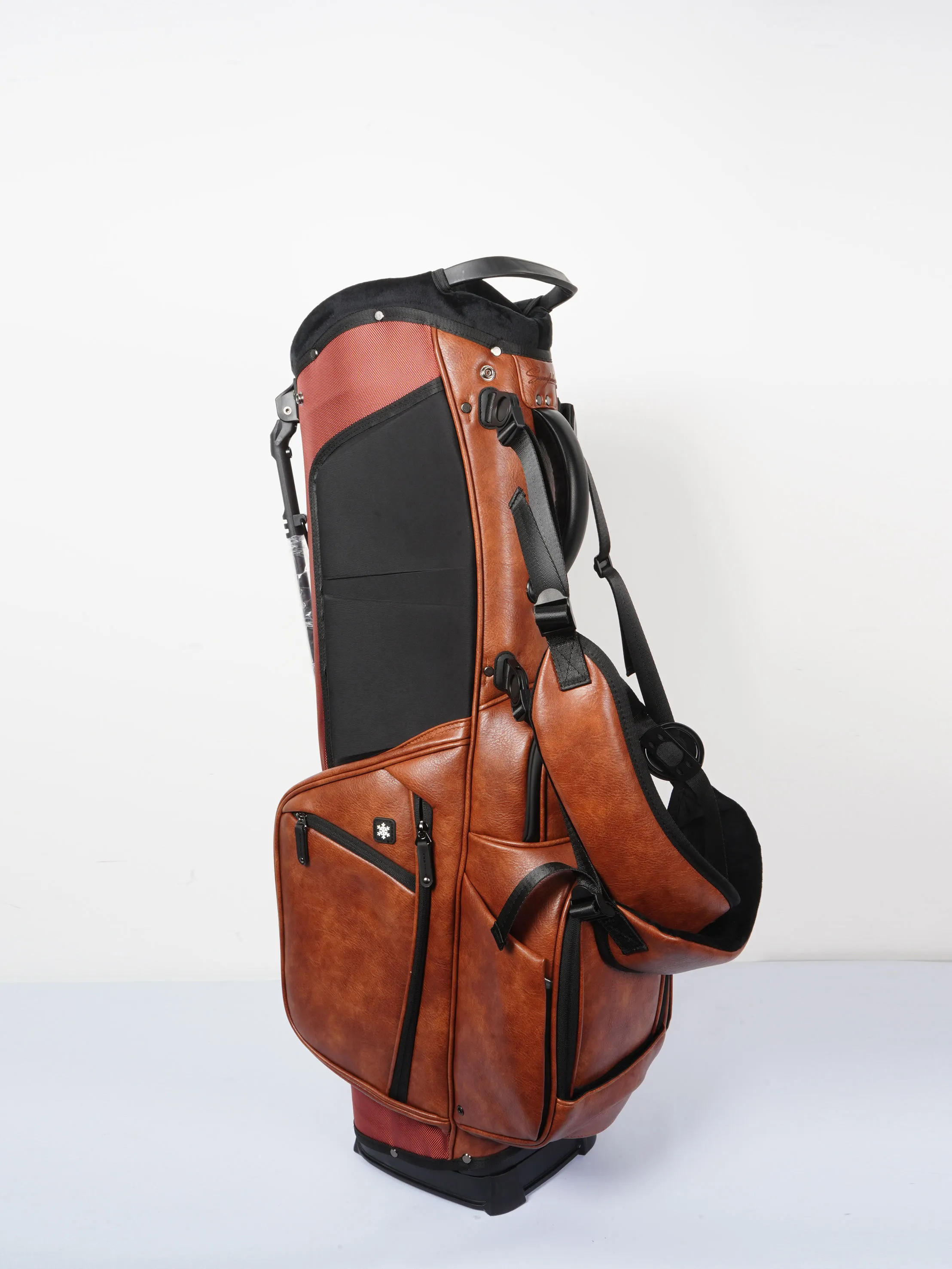
Corporate golf day bags fail at the logo far more often than at the bag, and the decision that causes the failure is usually made in the artwork file rather than on the machine. A marketing team approves a colour-accurate PDF, the file reaches a print room that works in screens and stitch counts, and the gap between those two worlds is where thin type fills in, a dark mark vanishes on a dark panel and a brand colour drifts two shades on textured polyester. Everything below is written from the production side of that gap: print areas measured in millimetres, setup cost per colour, what a textile colour reference actually controls, and how to prove a mark before 200 bags are committed. Typical terms for a corporate run: 200 units a colourway, 100 on trial, sampling 6-10 working days, bulk 35-50 days from sign-off, T/T 30/70, FOB Xiamen.
Related reading: Golf Tournament Prize Bags: OEM Sourcing Guide
Related reading: Custom Golf Bags: Best Options for Business Gifts
Where a Corporate Logo Can Actually Go on a Golf Bag
Every panel on a golf bag looks printable and only five of them are. The constraint is not the print process, it is curvature, seam allowance, abrasion and the way the bag folds when it is carried. A logo placed on a curved seam will lift at the edges; a logo placed where a cart strap crosses it will abrade within a season; a logo placed on the base skirt is invisible in every photograph the sponsor will ever receive.
| Zone | Usable area (mm) | Best method | Constraint to respect |
|---|---|---|---|
| Front lower panel, cart bag | 200 x 100 | Screen print or embroidery | Keep 15 mm clear of the base seam |
| Ball pocket, stand bag | 110 x 60 | Embroidery | Pocket must stay functional when full |
| Top collar band | Height 12-18 | Woven label or transfer | Curvature; no embroidery above 8 mm cap height |
| Side panel | 130 x 90 | Screen print or transfer | Avoid the leg hinge by 40 mm on stand bags |
| Shoulder strap pad | 90 x 40 | Woven label or silicone | Contact abrasion; must survive 500 rub cycles |
The front lower panel is the primary zone for one reason: it faces the camera in a group photograph and it sits flat against a cart, so it takes no load. Everything else is secondary placement. When a brief asks for the logo on four zones, the honest answer is that the fourth zone will be seen by almost nobody and will add 12-18 per cent to the logo cost.
Two zones should be refused outright. The base skirt abrades on every cart and every path. The rain hood is a separate component, frequently lost, and printing it means printing a part that the buyer will reorder without the bag.
Print Methods Ranked by Durability and Setup Cost
Screen print
Screen print lays a plastisol or water-based ink through a mesh and is the workhorse for large, flat, one-to-three colour marks. Plastisol holds saturation on dark 600D and 1680D and resists abrasion better than water-based ink, at the cost of a slightly raised, stiffer hand. Resolution is limited by mesh count: type below 6 mm cap height with serifs will fill in, and a 1 pt rule will disappear. Each colour needs a screen, and a white underbase on a dark bag counts as a colour because it is a separate print pass.
A four-colour mark on a dark bag is therefore five passes: underbase plus four. That is where a corporate brief with a full-colour crest and a strapline starts to look expensive per unit at 200 pieces, and where converting the mark to one-colour silhouette for the bag and keeping full colour for the hangtag is the sensible compromise.
Embroidery
Embroidery is the method corporate buyers default to because it reads as a textile treatment rather than an applied sticker, and because it holds up to washing, sun and cart abrasion. The limits are detail and density. Below 6 mm cap height, letters lose their counters; gradients cannot be reproduced; and a stitch field denser than the fabric can support will pucker the panel.
A typical corporate mark runs 6,000-10,000 stitches and 3-5 minutes of machine time, adding USD 1.20-2.60 a unit on a 200-piece run, plus a one-time digitising fee of USD 25-60. Capping the thread palette at four colours keeps the machine stops down; a nine-colour crest will run two to three times longer and cost accordingly.
Heat transfer, silicone and moulded parts
Heat transfer carries fine detail, gradients and photographic elements in a single pass at low setup, typically USD 60-120 for a transfer die. On textured fabric the bond is the weak point, so specify a grade rated for the substrate and include an abrasion check. Silicone or high-density print gives a raised, soft-touch mark at 0.6-1.2 mm relief with tooling around USD 120-350, which suits a modern one-colour wordmark. A moulded PVC or TPU badge with tooling at USD 250-600 is worth it only when the same part returns across seasons.
| Method | Setup (USD) | Unit add at 200 pcs (USD) | Detail floor | Durability on 600D |
|---|---|---|---|---|
| Screen print, 1 colour | 45-90 | 0.40-0.90 | 6 mm cap height | High, best on flat panels |
| Screen print, 4 colours + underbase | 225-450 | 1.10-2.20 | 8 mm, no fine serifs | High |
| Embroidery | 25-60 digitising | 1.20-2.60 | 6 mm, no gradients | Very high |
| Heat transfer | 60-120 | 0.55-1.20 | 2 mm text possible | Medium on textured fabric |
| Silicone print | 120-350 | 0.90-1.80 | 3 mm | High, soft touch |
| Woven label | 40-80 | 0.08-0.15 plus sewing | 1.5 mm | Very high, sewn on |
Matching a Brand Colour on Fabric
A brand guideline gives a coated or uncoated paper reference. Fabric is neither. Polyester is dyed, not painted, and ink printed on top of a textured woven surface reflects light differently from a flat paper swatch. The result is that a mark matched numerically to a paper reference can still look wrong on a bag, and a mark matched visually on a desk can look wrong on a course in daylight.
The workable protocol is to convert the paper reference to a textile reference in the same family, ask for a physical strike-off printed on the actual base fabric, and judge it outdoors at midday rather than under office lighting. Set the acceptance tolerance in writing: 1.5 on the standard colour-difference scale is a normal target, and 2.0 is realistic on a textured dark substrate where the ink sits in the weave valleys.
Where the brand colour is a light tone on a dark bag, the ink needs an underbase, which changes the shade subtly and adds a pass. Where the brand colour is a metallic, a printed approximation will always read flat; a silicone or moulded element is the only honest route and should be budgeted as such.
Spec tip on colour approval. Approve the strike-off outdoors and keep the signed physical sample. A colour approved on a monitor cannot be defended at inspection, and a colour approved on a physical swatch can be matched against every subsequent lot without argument.
Artwork Files and What the Print Room Needs
The single most common cause of a reprint on a corporate order is an artwork file that cannot be separated. Marketing teams work in RGB, in raster, with effects and gradients. A screen room works in spot colours, vectors and pass counts. Bridging that gap before the file reaches the press is a fifteen-minute conversation and a five-day delay avoided.
- Vector, not raster. Outlined type, no live fonts, no drop shadows unless the shadow is being produced as a separate spot colour.
- Spot colours named to a reference, with the textile equivalent stated, plus a one-colour silhouette version for the cheap tier.
- A placement drawing with dimensions taken off a fixed datum, print area marked, 15 mm seam clearance shown.
- Minimum feature sizes stated: 6 mm cap height and 0.4 mm positive line weight for screen, 6 mm and 0.8 mm for embroidery.
- A dark and a light version of the mark, because one of them will be applied to a panel that inverts the contrast.
Ask the print room to send back a marked-up proof showing exactly what will happen to the smallest element. If the answer is that the strapline becomes a solid bar, that is a design decision the marketing team should make, not something discovered on the first article.
Setup Charges and the Cost of Adding a Colour
Setup is a one-time charge per order, not per bag, and it is the line corporate buyers most often forget when comparing quotes. A supplier quoting USD 0.70 per bag for a one-colour mark and USD 1.60 for a four-colour mark is not being inconsistent; the second quote contains three more screens worth USD 45-90 each and three more print passes.
The arithmetic that matters is the break-even point. At 200 pieces, a four-colour mark at USD 1.60 adds USD 320 plus USD 300 of setup, roughly USD 3.10 per bag all in. At 1,000 pieces the same setup spreads to USD 0.30 per bag and the total falls to under USD 2.00. Colour count is therefore a volume decision: two colours below 300 pieces, four colours above 600, and full colour only where the artwork genuinely needs it.
Repeat orders should not carry setup again, provided the screens or the digitised file are retained. Ask explicitly whether setup is charged on reorders and whether the screens are kept. A supplier that re-charges screens on a repeat of the same artwork is charging for storage it is not providing.
One more line to check: colour-matching charges. Some quotes include a strike-off, some add USD 60-120 for it, and some treat it as free until a second round is needed. Get it in writing, because a brand colour that needs three rounds of matching will consume more time than the printing itself.
Proving the Logo Before Bulk
A corporate logo has three approval gates and skipping any one of them moves the discovery to the pallet. The sequence below is what a well-run order looks like from the marketing side.
- Artwork check, 2-3 days. The print room marks up the file for minimum feature sizes and returns a separation list.
- Digital visual, 1-2 days. A flat mock-up on the actual panel shape and colour, used for internal sign-off only, never for colour approval.
- Physical strike-off or sew-out, 5-7 days. The mark applied to the actual base fabric, in the actual ink or thread, at the actual size.
- Pre-production sample, 6-10 working days. One or two complete bags with the mark in place, which is also the point at which placement, stitch density and hardware colour are signed off.
- Signed golden sample. The approved physical bag is retained by both sides and becomes the reference for inspection, so that every later argument is settled by an object rather than a memory.
The pre-production sample is not a formality. It is the only stage where placement, panel distortion and contrast are visible together on a finished bag, and it is far cheaper to change a placement by 10 mm on a sample than to argue about it across 200 units.
This proofing sequence is the one QUANZHOU JUNYUAN BAGS has used since 2014, tightened by a team that has been marking bags since 2004, and each gate exists because skipping it has produced a reprint at some point in that history.
Colour fastness deserves a line in the approval record. A printed mark that shifts under ultraviolet light will look different after a summer in a car boot, so where the bag is a light colour with a dark mark, ask for a light-fastness check to ISO 105-B02 and record the result with the golden sample.
Timing a Corporate Order Against the Event Calendar
Corporate golf days are dated events with fixed sponsorship obligations, and the order is usually placed by a marketing coordinator whose internal approval chain is longer than the production schedule. Planning the calendar backwards from the event is what keeps the two from colliding.
| Stage | Working days | Who owns it |
|---|---|---|
| Artwork preparation and brand approval | 5-10 | Marketing and print room |
| Strike-off or sew-out approval | 5-7 | Marketing |
| Pre-production sample | 6-10 | Production and buyer |
| Bulk production | 35-50 | Production |
| Inspection and packing | 3-5 | Quality team |
| Ocean freight and clearance | 25-40 | Freight forwarder |
Total elapsed time from artwork release to bags on site is normally 11-16 weeks by sea, and 7-9 weeks if the shipment flies. That is the number to put in front of a marketing director, because it is the one that determines whether a spring event is feasible for an order raised in January.
Where the calendar is already tight, the levers in order of effectiveness are: reduce colour count to cut print passes, move to a stock bag colourway so no fabric is dyed, print the mark on a woven label that can be sewn onto stock bags, and split the shipment so the first 50 units fly and the remainder follows.
Logo Failures That Appear After the Event
Most logo defects are invisible at handover and obvious three months later, which is exactly when a sponsor is deciding whether to renew. The five patterns below account for the majority of complaints.
- Edge lift on transfers, caused by a grade chosen for smooth nylon being applied to textured polyester. The fix is substrate-specific specification plus a rub check.
- Fill-in on small type, caused by a mesh count that cannot hold the detail. The fix is a redrawn mark for the bag, not a smaller version of the paper logo.
- Puckering around dense embroidery, caused by missing backing or a stitch count pushed beyond the weave. The fix is backing plus a density reduction of 10-15 per cent.
- Colour drift between print and trim, where the ink and the piping are matched to different references. The fix is one reference and one approval for both.
- Abrasion at the strap pad, where a sewn label or silicone element takes constant contact. The fix is a higher-density element, or moving the mark off the contact zone entirely.
Inspection catches the ones that are visible on the line: placement held to 3 mm, stitch counts of 9-11 to the inch on seams carrying load, hardware colour matched to trim, and print edges free of bleed. That check runs at AQL 2.5 on the ISO 2859-1 level II tables, so 32 pieces come out of a 200-piece lot and 2 majors are the acceptance number. Panel strength behind the mark comes off the grab test in ASTM D5034, with 250 N as the floor.
The wider question of which zones, pockets and hardware to specify sits in the branded cart bag design guide, and the choice between marking routes is covered in more depth in the logo method comparison. Both are worth reading before the artwork is finalised, because the cheapest change in this whole process is the one made in a file.
Next steps: custom solutions, manufacturing capability, and a quotation request. Corporate golf gifting. Private label programme.
Sources and Standards Referenced
- ISO 105-B02 Colour fastness to artificial light
- ISO 2859-1:2022 Sampling procedures for inspection by attributes
- ASTM D5034 Breaking strength and elongation of textile fabrics (grab test)
- ASTM D2261 Tearing strength of fabrics (tongue method)
- ISO 9001 Quality management systems
Frequently Asked Questions
How big can a corporate logo be on a golf bag?
On a cart bag the front lower panel takes about 200 x 100 mm with 15 mm clear of the base seam. A stand bag ball pocket holds roughly 110 x 60 mm, a side panel 130 x 90 mm, and a top collar band only 12-18 mm of height. Anything larger wraps around a curve and lifts.
Is embroidery or screen print better for a corporate logo?
Embroidery for smaller marks on fabric panels, because it survives abrasion and washing and reads as a premium textile treatment. Screen print for larger graphics, flat colour blocks and marks that need to be visible from several metres. Many corporate programmes use embroidery on the pocket and print on the front panel.
What does logo setup cost?
Screen setup runs USD 45-90 per colour, and a white underbase on a dark bag counts as an extra colour. Embroidery digitising is USD 25-60 per mark. Heat transfer dies are USD 60-120, silicone tooling USD 120-350, and a moulded badge USD 250-600. Setup is charged once, not per bag.
How many colours can a bag logo have?
Technically eight or more, commercially two to four. Adding a colour adds a screen, a print pass and USD 45-90 of setup, so at 200 pieces a four-colour mark costs about USD 3.10 per bag all in. Below 300 pieces, two colours is usually the sensible ceiling.
Can you match our exact Pantone colour on fabric?
Closely, not exactly. Paper references are converted to a textile reference, then printed on the actual base fabric and judged outdoors. A reading of 1.5 on the standard colour-difference scale is a normal target; 2.0 is realistic on textured dark polyester where ink sits in the weave.
Why does small text disappear when printed on a bag?
Mesh count limits resolution. Below 6 mm cap height, serif type and thin rules fill in with ink, and the same applies to embroidery, where letters below 6 mm lose their counters. The fix is a redrawn version of the mark for the bag, not a scaled-down copy of the paper logo.
What is a pre-production sample and do we need one?
A complete bag with the logo applied in the final position and method, produced in 6-10 working days. It is the only stage where placement, panel distortion and contrast are visible together, and both sides keep the approved piece as the inspection reference.
How long does a corporate golf day order take?
Eleven to sixteen weeks from artwork release to bags on site by sea: 5-10 days of artwork approval, 5-7 days of strike-off, 6-10 days of sampling, 35-50 days of bulk, 3-5 days of inspection and 25-40 days of freight. Air freight brings the total to 7-9 weeks.
What artwork file format should we send?
Vector with outlined type, spot colours named to a reference, and no live effects. Include a dimensioned placement drawing and both a dark and a light version of the mark. Raster files and RGB screenshots force the print room to rebuild the artwork, which adds days and risk.
Will the logo come off in a car boot or in the rain?
A correctly specified print or embroidery will not. Transfers are the exception: a grade chosen for smooth nylon applied to textured polyester lifts at the edges within a season. Specify the substrate, ask for a rub check, and prefer sewing or silicone where the mark sits in a contact zone.
Do you re-charge setup on repeat orders?
Not where the screens, transfer die or digitised file are retained, and retention should be written into the order. Ask explicitly before the first order, because a supplier that charges screens again for identical artwork is charging for storage it is not providing.
Can the logo go on the strap or the rain hood?
Both are possible and both are poor value. The strap pad takes constant contact abrasion and needs a dense label or silicone element. The rain hood is a separate part that gets lost and reordered without the bag, so a printed hood doubles the artwork work for a component nobody photographs.
Send Artwork for Review
Share the vector file and the intended placement, and a marked-up proof with separation counts and a per-unit logo cost comes back in two working days.
Submit Artwork See Branding Options