Branded Golf Bags as Corporate Gifts: ROI Analysis
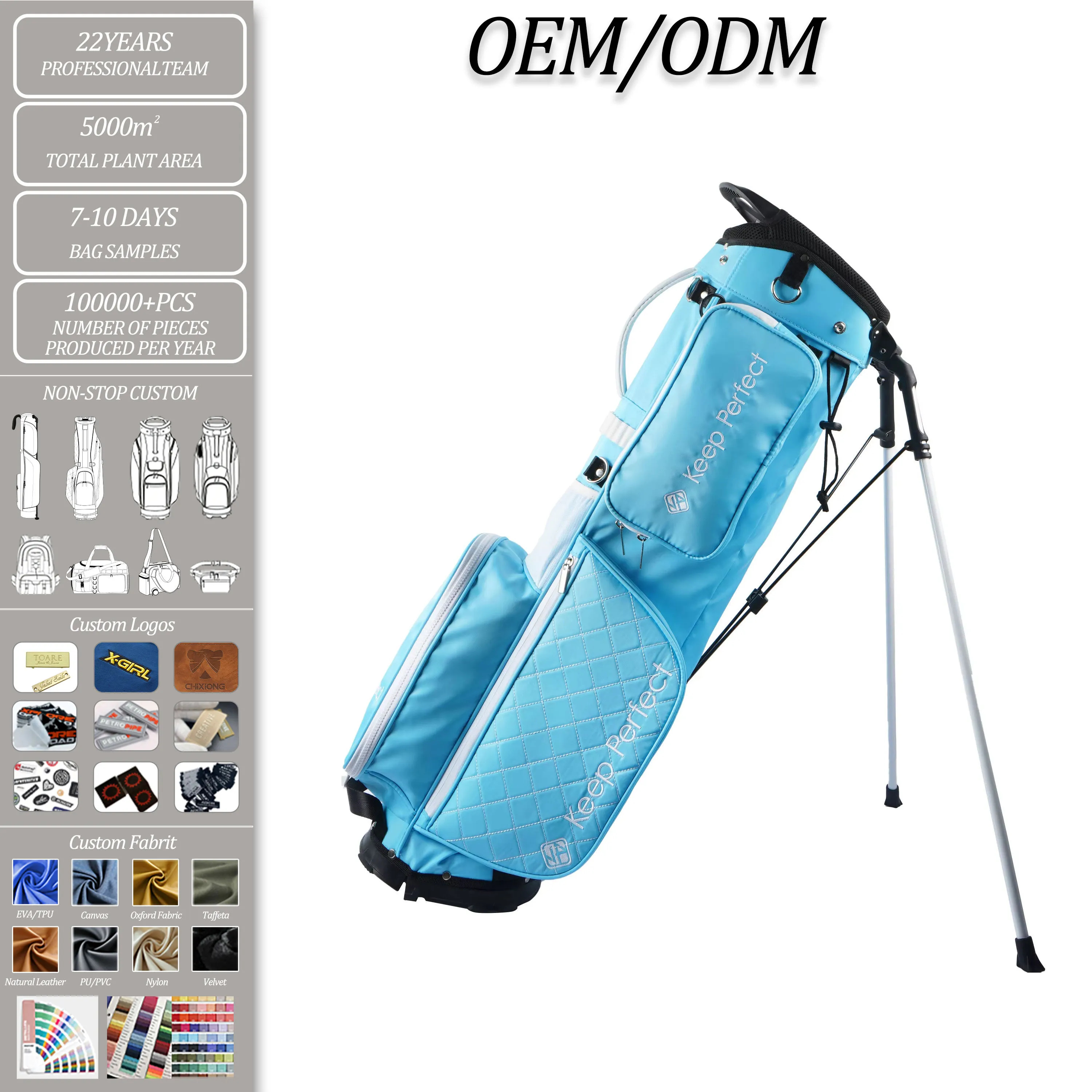
A branded golf bag pays back in rounds played, not in leads captured, so the defensible model is cost per use across the life of the bag rather than a headline return multiple. On the programmes we quote, a six-way stand bag sits at roughly USD 34-46 FOB Xiamen before logo, packaging and freight, and 200 pieces per colourway is the practical unit for a corporate run. Carried across a modelled four seasons at twenty rounds a year, that lands near USD 0.50-0.73 per round, which is the figure worth putting beside a cap, a polo or an umbrella. Sampling runs 6-10 working days, a signed sample releases 35-50 days of production, and every lot is judged at AQL 2.5, ISO 2859-1.
Related reading: Corporate Golf Gifts: Custom Options for Business Gifts
Related reading: Tournament Prize Bags: OEM Sourcing Guide
The ROI Question, Reframed for a Physical Gift
Every gifting proposal arrives with an implied return, and almost none of them survive contact with a spreadsheet. A bag does not generate revenue the way a display unit or a trade-show stand does. What it generates is repeated, low-cost exposure to a narrow audience that already shares the interests of the buyer, and that exposure can be costed honestly once the assumptions are written down and labelled as assumptions. The framework below does exactly that, and it deliberately refuses to dress a planning figure up as a measured media value.
Three variables drive the whole calculation: the landed cost of one bag, the number of rounds a recipient plays in a year, and the number of years the bag stays in service. Two of those the buyer controls through specification. The third is an estimate that should be challenged rather than accepted. Get the landed cost right and the rest of the model becomes a sensitivity exercise instead of an argument about whose intuition is better.
There is also a second-order effect that never appears in the spreadsheet. A bag that survives four seasons keeps the mark in circulation and quietly signals that the brand behind it buys well. A bag that splits a seam in the second month does the opposite, and it does it in front of exactly the audience the gift was meant to reach. Durability is therefore not a quality nicety in this category; it is the return mechanism itself.
Building the Cost Side Before the Story
Landed cost is where gifting budgets go wrong, because quotations are habitually compared at the FOB line and nowhere else. Five lines belong in the comparison: bag cost, marking, presentation, freight and clearance, and duty at the rate in force on the date of entry. The last two move independently of the bag, and together they can swing a landed figure by more than the gap between two suppliers.
| Cost line (USD per unit) | Stand bag, 6-way | Cart bag, 14-way | Sunday bag |
|---|---|---|---|
| FOB Xiamen, 200 pieces | 34-46 | 48-72 | 14-22 |
| Embroidery, 8,000-12,000 stitches | 1.20-2.60 | 1.20-2.60 | 1.20-2.60 |
| Printed sleeve and hangtag | 0.70-1.40 | 0.70-1.40 | 0.70-1.40 |
| Ocean freight and clearance, LCL | 4-8 | 4-8 | 3-6 |
| Indicative landed cost | 40-58 | 54-84 | 19-32 |
Duty is left out of the table on purpose. Rates on the heading that covers golf bags have moved more than once in recent years, and a figure copied from an old quotation is worse than no figure at all. Ask a licensed customs broker for the rate that applies on the planned date of entry. An eight percentage point swing on a USD 49 bag is roughly USD 3.90 per unit, which is enough to move the cost per round by a visible margin. Buyers running a mixed programme of bags and smaller items can see how the whole basket is costed on the corporate gifting page.
Marking and presentation are small lines that behave like fixed costs. An embroidered mark of 8,000-12,000 stitches runs USD 1.20-2.60 at 200 pieces, and the one-time digitising fee of USD 60-120 is worth paying properly the first time rather than twice cheaply. A sleeve and a numbered hangtag add USD 0.70-1.40 and are the cheapest way to make a USD 40 bag read as a deliberate gift rather than surplus stock. Neither changes what the bag does. Both change how it is received.
Usage Assumptions That Decide the Answer
The usage side of the model needs five inputs, and every one should be carried as a range with a stated source. If a supplier or an agency hands over a single confident number for any of them, ask where it came from.
- Rounds per year. 15-30 for a regular club player, 8-15 for a corporate recipient who plays a handful of society days. Model the lower figure first and see whether the case still holds.
- Years in service. 3-5 for a 600D stand or cart bag in normal use, 2-3 for a lightweight Sunday bag kept as a travel spare.
- Players per round. A four-ball plus the group ahead and behind puts the bag in front of 3-12 people per round, most of whom sit inside the target audience by definition.
- Exposure per round. Four to five hours of close proximity, against minutes for a cap or a polo shirt.
- Attrition. Assume 10-20% of gifted bags leave circulation each year through loss, damage or resale, and reduce the round count before dividing.
Run the sensitivity before committing. Doubling the rounds assumption halves the cost per round, which means a model built on optimistic usage will always flatter the order. Cutting the service life in half does more damage than any price negotiation, because a bag that fails in year two removes every round that would have followed it.
Cost Per Use Across the Gifts Buyers Actually Compare
The table below places a golf bag beside the four items that most often appear in the same gifting discussion. Figures are landed costs at 200-500 pieces in the bands used above, with the usage assumptions from the previous section applied consistently. They are planning estimates, not measured values, and should be replaced with your own recipient data as soon as you have any.
| Gift | Landed cost (USD) | Uses per year | Years | Cost per use (USD) | Exposure per use |
|---|---|---|---|---|---|
| Cap | 6-9 | 40 | 2 | 0.08-0.11 | Minutes, worn |
| Polo shirt | 20-28 | 25 | 1.5 | 0.53-0.75 | Hours, worn |
| Umbrella | 15-22 | 12 | 2 | 0.62-0.92 | Hours, rain only |
| Cooler bag | 18-26 | 15 | 3 | 0.40-0.58 | Hours, at the turn |
| Stand bag, 6-way | 40-58 | 20 | 4 | 0.50-0.73 | 4-5 hours per round |
| Travel cover | 55-80 | 3 | 5 | 3.70-5.30 | Hours at airports |
Read the last column before the fifth. A cap wins on cost per use by a wide margin and loses on everything else. It is seen in passing, it is worn by people who already know the brand, and it rarely survives two seasons of regular play. A travel cover loses badly on cost per use and still earns its place, because the exposure happens in airport queues and at the carousel in front of an audience that is unusually receptive to a golf brand.
The bag sits in the middle on both measures, which is why it works as the anchor of a programme rather than the whole of it. Pairing a bag for the top tier with caps, towels or ball markers for the wider list usually produces a better blended cost per impression than any single item bought at volume, and it keeps the headline gift feeling like a headline gift.
Four Levers That Move the Number
Cost per use responds to four decisions, and none of them requires a larger budget.
Match the format to the recipient list
A cart bag gifted to a walking member is a bag that lives in a garage. A Sunday bag gifted to someone who plays twice a week is under-built for the load. Format should follow the list: cart bags for trolley players and club officials, six or seven-way stand bags for regular walkers, pencil or Sunday bags for high-count event giveaways where the relationship is lighter.
Spend on what is loaded in use
Money spent on the base plate, the top collar and the leg hinge returns more than money spent on decoration. A 90-130 g moulded HDPE base resists the abrasion that kills bags on trolley frames. A reinforced hinge block survives the 4,000-6,000 open and close cycles a regular player will put through a stand mechanism across four seasons. Both are invisible in a photograph and both stretch the years variable in the model.
Keep the mark small, legible and honest
A 60-80 mm embroidered mark on the front lower panel, placed 20-35 mm above the base seam, reads at conversational distance and survives abrasion, washing and sun. A full-panel print costs more, dates faster and turns the object into an advertisement, which is the quickest way to have a premium gift left behind in a hotel room.
The fourth lever is order structure rather than design: one platform with several colourways instead of three unrelated models. A shared shell and hardware set keeps tooling and sampling costs down and lets a single 200-piece run cover more than one audience. The arithmetic behind that choice sits in the wholesale pricing guide.
A Worked Example at 200 Pieces
Three configurations, each at 200 pieces, with landed cost taken at the midpoint of the bands above and the conservative usage assumptions applied. The point of the table is not the absolute figures. It is how little separates them.
| Configuration | Landed per unit (USD) | Total spend (USD) | Rounds delivered (modelled) | Cost per round (USD) |
|---|---|---|---|---|
| Sunday bag, 12 rounds a year for 3 years | 24 | 4,800 | 7,200 | 0.67 |
| Stand bag, 20 rounds a year for 4 years | 49 | 9,800 | 16,000 | 0.61 |
| Cart bag, 24 rounds a year for 5 years | 69 | 13,800 | 24,000 | 0.58 |
The three land within about 15% of each other on cost per round, and the cheapest option is not the best one. What the table cannot show is that the Sunday bag is the least likely of the three to still be in a recipients hands in year three, so its 7,200-round figure is the most optimistic line in the table. Apply a realistic attrition rate and the gap widens in favour of the better-built bag.
The other thing the table makes plain is scale. A 200-piece order that delivers 16,000 rounds is a rounding error against a media buy and a serious number against a gifting budget. That is the correct frame for the decision, and it is the reason a gifting programme should be argued in rounds rather than in unit price.
One line is missing from that table and it matters more than it looks: the cost of holding the bags. A 200-piece run delivered in one shipment has to be stored somewhere until the gifting date, and a bag in a warehouse is capital that is not working. Spreading the release across two shipments costs a second set of freight and inspection charges, but it usually beats renting storage and it removes the risk of a pallet being damaged before the event. Where the gifting date sits more than ten weeks after production, ask for a split release and price both options before choosing.
Measuring Whether It Worked
Measurement in gifting is usually skipped because the obvious metrics look unavailable. They are not unavailable, they are merely unglamorous. Five signals can be collected without surveying anybody twice.
- Redemption on a paired offer. A card in the sleeve with a code for a fitting, a lesson or a club event produces a countable response at almost no added cost.
- Photo and tag participation. Ask recipients to post a picture with a campaign tag and count participation per hundred bags rather than absolute reach.
- Repeat order behaviour. Compare account activity in the twelve months after gifting against the twelve months before, on the same account list.
- Field failure reports. Track warranty contacts per hundred bags. Anything above 2% is a specification signal rather than a customer service problem.
- Recipient interviews. Ten conversations with people who received the bag will say more about perceived value than any dashboard.
Take the baseline before the order ships, not afterwards. A baseline collected later is always contaminated by hindsight, and the comparison that matters is between the list that received a bag and a comparable list that did not.
Field note. The most useful single number in a gifting programme is the field failure rate per hundred bags. It is the only measure that tells you whether the object is still doing its job in month eighteen, and it doubles as an early warning on the line, because a gifting run and a retail run share the same construction and the same inspection standard.
Where the Model Breaks
Four patterns account for most disappointing gifting orders. The first is gifting a bag to people who do not play, which caps rounds near zero no matter how good the bag is. The second is buying at the bottom of the price band for an audience that will notice the difference, which trades a durable object for a disposable one and deletes the durability term from the calculation entirely.
The third is timing. Production takes 35-50 days from the signed sample, and the sample itself needs 6-10 working days before that, with ocean freight adding several weeks depending on routing. A programme that starts eight weeks before a December event will either fly the order at three to six times the sea cost or accept a January delivery, and neither outcome appears in the original model.
The fourth is over-specification in the wrong place: a 5,000 mm shell with sealed seams on a bag destined for a dry-climate list, when the same money would have bought a stronger base and a better hinge. Specification should follow the recipient and the climate. The custom solutions route exists to rebalance those choices before tooling is cut, which is far cheaper than rebalancing them after the first sample arrives.
Put the event date, the recipient profile and the landed-cost target into one message, and what usually comes back is two workable configurations with a cost per round attached to each. That is a better starting point than a beautiful brief with no arithmetic behind it. The company behind this site has produced bags since 2014, with a founding group that has been in bag production since 2004 and a sourcing desk in Quanzhou quoting against dedicated production capacity, open to third-party audits on request.
Next steps: custom solutions, manufacturing capability, and a quotation request. Corporate golf gifting. Wholesale programme overview.
Sources and Standards Referenced
- ISO 2859-1:2022 Sampling procedures for inspection by attributes
- ASTM D5034 Breaking strength and elongation of textile fabrics (grab test)
- ASTM D2261 Tearing strength of fabrics (tongue method)
- ISO 105-B02 Colour fastness to artificial light
- USGA Equipment Rules, equipment standards and conformance
Frequently Asked Questions
How do you calculate ROI on a branded golf bag?
Divide landed cost by the rounds the bag is expected to deliver. A stand bag landed at USD 40-58, used 20 times a year for four years, comes to about USD 0.50-0.73 per round. That figure is a planning estimate, not a measured media value, and it should be run again with your own recipient data before a budget is approved.
What does a branded golf bag cost landed?
A six-way stand bag lands at roughly USD 40-58 per unit, a 14-way cart bag at USD 54-84, and a Sunday or pencil bag at USD 19-32. Those bands assume 200 pieces, embroidery of 8,000-12,000 stitches, basic presentation, LCL freight and clearance. Duty is excluded because the rate depends on the date of entry.
Is a golf bag a better corporate gift than a cap or a polo?
It depends on the audience. A cap wins clearly on cost per use, at USD 0.08-0.11, and loses on exposure and longevity. A bag costs more per use than a cap but keeps a mark in front of three to twelve golfers for four to five hours at a time, across three to five seasons, which is why it works as the anchor gift rather than the whole programme.
Which assumptions are most likely to be wrong?
Rounds per year and years in service. Both are usually set optimistically, and both multiply directly into the answer. Model 15 rounds and three years first, confirm the case still works, and only then run the higher scenario. A bag that fails in year two removes every round that would have followed it.
What is the minimum order for co-branded corporate bags?
Two hundred units per colourway is where a corporate run becomes economic, and a 100-piece trial is realistic where the shell, fabric and logo are already settled. Introduce a new shell, a new top geometry or fresh tooling and the entry point rises to about 500 pieces, because the development cost then has to be carried by a longer run to stay sensible.
How long does a corporate gifting order take?
Roughly 12-16 weeks from a signed specification: one to two weeks of sampling and sample review, five to seven weeks on the line, then five to six weeks at sea and through customs. A fixed event date inside eight weeks usually forces an air shipment for at least the headline quantity, at three to six times the ocean cost.
Which bag format gives the best return per dollar?
For a list of regular players, a six or seven-way stand bag in 600D is the strongest balance of cost, durability and relevance. Cart bags suit trolley players and club officials. Sunday and pencil bags work where the count is high and the relationship is lighter, but their service life is shorter and the round count should be discounted accordingly.
Does the logo method change the return?
Only at the margin. An embroidered mark costing USD 1.20-2.60 a unit reads as value and survives wear, which matters over four seasons. A large printed panel costs more, dates faster and can make a gift feel like advertising. Small embroidered marks hold their legibility longest, and digitising is a one-time USD 60-120 cost.
How can we tell whether the gifting programme worked?
Track four things: redemption on a paired offer, photo or tag participation per hundred bags, repeat order behaviour on the same account list, and warranty contacts per hundred bags. Take the baseline before the order ships. Ten recipient conversations will usually explain the numbers faster than a survey.
Should we gift bags to people who do not play golf?
Only if the bag has a second function for them, and usually the answer is to give those recipients something else. A golf bag given to a non-player delivers almost no rounds, which is the entire return mechanism. Splitting the list into players and non-players is the cheapest optimisation available in a gifting budget.
What payment terms apply to a corporate order?
A 30% deposit on order and the 70% balance on documents is the norm, with freight, insurance and destination charges sitting with the buyer at FOB Xiamen. For a fixed-date programme, book the freight early rather than shopping it late, because the last fortnight of a gifting calendar is the most expensive window of the year.
What most often destroys the return on a gifting order?
Late delivery and premature failure. Late delivery means air freight or a missed event. Premature failure means the bag that was meant to carry the brand for four seasons is discarded in year two and the recipient remembers the seam, not the logo. Both are specification and scheduling problems, not marketing problems.
Cost a Gifting Run
Send the recipient profile, quantity and target landed cost, and a build sheet with cost per round for two configurations comes back within two working days.
Request a Costed Build Sheet Review Custom Solutions