Resort Golf Club Branded Bags for Guest Programmes
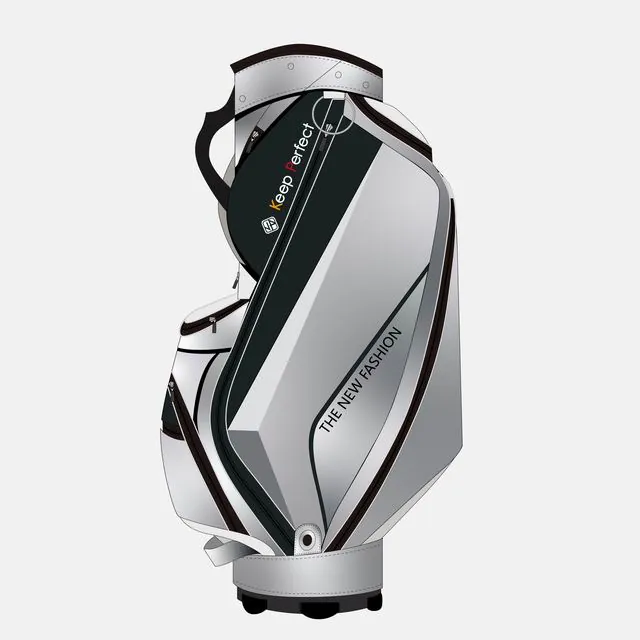
A resort bag is the most photographed object in the clubhouse and the least gently treated: it goes out twice a day, comes back damp, sits in a bag room at 40 degrees Celsius and is handed to a guest who has never carried that model before. That combination produces a specification quite unlike a retail line. The bag has to survive a shared life, read correctly from ten metres in a photograph, stay identifiable as club property and still feel like part of the guest experience rather than a piece of equipment with a number stencilled on it. On the guest programmes we build, terms run to 200 pieces a colourway (100 on trial), a 6-10 working day sample, 35-50 days of bulk, 30 per cent up front with 70 on documents, FOB Xiamen, and inspection at AQL 2.5.
Related reading: Custom Cart Bags for Golf Resorts and Country Clubs
Related reading: Why Golf Resorts Offer Branded Sunday Bags to Guests
Guest Wear: What a Rental Fleet Endures
Cycle counts that shape the specification
A retail bag is used by one owner about forty times a year and stored indoors. A fleet bag is used by two hundred different guests a year, loaded onto a cart by a caddie, hosed down by a locker attendant and stacked in a bag room where the summer temperature sits in the high thirties. Cycle counts matter more than anything else in the specification: a fleet bag passes through the same handling steps roughly fifty times more often than a private bag over the same period.
The failures that follow from that are specific and repeatable. Straps fail at the attachment first, because a caddie lifts by the strap rather than the handle. Zipper sliders fail at the ball pocket because guests open it with one hand while wearing a glove. Base corners wear through because the bag is dragged across a cart path rather than lifted. Pocket seams split where a guest has forced a wet towel into a compartment designed for a scorecard.
None of those are exotic engineering problems, and each has a cheap fix at specification stage: a bar-tacked strap attachment with a metal D-ring, a size 8 or 10 coil zip with a moulded pull, a moulded base plate with a 12 mm abrasion skirt, and a wet pouch that is separate from the dry pockets. A fleet specification that names those four items will outlast one that does not by a factor of two.
There is a fifth item that resorts rarely specify and always regret: a grab handle at the top collar, rated for the full loaded weight rather than for a nominal 10 kg. Caddies lift by whatever is nearest, and if the only lifting point is the strap, the strap attachment absorbs loads it was never designed for. A webbing handle bar-tacked through the collar costs under a dollar and removes the single largest source of fleet damage.
Rental, Loan and Retail Are Three Specifications
Most resorts run at least two of these three programmes and frequently blur them, which is how a fleet ends up with a retail-grade bag that fails in month seven. The table below separates the specification logic.
| Programme | Lifecycle | Priority | Specification focus | Units for a 36-hole club |
|---|---|---|---|---|
| Rental fleet | 2-3 seasons, 400+ outings | Durability and cleaning | 600D shell, moulded base, replaceable legs, printed crest | 60-120 |
| Member or guest loan | 4-6 seasons, lighter use | Appearance and comfort | Padded strap, softer trim, embroidered crest | 20-40 |
| Retail at the pro shop | Sold, one owner | Shelf appeal and margin | Finer fabric, contrast piping, hangtag | 40-80 per season |
The rental fleet is the specification that drives the order, because it is the largest quantity and the harshest duty. Two hundred pieces per colourway is the standard minimum; a 36-hole club with a fleet of 90 usually orders 120 to hold a replacement buffer within the same dye lot, and dresses the remainder as member loan stock or retail units in a second colourway.
A useful discipline is to write the three programmes into one purchase document with three line items and three prices. It stops the fleet from quietly absorbing the retail specification, and it gives the finance team a per-programme cost that can be justified against green fee revenue.
Cleaning, Sun and Chemical Exposure
Cleaning chemistry
Resort bags are cleaned far more aggressively than private bags, and the cleaning is the specification item most often missed. A locker attendant with a pressure washer and a general-purpose degreaser will strip a water-repellent finish in a season, degrade a PU coating at the seams and lift a heat transfer within two.
Sun, salt and sunscreen
Sunscreen is the second hazard and the one nobody believes until they see it. Oxybenzone and avobenzone, both common in high-factor products, are solvents for some PU and PVC coatings; repeated contact at the head end of the bag produces a sticky, tacky surface that then collects sand. Insect repellent containing DEET is worse, and it will soften a printed logo in a single season. Neither can be designed out entirely, but a solvent-resistant coating and a stitched rather than printed crest remove most of the exposure.
Ultraviolet light is the third. A bag that spends six hours a day on a cart in a subtropical climate receives roughly three times the annual UV dose of a bag stored indoors. Where the crest is a contrast colour, specify light fastness to ISO 105-B02 and check the result on the actual fabric, because a red that fades to pink in one season is the most visible failure a club can have.
Field note on cleaning products. Ask the housekeeping manager which chemicals actually reach the bag room, then test coupons of the shell fabric against them before the order is placed. A five-dollar lab check on three swatches prevents a fleet-wide dulling that no warranty conversation will resolve.
Branding That Reads at Ten Metres
Resort branding has one job: identify the club in a photograph taken from the first tee, from a terrace, or by a guest posting to social media. That is a legibility problem rather than a design problem, and it produces rules that differ from retail branding.
A crest needs to be at least 80 mm wide on the front panel of a cart bag to be readable at ten metres. Below 60 mm it disappears at that distance and only works as a close-up detail. A wordmark needs 9 mm cap height minimum, and a strapline below 6 mm will not survive screen print at all. One mark, one position, high contrast: a light crest on a dark shell or the reverse, never a mid-tone on a mid-tone.
The club name belongs on the front panel and on one side panel, which is the pair that appears in most cart-mounted photographs. Embroidered crests suit member loan bags and retail units; for the rental fleet, a woven label or a moulded badge holds up better to repeated cleaning than a stitch field that collects sand in the thread.
Resist the temptation to brand every surface. A bag with a crest on the front, a name on the side, a logo on the strap, a print on the base and a tag on the handle reads as a promotional item rather than club property, and guests notice the difference in how they handle it.
Where the club has more than one course, brand the programme rather than the course. Guests who play both tracks should see the same bag, because a bag is remembered as the club rather than as the layout. Course differentiation belongs in the coding system that the caddie master uses, not on the shell, and it costs nothing to keep it there.
Asset Control Without Looking Institutional
A fleet of ninety bags is an asset that has to be counted, and the counting method shows through to the guest. The wrong solutions are an inventory number in 30 mm type on the front panel, a stencilled code on the base or a plastic tag tied to the handle. All three read as rental stock and all three degrade the experience the bag is meant to support.
- Colour coding by course or tee sheet lets a caddie sort a rack at a glance without a number being visible from the front.
- A small woven tag inside the top opening, 25 x 15 mm, carrying the club code and a two-digit fleet number, invisible in use and unambiguous at stocktake.
- A discreet embroidered number on the shoulder pad, 12 mm high, which is only seen by the person carrying the bag.
- A consistent hardware finish so that a mixed rack still looks like one fleet, and a replacement bag does not stand out.
- A designated repair channel with a named contact, so a bag with a failed leg returns to service instead of being written off.
The last item is the one that changes the economics. A fleet with a repair route and a stock of leg sets, base plates and strap assemblies typically extends average service life from two seasons to three, which is a third of the capital cost of the programme returned without buying a single additional bag.
Sizing a Fleet and Phasing Replacement
Fleet size follows from tee sheet arithmetic rather than from a round number. Take the peak daily number of rental sets issued, add 15 per cent for same-day turnaround, add 10 per cent for bags out of service, and that is the floor. A club issuing 55 sets on a peak day needs roughly 70 bags in service, which sits comfortably under a 200-piece minimum once a buffer and a retail line are added.
| Phase | Fleet size | Replace per year | Trigger | Notes |
|---|---|---|---|---|
| Launch | 70-120 | n/a | Programme start | One dye lot, 3-5 per cent buffer |
| Steady state | 70-120 | 20-30 per cent | Condition audit each close season | Top-up in the original fabric reference |
| Refresh | 70-120 | Full fleet over 3 years | Brand change or course renovation | Stagger by one third per year |
Replacing a third of the fleet each year keeps average bag age under two seasons, which is where the guest experience stays consistent, and it avoids a single large capital event every third year. The constraint is colour continuity: three annual top-ups of the same nominal colour will not match unless the fabric reference is held and each shipment lands within a 1.5 tolerance of the master swatch. A club that changes fabric reference to chase a small price difference will rebuild its fleet twice as fast, which is the most expensive kind of saving available in this category.
Where a brand refresh forces a full-fleet change, order the full quantity in one run and store the later phases in a dry, ventilated room away from sunlight. Finished goods stored flat in a carton for six months are fine; finished goods stored upright against a south-facing window are not.
Fleet work is the part of the business QUANZHOU JUNYUAN BAGS has handled since 2014, with a production team on the floor from 2004, and most of the advice above comes from watching replacement cycles rather than from a product catalogue.
Cart Fit and Caddie Handling
A resort bag lives on a cart, and cart fit is a dimensional question with a narrow answer. Most fleet carts take a bag with a base between 240 and 270 mm across and a top collar between 230 and 250 mm; a bag outside that band either rocks in the cradle or will not seat at all. Ask for the base and top dimensions in the specification rather than a nominally equivalent model name, because two bags from different programmes with the same top diameter can differ by 15 mm at the base.
Strap routing matters as much as dimensions. A bag with a single central strap pass sits better on a cart than one with two offset passes, and a caddie strapping ninety bags a day will notice the difference in seconds. Where the club runs both carts and pull trolleys, specify a base that presents a flat face on both axes so the bag does not tip when the trolley is parked on a slope.
Weight discipline is the other half. A rental cart bag at 2.4 kg empty is comfortable for a caddie and stable on a cart; the same bag at 3.1 kg is not, and the difference is usually pocket count and lining rather than structure. Trim pockets that guests do not use, and put the ones they do use where the bag is accessible without lifting it off the cart.
Bag room layout deserves a mention because it interacts with the specification. If bags hang from a rail by the top handle, specify a handle that will not deform under a loaded bag hanging for eight hours a day. If they stand on a shelf, the base plate takes a point load at one corner and a moulded base with a wide skirt spreads it. A five-minute walk through the bag room before the order is placed will change at least one line of the specification, and it costs nothing.
What to Inspect on a Resort Delivery
Sampling follows AQL 2.5 in ISO 2859-1 at general level II, which means 32 bags examined out of a 200-piece order and 2 majors tolerated before the lot is blocked. A resort delivery justifies a few checks that a retail order does not.
- Crest position and size measured against the approved drawing, on every piece in the sample rather than one.
- Colour against the master swatch, judged in daylight, with the difference recorded rather than described.
- Strap attachment pull test, 15 kg static for ten minutes at both ends, since this is the first failure in service.
- Zipper function opened and closed ten times on each pocket, with the slider checked for smooth travel at the curve.
- Base seam and skirt, checked for abrasion resistance and for a continuous stitch line around the full perimeter.
- Cart seating, by mounting one sampled bag on the club cart model if a sample cart is available at the port of loading or at first receipt.
Fabric strength is measured on the grab test in ASTM D5034, floor 250 N, and on tear in ASTM D2261, which is the check that catches a lightweight shell before it reaches a fleet. Where cleaning chemicals are a known risk, include a rub test with the actual housekeeping product on a spare panel, and record the result against the master swatch so that season two has a baseline to compare against.
The maintenance regime that follows delivery is covered in the bag care guide, and the cart-specific fit questions sit in the cart bag selection notes. Both are worth passing to the head caddie rather than keeping in the office, because the first season is where a fleet is either trained or ruined.
Next steps: custom solutions, manufacturing capability, and a quotation request. Cart bag range. Wholesale programme.
Sources and Standards Referenced
- ISO 105-B02 Colour fastness to artificial light
- ISO 2859-1:2022 Sampling procedures for inspection by attributes
- ASTM D5034 Breaking strength and elongation of textile fabrics (grab test)
- ASTM D2261 Tearing strength of fabrics (tongue method)
- ECHA REACH restrictions on substances in consumer articles
Frequently Asked Questions
What is the minimum order for a resort branded bag programme?
Two hundred pieces per colourway, which suits a fleet of 70-120 bags plus a 3-5 per cent buffer and a small retail line. A 100-piece trial is workable on an existing platform. A new shell or a new moulded badge moves the threshold to 500 pieces.
What bag should a rental fleet use?
A 600D polyurethane-backed cart bag with a moulded base plate, a 12 mm abrasion skirt, a bar-tacked strap attachment with a metal D-ring, and size 8 or 10 coil zips. Retail-grade trim and fine fabric belong on the loan or pro shop line, not on the fleet.
How long does a rental bag last?
Two to three seasons at 400 or more outings a year. With a repair route and spares for legs, base plates and straps, three seasons is realistic. Without one, most fleets write off bags at the end of season two when a single component fails.
Why do resort bags fade or go sticky?
Ultraviolet light and sunscreen. High-factor products contain solvents that soften some PU and PVC coatings, and DEET-based repellent will lift a printed logo in a season. Specify light fastness to ISO 105-B02 and prefer a stitched or woven crest over a printed one.
How large should a crest be to read in photographs?
At least 80 mm wide on a cart bag front panel for legibility at ten metres. A wordmark needs a minimum of 9 mm cap height, and a strapline below 6 mm will not survive screen print. Mid-tone on mid-tone never reads, whatever the size.
Can the fleet be branded without looking like rental stock?
Yes. Put the crest on the front and one side panel, keep inventory numbers inside the top opening on a 25 x 15 mm woven tag, and use colour coding by course or tee sheet rather than visible numbers. Guests handle a bag differently when it does not read as equipment.
How do we size a rental fleet?
Peak daily sets issued, plus 15 per cent for same-day turnaround, plus 10 per cent out of service. A club issuing 55 sets on a peak day needs about 70 bags in service, which sits inside a 200-piece order once a buffer and retail units are added.
How often should a fleet be replaced?
Replace 20-30 per cent a year after a close-season condition audit, which keeps average bag age under two seasons. A full refresh is better staggered over three years to spread the capital cost, unless a brand change forces a single run.
Will replacement bags match the original colour?
Only with the fabric reference held and a master swatch retained by both sides. Two dye lots of one nominal shade, run twelve months apart, will not match reliably. Ask for every top-up lot to sit inside a 1.5 tolerance of the master swatch.
Will the bag fit our existing carts?
Check base width at 240-270 mm and top collar at 230-250 mm against the cart cradle. Specify measured dimensions rather than a model name, since two bags with the same top diameter can differ by 15 mm at the base. A single central strap pass seats better than two offset passes.
What inspection applies to a resort delivery?
Sampling follows AQL 2.5 in ISO 2859-1 at general level II. Thirty-two bags are examined from a 200-piece lot, with 2 majors tolerated before the lot is blocked. Resort-specific checks add a 15 kg strap pull test, crest size and position on every sampled bag, and a daylight colour comparison.
Can we order the fleet and the retail line together?
Yes, as separate line items in one order, which is the cleanest way to keep the fleet from absorbing the retail specification. Both share the same crest and colourway, and the combined quantity usually clears the 200-piece minimum with room for a buffer.
Specify a Guest Fleet
Send the fleet size, the cart model and the crest file, and a rental specification with per-unit cost and a phased replacement schedule comes back in two working days.
Request a Fleet Quote See Resort Solutions