PU vs PVC Leather in Golf Bag Trim Manufacturing
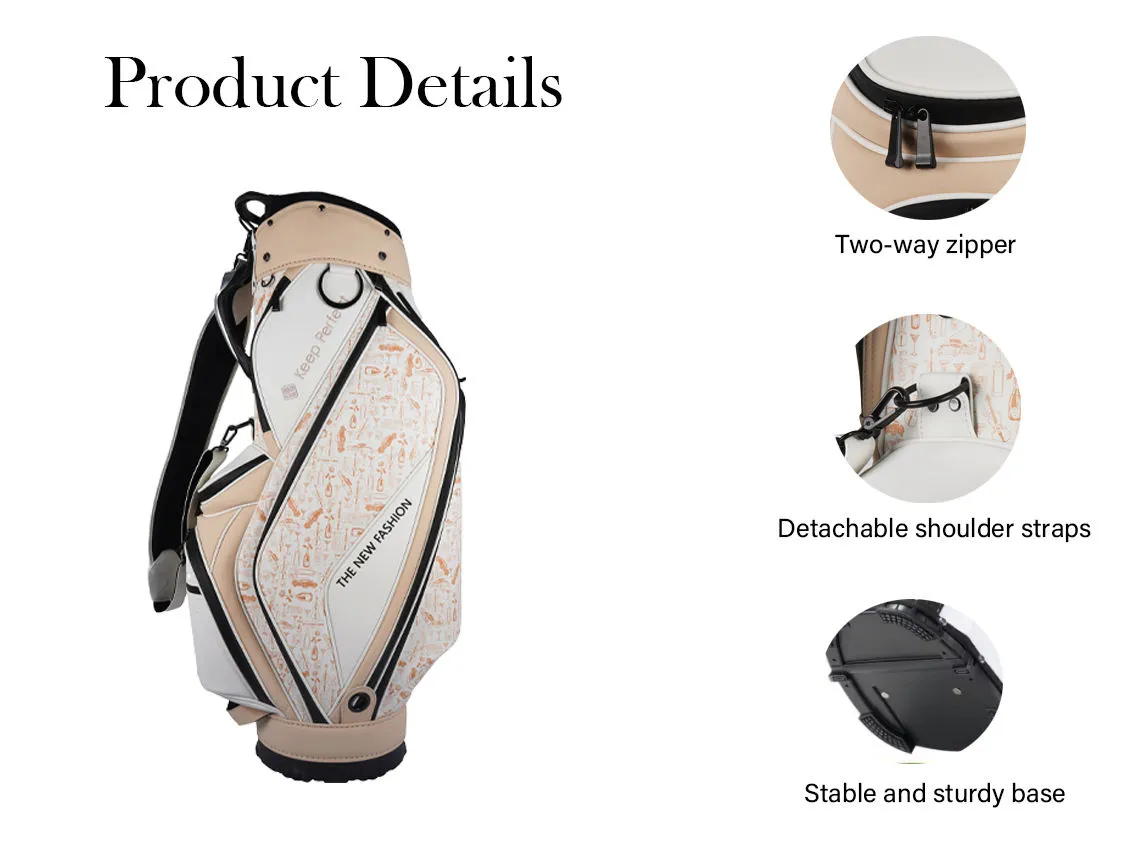
Both materials read as leather on a shelf, but PU-coated and PVC-coated fabric behave like different substances once a bag has spent a season on a cart, eight weeks in a container and a summer in a car trunk. PU is a polyurethane skin on a knit or woven base: lighter, softer, far more tolerant of repeated folding, and free of the plasticiser that makes vinyl go tacky and bleed into neighbouring cloth. PVC is a vinyl coating, cheaper per square metre and stiffer, which suits flat trims that never bend. Real trim programmes usually end up with both materials on one bag rather than one material everywhere. Order quantities start at 200 pieces per colourway, sampling takes 6-10 working days, bulk runs 35-50 days, and lots are inspected to AQL 2.5 under ISO 2859-1.
Where Synthetic Leather Actually Sits on a Golf Bag
A full-size staff bag carries six to nine separate coated-fabric components, and they are rarely doing the same job. Piping runs 1.2-2.5 m around the top collar, pocket openings and base seam. The handle wrap is a 200-260 mm sleeve that flexes every time the bag is lifted out of a car. The base skirt takes ground contact and cart cradle abrasion. Pocket flaps hinge along a fold line dozens of times a round. Collar bands sit in direct sun for hours. Zipper garages and logo patches are small, flat and mostly decorative.
Because all of these come off the same cutting table, buying teams tend to consolidate to one or two materials, chosen on price per metre and on which colours the mill already stocks. The consequence is predictable. A stiff vinyl specified for the base skirt migrates onto the handle wrap because it is already in the warehouse, and eight months later the wrap has split along its fold. The consolidated purchase looked cheaper on the costing sheet and turned into a warranty conversation.
Three questions sort any trim faster than a full data sheet. Does the part bend, and how tight is the radius? Does it rub against a cart, a strap or the ground? Does it sit in sunlight with a pale fabric pressed against it? The answers narrow the field to one family and usually to a different grade inside that family. Everything else in this article is the detail behind those three questions.
The trim map is worth drawing before any material is chosen. Sketch the bag, mark every coated component, and write beside each one the flex radius, the contact surface and the sun exposure. That single page does more to prevent field failures than any generic material comparison, because it forces the conversation onto the specific part instead of the product category.
Related reading: Screen Printing vs Embroidery vs Heat Transfer for Golf Bag Logos
Two Coating Lines, Two Very Different Materials
Both families are a polymer film bonded to a base cloth, and the base does more work than most buyers expect. A 300D or 600D polyester oxford supplies tear strength and holds a defined grain. A cotton drill base gives polyurethane a softer hand and appears often on premium handle wraps. Non-woven bases are cheap, dimensionally weak, and belong nowhere near a stress point. Coating weight is quoted in grams per square metre and normally lands between 180 and 420 g/m² on bag trim.
PVC: calendering and plastisol spreading
Vinyl is applied by calendering or as a plastisol spread, and the resin only becomes flexible with plasticiser, typically 30-50 parts per hundred of resin. That plasticiser is the material weak point. It migrates into anything it touches, it volatilises slowly, and it softens the surface in heat. Stabilisers slow the degradation but do not stop migration. Grain is embossed by an engraved steel roll, which is why vinyl still delivers the sharpest and most repeatable leather texture of any coated fabric at this price.
PU: transfer coating and direct coating
Polyurethane arrives either knife-coated directly onto the base or cast on release paper and transferred, in solvent-borne, waterborne or solids form. Skin thickness on trim runs 0.15-0.35 mm. Transfer coating produces a finer, more cloth-like grain and a softer drape, which is what buyers are responding to when they say a trim feels expensive. PU can be embossed, printed, perforated or made breathable. Chemically it is polyester-based, tougher but prone to hydrolysis, or polyether-based, more stable but softer and less abrasion-resistant.
The two routes also differ in tooling and minimums. Vinyl grain comes from a roll that the mill already owns, so a new texture usually costs nothing beyond a stock pattern choice. A bespoke PU grain may need a new release paper, which carries a one-off charge in the low thousands of US dollars and a four to six week lead time. On a 200-piece trim programme that charge is hard to justify unless the texture is the brand signature.
Property Comparison That Decides the Specification
Published data sheets rarely line up across suppliers, so compare on the handful of measures that map to real failures. The table below is what a production spec should be built from, and the right-hand column is how each number shows up on a finished bag.
| Property | PU coated | PVC coated | Where it bites on a bag |
|---|---|---|---|
| Areal weight at 0.8 mm | 380-480 g/m² | 520-680 g/m² | 50-150 g added across a full trim set |
| Cold flex, no cracking | -25°C | -5 to -10°C | Winter storage, unheated warehouse, air freight |
| Flex fatigue at 10,000 folds | No failure | Crazing from 4,000-6,000 | Handle wrap, pocket flap hinge line |
| Abrasion, Taber CS-10, 500 g | 300-600 cycles | 700-1,200 cycles | Base skirt, piping at cart contact points |
| Hydrolysis risk | High unless inhibited | None | Tropical markets, 60-day sea freight |
| Plasticiser migration | None | Yes above 40°C | Ghost staining on pale fabric in contact |
| UV stability, undyed | Good | Fair, yellows | Collar band, top piping in open sun |
| Relative cost per metre | 1.3-2.2x | 1.0 index | Budget, mid and premium trim tiers |
Read the table by placement rather than by average. Vinyl wins abrasion and loses flex. Polyurethane wins flex and weight, and loses on cost and moisture sensitivity. A bag that mixes both correctly is not a compromise, it is the standard production answer: vinyl on the base skirt and stiff edge bindings, polyurethane on anything that folds or is handled.
Field note. On a sand or light grey colourway, a vinyl trim pressed against 600D polyester leaves a pale ghost line where plasticiser has migrated into the cloth after a summer in a warehouse. The defect appears on the fabric, not on the trim, so it usually gets blamed on the mill that wove the shell. Specify a polymeric rather than monomeric plasticiser, or keep vinyl away from pale fabric altogether.
Hydrolysis: The Failure That Arrives Nine Months Later
Polyester-based polyurethane absorbs atmospheric moisture, and the ester linkages break under heat. The film first feels faintly tacky, then crazes at every fold, then splits. The sequence can complete inside one shipping cycle: sixty days in a container crossing the tropics reaches 55-65°C by day and 90% relative humidity at night, which is an accelerated ageing chamber that happens to be carrying your goods.
The symptom is almost always misdiagnosed at the retail end. A wrap that splits in month nine gets reported as a stitching failure or a bad batch. The seam is intact; the film has failed immediately beside it. Once the split appears there is no economic repair, and the whole batch becomes a claim against the brand rather than against the film.
Control lives at the coating mill, which is why the specification has to name the chemistry and not just the look. Anti-hydrolysis additive, usually a carbodiimide at 1-2% of polyurethane solids, extends service life several-fold. Polyether polyol systems are inherently more stable than polyester, at some cost in tensile and abrasion. A film that survives seven days at 70°C and 95% relative humidity with no tack and no cracking when folded back on itself is a reasonable proxy for a two-year shelf life in a humid market.
Where the end market is tropical or the goods will sit in an open-air warehouse, the practical order is thermoplastic polyurethane first, inhibited polyether PU second, vinyl third, and uninhibited polyester PU nowhere. TPU costs roughly 1.4-1.8 times a standard PU per metre at the time of writing, and it is stiffer to cut, but it neither hydrolyses nor plasticises. Confirm current resin and freight levels with your mill before locking a landed cost.
Matching the Trim to the Material
Piping and welt
Piping is a cord inside a bias-cut strip, normally 3-5 mm cord under a 12-15 mm finished tape, and the material needs to be 0.6-0.8 mm so it curves without rippling. Polyurethane at that thickness turns a 12 mm radius cleanly. Vinyl has to be skived thinner or it waves on tight corners, and a waved piping line reads as sloppy work even when the seam strength is fine. On a cart bag the piping around the base takes the hardest abrasion of any trim, so specify a polyester cord rather than cotton and cut the strip on the bias.
Handle wraps, collar bands and strap pads
A handle wrap is the most flexed trim on the bag. Polyurethane at 1.0-1.4 mm over 2 mm EVA gives the right hand feel and survives the fold line for the life of the product. Make it a single piece with the join underneath and a bar-tack at each end, never a butt splice in the middle of the grip. Vinyl wraps are common at entry price points and typically show crazing along the fold after two seasons of weekly play, which is exactly when the warranty period ends.
Skirting, base bands and pocket flaps
Base skirts and stiff edge bindings are where vinyl earns its place: 0.9-1.2 mm, high abrasion resistance, almost no flex, and enough stiffness to help the base hold shape against a cart cradle. The caveat is cold. Vinyl turns brittle below about -10°C, so a bag stored in an unheated garage can crack a skirt on the first drop of winter rather than the hundredth drop of summer. If the market is northern, keep the skirt vinyl and move the flap binding to PU.
One more trim deserves its own line: the collar band at the top opening. It sits in the most sunlight and takes club shafts dragging across it a hundred times a round. Polyurethane with a UV package and a matte top coat holds colour better than vinyl, and it will not go glossy where hands and shafts polish the surface. On a premium programme this is the trim a retail buyer touches first.
Cutting, Skiving and Sewing Differences
Coated fabric is not woven shell, and a sewing room set up for 600D polyester will produce rejects on trim until four parameters change: the blade, the needle, the feed and the foot pressure. The sequence below is the one that holds up across both families, with the points where they diverge.
- Die cutting and nesting. Panels are clicked or CNC cut with the grain direction marked. Coating stretches more across the weft than along the warp, so a piping strip cut off-grain will wave no matter how carefully it is sewn.
- Skiving. Edges that will be folded or joined are skived to 0.4-0.6 mm. A dull skiving blade tears the coating instead of thinning it, and that tear propagates as a split once the part is under load.
- Edge sealing on vinyl. Cut vinyl edges are hot-knife sealed or welded. An open edge exposes the base cloth and wicks water straight into the laminate.
- Needle choice. Round-point needles at 16-18 gauge, never a leather point, which cuts a slit through the film that then tears along the stitch line.
- Thread. Bonded nylon 69 or 92, matched to the seam load. Unbonded thread fuzzes and the knots pull through coated surfaces.
- Stitch setting. 8-9 stitches per inch on polyurethane. Vinyl runs one stitch longer with lighter foot pressure, because it is stiffer and takes a permanent mark from the presser foot.
- Feeding. A roller or walking foot, not a drop feed. Coated face is slick, the back is grippy, and a drop feed stretches the top ply and puckers the seam.
- Bonding where stitching is not viable. Small logo patches and thin bindings are often bonded with a heat-activated film so the face is not perforated, which matters on any bag sold as water-resistant.
- Final check. Seam grin, skipped stitches, adhesive bleed, edge seal continuity, and colour against the approved swatch under D65 light.
Two of these steps account for most trim rejects: skiving and feeding. A dull skive is invisible at the bench and obvious three weeks later when a split opens from the edge inward. A drop-feed machine on a curved piping run produces a seam that measures correct and looks wrong, and looks are what the retail buyer judges before anything is tested.
Cost, Colour Matching and What Volume Buys
Price tracks three things: the base cloth, the coating weight and whether the colour is stocked. A black or navy PU at 0.8 mm from mill stock is the cheapest specification that still performs. A custom-matched shade in a short run is a different order of cost, because the mill has to clean down and run a minimum batch.
| Cost driver | Share of trim cost | What moves it |
|---|---|---|
| Base cloth: 300D, 600D or cotton drill | 25-35% | Tear strength and hand feel |
| Coating weight and grade | 25-35% | Abrasion, cold flex, hydrolysis resistance |
| Colour matching and lot size | 15-25% | Stocked shade versus custom dyed batch |
| Cutting, skiving and sewing labour | 15-20% | Trim count, radius, reinforcement points |
| Testing and inspection | 5-10% | Oven ageing, abrasion cycles, AQL level |
Mill minimums for a custom coated colour usually sit at 500-1,000 m, far more than a 200-piece bag run consumes in piping and wraps. That mismatch is the most common reason a colourway slips: the brand approves a Pantone chip, the mill will not run it below its minimum, and the trim either changes shade or the launch date moves. Stocked shades held to a colour difference of 1.0 within a lot and 1.5 across lots keep a programme on schedule.
On a staff bag with eight or nine trims, the material difference between an all-vinyl and a mixed specification usually lands around USD 1.60-3.40 per bag, which is trivial against a retail price and substantial against a return rate. That asymmetry is the whole argument for specifying per trim. The materials guide shows how coated fabric sits alongside shell cloth, foam and hardware, and the sampling stage is where the trim map gets proven on a real bag rather than a swatch card.
What to Write Into the Trim Specification
A trim specification that cannot be argued about at inspection is one where every line carries a number. Six fields remove almost all first-article disputes, and each of them corresponds to a failure mode described above.
- Material family and grade per trim, not one line covering the whole bag. Name the part, the family, the thickness and the base cloth.
- Coating weight in g/m², with a tolerance of plus or minus 5%.
- Hydrolysis requirement on every PU part: additive present, test method named, acceptance criteria stated.
- Plasticiser type on any vinyl part that touches pale fabric or sits against clear-coated hardware.
- Colour reference and tolerance: physical swatch or Pantone, difference of 1.0 within a lot and 1.5 across lots, assessed under D65.
- Seam and edge treatment: skive width, edge seal method, stitch density, thread ticket.
Two additions are worth making even though they are not standard practice. Specify the trim set weight as a target, because eight trims at 40 g over each is a third of a kilogram nobody budgeted for on a carry bag. And specify a shelf life statement from the mill for any PU component, so an ageing problem surfaces in writing at purchase rather than in a customer complaint eighteen months later.
If the colourway is already committed and the mill minimum is the blocker, the workable route is to keep the visible wear trims in the specified PU and move hidden structural trims to a stocked vinyl in a matched shade. Send the trim map and the target retail band, and that trade-off can usually be settled before the first cut is made.
Next steps: custom solutions, manufacturing capability, and a quotation request. Waterproof coating and PU lamination. 600D vs 1680D polyester fabric.
Sources and Standards Referenced
- ASTM D5034 Breaking strength and elongation of textile fabrics (grab test)
- ASTM D2261 Tearing strength of fabrics by the tongue method
- ISO 105-B02 Colour fastness to artificial light
- ISO 2859-1 Sampling procedures for inspection by attributes
- ECHA REACH regulation on chemicals in consumer articles
Frequently Asked Questions
Is PU leather better than PVC for a golf bag?
For anything that folds, PU is the better material: it is 25-30% lighter at the same thickness, stays flexible to -25°C and does not craze at a fold line. For flat, abraded parts such as the base skirt, PVC is harder wearing and cheaper. Most production bags use both, matched to the load on each trim.
How much heavier is PVC than PU on a golf bag?
At 0.8 mm, PU runs 380-480 g/m² and PVC 520-680 g/m². Across a full trim set of eight or nine components, that difference is roughly 50-150 g on the finished bag, which matters most on a carry or stand bag where every 100 g is argued over.
Does PU leather peel off golf bags?
Peeling is usually hydrolysis, not adhesion. Polyester-based PU absorbs moisture and the film degrades from within, going tacky and then splitting beside the seam. An anti-hydrolysis additive at 1-2% of solids plus a 70°C/95% RH oven test at development stage prevents most of it.
What thickness of PU is used for a golf bag handle wrap?
1.0-1.4 mm over a 2 mm EVA backing. Thinner than 1.0 mm the wrap transmits the handle bar and wears through at the fold; thicker than 1.4 mm it will not turn the end radius without wrinkling. The wrap should be one piece with the join underneath.
Why does PVC trim leave a mark on light fabric?
Plasticiser migration. Above about 40°C the plasticiser in vinyl moves into any absorbent material in contact with it, leaving a pale ghost line on the cloth. A polymeric plasticiser reduces it; keeping vinyl away from pale fabric removes it.
Can PVC trim crack in cold weather?
Yes. Vinyl becomes brittle below roughly -10°C, so a bag stored in an unheated garage or shipped through a cold corridor can crack a base skirt on impact. PU stays flexible to about -25°C, which is why cold-climate programmes specify PU on exposed trims.
What is the minimum order for custom coated trim fabric?
Finished bags start at 200 pieces per colourway, but the coated fabric itself is a mill product with a 500-1,000 m minimum for a custom shade. That gap is why stocked colours with a 1.5 colour difference tolerance keep programmes on time.
How long does sampling take for a new trim colourway?
Sampling runs 6-10 working days where the fabric is from stock. A custom coated colour adds mill lead time, and a bespoke embossed grain requiring new release paper adds four to six weeks before sampling can begin at all.
Which tests should coated trim pass before bulk?
Grab strength to ASTM D5034, tear strength to ASTM D2261 on the tongue method, 10,000 flex cycles at the tightest radius on the bag, Taber abrasion at 500 g with CS-10 wheels, and colour fastness to light to ISO 105-B02 for any trim exposed to sun.
Does PU trim fade in sunlight?
Undyed PU holds colour better than vinyl, which yellows under UV. Pigmented PU with a matte top coat is the stable option for collar bands and top piping. On a contrast trim exposed to daily sun, colour fastness to artificial light should be tested to ISO 105-B02 rather than assumed.
Can embroidered logos go onto PU trim?
Yes, with a backing. PU is thin and slick, so a logo patch needs a non-woven stabiliser behind it and a round-point needle. More than about 4,000 stitches in one patch will perforate the film and create a tear line, which is why dense logos usually go on a separate patch.
How is trim quality checked in production?
AQL 2.5 under ISO 2859-1 at general inspection level II, which samples 32 pieces from a 200-piece lot with an acceptance number of 2 major defects. Trim checks cover thickness, colour against swatch, skive width, edge seal continuity and seam appearance.
Send Your Trim Map
Send the trim list with thickness and target retail band, and a per-trim material recommendation with weights and cost delta comes back within two working days.
Get a Trim Recommendation See Custom Solutions