Ladies Golf Bags Custom Manufacturing for the Womens Market
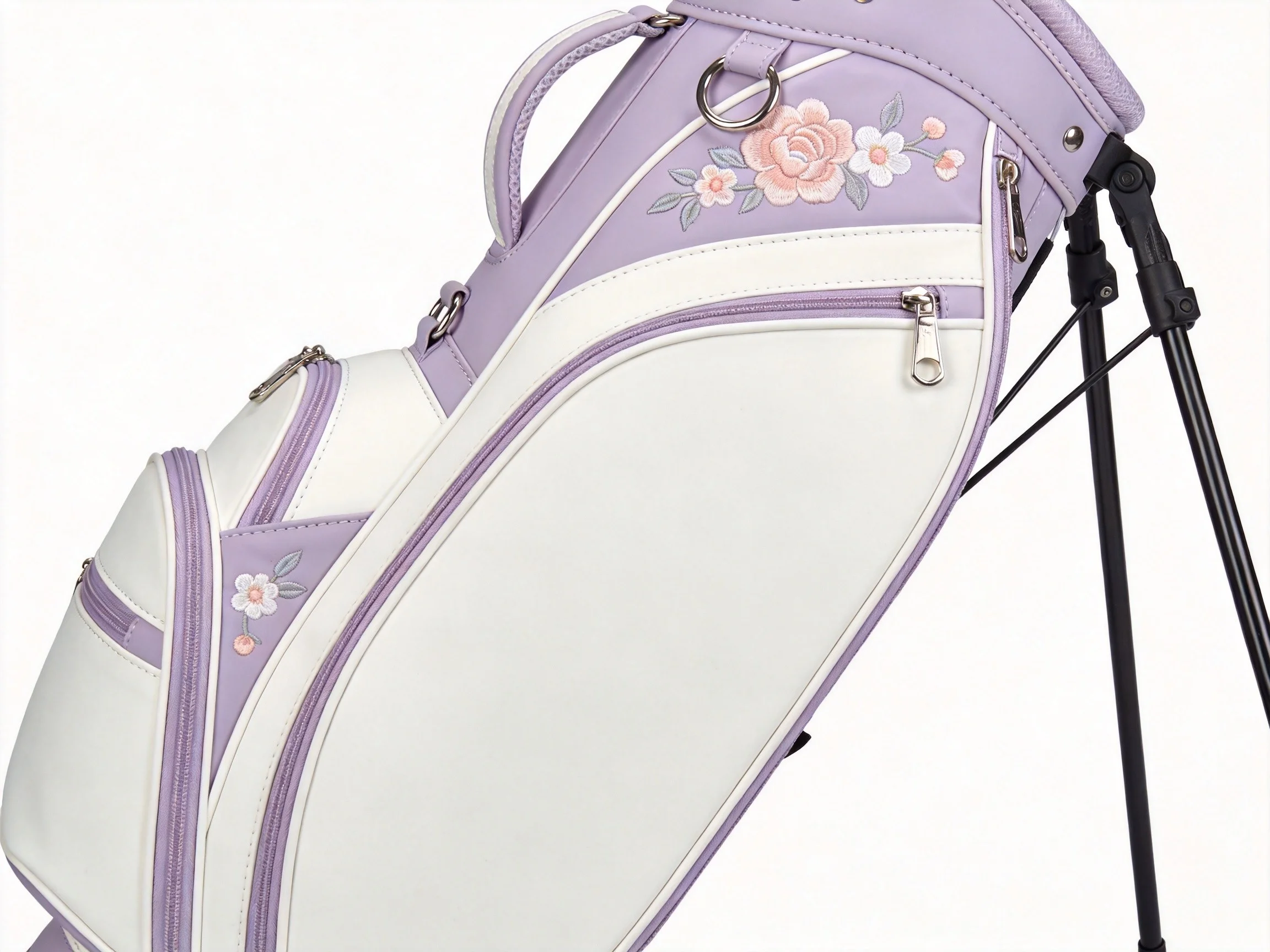
Reach and weight decide whether a women's golf bag sells through; colour decides only which one gets picked up first. A bag built by shrinking an adult male pattern by ten percent and swapping the palette will photograph acceptably and disappoint in use, because the top sits too high for a shorter player to see into, the strap sits too wide on the shoulder, and the empty weight is 300 g over what the customer will tolerate. This page sets out the dimensions, the weight budget, the strap geometry and the colour discipline that separate a real women's pattern from a recoloured one, with the working numbers behind it: a 200-piece colourway minimum, 100 for a trial, samples inside 6-10 working days, 35-50 days for production, and acceptance at AQL 2.5 on the ISO 2859-1 level II plan.
Where a Women's Pattern Actually Diverges
The differences that matter are measurable, and they start at the top opening. A player of 160-170 cm standing beside a bag on a trolley looks down into the mouth at a steeper angle than a player of 180 cm, so a bag that is 40 mm shorter with a mouth that is 20 mm narrower is easier to use all round, not merely lighter. The same logic runs through every dimension below.
| Dimension | Women-spec target | Adult male pattern | Why it changes |
|---|---|---|---|
| Overall height | 860-900 mm | 900-940 mm | Sightline into the top, cart cradle fit |
| Body width | 240-270 mm | 270-300 mm | Weight, cart footprint, shoulder clearance |
| Top opening | 216-241 mm | 241-267 mm | Reach into wells, grip clearance |
| Well diameter | 36-40 mm | 38-45 mm | Smaller hands, grip size unchanged |
| Stand bag weight | 1.5-1.9 kg | 1.8-2.2 kg | Carry load over 18 holes |
| Cart bag weight | 1.9-2.4 kg | 2.4-3.0 kg | Lift on and off a trolley, boot handling |
| Strap pad width | 55-70 mm | 70-90 mm | Shoulder width, pressure distribution |
Height and sightline
Two of these numbers do most of the work commercially. Height reduction of 40-50 mm cuts fabric consumption by roughly 5% and removes 60-90 g from the finished bag, and narrowing the body by 30 mm takes another 40-70 g out of the shell and the base plate. Together they account for most of the weight gap without touching the frame, which is where weight reduction becomes expensive.
One customer, not one demographic
A word on the phrase itself. Buyers write women's, ladies and female-fit interchangeably, and the market they describe is not one customer. A 30-year-old club member buying a cart bag, a 60-year-old buying a lightweight carry bag and a resort buying fleet bags have different priorities, and a range meant to serve all three usually serves none of them. Fixing one primary customer before the pattern is drawn is the single most useful decision in the project.
The Weight Budget, Line by Line
Weight targets are only useful when they are allocated. A 1.75 kg stand bag target that nobody breaks down into components ends up at 2.05 kg, and the argument at sample approval is about which department is responsible. The table below is the allocation we use for a 1.7-1.8 kg women's stand bag, and it is worth copying into the tech pack as a requirement rather than a wish.
| Assembly | Allocation | Lever that moves it |
|---|---|---|
| Shell fabric and lining | 380-460 g | Denier, PU backer thickness, lining grade |
| Top ring and dividers | 180-250 g | Ring wall thickness, moulded vs sewn grid |
| Base plate and feet | 130-180 g | PP vs PE, overmoulded TPE, foot count |
| Frame and leg set | 330-420 g | Tube wall, leg diameter, hub material |
| Straps and pads | 180-240 g | Pad density, webbing width, buckle material |
| Pockets and hardware | 190-260 g | Pocket count, zip size, pullers, D-rings |
The frame and leg set is the largest single block and the hardest to reduce, which is why programmes that chase weight late end up with a bag that will not stand up. Removing 40 g from a leg set by dropping the tube wall from 1.0 mm to 0.8 mm is achievable but moves the failure mode from bending to buckling, and the buckled leg usually arrives as a warranty claim in month four.
Fabric is the easier lever, and the one buyers push hardest. A 420D polyester with a 0.6 mm PU backer saves 80-110 g against 600D with a 1.0 mm backer on a body this size. The trade is abrasion resistance at the base rim and at the cart contact points, so the usual compromise is 420D on the body and 600D on the base skirt, which keeps the weight saving and protects the wear zones.
Spec tip. Ask for a component weight sheet at first article, not a single finished weight. When a sample comes in 150 g heavy, a scale reading tells you there is a problem; a component sheet tells you which supplier to call.
Top, Dividers and Getting a Hand In
The functional test for a women's top is simple: can the player reach the club at the back of the well without lifting the bag off the trolley? On a 9.5-inch top with 14 wells, a shorter player frequently cannot, and the workaround at retail is a 6 or 8-way top with fewer, wider wells. That is a design decision with a cost consequence, because a 6-way moulded grid needs less tooling and less material than a 14-way, yet it is often perceived as the lesser product.
Well diameter is where a copied pattern shows. Adult wells at 38-45 mm are sized for a midsize grip plus a gloved hand; women's gloves run smaller and the correct assembled diameter is 36-40 mm. Under 36 mm the grip binds on insertion once the lining is in, and above 40 mm the clubs rattle and the heads knock. Specify the assembled value, and test it with a gauge after lining, not on the cut part.
Divider height matters more than divider count on this product. A full-length divider set that runs to the base adds 200-300 g and improves club separation, but on a 860-900 mm bag it also reduces the usable depth of the apparel pocket, because the pocket is stitched onto the outside of the divider wall. The compromise most programmes use is three full-length walls with partial dividers above, which gives separation where grips bunch without eating pocket depth.
If the bag is a cart model, the top also has to accept a cart strap and a trolley bracket without the strap running across the putter well. Checking that on a drawing is not enough; the first article needs to sit on an actual trolley before approval. The cart bag range shows the layouts that survive that check.
Straps, Handles and Carry Geometry
Strap geometry is the most under-specified element in the category and the one customers notice within a minute of trying the bag on. Three parameters decide whether a dual strap works on a narrower frame: the yoke length, the pad width and the anchor separation on the bag body. Take an adult pattern with a 210 mm yoke and 80 mm pads, and on a shorter torso the pads cross the neck rather than sitting on the shoulder blades.
The workable junior-to-women translation is a yoke of 160-185 mm, pads of 55-70 mm, and a total adjustment range of 450-600 mm so the bag sits correctly over a polo in summer and a waterproof shell in winter. Anchor separation matters too: pulling the two anchor points 20-25 mm closer together moves the load path inward and stops the bag swinging outward when the player walks.
Padding density is a specification, not an adjective. A 10 mm pad at 25 kg/m³ feels plush in the showroom and compresses to 4 mm after a season; a 12 mm pad at 35-40 kg/m³ costs about 0.30 USD more and holds its shape. For a bag that will be carried, that is the best-value upgrade in the whole bill of materials.
Handles are the other reach issue. A top handle placed centrally on a 900 mm bag is at roughly 900 mm; on a shorter player that is above comfortable lift height when the bag is on the ground. Moving the handle 30 mm down and 15 mm forward of the adult position, and adding a second grab handle at the base skirt for two-handed lifting, solves the boot-and-trolley handling problem for negligible cost.
Colour, Trim and Matching Discipline
Palette work is where this category earns or loses its reputation, and it is entirely a specification problem. A women's range typically runs four to six colourways per season, with each colourway combining a shell, a contrast panel, a trim, piping, a lining and a hardware finish. That is six components per colourway, and any one of them drifting outside tolerance makes the bag look cheap at arm's length.
Trim is the usual culprit. A PU trim dyed to match a polyester shell will not match, because the two substrates take dye differently and the PU has a surface sheen that changes apparent colour under store lighting. The practical solution is either a tonal match with a deliberate ΔE allowance and a matte PU, or a deliberate contrast where a small mismatch reads as design rather than error. What never works is asking for an exact match and hoping.
| Component pair | Tolerance | Check method |
|---|---|---|
| Shell to contrast panel, same lot | ΔE ≤ 1.0 | Spectrophotometer, D65 |
| Shell to PU trim, same lot | ΔE ≤ 1.5 | Spectrophotometer plus visual under D65 |
| Piping to body | ΔE ≤ 1.5 | Visual against master swatch |
| Hardware finish to trim | Visual match to master | Master plate under D65 and warm light |
| Repeat order against first order | ΔE ≤ 1.5 | Retained master swatch, not a photo |
Hardware finish is worth naming separately because it is the fastest way to make an inexpensive bag look considered. Matte nickel, brushed gunmetal and soft champagne tones cost the same as bright chrome at volume and photograph better with a soft palette. Bright polished chrome against a pastel shell reads as a men's bag with a colour change, which is the exact impression the range is trying to avoid.
The colourway arithmetic
One commercial warning: every colourway is a separate fabric dye lot and therefore a separate 200-piece minimum. A six-colourway launch at 200 pieces each is 1,200 pieces before any size variation. Where the plan is smaller, the sane structure is two or three shell colours with additional colourways created through trim, piping, lining and hardware, which costs no dye lot at all.
Pockets That Match How the Bag Is Actually Used
Pocket design in this segment is not about count, it is about depth and reach. A pocket whose opening sits 200 mm down the body is unreachable for a shorter player without taking the bag off the trolley, which is why the most-used pocket should sit within 60-180 mm of the top edge and open toward the player rather than across the body.
- Valuables pocket at the top, 140-170 mm wide, fleece lined, with a water-resistant zip and a puller long enough for a gloved hand.
- Apparel pocket on the front, 300-360 mm deep, with a two-way zip so it can be opened from either end when the bag is on a trolley.
- Bottle sleeve sized for a 0.6-0.75 L bottle, insulated on premium programmes, positioned low so the centre of gravity does not rise.
- Range finder or phone pocket with a soft lining and a 10 mm foam back, at the top where it can be reached without dismounting.
- Cart strap channel at 120-160 mm from the base, clear of every pocket opening so the strap cannot trap a zip.
Pocket placement changes the pattern, not just the trim, so it has to be settled before sampling. Moving a pocket 30 mm after the first article means a new panel, a new marker and usually a new sample, which adds 6-10 working days to a calendar that is already tight before a spring reset.
Testing, Minimums and the Development Calendar
The test list for this product is not exotic, but three checks are consistently skipped and consistently cause returns. Strap anchor strength under a static pull of 400 N held for 60 seconds, because the anchor takes the full carry load on a narrower bag. Zip function over 3,000 cycles with the pocket loaded, because overfilled apparel pockets are normal. Colour fastness under ISO 105-B02, because a pale shell on a trolley spends four hours a round in direct sun and a shift in shade across panels is the most visible defect on a light-coloured bag.
Shell and seam strength follow the usual route: 220 N warp grab strength by ASTM D5034 on a 420D body, tear strength to ASTM D2261, and a 1 m drop onto the base plate and both lower corners. The inspection scheme is ISO 2859-1 level II at AQL 2.5, which means thirty-two units checked from a 200-piece lot and a two-major ceiling, covering stitch density, strap anchor, pocket alignment, colour against the master swatch and hardware function.
Commercially, the sequence is predictable. A stock-material sample closes in six to ten working days; cutting and proving a new top ring, base plate or hub tool stretches that to twelve to fifteen, because the first shot needs moulding, measuring and usually one adjustment. Goods follow in 35-50 days from sign-off, and the upper end is reached when a range carries four or more colourways, since each one needs its own cutting ticket and its own dye lot.
- Customer profile and dimension brief. One primary user, a target height band, and the trolley or carry pattern settled before a pattern is drawn.
- Pattern and weight allocation. Component targets issued with the tech pack, so the frame, shell, hardware and straps all have a number to hit.
- First article and trolley fit. The sample is mounted on a trolley and carried, not just measured, before any colour work starts.
- Colourway and trim approval. Shell, contrast panel, PU trim, piping, lining and hardware signed off against physical master swatches.
- Bulk release and sampling plan. Cutting tickets issued per colourway, AQL 2.5 plan agreed, defect classes written down before the first carton.
The opening quantity is 200 pieces per colourway, with a 100-piece trial on stock shell fabric and a 500-piece floor where a new pattern or tool is involved. Payment is T/T 30/70 against documents, terms are FOB Xiamen, and the lines in Quanzhou carry third-party audits on request for capacity. The brand on the paperwork is QUANZHOU JUNYUAN BAGS, trading since 2014 with a team that has been in bag production since 2004.
Related reading: Women's Golf Bag Design Features Buyers Ask For
For buyers assembling a full range rather than a single SKU, the shape of the line matters as much as any one specification. Two cart models and one stand model, in three colourways that share trim and hardware, gives six to nine SKUs from three dye lots and keeps the opening order inside a single container. A range built the other way, six colourways across four shapes, needs three times the capital and ships later. The women's stand bag line and the materials guide are the two references worth reading before that decision is made.
Sources and Standards Referenced
- ISO 2859-1:2022 Sampling procedures for inspection by attributes
- ASTM D5034 Breaking strength and elongation of textile fabrics (grab test)
- ASTM D2261 Tearing strength of fabrics (tongue method)
- ISO 105-B02 Colour fastness to artificial light
- ISO 9001 Quality management systems (process control at the production site)
Next steps: custom solutions, manufacturing capability, and a quotation request.
Frequently Asked Questions
What makes a golf bag a women's model rather than a recoloured men's bag?
Dimensions and geometry, not colour. A women-spec bag is normally 40-50 mm shorter, 30 mm narrower in the body, 25 mm smaller at the top opening, and built with 55-70 mm strap pads on a shorter yoke. Weight targets run 1.5-1.9 kg for a stand bag and 1.9-2.4 kg for a cart bag.
What order quantity does a ladies bag programme need?
200 pieces per colourway. A 100-piece trial works when the shell fabric comes from stock and customisation sits in trim, piping, lining and hardware, which costs no dye lot. A new pattern, top ring tool or base plate moves the opening quantity to 500 pieces.
How much should a women's golf bag weigh?
1.5-1.9 kg for a stand bag and 1.9-2.4 kg for a cart bag. Weight tolerance is ±5%, and the useful control is a component weight sheet at first article, because a single finished weight tells you there is a problem but not where it sits.
What well diameter suits smaller hands?
36-40 mm assembled, against 38-45 mm on an adult male pattern. Below 36 mm a standard grip binds once the lining is installed; above 40 mm clubs rattle and heads knock together. Specify the assembled diameter and check it with a gauge after lining.
How wide should the shoulder strap pads be?
55-70 mm on a women's pattern, with a 160-185 mm yoke and 450-600 mm of total adjustment. A 12 mm pad at 35-40 kg/m³ holds its shape far better than a 10 mm pad at 25 kg/m³, for roughly USD 0.30 more per bag.
Why do the colours on a women's bag look mismatched at retail?
Because PU trim and polyester shell take dye differently, and a glossy PU changes apparent colour under store lighting. Set ΔE ≤ 1.0 for panel-to-panel and ΔE ≤ 1.5 for shell-to-trim, use matte PU, and approve against a physical master swatch rather than a screen.
How many colourways can we launch without raising the order?
Each shell colour is a separate dye lot and a separate 200-piece minimum, so four colourways means 800 pieces. To launch smaller, fix two or three shell shades and create the remaining colourways through trim, piping, lining and hardware, which adds no dye lot.
How long does development take?
Six to ten working days with stock materials, twelve to fifteen when a tool has to be cut and proven. Production then takes 35-50 days after approval. Ranges with four or more colourways tend toward the upper end of that window, because each colour carries its own cutting ticket and dye lot.
What inspection standard is used for ladies bags?
Thirty-two units out of two hundred, run under the ISO 2859-1 level II plan at AQL 2.5, with two majors allowed. Checkpoints are stitch density, strap anchors, pocket alignment, colour against the master swatch and hardware function.
Do women's cart bags fit standard trolleys?
They fit, but the narrower body changes where the cradle contacts the bag, so the lower strap channel has to be positioned and tested on an actual trolley before approval. A channel 120-160 mm from the base, clear of pocket openings, is the usual specification.
Which tests matter most on this product?
A 400 N static pull held 60 seconds on each strap anchor, 3,000 zip cycles with the pocket loaded, a 1 m drop onto the base and both lower corners, 220 N warp grab strength to ASTM D5034, and light fastness to ISO 105-B02 on pale shells.
Can we mix cart and stand models in one order?
Yes, and it is usually the right move for a first season: two cart models and one stand model sharing trim and hardware gives a coherent range from three dye lots. Each shape still needs its own sample approval, so allow 6-10 working days per shape.
Build a Women's Range
Send the customer profile, target weight and colourway count, and a dimensioned specification with a weight allocation comes back within two working days.
Discuss Your Range View Women's Bags