Golf Cart Bag Base Plate Compatibility and Manufacturing
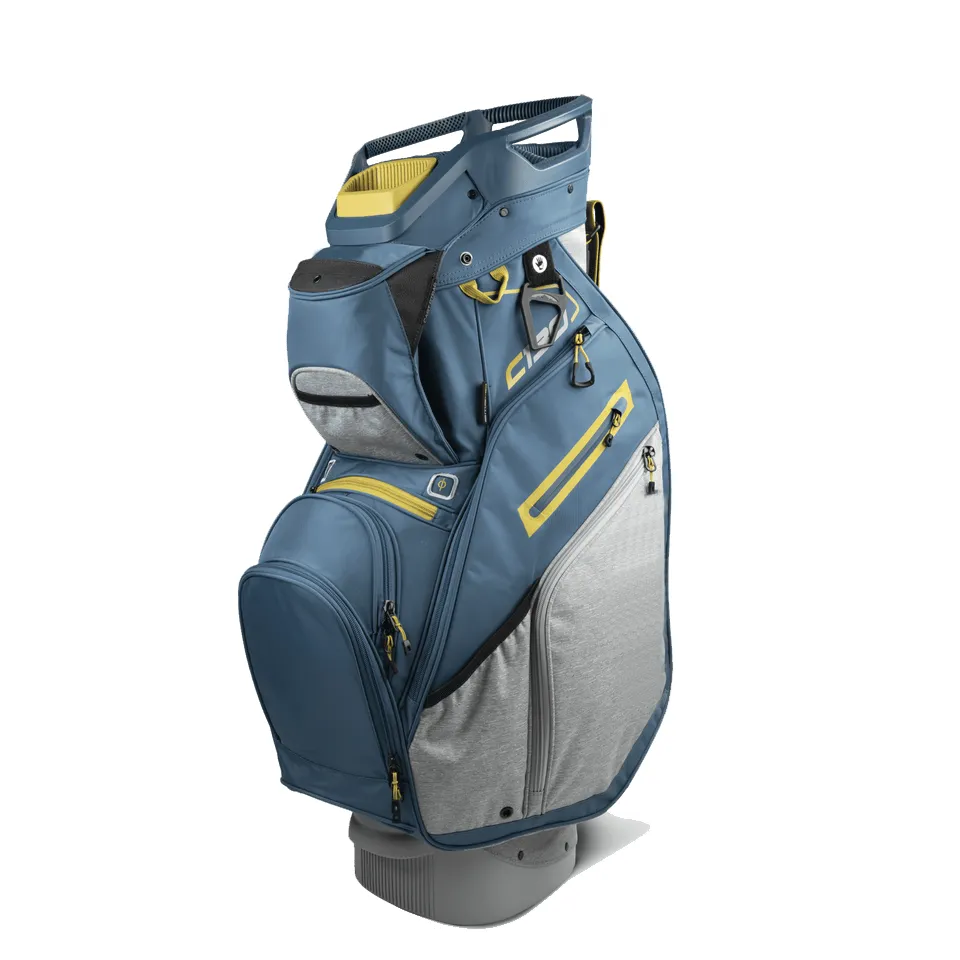
A cart bag base plate is a compatibility part before it is a cosmetic one, and most fit complaints trace back to a 90 mm moulding that nobody specified properly. The plate is the surface that sits in a trolley cradle, carries the whole loaded mass of the bag, and absorbs every kerb, ramp and car park the trolley crosses. Buyers spend weeks on fabric and colour, then approve a base from a two-line drawing with no flatness tolerance, no cradle land dimension and no abrasion requirement. This page covers the three cradle interfaces in use, the dimensions that decide fit, material and moulding choices, the failure modes at the skirt, and the commercial frame: 200 pieces per colourway, 100-piece trials, 6-10 working days for samples, 12-15 where a plate tool is cut, 35-50 days for bulk, and AQL 2.5 acceptance sampling.
What the Plate Is Actually Asked to Do
A base plate performs four jobs at once. It closes the bottom of the shell and gives the seam something rigid to attach to. It presents a flat land to the cart cradle so the bag sits without rocking. It distributes the load of fifteen clubs, a full pocket set and a bottle across the cradle rather than into four rivets. And it takes the abrasion that no other part of the bag sees, because it is the part in contact with plastic, metal and stone every time the trolley moves.
Those four jobs pull in different directions. A plate thick enough for abrasion resistance adds mass at the worst possible place, because the base is already the low point of the bag and a heavy base makes a cart bag feel dead when lifted. A plate thin enough to be light needs either a ribbed underside or a smaller unsupported span, and both constrain where the cradle can contact it.
The specification that resolves the tension is not thickness but support geometry. A 4 mm plate with two 3 mm ribs running fore and aft behaves stiffer than a 5 mm plate with none, at about 60% of the weight. Ribs also give the mould a place to hide sink marks, since a flat 5 mm section opposite a boss will show a shadow on the visible face.
Three Cradle Interfaces and What Each Demands
Trolley and cart cradles in the market fall into three families, and a base designed around one of them can fail on the other two. The differences are worth understanding before a plate is drawn, because tooling locks the geometry in for the life of the product.
| Cradle type | Contact pattern | What the plate must provide | Common failure |
|---|---|---|---|
| Platform cradle | Flat tray, 150-240 mm wide | Flat land at least 140 x 110 mm, corner radius 20-40 mm | Rocking if the land is crowned |
| V-cradle | Two angled rails meeting at a spine | Central spine flat 40-60 mm wide, no protruding feet | Bag rotates 10-15 degrees on the rails |
| Strap-only | No cradle, lower strap bears the load | Rear lip 20-35 mm and a strap channel 25-35 mm wide | Plate slides forward under braking |
Platform cradles
A platform cradle is the most forgiving and the most common on rental fleets. The plate needs a genuinely flat land, and flat means flat within 1.0 mm across the contact area, not flat to the eye. A plate that is 2 mm crowned in the middle touches the tray at one line and rocks fore and aft, which the player feels as a wobble on every step and reads as a badly made bag.
V-cradles and strap-only carriers
A V-cradle is less forgiving because the contact is two narrow lines rather than an area. The plate needs a spine flat of 40-60 mm so the rails land on material rather than on a radius, and it must not have feet or pads that sit outside the rails. Where a buyer wants rubber feet for shop-floor display, they should be inset 15 mm from the plate edge, or they become the contact point and the bag pivots on them.
Strap-only carriers, common on compact push trolleys and on some electric models, put the entire locating load into the lower strap. Here the plate needs a rear lip of 20-35 mm that hooks against the strap or the frame, plus a strap channel 25-35 mm wide positioned 100-140 mm above the base. Without the lip, the bag creeps forward under braking, and the strap slowly works up the body until it crosses a pocket zip.
Dimensions and Tolerances That Decide Fit
Fit is a function of five numbers, and all five belong on the drawing. Buyers who send a width and a depth and nothing else are the reason base plates get remade after first article, at which point the tool has already been cut.
| Parameter | Typical value | Tolerance | Effect if missed |
|---|---|---|---|
| Plate footprint width | 180-230 mm | ±1.5 mm | Will not seat in narrow cradles |
| Plate footprint depth | 200-260 mm | ±1.5 mm | Overhang catches the trolley frame |
| Flatness across contact land | 0 mm target | 1.0 mm max | Rocking, perceived as poor build |
| Strap channel width | 25-35 mm | ±0.8 mm | Strap binds or slips through |
| Rear lip height | 20-35 mm | ±1.0 mm | Forward creep under braking |
| Wall thickness | 3.0-5.0 mm | ±0.15 mm | Weight and stiffness swing |
| Corner radius | 20-40 mm | ±2 mm | Stress concentration, cracking |
Footprint has to be read together with the body width, not in isolation. A 240 mm plate under a 250 mm body leaves a 5 mm skirt all round, which looks sharp but gives the seam almost nothing to bite into, and the skirt tears at the first kerb. The workable rule is a plate 15-25 mm narrower than the body at the base, so the skirt has 7-12 mm of fabric turned under and stitched through the plate edge.
The strap channel position is the number most often copied from a previous model and most often wrong. It has to sit above the tallest point of the cradle and below the lowest pocket opening. On a bag with a low bottle sleeve, that window can be as narrow as 40 mm, and the channel gets moved to a position that traps the zip. Sorting the pocket layout and the channel position together at pattern stage avoids the conflict entirely.
Field note. Ask for a 1:1 paper template of the plate footprint before the tool is cut. Buyers routinely discover on paper that the plate is 8 mm too wide for the trolley they designed the bag around, and a template costs nothing compared with a re-cut.
Material and Moulding Choices
Resin selection
Almost every cart bag base plate is injection moulded, and the resin choice is a trade between stiffness, impact strength at low temperature and abrasion resistance. Polypropylene homopolymer is the default: cheap, stiff, and adequate down to about minus 10°C. Below that it becomes brittle, which matters for bags sold into northern European and North American winter markets where a bag sits in an unheated garage.
| Option | Wall | Plate weight | Abrasion | Cost index | Where it fits |
|---|---|---|---|---|---|
| PP homopolymer | 3.5-5.0 mm | 130-190 g | Moderate | 100 | Standard cart bags, mild climates |
| PP copolymer | 3.5-4.5 mm | 140-200 g | Moderate | 108-115 | Cold-climate markets, impact resistance |
| HDPE | 4.0-5.0 mm | 150-210 g | Good | 105-112 | Rental fleets, heavy use |
| PP with TPE overmould | 3.5 mm + 1.5-2.5 mm | 165-225 g | Very good | 135-150 | Premium cart bags, quiet contact |
| Glass-filled PP | 3.0-3.5 mm | 115-150 g | Moderate | 140-165 | Lightweight builds, thin sections |
A thermoplastic elastomer overmould at 60-75 Shore A on the contact land is the single most effective upgrade for the money. It removes the plastic-on-plastic rattle that makes a loaded bag sound cheap on a trolley, damps vibration, and roughly triples the abrasion life of the contact area. It adds 35-70 g and requires a two-shot tool or a bonded insert, which is why it belongs on premium programmes rather than entry ones.
Moulding detail
Moulding detail matters as much as resin. Wall sections should be uniform within 0.3 mm to avoid sink, bosses need a 0.5-0.8 mm wall with a radius at the root, and draft should be at least 1.5 degrees on every vertical face or the part drags and scuffs on ejection. A scuffed plate is a cosmetic reject that buyers notice on the visible underside when the bag is lifted.
Tooling for a plate runs USD 2,500-6,000 depending on size, rib complexity and whether an overmould shot is included, with 15-25 days to first article. Because the plate is tied to both the body footprint and the cradle interface, it is the part most likely to need a second iteration, and buyers should budget one round of adjustment rather than assume a clean first shot.
Load Paths, Rivets and the Failure at the Skirt
The base assembly fails in one of three places, and all three are visible in the field before they are visible in a test. The skirt tears where the fabric meets the plate edge. The plate cracks at a rivet hole or at a rib root. Or the plate separates from the shell entirely because the adhesive and the stitch line were both specified as optional.
Rivets are the usual starting point. Four to six 8 mm barrel rivets with backing washers, set 12-18 mm in from the plate edge, carry the load into the plate without crushing the fabric. Rivets set too close to the edge tear out under a 30 kg load; rivets without washers pull through the shell within a season. Where the design allows, a stitched and taped seam in addition to the rivets removes the dependency on any single fixing.
The skirt is a fabric and abrasion problem rather than a moulding one. A 600D polyester skirt with a PU backer, turned under 7-12 mm and stitched through the plate edge at 8-10 stitches per inch, survives kerbs that a 420D skirt will not. A piping strip along the skirt adds a wear surface and hides the stitch line, at roughly USD 0.10-0.18 per bag.
- Load test the assembly at 30 kg static for 24 hours, suspended by the top handle, and inspect the skirt and every rivet afterwards.
- Drop test from 1 m onto the base, then onto each bottom corner, on a hard floor rather than carpet.
- Trolley test on an actual cart over a 50 m route including a kerb, checking for rotation, creep and strap migration.
- Abrasion check by dragging the loaded bag 200 m on concrete and measuring material loss at the rear lip.
- Cold check at minus 10°C for 4 hours, then repeat the drop test, for any bag sold into a winter market.
Mock-Up Testing Before the Tool Is Cut
The cheapest way to de-risk a base plate is to test the interface before spending on steel. A 3D-printed or CNC-machined plate in the intended footprint, at the intended thickness, mounted on a production shell, answers the fit questions that a drawing cannot: where the cradle actually contacts, whether the bag rotates, and whether the strap channel is reachable with the bag loaded.
- Measure the target carts. Take the cradle width, cradle length, rail spacing and strap anchor height from at least three carts in the target market, not from a catalogue drawing.
- Cut a mock plate. Machine or print the footprint at 1:1 in the intended wall thickness, including the rear lip and channel.
- Mount on a loaded shell. Fit the plate to a production body with 15 kg of clubs and check contact pattern with carbon paper or chalk dust.
- Run the trolley route. Push the loaded bag over a kerb, a ramp and a rough path, and photograph any rotation or creep.
- Adjust and re-mock once. Move the channel, the lip or the corner radii on the mock, then release the tool with the verified geometry.
This sequence costs a week and a few hundred dollars, and it removes most of the risk from a tool that costs USD 2,500-6,000 and 15-25 days. Programmes that skip it usually discover the mismatch at first article, which means a second tool or a hand-modified plate and a delay that lands squarely on the shipping window.
One further test is worth adding for fleet and rental buyers: a compatibility sheet listing the carts the bag has been verified against, with cradle type and measured contact width. It is a sales document as much as an engineering one, and it answers the question a pro shop will ask first.
Order Structure, Tooling and Inspection
Base plates are bought inside the bag order rather than separately, but they set the minimums because the tool is the fixed cost. A colourway minimum of 200 pieces applies as it does to the rest of the bag, a 100-piece trial is workable where the plate and shell footprint already exist, and a new plate tool moves the opening quantity to 500 pieces unless the buyer pays for the tool outright and keeps ownership of it.
Sampling is 6-10 working days when the plate is an existing moulding in a new colour, and 12-15 working days where a fresh tool is cut, because the first shot needs moulding, a flatness check and a trial on a cart. Bulk production runs 35-50 days from approval, with the plate rarely the critical path unless the tool is late; the fabric dye lot usually sets the date.
The acceptance plan is level II of ISO 2859-1, at an AQL of 2.5; thirty-two bags come out of a 200-piece lot and two majors are allowed. On a base assembly the checkpoints are specific: footprint against the drawing, flatness on a surface plate, rear lip height, channel width, rivet count and washer presence, skirt stitch density, and a trial fit of the sampled bag into a cradle gauge.
Two commercial notes close this out. Payment terms are T/T 30/70, shipment is FOB Xiamen, and capacity sits on dedicated lines with third-party factory audits available on request in Quanzhou; the plates themselves are moulded in the same industrial cluster, which shortens the loop between a fit problem and a modified tool. The company running that capacity has been building golf bags since 2014, with a founding group active in the trade from 2004. For buyers starting a cart bag programme, the most useful first step is to send the cradle measurements from the carts in the target market together with the intended body width, so the plate footprint, the channel position and the skirt allowance can be set as one decision.
Related reading: Golf Bag Base Plate Material and Injection Moulding
Related reading: Push Cart and Trolley Compatibility for Golf Bags
Beyond the plate itself, the cart bag range shows how the base, the strap channel and the pocket layout are resolved together, and the size and dimension guide covers the body measurements that the plate has to match.
Sources and Standards Referenced
- ISO 2859-1:2022 Sampling procedures for inspection by attributes
- ASTM D5034 Breaking strength and elongation of textile fabrics (grab test)
- ASTM D2261 Tearing strength of fabrics (tongue method)
- ISO 9001 Quality management systems (process control at the moulding site)
- ECHA, Understanding REACH (restrictions on substances in plastic and rubber parts)
Next steps: custom solutions, manufacturing capability, and a quotation request.
Frequently Asked Questions
What does a cart bag base plate do?
Four jobs: it closes the bottom of the shell, presents a flat land to the trolley cradle so the bag does not rock, spreads the loaded mass across the cradle instead of into four rivets, and takes the abrasion of every kerb and car park. It is the only part of the bag in continuous contact with the cart.
How thick should a cart bag base plate be?
3.0-5.0 mm in polypropylene, with ribbing rather than extra thickness where more stiffness is needed. A 4 mm plate with two 3 mm ribs is stiffer than a 5 mm flat plate at roughly 60% of the weight, and ribs also hide sink marks on the visible face.
How many plates make a viable order?
200 pieces per colourway as part of a bag order, with a 100-piece trial where the plate and shell footprint already exist. A new plate tool moves the opening quantity to 500 pieces, unless the tool is paid for separately and retained by the buyer.
How much does base plate tooling cost?
USD 2,500-6,000 depending on size, rib complexity and whether a TPE overmould shot is included, with 15-25 days to first article. Budget one round of adjustment, because the plate is tied to both the body footprint and the cradle interface.
Why does my cart bag rock on the trolley?
Almost always plate flatness. The contact land needs to be flat within 1.0 mm across 140 x 110 mm; a plate crowned by 2 mm touches the cradle along one line and rocks fore and aft. The player feels it on every step and reads it as poor build quality.
Will a 230 mm base fit a narrow trolley cradle?
It must be checked against the cradle rather than assumed. Cradle widths run from about 150 mm to 240 mm, so a plate at the top of the 180-230 mm range will not seat in the narrowest cradles. Measure three carts in the target market before fixing the footprint, and keep the flat contact land at least 140 x 110 mm.
What is a strap channel and where should it sit?
It is the recess in the plate, or just above it, that the lower cart strap passes through. It should be 25-35 mm wide and positioned 100-140 mm above the base, above the tallest point of the cradle and below the lowest pocket opening, so the strap cannot snag a zip pull.
Do I need a TPE overmould on the base?
It is the best value upgrade on the part. A 1.5-2.5 mm TPE layer at 60-75 Shore A removes the plastic rattle, damps vibration and roughly triples abrasion life at the contact land. It adds 35-70 g and needs a two-shot tool or bonded insert, so it suits premium programmes.
What causes the fabric skirt to tear at the base?
A plate set too close to the body edge leaves too little fabric to turn under. The workable rule is a plate 15-25 mm narrower than the body at the base, giving 7-12 mm of skirt turned under and stitched through the plate edge, with a piping strip as a wear surface.
How is the base plate fixed to the bag?
Four to six 8 mm barrel rivets with backing washers, set 12-18 mm in from the plate edge, usually combined with a stitched and taped seam. Rivets without washers pull through the shell within a season; rivets set too close to the edge tear out under a 30 kg load.
What tests should a base assembly pass?
A 30 kg static load for 24 hours suspended by the top handle, a 1 m drop onto the base and each bottom corner, a trolley route including a kerb, a 200 m drag on concrete to check abrasion, and for winter markets a 4-hour cold soak at minus 10°C before the drop test.
What inspection standard applies to base plates?
Thirty-two bags drawn from two hundred, on the level II ISO 2859-1 scheme at AQL 2.5, with a two-major limit. Checkpoints are footprint, flatness, rear lip height, channel width, rivet and washer count, skirt stitching and a cradle gauge fit.
Check Your Base Fit
Send the cradle measurements from your target carts and the intended body footprint, and we will return a plate geometry, a flatness tolerance and a mock-up plan within two working days.
Request a Fit Review See Cart Bags