Golf Bag Manufacturing in China: 2026 Cost Breakdown
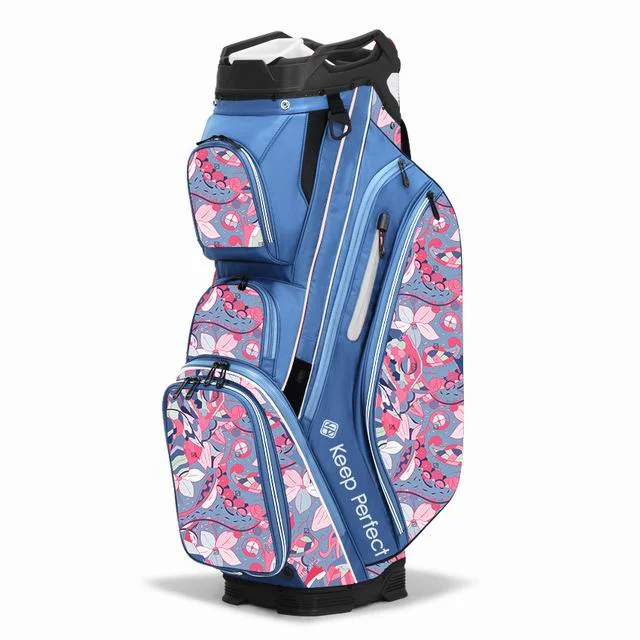
An FOB Xiamen price for a 600D cart bag is a stack of eight cost blocks, and in 2026 material is the largest and most volatile of them at roughly 50-58% of the total, followed by direct labour at 17-22%, structural parts, hardware, packaging, factory overhead and supplier margin. Most price arguments between buyer and supplier are arguments about the wrong block: a two-dollar gap on a quoted price is usually a material substitution or a labour-minute difference, not a margin grab. This breakdown separates the blocks, prices a worked example bag at USD 42 FOB, and shows what each common upgrade adds. The commercial terms behind the model are the familiar ones: a 200-piece colour minimum, a hundred units for a trial, five hundred where tooling is new, samples in 6-10 working days, production in 35-50 days, AQL 2.5 to ISO 2859-1, and payment split 30/70.
Related reading: Golf Bag Pricing Tiers Explained
What FOB Xiamen Actually Covers
FOB means the seller delivers the goods cleared for export on board the ship at the named port, and the buyer pays ocean freight, insurance and destination charges from that point. In practice, FOB Xiamen covers the finished bag, the export carton, inland transport to the port, export documentation and export clearance. It does not cover ocean freight, duty, destination handling or the last mile.
That boundary matters when comparing quotes from different regions, because a price quoted CIF or DDP bundles costs that look like product cost but are not. It also matters at the margin: two suppliers quoting FOB from different ports carry different inland trucking and terminal charges, which is why a quote from a plant two hours from the port can be a dollar lower on identical goods.
Inside the FOB number there are eight blocks worth separating: shell and lining fabric, trim and foam, hardware and zips, structural parts such as the divider, collar and base, direct labour, packaging, factory overhead, and supplier margin. Each behaves differently when volume, specification or exchange rate moves.
- Included in FOB: finished bag, individual polybag, export carton, carton marks, inland trucking to Xiamen, export declaration and documentation.
- Not included in FOB: ocean freight, marine insurance, destination terminal handling, duty, value-added tax on import and inland delivery to your warehouse.
- Sometimes bundled and worth separating: tooling, sampling, third-party inspection and custom packaging print runs.
Material: The Largest and Least Stable Line
Material sits at 50-58% of a typical cart bag price and is the line most exposed to market movement. Polyester filament pricing tracks crude oil and mill utilisation, PU and PVC coatings track their own chemical chains, and foam tracks petrochemical intermediates. A quote given in one quarter can be stale in the next, which is why credible suppliers state a quotation validity period rather than leaving price open indefinitely.
Shell fabric and lining
Shell is priced by the metre at a given width, and consumption per bag is roughly 1.2-1.5 metres depending on panel layout and pocket count. A 600D PU-backed polyester in a mid-range quality lands in a band that, at the time of writing, sits near USD 3.20-4.20 per metre; a 1680D ballistic weave runs 40-60% higher. Lining at 210D is a smaller line but not negligible, because a bag uses just over a metre of it and a brushed or printed lining costs 30-50% more than plain taffeta.
Coating and lamination
A basic PU coating is included in the fabric price. A three-layer waterproof laminate, a breathable membrane or a solvent-free coating is a separate material and a separate lamination step, and it changes both the cost and the sewing difficulty because laminated panels are stiffer and less forgiving at curves. This is one reason a waterproof upgrade costs more than the fabric difference alone.
Trim, foam and webbing
PU trim, piping, EVA foam, webbing, binding tape and elastic are small lines individually and a meaningful block together, typically 8-11% of FOB. They are also where substitution happens quietly: a 2 mm foam becomes 1.5 mm, a 25 mm webbing becomes 20 mm, a PU trim becomes PVC. None of those changes the photo, and all of them change the price and the feel.
Labour and the Operations Behind It
A cart bag is roughly 90-115 minutes of direct labour across cutting, sewing, assembly, finishing and packing. Sewing dominates, at 65-75 minutes, because a bag with a 14-way top, four exterior pockets, a cooler compartment and a padded strap has a lot of seam metres and a lot of turns. Assembly and finishing, which includes setting hardware, attaching the base, threading drawcords and cleaning, adds 15-20 minutes.
The labour rate used in costing is not the wage; it is the fully loaded hourly cost including social insurance, dormitory and canteen overhead, supervision and downtime. In the main bag-producing regions of Fujian, that loaded rate has been rising steadily for a decade, which is why the labour share of a bag price has not fallen even as automation has increased in cutting and in some stitching operations.
Labour minutes are also where a specification change hides. Adding a second row of piping, a contrast stitch line along every pocket, or a logo embroidered in four positions can add 6-10 minutes, which at a loaded rate translates into a visible per-bag increase. Buyers who ask for "a bit more detail" without asking for the minute impact are negotiating blind.
Hardware, Trim and the Small Parts That Add Up
A cart bag carries five to seven zips, four to eight buckles and adjusters, two to four D-rings, a set of moulded feet, sometimes a rain-hood clip and a towel ring. Individually these are cents. Together they are 6-9% of FOB and the single easiest place to lose or gain quality.
Zip quality is the clearest example. A generic #5 coil zip and a branded equivalent look identical in a photo and differ by 30-60 cents each. Over six zips that is USD 1.80-3.60 per bag, and it is the difference between a slider that runs smoothly for five seasons and one that catches in year two. The same logic applies to buckles: a moulded acetal buckle and a cheap nylon copy differ by a few cents each and by a warranty claim when the ladder lock slips under load.
Structural parts sit in the same block but deserve separate accounting. A moulded 14-way divider, a top collar and a base plate are three parts with three tools and three price points. On a cart bag they commonly total USD 5.50-7.50 in materials, which is 13-18% of FOB, and they are the parts that determine whether the bag holds its shape and sits correctly in a trolley cradle.
Tooling, Sampling and Development Charges
Tooling is not part of the per-unit FOB price, which is exactly why it gets forgotten in budget comparisons. A new top collar or divider mould runs USD 3,000-9,000 depending on size and cavity count, with 12-15 working days to first article. A new base plate is usually at the lower end; a multi-cavity divider grid sits at the upper end.
Sampling is charged separately, typically USD 300-900 for the full round of prototype, colour and pre-production samples, and it is often credited against the bulk order. Pattern development for a new shape, if it is not simply a modification of an existing block, adds a design and grading charge that varies with complexity.
The commercial question is who owns the tool. If the buyer pays for it, the buyer should hold or co-hold it, and the amortisation should be explicit: either a one-time payment with ownership, or a per-unit amortisation across an agreed volume with a defined end point. An undefined amortisation is a permanent surcharge by another name.
Overheads, Margin and the Factory-Gate Price
Factory overhead covers the building, utilities, equipment depreciation, quality staff, management, compliance audits and financing of work in progress. On a bag programme it typically runs 7-9% of FOB. It is the block buyers try hardest to cut and the one that most directly determines whether the plant can afford an inspection team and a maintenance schedule.
Supplier margin on volume programmes commonly sits at 8-14%. It is not a slush fund: it funds sample rooms, development work that never reaches production, rework, and the working capital gap between paying for fabric and being paid by the buyer. A quote with a 3% margin is not a bargain; it is a programme that will fail quietly at the first quality problem or the first currency movement.
This is also where volume changes the arithmetic. Spreading overhead across 1,000 pieces rather than 200 reduces the per-unit overhead line materially, which is why a 500-piece price can be 6-10% below a 200-piece price without any change in margin percentage.
A Worked Cost Model for a 600D Cart Bag
The model below prices a 14-way cart bag with four exterior pockets, a cooler compartment, a padded dual strap and a moulded base. Quantities and rates are representative for 2026 at the time of writing; treat them as a structure to argue with, not a quote.
| Cost line | Consumption | Unit rate | Cost (USD) |
|---|---|---|---|
| Shell, 600D PU-backed | 1.40 m | 3.60 / m | 5.04 |
| Lining, 210D | 1.20 m | 1.50 / m | 1.80 |
| PU trim and piping | 0.45 m | 5.00 / m | 2.25 |
| EVA foam and padding | 0.80 m² | 1.90 / m² | 1.52 |
| Webbing, binding, elastic | 3.60 m | 0.34 / m | 1.22 |
| Zips, five including one water-resistant | 5 pcs | 0.57 / pc | 2.85 |
| Hardware set, buckles and feet | 1 set | 1.62 | 1.62 |
| 14-way divider insert | 1 pc | 2.55 | 2.55 |
| Top collar | 1 pc | 2.35 | 2.35 |
| Base plate | 1 pc | 1.65 | 1.65 |
| Cooler pocket insulation | 1 set | 0.75 | 0.75 |
| Thread, labels, small parts | 1 lot | 0.60 | 0.60 |
| Direct labour, about 98 minutes | 1 bag | loaded rate | 8.20 |
| Factory overhead | 1 bag | allocation | 3.60 |
| Packaging, polybag and carton share | 1 bag | allocation | 0.90 |
| Supplier margin | 1 bag | about 12% | 5.10 |
The lines sum to USD 42.00 FOB. Material and structural parts total USD 24.20, or 58% of the price; labour is 19.5%; overhead, packaging and margin make up the rest. Push any single line by 10% and the total moves by 0.6-5.8 percentage points, which is why a supplier asked to cut 15% has to remove a block, not trim a percentage from each one.
| Specification change | Effect on FOB | Where it lands |
|---|---|---|
| 600D to 1680D ballistic shell | +USD 3.50-5.50 | Material |
| Add 5,000 mm laminate and taped seams | +USD 3.00-7.00 | Material and labour |
| 6-way to 14-way moulded divider | +USD 2.50-4.00 | Structural parts |
| Generic zips to branded zips | +USD 1.80-3.60 | Hardware |
| Add insulated cooler pocket | +USD 1.50-2.50 | Material and labour |
| Second embroidery placement | +USD 0.35-0.60 | Labour and trim |
| Custom carton instead of stock | +USD 0.40-0.90 | Packaging, at volume |
Where Buyers Overpay and Where They Underpay
The most common overpayment in this category is a cosmetic top collar. A thicker moulded shell with a carbon-look finish adds USD 1.50-2.50 per bag and changes nothing structural; it photographs well and sells at the sample stage. The second is over-specified waterproofing on a fair-weather product, where a 5,000 mm laminate is paid for and never tested by the customer.
The most common underpayment is in the invisible places: thread, seam reinforcement and inspection. A high-tenacity thread costs cents more per bag and prevents the seam failures that generate returns. A bar-tack at each strap anchor costs a few seconds of labour and is the difference between a bag that survives three seasons of cart use and one that tears at the anchor. Inspection at AQL 2.5 to the ISO 2859-1 scheme costs the supplier real money in staff time, and a quote that excludes it is not cheaper, only less complete.
There is also a structural underpayment that buyers rarely see: capacity. A plant running at 100% utilisation has no room for rework, and rework is where quality is recovered. A price that assumes perfect first-time yield is a price that will be renegotiated at the first defect batch.
- Ask for the shell denier, the backing and the mill. If the answer is a generic 600D without a backing type, the quote assumes the cheapest interpretation.
- Ask for the zip brand and gauge. A one-dollar variance on six zips is usually the whole gap between two quotes.
- Ask how many labour minutes the bag carries. A costed route sheet will have a number; a guess will not.
- Ask which parts are new tooling and who owns the tool. This is the line that reappears as a surcharge two years later.
- Ask what the quote excludes. Inspection, packaging print, freight and duty are the usual omissions, and together they can move landed cost by 20%.
A supplier who can answer all five without consulting anyone else is quoting from a real cost model. One who answers three and deflects two is quoting a target price and will recover the difference somewhere later in the programme.
Commercial note. Ask for the quote split into material, labour, hardware, structural parts, packaging and tooling. A supplier who can break the price down this way can also explain a change, absorb a material movement honestly, and show you where a 10% saving would actually come from.
Currency, Freight and Duty Outside the FOB
Three costs sit outside the FOB price and routinely break a landed-cost model built on FOB alone. The first is exchange rate: a programme quoted in US dollars against renminbi costs is exposed to movement between quotation and payment, and a 3% swing on a USD 42 bag is USD 1.26 per unit, which is larger than most buyers expect and larger than most margin lines can absorb twice.
The second is freight. Ocean rates move with capacity and season, and a 40ft container holds roughly 600-800 cart bags depending on carton size, so the per-bag freight for a full container is modest while LCL on a small order can be several times higher per unit. The third is duty, which depends on HS classification and destination and can include additional measures that change with trade policy; confirm the current rate for your code with a customs broker rather than carrying last year's figure.
Payment terms interact with all three. The standard 30/70 structure, 30% deposit and 70% against shipping documents, is T/T and sits inside the FOB arrangement; anything longer is a credit decision rather than a price term. Our payment terms guide compares the alternatives, and the wholesale pricing guide sets FOB bands against retail positioning.
QUANZHOU JUNYUAN BAGS has costed bag programmes since 2014, with a team that has been in this trade since 2004, and the model above is the same structure our costing team uses when a buyer asks why two quotes for the same drawing differ by four dollars. Usually the answer is one substituted material, one hardware change and fifteen minutes of extra sewing.
Next steps: custom solutions, manufacturing capability, and a quotation request. China sourcing overview. Wholesale pricing guide.
Sources and Standards Referenced
- US Customs and Border Protection, trade and duty guidance
- ISO 2859-1:2022 Sampling procedures for inspection by attributes
- ASTM D5034 Breaking strength and elongation of textile fabrics (grab test)
- ISO 9001 quality management systems
- ECHA REACH regulation, substance restrictions in articles
Frequently Asked Questions
What percentage of a golf bag FOB price is material?
Roughly 50-58% for a 600D cart bag, including shell, lining, trim, foam, webbing, hardware, zips and the structural parts. Direct labour is 17-22%, factory overhead 7-9%, packaging 2-3% and supplier margin 8-14%. The mix shifts with denier, pocket count and hardware grade.
How many labour minutes go into one golf bag?
About 90-115 minutes of direct labour for a 14-way cart bag with four pockets and a cooler compartment. Sewing accounts for 65-75 minutes, assembly and finishing 15-20, cutting and packing the remainder. Each added detail, such as a second piping row, adds 6-10 minutes.
Why do two quotes for the same drawing differ by several dollars?
Usually three things: a substituted material such as 420D instead of 600D or PVC instead of PU, a lower-grade hardware set, and a shorter sewing allowance. Ask for the quote split by cost block, and the difference becomes visible instead of arguable.
How much does a waterproof upgrade add to the cost?
About USD 3-7 per bag for a 5,000 mm laminate with taped seams, plus 60-110 g of weight. The fabric difference is only part of it; the lamination step and the slower sewing on stiffer panels account for most of the increase.
What does a 14-way divider add over a 6-way?
Roughly USD 2.50-4.00 per bag at the structural-parts stage, plus the tooling if a new grid is required. A moulded 14-way insert typically costs USD 2.55 at the part level against about USD 1.10 for a simple 6-way fabric divider.
Are branded zips worth the extra cost?
On a bag that will see regular cart use, usually yes. The difference is USD 1.80-3.60 per bag across five to seven zips, and it shows up in slider reliability and warranty claims rather than in appearance. On a promotional bag, the calculation is different.
How is tooling charged and who owns it?
A new top collar or divider mould runs USD 3,000-9,000 with 12-15 working days to first article. It should be either paid once with ownership transferred or co-held, or amortised across a defined volume. Undefined amortisation acts as a permanent surcharge.
What margin does a bag supplier actually make?
Commonly 8-14% on volume programmes at FOB. That margin funds the sample room, development that never reaches production, rework and the working-capital gap between buying fabric and being paid. A quote at 3% margin tends to fail at the first quality problem.
Does a bigger order really lower the unit price?
Yes, mainly through overhead absorption and fabric efficiency rather than margin. Moving from 200 to 500 pieces typically lowers the unit price by 6-10% with the same margin percentage, because the fixed overhead is spread across more units.
What costs sit outside the FOB price?
Ocean freight, insurance, duty, destination handling and inland delivery. Duty depends on HS classification and destination and may include additional measures; confirm the current rate with a customs broker. Exchange-rate movement between quotation and payment is a separate exposure.
How much does freight add per bag?
On a full container of 600-800 cart bags the per-bag sea freight is modest. On an LCL or air shipment for 100-200 pieces it can be several times higher, and air freight lands nearer USD 6-11 per bag, a figure that swings with destination and the time of year.
What payment terms apply to FOB Xiamen orders?
The convention is 30% on order and the remaining 70% when documents are presented, settled by T/T. Longer terms are a credit decision based on volume and history rather than a standard price term, and a 200-piece opening order normally pays on that basis.
Get a Broken-Down Quote
Send the drawing or tech pack and the target quantity, and our costing team will return a line-by-line FOB model with the material, labour and tooling split shown separately.
Request a Cost Model Review Custom Solutions