Quality Control Steps in Professional Golf Bag Manufacturing
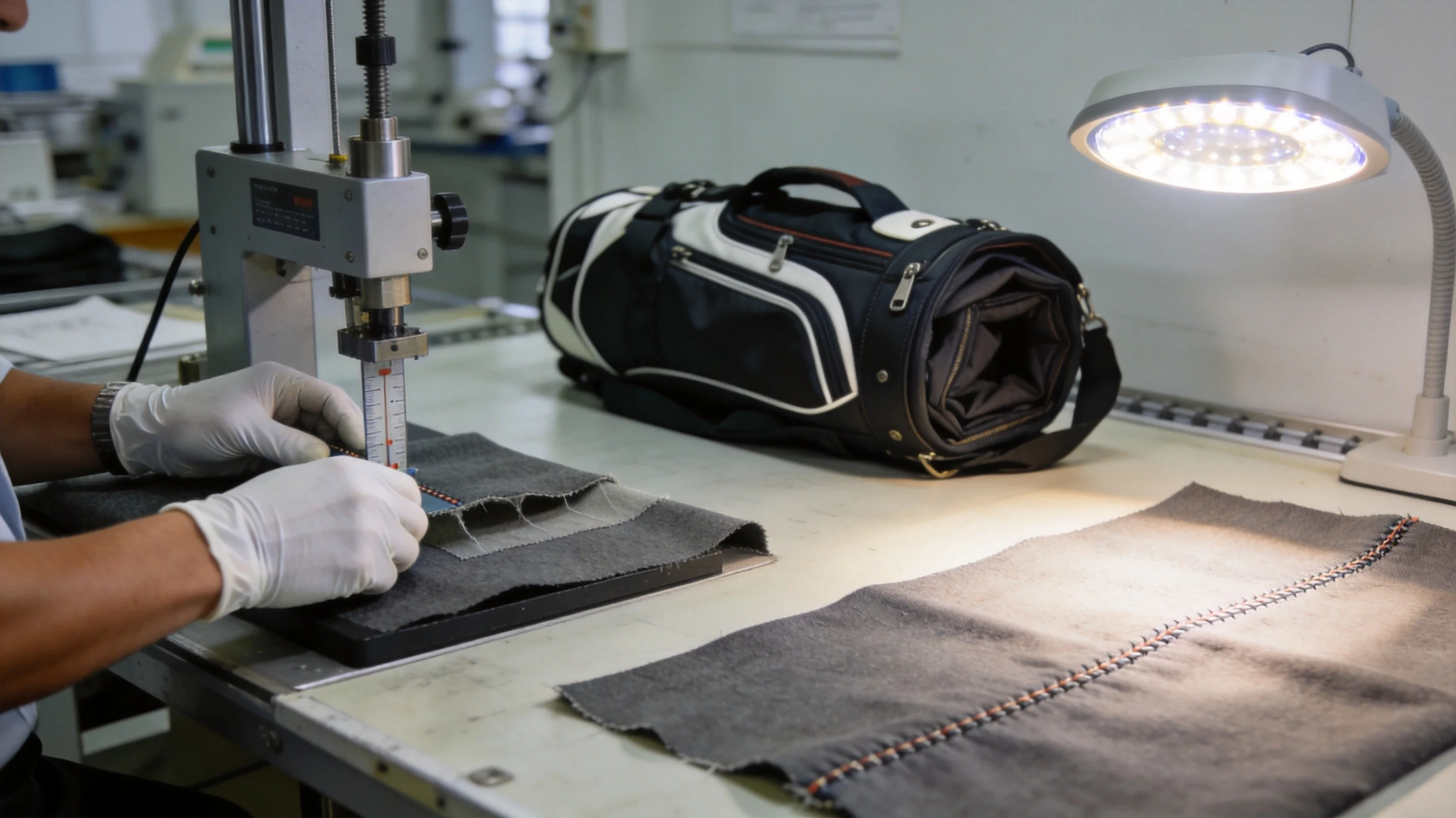
Professional golf bag manufacturing runs six connected quality control steps — incoming material inspection, cutting checks, in-process sewing inspection, hardware and function testing, finished-goods validation against the approved sample, and an AQL-based pre-shipment sample — each gate catching a specific class of defect at the point where it is cheapest to fix; taken together they are what let a 7-line, 126-sewing-machine factory ship consistent quality at 200,000 bags a month. This is a step-by-step breakdown you can hold any supplier to.
Step 1: Incoming Material Inspection
Quality control begins before a single bag is cut, with the raw materials that arrive at the factory. The incoming inspection verifies that every lot of fabric, hardware, zipper, padding and trim matches the specification agreed with the buyer. Fabric is checked for weight, finish and colour consistency; hardware for correct grade, finish and dimensional accuracy.
This first gate is decisive because defects in materials replicate into every finished bag made from them. An off-spec dye lot, a weak zipper or an undersized buckle will surface across the whole run, not just one unit. Catching these at intake — when the faulty stock can be returned or quarantined — protects the entire order at a near-zero cost compared to fixing them inside assembled bags.
Step 2: Cutting Inspection
At the cutting stage, panels are generated from the approved patterns, and inspection verifies they are accurate, complete and free of material flaws. Panels are checked for dimensional accuracy against the pattern, and for any visible defects in the fabric that could not be avoided at intake. Dye-lot discipline is confirmed, keeping panels for one bag consistent in colour.
Cutting is the last point where a defective panel is cheap to replace. Once a flawed panel is sewn into an assembly, correcting it means unpicking seams and re-stitching. By inspecting at cut-off, the factory protects the downstream work and keeps defect correction cost minimal. This is also where panel quantities are reconciled, so sewing never starts short of a component.
Step 3: In-Process Sewing and Assembly Inspection
As panels are sewn and assembled, supervisors and inspectors sample work at defined intervals along the line. Checks focus on seam quality, stitch density and tension, correct seam allowances and reinforcement at load points, and correct assembly of pockets, dividers and connections. The goal is to catch a slip while it affects a few units, not a whole batch.
In-process inspection is where the economics of quality are most favourable. A misfold caught at the station is corrected in seconds; the same defect on a finished, decorated bag requires dismantling and can waste the decoration applied to a panel that must be replaced. By sampling early and often, a well-run line keeps rework minimal and protects its schedule as much as its quality.
Step 4: Hardware and Function Testing
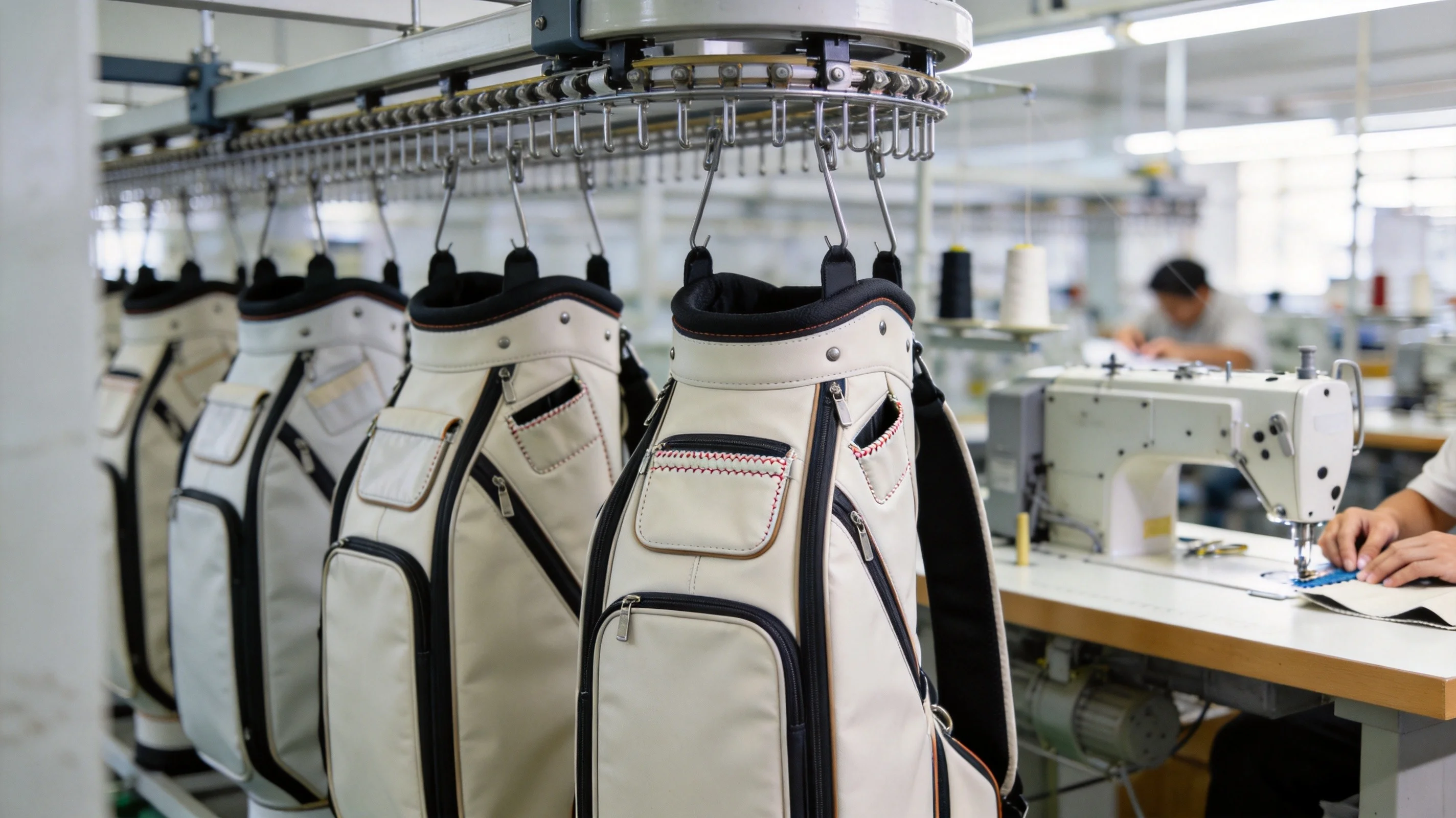
Once assembled, the bag's moving parts and load-bearing elements are function-tested. Zippers are cycled to confirm smooth operation; stand mechanisms on stand bags are extended and retracted repeatedly to verify the mechanism locks; straps and handles are pull-tested under load; and the base is checked for rigidity under weight.
Function testing exists because visual inspection cannot certify performance. A zipper may look fine yet fail after fifty cycles; a strap may look secure yet pull free under a loaded bag. For waterproof and weather-resistant lines, water-resistance testing is added to validate the rating. Defining and running the right tests is part of a serious QC programme and protects real-world use, not just shelf appearance.
Step 5: Finished-Goods Inspection Against the Sample
After finishing and decoration, every bag is checked against the approved sample — the visual and functional benchmark for the entire order. Dimensional checks confirm height, width and depth match spec. Seams and edges are examined for tension, puckering and reinforcement. Decoration is compared to the approved artwork for placement, colour and stitch quality.
The approved sample is the contract for how the finished product must look and behave. Whatever you approve at the sample stage becomes the standard held against every production unit, which is why sample approval deserves such care. A thoroughly inspected, fully specified sample gives the factory an unambiguous target and gives you an enforceable standard. Our sampling guidance details how to build that benchmark correctly.
Step 6: Pre-Shipment Inspection and AQL Sampling
The final gate occurs before the cartons are shipped. Under an AQL (Acceptable Quality Limit) plan, a statistically determined sample is drawn from the finished lot and inspected against the agreed criteria. Defects are rated critical, major or minor, and the lot is accepted only if the sample's defect counts stay within limits. For critical defects, rejection is automatic.
Pre-shipment inspection is often performed by an independent third party such as SGS, who samples objectively, measures against your criteria and issues a report. This independent check protects your container from becoming a costly surprise, and it is strongly recommended for first orders and large shipments. Combining your own AQL criteria with third-party execution gives a verifiable, agreed quality gate. Learn how to configure your plan in our quality standards guide.
Insist on These QC Steps for Your Order
We document and can demonstrate every QC step on request, and welcome independent pre-shipment inspection. ISO 9001 & BSCI certified, SGS and Alibaba verified March 2026.
Set Up Documented QC →The Six Steps at a Glance
For a buyer planning an order, the QC sequence maps cleanly onto production. Holding each step non-negotiable de-risks the entire programme.
| QC Step | Focus | Catch |
|---|---|---|
| 1. Incoming material | Fabric, hardware, zippers | Off-spec supply |
| 2. Cutting | Panel accuracy, flaws | Bad panels early |
| 3. In-process sewing | Seams, assembly | Slips in small batches |
| 4. Hardware & function | Zippers, stand, straps, base | Performance failures |
| 5. Finished goods | Vs approved sample | Visual & dimension drift |
| 6. Pre-shipment | AQL lot sample | Lot-level rejection |
Why Step Order and Staffing Matter
The sequence of the six steps matters as much as their existence. Running each gate in order lets the factory catch defects at the cheapest stage and prevents rework from cascading. Equally important is how the steps are staffed. Genuine QC requires trained inspectors, not operators checking their own work in passing.
Our facility runs this six-step process across 7 production lines with 126 sewing machines and 137 employees, sustaining a 200,000-bag monthly capacity while staffing real inspectors at each gate. That staffing is itself a quality signal: a factory that invests in inspection capacity demonstrates it treats quality as a core commitment rather than an afterthought squeezed between shipments.
Turning the Steps Into Your Sourcing Advantage
These six steps become a buying advantage when you institutionalise them in your own process. Write each gate into your contract, require documented records per order, and reserve the right to pre-shipment inspection. Where a factory resists, that resistance is information. Where one demonstrates the steps openly — with records, photos and a standing invitation to audit — you have found a quality-aligned partner.
Over multiple orders, this discipline compounds. A factory that records defects and corrects root causes (as ours does through its QC system) delivers steadily improving consistency, which is why such partners matter for anyone planning repeat production. For a full framework on selecting and vetting such a supplier, our manufacturer selection guide is the natural next step.
Conclusion
The six quality control steps — incoming material, cutting, in-process sewing, hardware and function, finished-goods and pre-shipment — form the reliable backbone of professional golf bag manufacturing. Each catches a different failure class at the cheapest point to fix it, and together they convert a single approved sample into a dependable thousand-unit run. A buyer who understands and insists on these steps protects their product, their customers and their brand from the costly surprises that poor QC inevitably delivers.
The Economic Logic That Orders the Steps
The six quality control steps are not arranged arbitrarily; their order follows a clear economic logic. Each step catches a class of defect at the point where correcting it costs the least, so the sequence as a whole minimises the total cost of quality while maximising protection. Understanding this logic tells you why the steps exist in this exact order and why skipping any one of them is a false economy.
Catching an off-spec material at intake costs almost nothing, because the faulty stock can simply be returned or quarantined. Catching a bad panel at cutting costs a single inexpensive replacement. But catch the same underlying problem at pre-shipment and it has already consumed sewing, finishing and decoration labour — and potentially an entire container's worth. The earlier the step, the cheaper the correction, which is why the sequence front-loads inspection.
For a buyer this logic is a practical argument. When a factory pressures you to accept only a final inspection, or to rely on their word without gates, you are being asked to abandon the cost structure that protects your order. A factory that runs all six steps in order — and can explain why — is demonstrating that it understands quality economics, not just that it performs inspections.
How the Steps Interlock for Total Protection
The six steps interlock so that each one's checks feed the next. Incoming material inspection establishes that the inputs are sound, giving the cutting inspection meaningful panels to validate. Cutting inspection confirms the panels are correct, so the sewing stations assemble good components. In-process sewing checks keep the build on standard, so finishing validates against a sound product. And finished-goods inspection confirms the sample benchmark, so the pre-shipment AQL sample tests a representative lot.
This interlocking is why a well-run factory never treats the steps as optional checkboxes. Missing an early step does not just remove one check; it undermines the confidence of every later step, because each later gate assumes the earlier ones were effective. The system is only as strong as its weakest link, and skipping a step breaks the chain even when the later inspections pass on the sampled units.
The protection compounds. Because the steps interlock, a defect has to survive multiple independent inspections to reach the customer, and each gate increases the odds of catching it. This layered defence is precisely what a serious factory offers when it commits to all six steps, and it is the basis of consistent, dependable output over thousands of units.
Staffing, Training and QC Depth
Reliable quality control depends on the people who run it. A professional factory does not rely on operators checking their own work in passing; it deploys dedicated, trained inspectors at each gate, independent of production, whose only job is to verify that the product meets standard. Segregation of checking from making is a core principle that prevents bias from creeping into results.
Training gives inspectors the standard definitions and measurement skills to evaluate consistently. They must know what constitutes a critical, major or minor defect, how to measure dimensions accurately and how to record results without ambiguity. Consistent inspection requires consistent standards in the inspector's mind, which is a product of training and experience rather than intuition.
Our facility deploys this depth of inspection across its seven lines, with enough trained inspectors to cover every gate even at full capacity. That staffing is a deliberate quality investment, and it is part of how we protect the six-step process in practice. For a buyer, asking how inspectors are trained and whether they are independent of production reveals whether a factory's QC commitment is institutional or merely rhetorical.
Verifying the Steps Yourself
You do not have to take a factory's word that the six steps run properly; you can verify them. Request the inspection checklists used at each gate, ask for documented results for a recent order, and reserve the right to a pre-shipment inspection under your agreed AQL plan. Where a factory shares these openly, you have evidence that the steps are real. Where it resists, that resistance is itself information about the depth of its QC commitment.
Combining your own documentation demands with an independent third-party inspection is the strongest verification. Firms such as SGS execute the pre-shipment step objectively, draw their own sample and issue a report you can rely on. Backed by our own recorded checks and an open-doors audit policy, a prey's independent pre-shipment inspection closes the loop on the entire six-step process.
When every step is documented and independently verified, quality control stops being a claim and becomes a record. That is the standard we offer at our facility, and it is the standard that lets a buyer ship thousands of bags with the confidence that each one was protected through every stage of production. Learning to verify the steps is the final, most empowering skill in working with a quality factory.
Common QC Failures and How to Avoid Them
Even well-designed QC systems face predictable pitfalls, and knowing them helps a buyer recognise where a factory may be cutting corners. The most common failure is restricting inspection to finished goods only, abandoning the early gates where defects are cheapest to fix. A second is letting production self-inspect, removing the independence that makes checking trustworthy. A third is undocumented inspection, which collapses into unverifiable claims the moment a dispute arises.
Each failure reflects a real temptation. Cost pressure pushes factories to drop early gates and let operators check their own work; convenience pushes them to skip paperwork. A serious factory resists these pressures because it understands that the early gates and independent inspectors are what make the later steps meaningful and the whole run consistent. Recognising these pitfalls lets you ask whether a factory has fallen into them.
For a buyer, the defence is to contract the full six-step process, require documentation, reserve pre-shipment inspection and treat a factory's willingness to be audited as a quality signal. Our own facility counters these pitfalls with trained, independent inspectors and documented records under ISO 9001. Where a factory is transparent about maintaining the full sequence, you have found the discipline that protects your order through every gate.
Independent Third-Party Inspection as Final Assurance
The strongest final assurance a buyer can build into the six-step process is an independent third-party pre-shipment inspection. Rather than relying solely on the factory's own results, an independent firm such as SGS draws its own statistically valid sample, inspects against the agreed AQL criteria and issues its own report. This adds an objective, unbiased layer over the factory's in-house gates.
Independent inspection matters most for first orders and large shipments, where trust is unproven or the cost of a bad batch is highest. It removes the conflict of interest inherent in a factory evaluating its own output, and its report is a document you can rely on, share and enforce against. For most importers it is among the cheapest risk-reduction measures available relative to the value of a container.
Our facility welcomes independent inspection on every order and holds the AQL criteria agreed with the buyer, so the third party verifies genuine conformity rather than a hidden standard. Combining our documented in-house gates with an independent sample gives you belt-and-braces assurance that the six steps are working. It is the clearest way to close the process with verified, trustworthy confidence.
The Documentation Trail Behind Each Step
Each of the six steps leaves a documented record, and together these form the evidence that quality control genuinely happened rather than being asserted. Incoming-material inspection produces certificates and inspection notes; cutting and in-process gates capture dimensional and workmanship checks; the assembly and final-goods gates produce inspection and rework records; and the AQL gate yields a formal lot report. This paper trail is the auditable backbone of the process.
Documentation matters most when things go wrong — which is exactly when memory is least reliable. A documented trail lets a defect be traced to its source, whether that is a material batch, an operator station or a specific step, so the fix is targeted rather than guessed. It also protects you in a dispute: the records are objective evidence of what was checked and what passed.
Because we operate a documented ISO 9001-style system, we maintain this trail on every order and can show it to a buyer as evidence of process integrity. When you ask a factory for its inspection documentation and it cannot produce coherent records, you are seeing a process that runs on claim rather than control. The documentation is not bureaucracy; it is the verifiable difference between a genuine six-step QC system and a slogan.
Getting Started With a Qualified Partner
The most practical way to turn this groundwork into a reliable product is to engage a factory with verifiable credentials, proven output and transparent process. A qualified facility founded in 2014, staffed by a team whose founder entered the industry in 2004, brings more than twenty years of hands-on knowledge to every programme. That experience shows in faster sampling, fewer defects and sound advice at each decision point.
At our facility in China, seven production lines and 126 sewing machines support a 137-person team producing about 200,000 golf bags a month for 200+ brands sold to 100+ countries. Backed by SGS factory audits and BSCI-aligned practices, we combine real capacity with documented quality control, so you can validate us before committing. Whether you begin with a 100-piece test order or move straight to a full production run, the milestones you have read here are the milestones we apply to your order.
To start, bring a detailed specification and an honest sense of your volume and deadline, and we will map the stages, timings and costs for your exact programme. With direct contact to our export team, service@junyuanbags.com or +86 17750020688, you can begin a conversation that moves quickly into a structured plan. The process and standards described above are not theory; they are the operating reality you are welcome to verify before your first container ships.
Our Factory Profile and How It Shapes This Standard
The standards and timings described here reflect how we actually operate. QUANZHOU JUNYUAN BAGS runs a 4,950 sqm
factory as an affiliated production partner, a facility founded in 2014 by a founder who entered the golf bag industry in 2004 — more than twenty years of hands-on manufacturing experience. It operates seven production lines with 126 sewing machines and a team of 137 employees, producing on the order of 200,000 golf bags per month for more than 200 brands in over 100 countries.
For custom and OEM/ODM work, our standard MOQ is 200 pieces, with a lower 100-piece test order available to validate a design before scaling. Prototype sampling runs 10-20 days, and bulk production runs 45-60 days, giving you a realistic, verifiable window rather than an optimistic promise. Our quality and compliance record is independently confirmed: the factory has completed SGS factory audits and its management system is documented under the ISO 9001 framework.
Questions on how these numbers apply to your product are welcome. Our export team is reachable at service@junyuanbags.com or +86 17750020688, and you can explore the services we offer through our OEM/ODM services and process guide pages. Wherever an order begins, these are the concrete operating figures behind every bag we build.
Sources
Frequently Asked Questions
- What are the main quality control steps in golf bag manufacturing?
- Incoming material, cutting, in-process sewing, hardware and function, finished-goods against the sample, and pre-shipment AQL sampling.
- When does quality control happen in golf bag production?
- Continuously through production - at intake, during cutting and sewing, after finishing, and again at pre-shipment. It is a chain of gates, not one final check.
- What is a pre-shipment inspection for golf bags?
- A statistically representative sample of the finished lot is checked against the agreed criteria and AQL plan before export, often performed by a third party.
- How many QC steps does a golf bag go through?
- A professional programme passes through five or six QC gates, with multiple checkpoints possible within each gate.
- Can I witness or require QC steps on my golf bag order?
- Yes. Require documented inspection at each gate, request in-line or final photos, and contract an independent pre-shipment inspection against an agreed AQL plan.