How Golf Bag Factories Ensure Consistent Product Quality
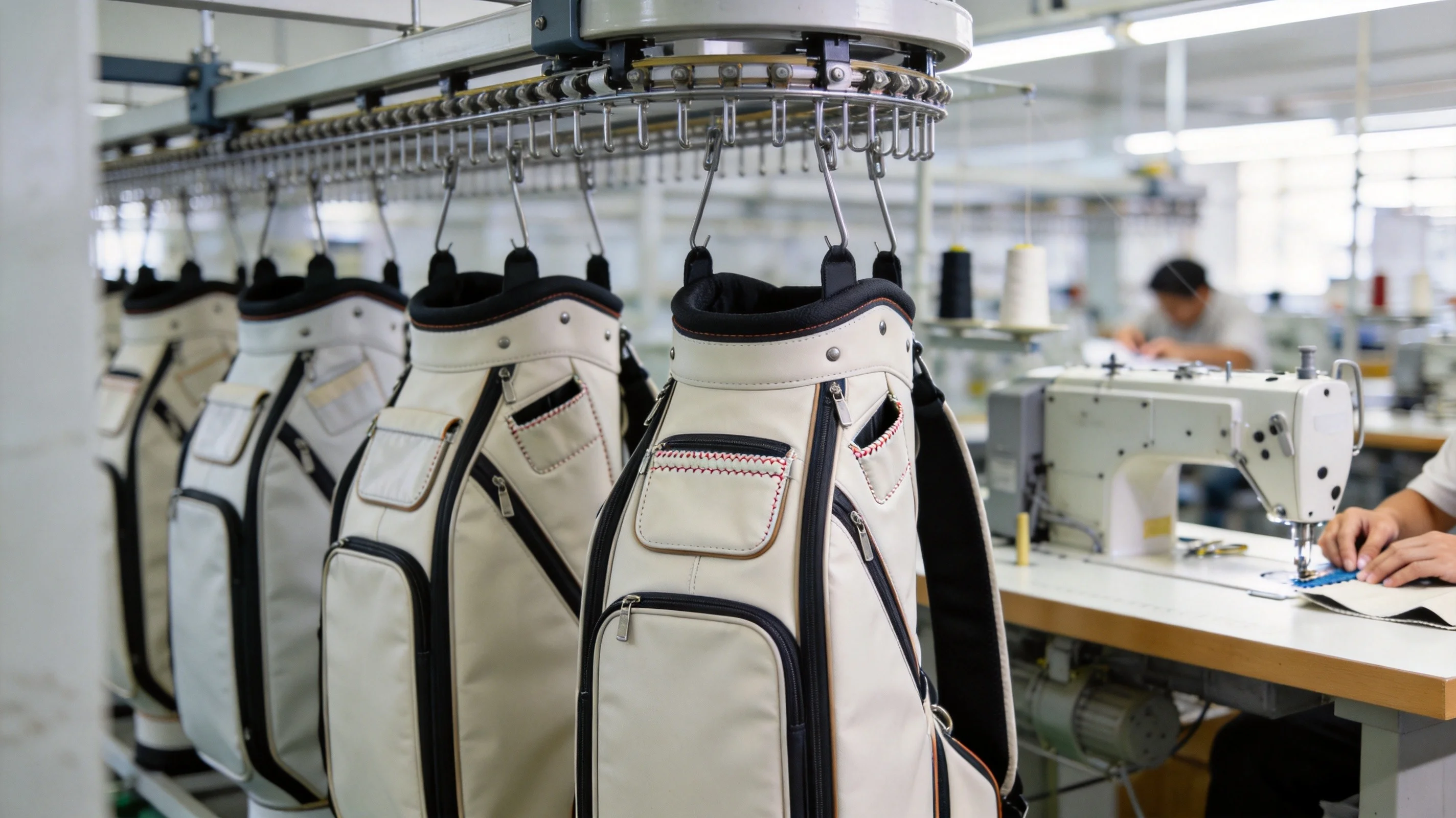
Golf bag factories ensure consistent product quality by standardising the build into defined operations, cutting all panels from identical patterns, running dedicated production lines with trained operators, staffing inspectors at each QC gate, controlling materials by dye lot and batch, and verifying the lot through an AQL pre-shipment inspection — the combination that lets a 7-line, 126-sewing-machine ISO 9001 certified factory deliver uniformly good bags at 200,000 units a month. Here is how that consistency is actually achieved.
Why Consistency Is the True Test of a Factory
Any factory can produce one good bag — the challenge is producing ten thousand identical good bags. A single great sample proves little; what a buyer actually purchases is the factory's ability to repeat that sample across an entire, high-volume run. Consistency is therefore the truest measure of manufacturing maturity, and it is what separates a managed plant from a workshop.
Inconsistent output has a direct business cost. Colour drift between bags, pockets sewn at slightly different heights, zippers of mixed grades — all of it erodes brand quality in the field and generates returns and complaints. Consistency, by contrast, builds the reliable product experience that customers and buyers both depend on. Understanding how factories achieve it lets you select a partner on the evidence that matters.
Standardisation of the Build Process
Consistency begins with standardising how every bag is built. The production is broken into defined, documented operations — cutting, specific sewing steps, hardware setting, finishing — each performed to a written standard rather than an operator's judgment. This removes most natural human variation, because every station follows the same instructions for every unit.
Standardisation extends to machine setup. Sewing machines are tension-set and calibrated for the fabric and thread of the current order; stitch density is specified; seam allowances are fixed. When every machine and operator works to the same standard, dozens of cars out of your line are indistinguishable. This is the foundation that makes all the other control measures meaningful.
Identical Patterns and Batch Cutting
Panels are the second battleground of consistency. All panels for an order are cut from identical patterns, ideally in a single cutting session or from a calibrated cutter, so that dimensional variation between panels approaches zero. When the two halves of one bag come from the same cutting run, they fit together cleanly and match in size.
Batch cutting and dye-lot control work together. Fabric panels for one order are kept within the same dye lot, so colour is uniform across every bag in the shipment. A panel cut from a different dye lot would introduce visible colour differences that destroy perceived quality even if the construction is flawless. Discipline here is a quiet but decisive factor, and it is reinforced at the incoming-material and cutting inspection gates.
Dedicated Lines and Trained Operators
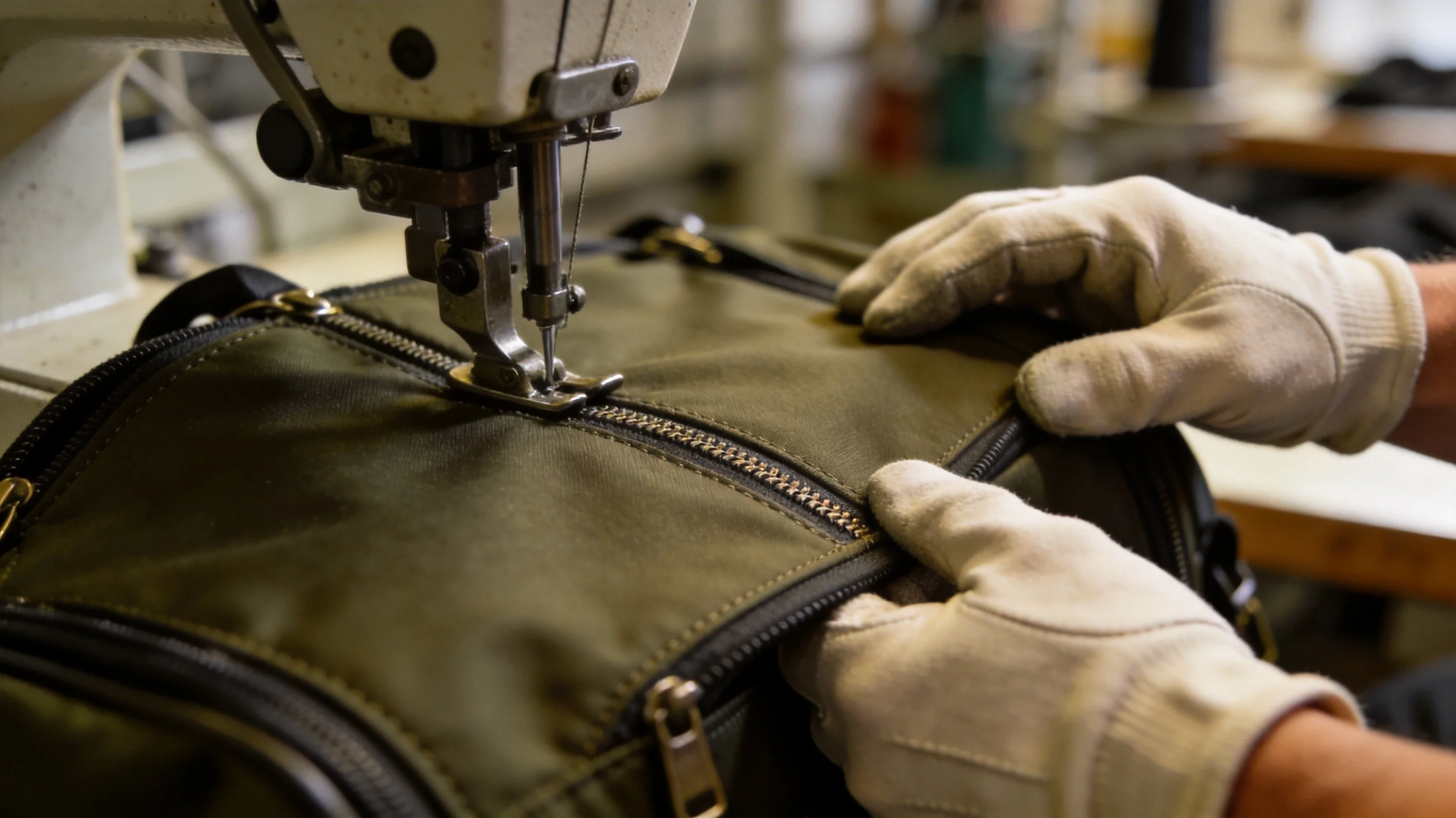
Consistency is also a function of how production is organised and staffed. Dedicated production lines, each building one product type in flow, let operators become deeply skilled at their specific operations. A sewer who sets zippers all day, every day, is far more consistent than one who rotates across different tasks and products.
Operator training and stability reinforce this. A factory that invests in training and retains its workforce builds skill into the process rather than constantly re-hiring and re-teaching. Our 137 employees across 7 lines and 126 sewing machines are organised and trained on this principle, which is a large part of how we sustain 200,000 units a month without quality drift.
QC Gates as Consistency Checkpoints
Every consistency achievement must be verified, which is the role of the QC gates. Incoming materials are checked and quarantined if off-spec; cutting is inspected for panel accuracy and flaw; in-process sewing is sampled at intervals; finished goods are validated against the approved sample; and the lot is verified by pre-shipment AQL sampling. Each gate catches a class of variation before it multiplies.
The gates also feed data back into the process. When a gate reveals a recurring issue, the factory traces it to a cause — a machine calibration drift, a material lot, a training gap — and corrects it. This closes the loop so consistency improves over time rather than simply being inspected after the fact. It is the difference between checking for consistency and building consistency in.
Looking for Proven Batch Consistency?
ISO 9001 & BSCI certified, SGS and Alibaba verified March 2026, serving 200+ brands across 100+ countries with documented per-order QC. Contact us to review consistency records.
Verify Our Consistency →Material and Supplier Control
Consistent output is impossible with inconsistent inputs, so serious factories control their suppliers with the same rigour they apply to their own lines. Materials are sourced from qualified suppliers to stable specifications, and each incoming lot is verified against those specifications. Hardware grades, fabric weights and finishes are locked to the product spec rather than traded on price.
This supplier discipline protects the product through the whole order. If a factory allowed cheaper zippers or thinner fabric into a run to protect a margin, it would reintroduce exactly the inconsistency the control system exists to remove. A factory's willingness to hold material standards even when margins tighten is a strong signal of genuine quality commitment, a theme our materials guide explores in detail.
Reference Sample Control and Locked Specifications
All consistency ultimately anchors to a single reference: the approved sample and the written specification. The sample fixes appearance, construction and details; the specification fixes the measurable values — dimensions, material weights, stitch density, hardware grades, decoration placement. Every production unit is held to both.
Locking the specification is the buyer's responsibility every bit as much as the factory's. A vague or changing spec invites drift, because the factory cannot produce consistently to requirements that keep moving. Agreeing a complete, frozen specification at sample approval — with tolerances — is what makes consistency achievable. Our sampling guidance and quality standards guide walk you through building that locked benchmark.
How Consistency Is Measured and Reported
Consistency should be measured, not assumed. The primary tool is the AQL pre-shipment inspection, which samples the lot statistically to test whether it meets the agreed criteria. Defect rates and their classification (critical, major, minor) give an objective, comparable measure of how well the run held to standard.
Modern factories also track defect trends over time. A falling defect rate across successive orders is the strongest evidence a factory is genuinely improving consistency; a flat or rising one warrants investigation. When a factory will share such data — and ours maintains documented records per order — it is offering proof rather than reassurance. Combining your own AQL requirement with an independent third-party execution such as SGS gives the most credible verification.
The Factory Quality Systems That Underpin Consistency
Consistency is finally underwritten by formal quality systems. ISO 9001 requires documented process control and continuous improvement, giving structure to the standardisation and gates described here. BSCI audits social compliance, protecting the stable workforce that consistency depends on. Independent factory audits — such as the SGS and Alibaba verification our facility passed in March 2026 — evidence that these systems are real and running, not just claimed on a webpage.
Taken together, ISO 9001 for process, BSCI for labour and an independent audit for proof form a credible quality ecosystem. They are the institutional reason a buyer can trust a factory's consistency claims, and they are why our partnership evaluations, set out in the manufacturer selection guide, weigh certification and audit evidence heavily.
Consistency Drivers at a Glance
For anyone evaluating or managing a custom golf bag programme, the key consistency drivers are worth summarising as a reference.
| Consistency Driver | What It Controls | Failure Symptom |
|---|---|---|
| Standardised operations | Build method per station | Operator-to-operator variation |
| Identical patterns | Panel dimensions | Mismatched panels |
| Dye-lot & batch control | Colour & finish uniformity | Colour drift between bags |
| Trained operators | Sewing skill & speed | Inconsistent seams |
| QC gates | Variation at each stage | Defects compound late |
| AQL pre-shipment | Lot acceptance | Off-standard lot ships |
Conclusion
Consistent product quality is not luck; it is engineered. Golf bag factories achieve it by standardising the build, cutting from identical patterns, controlling materials by batch and dye lot, running dedicated trained lines, staffing QC gates and verifying the lot through AQL inspection — all under formal ISO 9001 and BSCI quality systems. For a buyer, choosing a factory that demonstrably runs this machinery of consistency is the single most reliable safeguard for your brand across every unit of every order.
Consistency Across Batches and Over Time
Consistent quality has two dimensions: consistency within a single batch (every unit in one order matches) and consistency across batches over time (each order matches the last). Both matter, and they are achieved by the same discipline but tested differently. Within-batch consistency is managed by dye-lot control and single-pattern cutting; across-batch consistency is maintained by locked specifications and archived reference samples that allow a new order to reproduce the original standard.
Across-batch consistency is where many smaller factories fall down. They can match a sample once, but without archived reference samples, frozen specifications and controlled materials, the second and third orders drift. Colour shifts subtly, dimensions change marginally, hardware grades wobble. The customer notices even when no single change is dramatic. Consistency across time is what builds a reliable, repeatable product line.
For a buyer planning reorders and seasonal seasons, this second dimension is decisive. The whole point of an approved sample and a frozen specification is that they become the durable benchmark for every future production run. A factory that archives these and reproduces them faithfully gives you a product you can reorder with confidence — and that continuity is what turns a single order into a dependable supply relationship. Our quality standards guide covers how to lock the criteria that make cross-batch consistency enforceable.
The Human Factor in Consistency
Behind every consistency mechanism stands the human factor. Operators who are well trained, well supervised and fairly treated produce more consistent work than a workforce that is unstable or under-resourced. Skill is built over time, and a factory that retains its staff builds consistency into its people as well as its processes. High turnover is a silent enemy of uniform output.
Supervision reinforces the human factor. Line supervisors and inspectors catch drift in technique before it becomes widespread, correct it at the station and keep operators aligned with the build standard. This coaching role is part of consistency: it prevents the gradual, uncontrolled variation that plain inspection alone cannot stop because by the time inspection flags it, many units are already affected.
This is one reason social compliance is not separate from quality. A stable, fairly treated, well-trained workforce (the domain of BSCI audits) is a skilled and consistent one. Treating people well and consistency in output are connected, which is why our facility pairs ISO 9001 quality management with BSCI certification. For a buyer, a factory that respects and retains its team is investing, indirectly but powerfully, in the consistency of its product.
Audits and Certifications as Evidence
Consistency is a claim that deserves independent evidence, which is why audits and certifications matter. ISO 9001 certification evidences disciplined process control; BSCI evidences a compliant, stable workforce. Independent factory audits — such as the SGS and Alibaba verification our facility passed in March 2026 — confirm that the stated capacity, equipment and systems are real and operating.
These credentials are particularly valuable to remote buyers who cannot visit. They package, into a readable report, the institutional reasons to trust a factory's consistency claim. Combined with reference brands that attest consistent output, they give a buyer an evidence base for partnering rather than a leap of faith.
When evaluating a supplier, treat certification and audit evidence as a minimum bar rather than a marketing flourish. Ask to see the certificates, read the audit findings and reference the brands. The strongest evidence of consistency is a documented, audited, referenced track record — and that is the basis on which a buyer can commit with confidence to a factory whose quality is genuine and durable.
How You Protect Consistency From Your Side
Consistency is a shared responsibility. The factory controls the process, but you create the conditions for it by locking the reference. Approve your sample rigorously, freeze the specification with tolerances, avoid changing requirements mid-run and communicate clearly. A stable, well-defined brief is the partner to a stable, well-run process.
Conversely, changing specifications after approval, or leaving them vague, invites the very inconsistency you fear. A factory cannot consistently produce to requirements that keep moving. The stronger and more complete your specification — and the more decisively you approve the sample — the easier it is for the factory to hold every unit and every batch to the same standard.
Good consistency is engineered from both sides of the table. When a buyer provides a locked, unambiguous brief and a factory runs the full consistency machinery of standardisation, batch control, QC gates and validated audits, the result is a product that arrives as designed, reorders predictably and earns the trust on which lasting partnerships and growing brands are built.
Consistency Testing: Sampling and Statistical Lotto
Because a factory cannot inspect every unit of a large order economically, consistency is verified by sampling under a statistically valid plan — most commonly under the AQL (Acceptable Quality Limit) method. A sample is drawn from the lot and inspected against the agreed criteria; the lot is accepted or rejected depending on the number of defects of each severity the sample reveals. This converts consistency from a hope into a measurable, verifiable property.
Sampling works because it is governed by agreed rules rather than spot checks. The sample size, the defect classification and the acceptance limits are decided in advance, so both buyer and factory know exactly what constitutes a passing lot. This objectivity prevents argument at the container and gives each side confidence that the inspection will be fair.
At our facility, sampling under AQL is the final gate after the layered in-house checks, and a common contract is AQL 2.5 major and 4.0 minor. Combining our internal sampling discipline with an optional independent third-party execution (such as SGS) gives a buyer the strongest evidence that the whole lot — not merely the inspected units — holds to standard. Sampling is how consistency, built through the whole process, is finally certified before a container ships.
Building Consistency Into Repeated Orders
Consistency truly proves itself across repeated orders, and that takes more than a single well-executed run. It requires archived reference samples, frozen specifications, controlled materials and recorded process history that together let each new order reproduce the standard of the last. Without these, the second and third orders drift even if the first was excellent.
A factory that systematically archives and reuses the reference — and that feeds forward the lessons of each order — is building a compounding advantage. Defect rates trend down, setup time falls, and each subsequent order arrives closer to the benchmark. For a buyer planning seasonal repeats, this improving consistency is the hidden value of a long-term partnership over one-off sourcing.
Serving 200+ brands across 100+ countries, our facility has the depth of history to support this cross-order consistency. By locking the reference and letting the discipline of each order strengthen the next, we help repeat buyers ship reliably season after season. Consistency is not a one-time achievement but a durable capability, and it is the capability that transforms a good supplier into a trusted partner.
Communication and Feedback Loops
Consistency also depends on communication and feedback loops that seem simple but are powerful. Clear, documented communication at each gate — confirmed materials, approved samples, frozen specifications — prevents the silent drift that erodes consistency. And a feedback loop that channels inspection findings back into training and process adjustments makes each order's lessons improve the next.
Feedback loops are what turn a single-quality process into a compounding one. When a rework pattern points to a specific sewing station, that finding informs retraining; when a material issue recurs, it feeds a supplier review. Over repeated orders this tightening produces the improving consistency that long-term brands notice and rely on.
On our side, this is built into how we run nearly 200,000 bags a month for 200+ brands: disciplined communication keeps every order aligned with its reference, and feedback keeps the process learning. For a buyer, choosing a partner with genuine feedback loops means your second and third orders get better, not riskier. Consistency is maintained both by strict gates and by a culture that continuously learns from them.
Getting Started With a Qualified Partner
The most practical way to turn this groundwork into a reliable product is to engage a factory with verifiable credentials, proven output and transparent process. A qualified facility founded in 2014, staffed by a team whose founder entered the industry in 2004, brings more than twenty years of hands-on knowledge to every programme. That experience shows in faster sampling, fewer defects and sound advice at each decision point.
At our facility in China, seven production lines and 126 sewing machines support a 137-person team producing about 200,000 golf bags a month for 200+ brands sold to 100+ countries. Backed by SGS factory audits and BSCI-aligned practices, we combine real capacity with documented quality control, so you can validate us before committing. Whether you begin with a 100-piece test order or move straight to a full production run, the milestones you have read here are the milestones we apply to your order.
To start, bring a detailed specification and an honest sense of your volume and deadline, and we will map the stages, timings and costs for your exact programme. With direct contact to our export team, service@junyuanbags.com or +86 17750020688, you can begin a conversation that moves quickly into a structured plan. The process and standards described above are not theory; they are the operating reality you are welcome to verify before your first container ships.
Our Factory Profile and How It Shapes This Standard
The standards and timings described here reflect how we actually operate. QUANZHOU JUNYUAN BAGS runs a 4,950 sqm
factory as an affiliated production partner, a facility founded in 2014 by a founder who entered the golf bag industry in 2004 — more than twenty years of hands-on manufacturing experience. It operates seven production lines with 126 sewing machines and a team of 137 employees, producing on the order of 200,000 golf bags per month for more than 200 brands in over 100 countries.
For custom and OEM/ODM work, our standard MOQ is 200 pieces, with a lower 100-piece test order available to validate a design before scaling. Prototype sampling runs 10-20 days, and bulk production runs 45-60 days, giving you a realistic, verifiable window rather than an optimistic promise. Our quality and compliance record is independently confirmed: the factory has completed SGS factory audits and its management system is documented under the ISO 9001 framework.
Questions on how these numbers apply to your product are welcome. Our export team is reachable at service@junyuanbags.com or +86 17750020688, and you can explore the services we offer through our OEM/ODM services and process guide pages. Wherever an order begins, these are the concrete operating figures behind every bag we build.
Sources
Frequently Asked Questions
- How do golf bag factories keep quality consistent in large orders?
- By standardising operations, cutting all panels from identical patterns, running dedicated lines, staffed QC gates, and controlling material by dye lot and batch.
- What causes inconsistency in golf bag production?
- Loose process control: operator variation, uncalibrated cutting, mixed dye lots, skipped inspection and staff turnover. Standardisation and training remove most of it.
- What is batch or lot control in golf bag manufacturing?
- Keeping all panels and materials for one order consistent in colour and spec, segregated by dye lot and batch, so a full order comes out uniform.
- How do factories verify consistency before shipping?
- Through an AQL pre-shipment inspection that samples the lot statistically against the agreed criteria and approved sample, often done by a third party.
- Can a factory prove its quality consistency?
- Yes - via ISO 9001 certification, audits such as SGS or BSCI, documented per-order QC records, defect trend data and reference brands.