Waterproof Options in High-End Golf Staff Bags
Waterproofing in high-end golf staff bags comes in three clearly defined levels — water-repellent finishes (a DWR or coated shell that sheds showers), water-resistant builds (the same shell plus sealed seams and water-resistant zips on the pockets that matter), and fully waterproof construction (laminated face fabric, sealed zips and welded or taped seams whose entire envelope keeps rain out for prolonged, heavier downpours). Choosing between them is a matter of honest matching: how much rain and how much handling the bag will actually face, because a true waterproof build costs more, weighs more and needs different maintenance than a simply water-repellent one. This guide, written by QUANZHOU JUNYUAN BAGS, explains the waterproofing options available in high-end staff bags, how their performance claims are tested and rated, and how an affiliated factory builds each level consistently.
Why Waterproofing Matters on a Professional Staff Bag
A professional staff bag carries far more than clubs — it carries the working wardrobe of the round: outerwear, spare gloves, balls, towels and valuables. Rain is not an occasional inconvenience on tour or at a busy academy; it is a recurring condition across most seasons. When a shower hits mid-round, a bag that keeps its contents dry protects both the equipment and the player’s or coach’s ability to continue comfortably.
Water exposure also attacks the bag itself. Repeated soak-and-dry cycles degrade uncoated fabrics, weaken stitching and breed mildew in damp compartments, shortening the life of a significant investment. A high-end staff bag that is built to handle weather — or upgraded to do so — keeps functioning and looking right for more seasons, which is exactly what a premium price is meant to buy.
The practical question is not whether waterproofing is desirable — it clearly is — but how much is warranted. A bag for a dry-region club that rarely sees rain does not need a fully sealed build; one for a links course or a wet-weather market does. Understanding the levels is the first step to buying the right amount of water protection rather than overpaying or under-protecting.
The Three Levels of Water Protection Defined
The industry conversations around waterproofing are clearer when you keep three distinct levels separate. The first is water repellency: a fabric treated with a DWR (durable water repellent) coating, or a PU-coated shell, that makes rain bead off and run away rather than soak in. This is the everyday minimum on a modern staff bag and is enough for light showers and morning dew.
The second level is water resistance. A water-resistant build keeps the water-repellent shell but adds the engineering that blocks the routes moisture actually takes — sealed or taped seams so water cannot enter through stitching, plus water-resistant zips on the main and valuables pockets. This holds off sustained rain around the outside of the bag long enough for a round, while still allowing air through and keeping the bag reasonably light.
The third level is fully waterproof construction. This uses a laminated face fabric (the shell itself is built to block water, not just coated), welded or fully taped seams, and waterproof zips across the envelope. A genuinely waterproof staff bag keeps the interior dry through prolonged, heavy downpours — the standard a wet-links player expects. Our waterproof-golf-bags-ultimate-guide compares the full spectrum in depth so a buyer can match the level to the market.
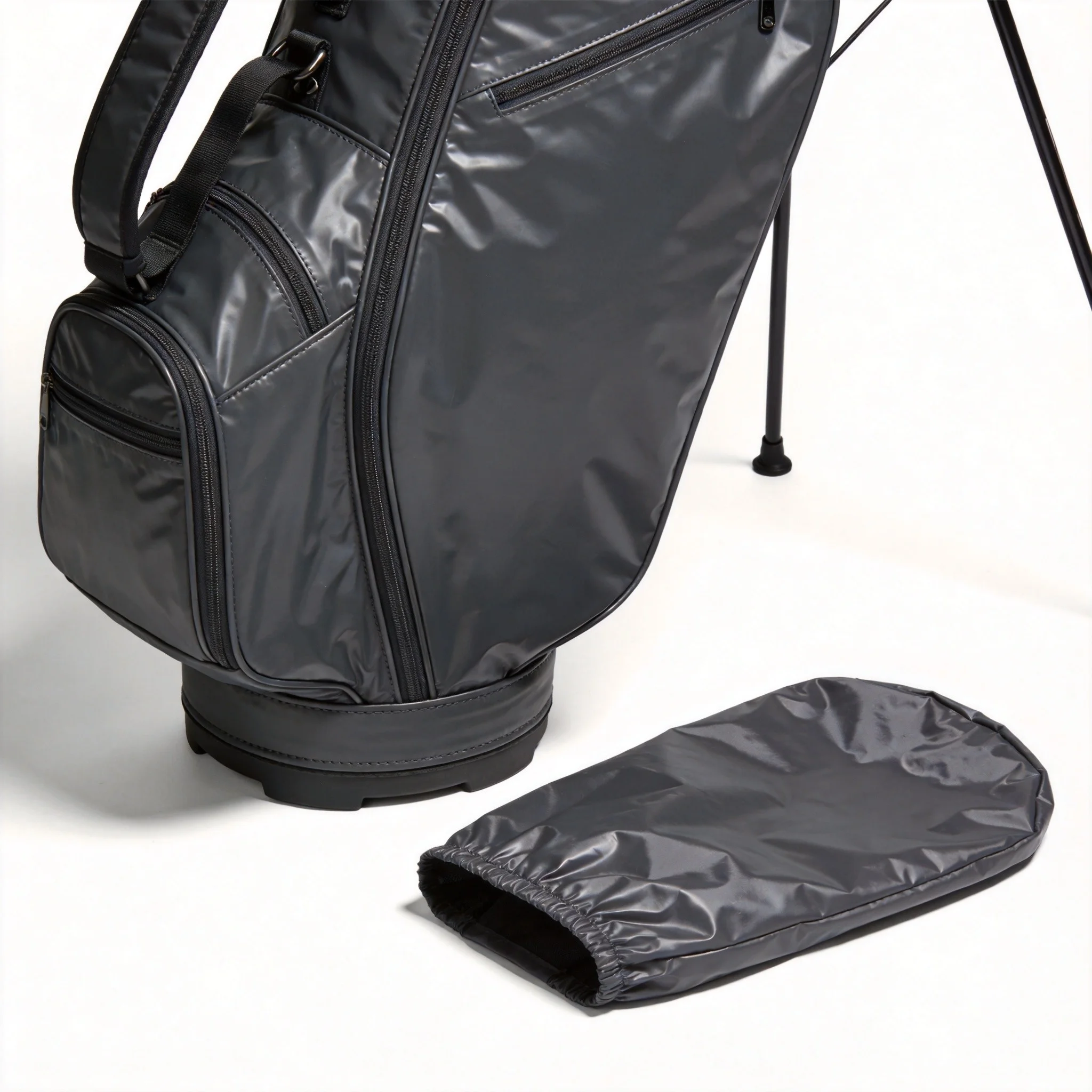
The Rain Hood Is the First Line
A tour-grade rain hood covers club heads and the top of the bag, deploying fast in a sudden shower and staying secured in wind.
Where Rain Actually Gets In
To spend on waterproofing intelligently, it helps to know where moisture enters a staff bag. The most obvious route is the top — the club mouth — which a rain hood seals. The next are the zips, whose teeth are natural wicking paths on a closed pocket. Then come the seams, where water can creep through stitching even on a coated fabric. Finally, the base and the bottom edges sit against wet cart trays and wet ground, wicking upward through seams unless the base is sealed.
A well-engineered water-resistant staff bag attacks each route in order of priority: a good rain hood for the top, water-resistant zips for the highest-use pockets, taped seams on the lower and seam-heavy zones, and a raised or reinforced base. A fully waterproof build seals all of them. Understanding these entry points explains why two bags that look identical can perform very differently in rain — one treats the routes, the other only paints the fabric.
It also explains the maintenance story. Seams and zips are where waterproofing fails first in the field, so these are exactly the areas to inspect seasonally and to re-treat when the DWR ages. Our guide to maintaining waterproof coatings covers how to protect that investment over time.
How Waterproof Claims Are Rated and Tested
Waterproofing claims are only useful if they are defined, and the industry has standards to anchor them. Hydrostatic head testing measures how much water pressure a fabric resists before leaking — higher numbers meaning a more waterproof shell — while seam-sealing and zipper grades are documented in the specification. IPX-style ratings, familiar from outdoor gear, give a shorthand for how much exposure a construction is designed to survive.
At the factory, water testing is a concrete step, not a marketing phrase. We test fabric hydrostatic resistance, inspect seam sealing, cycle zips for sealing integrity, and run wet-weather assembly checks to confirm the envelope holds before a bag ships. Testing methodology is documented in our quality standards guide, and our guide to testing waterproof quality explains what a buyer should ask for in a test report.
Honest ratings matter because waterproofing is expensive. A buyer needs a claim they can verify against a test report and a specification sheet, not a vague “waterproof” label. When a factory can show you the hydrostatic number and the sealing method, the level claim is credible; when it cannot, that is a signal to treat the claim as marketing.
Materials Behind a Water-Proof Staff Bag
The fabric is the foundation of any weather-ready staff bag. Fully waterproof builds use laminated shells — often a PU or TPU coated, laminated technical nylon — whose face layer itself blocks water. Water-repellent builds use coated, tightly woven nylons or polyesters that shed showers while staying lighter and more flexible. The choice balances protection against weight, cost and feel.
Zips are a category of their own. Water-resistant zips with a coated tape slow water entry dramatically; fully waterproof zips add a sealing lip for the complete envelope. On a high-end staff bag, the valuables and ball pockets most deserve the upgrade, since they carry the items most vulnerable to water. Hardware needs corrosion resistance for the same reason — a nickel- or stainless-grade finish survives the wet than a cheap plating.
The same material reasoning extends across the premium range. Our golf bag materials guide details the technical fabric families and when each is the right construction choice, from standard premium down through water-ready and fully waterproof.
For buyers who need a bag to perform in genuinely wet climates, our custom waterproof bags for wet climates page shows how a whole order can be engineered around weather from the shell up.
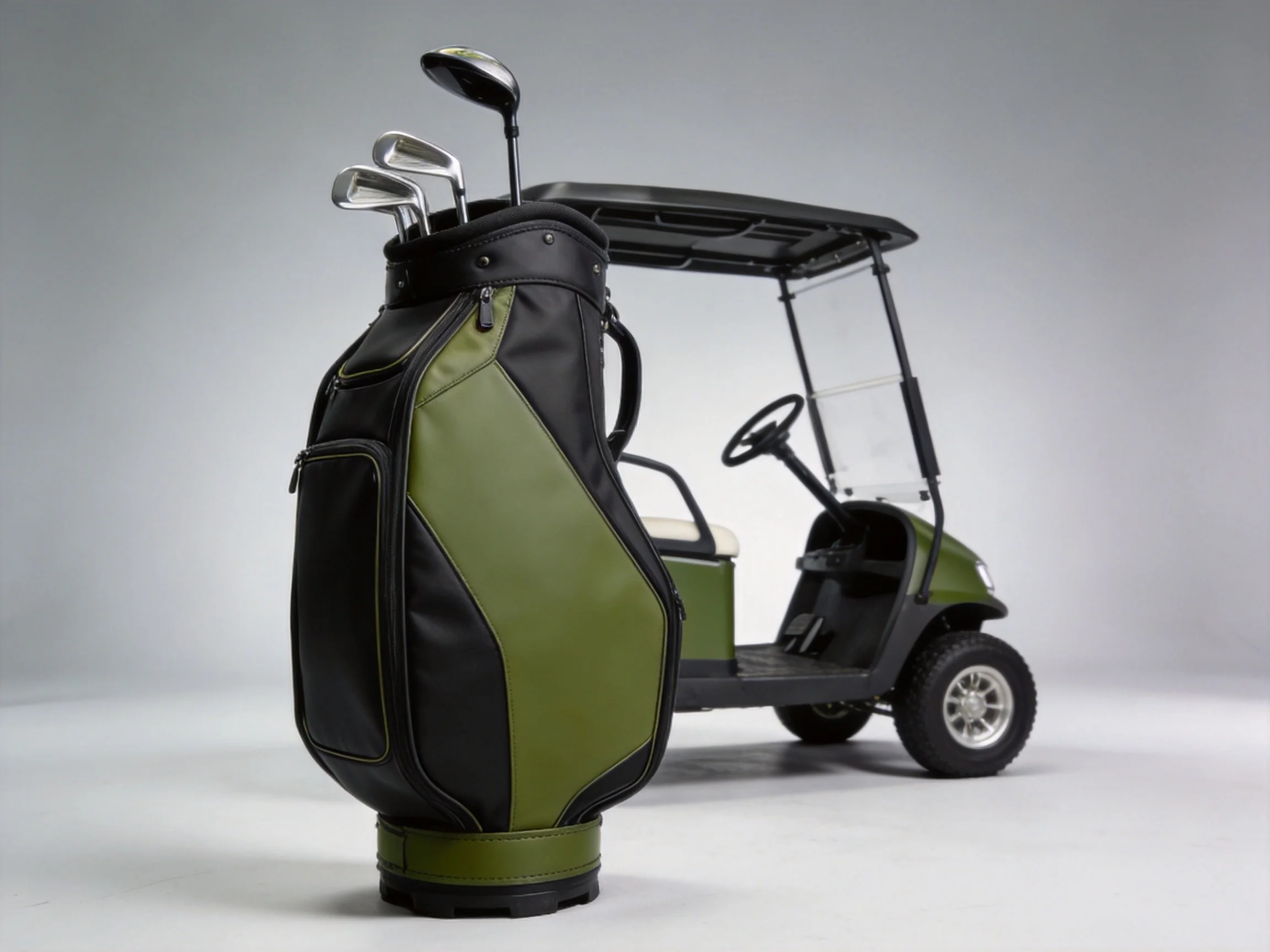
Weather-Ready Premium Construction
A high-end staff bag pairs premium finishing with the fabric, seam and zip engineering that keeps contents dry.
The Rain Hood: A Small Component, a Large Effect
Seam-sealed hoods hold up measurably better in real play than standard stitched versions, and the difference shows up quickly in the shoulder and seam areas where stress is highest. When a hood reaches over the top of the bag without exposing the divider gaps, the club grips stay dry even in steady rain between holes.
No single component protects a staff bag’s contents in rain as directly as the rain hood. A tour-grade hood covers the club heads and the entire top, deploying in seconds when the first drop falls and securing with a closure that holds in wind. Without a hood, even a fully waterproof shell leaves the clubs exposed to everything above the top ring.
The hood itself must be made to last: water-resistant fabric, reinforced stitching at the corners, and a profile that does not snag on club grips or flag audibly in wind. A poorly designed hood is the difference between clubs staying dry and a soaked set at the end of an afternoon storm. Our guide to golf bag rain covers details the technology and what to look for.
For staff bags that see daily outdoor use, we recommend the hood as a non-negotiable accessory — regardless of shell. It is the cheapest, most effective single upgrade for protecting a full set in wet weather.
Weighing Weight, Cost and Care
The upgrade to full waterproofing carries three honest trade-offs. It costs more per unit, because laminated fabrics and sealed zips are premium materials. It weighs more, because the lamined envelope is heavier than a coated shell — a real consideration even on a cart bag. And it needs different care: sealed bags breathe less, so contents should be dried after wet rounds and the bag stored open to prevent mildew between uses.
The maintenance discipline deserves emphasis because it determines whether the waterproofing lasts. DWR finishes age and need periodic re-treatment. Zips and seams should be inspected after heavy use. Our seasonal storage guide covers the drying and storage routines that keep a weather-ready bag performing for years rather than one season.
When these trade-offs are understood, the buying decision becomes simple matching: water-repellent for dry regions and occasional showers, water-resistant for reliable wet-weather coverage in a carrying bag, and fully waterproof for links-course and heavy-rain markets where a soaked interior is not acceptable.
Sourcing a Weather-Ready Staff Bag: MOQ and Sampling
Ordering waterproof staff bags is a specification discipline, because the weather performance lives in the spec sheet, not the look. Define the target level — repellent, resistant or fully waterproof — and the materials, seams, zips and hood that deliver it. Require a test report for the fabric’s hydrostatic head and the sealing method so the claim is verifiable.
Sampling is where weather claims get proven. A physical sample should be wet-tested — doused, checked at the seams and zips, inside and out — before any bulk investment. Sampling runs 10–20 days and bulk production 45–60 days from a confirmed sample. A standard MOQ is 200 pieces with 100 for test orders, giving a buyer a real, water-tested prototype before committing to the full run.
Quality is applied consistently across the weather build, and the affiliated factory was independently audited by SGS in March 2026. Our manufacturer selection guide lists the questions that reveal whether a factory genuinely water-tests or merely labels. Our wholesale pricing guide helps buyers model how the waterproof upgrade changes unit economics.
QUANZHOU JUNYUAN BAGS supplies golf bags from an affiliated 4,950-square-metre main factory whose founder entered the industry in 2004 and which was established as a company in 2014. The facility runs seven production lines with 126 sewing machines and a team of 137 staff, supporting a monthly capacity of up to 200,000 units for more than 200 brands across 100+ countries. Sampling typically takes 10-20 days and bulk production 45-60 days, with a standard MOQ of 200 pieces and 100 for test orders. The factory was independently audited by SGS in March 2026. Contact service@junyuanbags.com or +86 17750020688.
Matching Waterproofing to the Real World of Golf
The best waterproof specification is the one matched to the environment. A desert club that sees three rainy rounds a year gains little from a fully sealed bag’s weight and cost. A links course or a coastal region that plays in twice-weekly drizzle gains everything from it. The same logic applies to teams and academies whose practice schedules run through the wet season regardless of the forecast.
Buyers should also consider the bag’s full life. The premium construction that makes a staff bag weather-ready also tends to make it more durable and easier to protect through the season — which is why water readiness and quality control tend to rise together in well-built bags. Choosing a defensible level, requiring verifiable testing, and maintaining the build is the full recipe for staff bags that hold their own through every weather the round brings.
Inside the Waterproof Build: Fabrics, Seams and Zips
A waterproof staff bag earns its claim in three places rather than one: the fabric, the seams and the closure points. On the fabric side, a genuinely waterproof build uses a membrane-backed or heavily coated laminate that blocks water rather than merely shedding it — the difference between a bag that shrugs off drizzle and one that keeps a phone dry through an hour of rain. On the seam side, taped or welded seams close the paths where a coated fabric would otherwise leak, because water finds the stitch holes before anything else. On the closure side, waterproof zippers or secured flaps keep the entry points — the pockets you open all day — from becoming the leak.
These three systems work together, and a bag that skips one of them leaks in practice even if it looks protected. A coated fabric with ordinary zippers stays dry only until the rain reaches the zipper line; a bag with good zippers but untaped seams fails where the fabric is stitched together. A high-end staff bag holds up in real weather precisely because all three are engineered together, which is worth checking in any specification before you trust a claim in a downpour.
It is also the reason a genuinely waterproof build costs more to make — the materials, the equipment to tape seams and the quality control to verify closures all add up. Part of the visible expense of a premium staff bag is exactly this engineered protection rather than decoration, and it is the step that separates a weather-ready build from a merely sprayed one.
Testing and Honest Labelling
Reliable waterproofing is not a single claim but a chain of decisions that runs from the membrane to the seam tape, and honest labelling respects that chain. A factory that explains exactly which standard a bag clears, and what it does not promise, gives a buyer the confidence to sell to customers who ask the hard questions before they buy.
Because waterproofing is so easily overstated, testing matters as much as the build. A credible supplier tests rather than assumes — spraying, soaking or pressure-testing samples and reporting the result honestly rather than describing every bag as waterproof. The difference between water-repellent, water-resistant and waterproof is not marketing; it is a real, testable gap in performance, and a bag that claims more than it delivers lets a buyer down in exactly the worst conditions.
Independent verification adds a further layer of assurance. A factory that can show a recognised inspection or testing report for its weather claims gives a brand confidence that the specification will hold in the field, and a brand that passes that confidence to the end player protects its own reputation through a wet season.
For businesses sourcing weather-ready staff bags, the practical rule is simple: ask for the protection level, ask how it was tested, and verify with a third-party report where the weather stakes are high. A transparent answer is the mark of a genuine build; a vague one is the sign to dig deeper before committing an order.
Quick Comparison: Waterproofing Levels in Staff Bags
The table below summarises the three waterproofing levels available in high-end staff bags and when each is the right choice.
| Level | How It Works | Best For | Trade-offs |
|---|---|---|---|
| Water-repellent | DWR or coated shell sheds light showers | Dry regions, occasional light rain | Cheapest, lightest; not for heavy downpours |
| Water-resistant | Shell plus sealed seams and water-resistant zips | Reliable wet coverage while carrying | Slightly heavier and costlier than repellent |
| Fully waterproof | Laminated shell, sealed zips, welded/taped seams | Links courses and heavy-rain markets | Most expensive and heaviest; needs special care |
Match the level to the real climate and handling. Require a test report for fabric hydrostatic head and seam sealing so the claim is verifiable before you invest in bulk.
Build a Weather-Ready Staff Bag.
Source a premium staff bag with honest, tested waterproofing matched to your market. Physical water-tested sampling, MOQ 200 (100 for test orders), and SGS-audited manufacturing.
Discuss Your Waterproof Spec →Frequently Asked Questions
- What is the difference between waterproof and water-resistant staff bags?
- Water-repellent shells shed light showers; water-resistant builds add sealed seams and water-resistant zips for sustained rain; fully waterproof builds use a laminated shell and sealed envelope for heavy downpours.
- How are waterproof claims on staff bags tested?
- Through hydrostatic head testing of the fabric, inspection of seam sealing, zip sealing cycles and wet assembly checks, all documented in a test report.
- Does a fully waterproof staff bag weigh more?
- Yes. Laminated fabrics and sealed zips are heavier than a coated shell, a real consideration even on a cart bag.
- Is a rain hood necessary on a waterproof staff bag?
- Yes. Even a waterproof shell leaves the club mouth exposed; a tour-grade rain hood is the most effective single way to protect a full set in rain.
- What is the MOQ and lead time for custom waterproof staff bags?
- A standard MOQ is 200 pieces with 100 for test orders; sampling runs 10-20 days and bulk production 45-60 days from a confirmed sample.
- How do I maintain a waterproof staff bag?
- Dry contents after wet rounds, store the bag open to prevent mildew, re-treat the DWR as it ages, and inspect zips and seams seasonally.
Related Reading
- Waterproof Golf Bags Ultimate Guide — The full spectrum of weather-protection builds.
- Rain Cover & Waterproof Technology 2025 — Testing methods behind waterproof labels.
- How to Maintain Waterproof Coating — Care that keeps waterproof builds working.
- Waterproof Stand vs Cart Bags — Match the build to your climate and game.
- Materials Guide — Fabric families behind weather-ready builds.
- Quality Standards Guide — How construction supports waterproof claims.
- Wholesale Pricing Guide — Budgeting a weather-proofed product range.
Sources
- R&A — governing-body rules and weather-golf references supporting professional equipment practice.
- USGA — equipment-conformance standards informing high-end bag construction and testing.
- BSI (British Standards) — water-resistance test methodology references supporting verifiable waterproof claims.
- SGS — independent factory verification supporting the manufacturing claims in this guide.