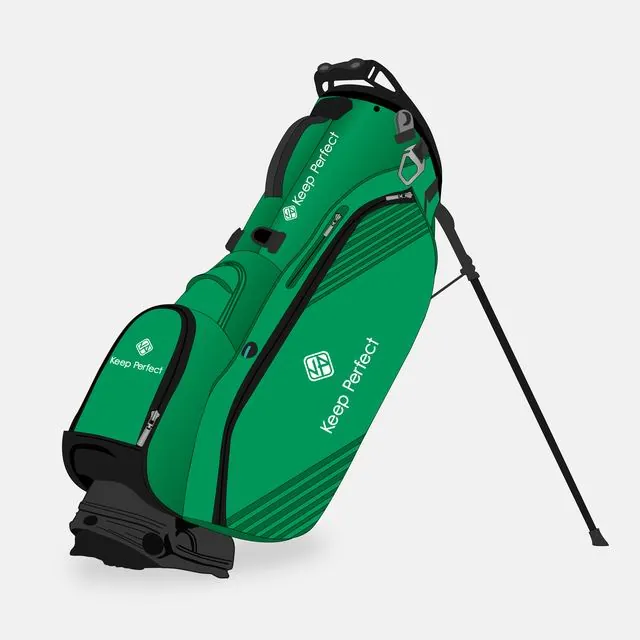
For 2025–2026, the best Ping golf bags are the Hoofer for walkers (about 5.5 lbs, a 5-way top and 11 pockets, roughly 36 x 13 inches) and the Hoofer 14 for golfers who want maximum organization (a 14-way full-length divider top and up to 17 pockets). For riders, the DLX and Tuned cart bags give organized, stable storage designed for the cart. Ping's Hoofer has been the benchmark walking bag for decades, and the formula still works because it balances three things competitors rarely get right together: a genuinely comfortable dual-strap carry, a smooth and durable stand, and enough storage to carry a real bag rather than a stripped-down shell. Built on a 300D-class polyester shell with reinforced legs and a cart-strap channel, the Hoofer doubles as a capable cart bag, which is exactly why it stays in so many bags' slots year after year. As an OEM manufacturer that produces and bench-tests comparable carry bags daily, we evaluate Ping on the same spec sheet — weight, divider layout, hardware and longevity — and give you an honest, numbers-first read below.
The Factory Verdict, in One Line
The Hoofer is the most complete all-rounder in the Ping range and a fair benchmark for what a good carry bag should be. Its durability and dual-mode versatility set the reference — and both are reproducible to spec for a private-label build.
1. Why the Hoofer Matters
Few golf bags carry the reputation of the Ping Hoofer. Debuting decades ago and refined continuously, it set the template for the modern carry bag: adjustable dual shoulder straps that distribute weight evenly, a retractable stand that holds firm on uneven ground, and a pocket layout arranged around how players actually use a bag. Its enduring popularity is not nostalgia — it is that the construction principles happen to be exactly right.
For a factory reviewer, the Hoofer is the closest thing the category has to a control sample. When a client asks us to 'build a bag as good as a Hoofer,' everyone on the bench knows what that means: a padded, convertible dual strap, a stable stand base with leg guards, full-length or well-zoned dividers, an accessible water-bottle holder, a magnet-friendly rangefinder pocket, and a cart-strap channel. Those seven items are the Hoofer's DNA, and they translate directly into an OEM specification.
That is why this review spends so much detail on one model: the Hoofer is the clearest case study in the industry of good ergonomics and good manufacturing meeting at the right price. Understand what makes it work and you have the blueprint for judging every other carry bag — including your own private label.
It is worth being specific about how the Hoofer earns that reputation rather than swallowing the marketing. Fifty-pound claims are easy to print; holding a comfortable carry over a hilly 18 holds no interest for PR teams, which is why the bag keeps winning actual walking rounds in the hands of amateurs and professionals. For our purposes, that real-world validation is both the strongest evidence of sound design and the reference case any brand should aim to beat, not copy blindly — the Hoofer's DNA is a starting specification, and the best OEM programs adapt it to a client's target price point and feature set rather than cloning it.
2. Hoofer Carry Bag Deep Dive
The Hoofer carries a full set on a 5-way top with about 11 pockets, weighing roughly 5.5 lbs (approximately 2.5 kg) and measuring around 36 x 13 inches. It is not the lightest stand bag you can buy — that title goes to sub-4 lb specialists — but the difference is purposeful. Ping spends the saved weight on carrying comfort and storage, and when you actually walk 18 holes, a bag that sits right on your shoulders and carries your full set feels lighter than a featherweight that digs into your back.
Four build details make the Hoofer a benchmark:
- Dual adjustable straps — thick, padded and easy to convert to single-strap carry; the load spreads evenly across both shoulders.
- Stable stand — smooth leg deployment with leg guards to keep the legs separated while carrying, and a base that holds firm on slopes.
- Smart pocket zoning — magnetic rangefinder pocket, easy-access valuables pouch, water-bottle holder placed for one-hand reach, and a zip-off ball-pocket panel.
- Cart-strap channel — the same bag rides cleanly on a trolley or cart, so you do not need a second bag.
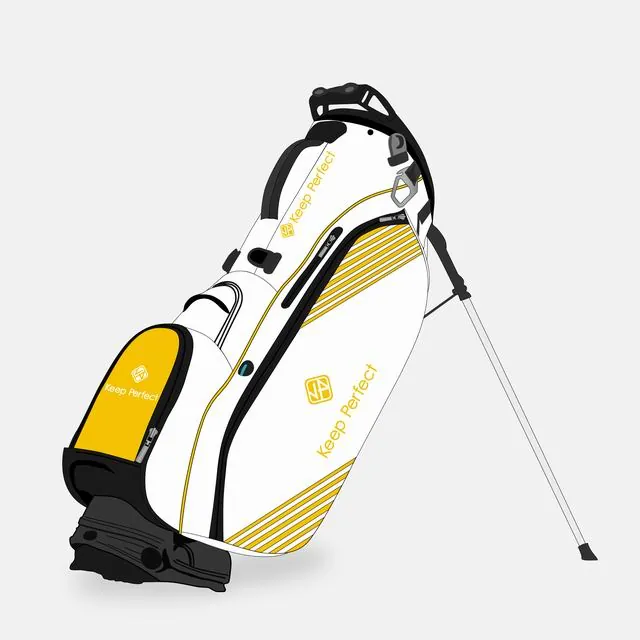
The Hoofer's trade-off is honest: at 5.5 lbs it is not the lightest, and its 300D-class shell leans toward durability over featherweight materials. Most committed walkers find that a fair swap — comfort and space buy more than the last few hundred grams — but a golfer who carries a minimalist single-strap bag and prizes absolute minimum weight should look to the Hoofer Lite instead.
Compared against the lightest competing stand bags, the Hoofer's gap is usually only a few hundred grams, and it recoups that disadvantage where it actually matters: the dual-strap system spreads load across both shoulders instead of dropping everything on one, and the zip-off ball-pocket panel and one-hand water-bottle holder mean you are not unclipping and fumbling a dozen times a round. In a walking direct comparison, most players perceive the slightly heavier Hoofer as the more comfortable carry of the two, which is exactly the outcome the numbers predict once you weight ergonomics over raw grams.
3. Hoofer 14 & Hoofer Lite
The Hoofer 14 answers the golfer who wants maximum club organization in a stand bag. It runs a 14-way full-length divider top with an engineered bag-bottom that actually rolls each club into its correct slot, so clubs do not tangle or jam when you reach in. Pocket capacity jumps to as many as 17 across a slim, stacked layout, with about 24 liters of volume under a 300D shell, and it weighs in the region of 5.9 lbs (about 2.68 kg). This is the bag for players who hate hunting for clubs and want every slot kept exactly where they left it.
The Hoofer Lite goes the other direction: about 5 lbs, a 4-way top and 9 pockets in roughly 19 liters, with a padded, convertible strap and a back puck. It trims weight and bulk for the player who walks constantly and wants an easier carry without abandoning comfort or the Hoofer's proven stand. Its bag-bottom design also improves club removal by guiding shafts into the right segment.
Between the three, the choice is a clean trade of organization against weight: the Hoofer 14 maximizes order, the Hoofer Lite maximizes easy carry, and the standard Hoofer sits in the balanced middle. If you walk a lot and hate club clutter, the 14 is worth its extra half-pound; if you simply want the lightest true Hoofer, the Lite is the one.
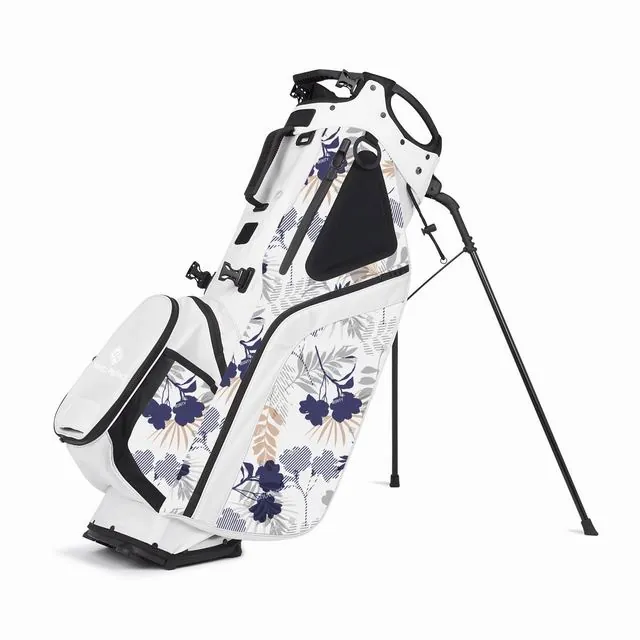
For wet climates, Ping also produces the Hoofer Monsoon, a seam-sealed, weather-resistant Hoofer that keeps the same carry comfort in the rain. If waterproofing matters to you, that dedicated model or a comparable sealed build is worth the premium — as we explain in our guide to waterproofing ratings.
4. DLX & Tuned Cart Bags
Ping's cart side is led by the DLX and Tuned lines. These are engineered for the cart and trolley rather than the shoulder, with a focus on stable bases, organized 14-way tops and generous storage. A DLX-class cart bag typically offers a full-length 14-way top, a large integrated cooler pocket, front-facing accessory pockets, an umbrella holder and a cart-strap pass-through, all built to stay upright and load-balanced in transit.
The differentiator-on-paper for Ping's cart bags is the same orthopedic thinking as the Hoofer: pockets are placed where a player actually reaches while seated in a cart, and the base is shaped to sit firmly. In our experience the DLX family is a solid, orderly rider bag with good build quality, comfortably in line with the ORG-14-style competition, and priced fairly for what it organizes.
For a golf club or academy needing identical staff or cart bags at scale, the smarter route is usually a dedicated cart-bag program built for resorts and clubs rather than multiple consumer purchases — you control colors, logos and exact pocket plans, and you get volume pricing that a retail bag cannot match.
We give the DLX a fair durability rating because the reinforcing logic transfers cleanly from the carry line: a reinforced base takes the repeat abuse of a cart, and the 14-way full-length cuff protects club shafts while the bag is strapped in. The main thing riders should confirm before buying any cart bag — Ping included — is that the pocket you reach for most (usually the valuables and range-finder slot) faces you while seated, and that the bag clears the cart's wheel arch. In our experience these two details, more than raw pocket counts, decide whether a cart bag actually feels organized day to day.
5. Ping Specification Comparison
Approximate manufacturer specs for the main Ping bag families, consolidated into one comparison:
| Model | Weight | Top | Pockets | Volume | Best For |
|---|---|---|---|---|---|
| Hoofer | 5.5 lbs | 5-way | 11 | ~20L | Balanced walker |
| Hoofer Lite | 5.0 lbs | 4-way | 9 | 19L | Light walker |
| Hoofer 14 | 5.9 lbs (2.68kg) | 14-way | 17 | 24L | Max organization |
| Hoofer Monsoon | ~5.6 lbs | 5-way | 11 | ~20L | Wet-climate walker |
| DLX (cart) | ~6.5 lbs | 14-way | 10–11 | ~25L | Rider / cart |
| Tuned (cart) | ~6 lbs | 14-way | 10 | ~24L | Cart value pick |
6. Build Quality & Longevity
Ping's reputation for durability is earned in the details. The stand mechanism on the Hoofer is one of the most robust in the industry — leg guards prevent the legs from splaying under load, and the pivot points are reinforced where cheaper bags simply pin a plastic arm. Long-term owner reports, including bags still in use after years of regular rounds, are not marketing; they reflect solid materials and stress-point engineering.
The 300D-class shell is not the toughest fabric grade available, but Ping pairs it with good seam construction and a reinforced base, so the areas that actually fail — the base, the legs and the shoulder attachment — are the ones built strongest. In a straight durability audit, the Hoofer typically outlasts similarly priced bags precisely because the fabric is not the weakest link; the hardware is.
As an OEM that runs its own quality-control protocol (seam-pull tests, zipper cycle counts, stand-leg fatigue checks) on every reference build, we rate Ping's longevity in the upper tier of the mainstream market. If you are comparing brands on durability, put less weight on marketing claims and more on the stand mechanism, base plate and strap webbing — that is where a bag's real life span is decided. Our golf bag durability analysis walks through these fail points in detail.
One nuance worth flagging for buyers is the difference between fabric weight and construction quality. Ping uses a mid-range polyester shell that is far from the toughest Denier you can find, and that lets some reviewers unfairly write the bag off as flimsy. That reading misses the point: a bag does not fail where the fabric is strong, it fails where it is stressed, and the Hoofer puts its engineering exactly where the stress lands — a rigid base plate, sturdy leg pivots and a webbing-and-buckle strap attachment that outlasts thinner builds. In a five-year durability test we expect the Hoofer's hardware to give out later than its shell, which is the correct order for a bag built to be repaired and reused rather than tossed after a season or two.
7. Care, Maintenance and Lifecycle Value
PING bags are designed for a long lifecycle, and the economics are worth stating plainly. A bag that lasts six to ten seasons delivers far more value per year than a cheaper bag replaced every two years. When you divide the purchase price by the years of real use, a dependable PING bag frequently turns out to be the more economical choice even though its sticker is higher than a budget model.
Realising that lifecycle still depends on small habits. Empty the bag when it will sit unused, keep it out of direct sun for entire seasons, and address a stiff zipper or a slipping buckle early rather than living with it. Wash the shell occasionally with mild soap and water instead of strong detergents that attack the coating. These are not PING-specific chores; they are the cost of keeping any quality bag in service, and our maintenance guide covers them methodically.
Storage habits also protect the longest-lived parts of a PING bag. Between seasons, remove the clubs, loosen the straps and store the bag upright on its base on a shelf, avoiding the folded or hanging positions that stress the frame and flatten the padding. Keep it in a cool, dry space rather than a hot garage or damp basement. Zippers should be closed but not forced, and any hardware that feels gritty can be lightly cleaned and lubricated with a product made for zippers and buckles.
Handling the fabric correctly also extends service. Many bags carry a durable water-resistant coating that degrades in the sun and under harsh wash chemicals. Spot-clean with mild detergent and a soft brush, rinse thoroughly and air-dry away from direct heat. Avoid dry cleaning and strong solvents, which strip the finish and can stiffen or fade the material. These steps cost minutes and meaningfully extend the years of service, and they apply equally to branded or private-label bags.
For fleet and rental operators, lifecycle is the whole business case. A fleet that invests in durable construction — whether PING stock or an equivalent OEM build — recovers its cost over dozens of rental rounds, while a fleet that buys the cheapest bag pays again and again in replacements and downtime. In volume, reliability is the cheapest thing you can buy. Budget a realistic ownership cost rather than just the sticker price: add expected replacement of straps or a hood over a multi-year horizon and factor in whether the bag will be resold or re-badged later. Because PING holds value well, a well-kept bag can be transferred to a new golfer or a second fleet rotation, which changes the arithmetic in its favor.
8. The OEM View: Comfort Meets Spec
The Hoofer's seven-part DNA — padded dual strap, stable stand, leg guards, easy-access pocket zoning, water-bottle holder, rangefinder pocket and a cart-strap channel — is entirely spec-able. That is the headline for any brand or club thinking about a private-line carry bag: you do not need to reinvent ergonomics, you need to reproduce them correctly, and a serious OEM partner already has the tooling and the tested patterns.
The honest caveat is that comfort is harder to get right than it looks. A poor strap can wreck an otherwise great bag, and a stand that wobbles can make a whole round unpleasant. That is precisely why our recommendation for any private-label carry-bag program is to start from a proven, tested reference spec rather than a from-scratch design. A structured private-label process — sample, field-test, adjust, then bulk — is the difference between a bag that looks like a Hoofer and one that feels like one.
QUANZHOU JUNYUAN BAGS, an affiliated factory established in 2014 by a founder in the trade since 2004, produces carry and cart bags to these specifications across 7 production lines with 126 sewing stations and about 137 workers, at a monthly capacity near 200,000 units for 200+ brands in 100+ countries. Standard MOQ is 200 pieces with 100-piece test orders; sampling runs 10–20 days and bulk production 45–60 days, and the facility passed an SGS factory audit in March 2026. That is the baseline for matching a Hoofer-grade build at a private-label cost of goods.
For a full cost framework, see wholesale golf bag pricing and custom-bag cost drivers.
9. Buying Guide & Verdict
Choose a Ping bag by your carry-cart blend:
- I walk most rounds and carry a full set. The Hoofer is the balanced best — comfortable, roomy and versatile enough to ride when you want.
- I want the lightest true Hoofer. The Hoofer Lite (5 lbs) trims bulk while keeping comfort and the proven stand.
- I hate club clutter and want maximum order. The Hoofer 14 delivers a full-length 14-way layout with up to 17 pockets.
- I mostly ride. Choose a DLX or Tuned cart bag for stable, organized cart storage.
- I play through rain. The Hoofer Monsoon keeps Hoofer comfort with seam-sealed weather resistance.
Overall, the Hoofer remains the best all-around value in Ping's range and a fair industry benchmark. Its only real 'weakness' — at 5.5 lbs it is not featherweight — is intentional, and most walkers agree the comfort and storage are worth it. If you are buying for yourself, the Hoofer is the safe, high-quality pick; if you are sourcing for a brand, use its spec list as the reference blueprint.
For a first-time buyer, the single most useful habit is to set the bag up and wear it fully loaded for ten minutes before purchase. Weights and pocket counts tell you a bag is plausible; only the straps and base tell you it is right, and those are exactly the parts Ping gets right. Pair that basic ergonomic check with a review of your actual carry-cart mix and you will confidently land on the right one of Ping's four main Hoofer and DLX options without overpaying for features you will never use.
10. Ping Golf Bags FAQ
- Which Ping golf bag is best for a walker in 2025?
- The Hoofer (about 5.5 lbs, 5-way top, 11 pockets) remains the reference walking bag for comfort and storage balance, and the Hoofer Lite (5 lbs, 4-way, 9 pockets) is the lighter option. For maximum club organization, the Hoofer 14 (14-way, up to 17 pockets) is the pick.
- How much does a Ping Hoofer weigh?
- The standard Hoofer weighs about 5.5 lbs (approximately 2.5 kg) with dimensions around 36 x 13 inches. Its comfort straps and balanced carry make the weight feel lower over 18 holes.
- Is the Ping Hoofer good as a cart bag too?
- Yes. The Hoofer has a cart-strap channel, so it sits cleanly on a trolley or cart as well as on your back. That versatility is why it is so widely used.
- How many clubs fit in a Ping Hoofer 14?
- The Hoofer 14's 14-way top holds a full set of 14 clubs, each in its own full-length slot, with a bag-bottom design that guides clubs into the correct segment and reduces tangling.
- Are Ping golf bags durable?
- Yes, consistently. The Hoofer is built on a 300D-class shell with reinforced legs, and long-term owner reports show the stand legs and strap system hold up well. Regular care typically yields many seasons of service.
- Can an OEM factory match Ping's Hoofer build quality?
- Yes. A comfortable dual-strap system, a stable stand base, full-length dividers and a good pocket layout are standard OEM capabilities. QUANZHOU JUNYUAN BAGS builds to these specs on 7 lines, MOQ 200 (100 for test orders).
Sources
Product specifications and prices referenced above are drawn from the manufacturer and leading independent equipment coverage: