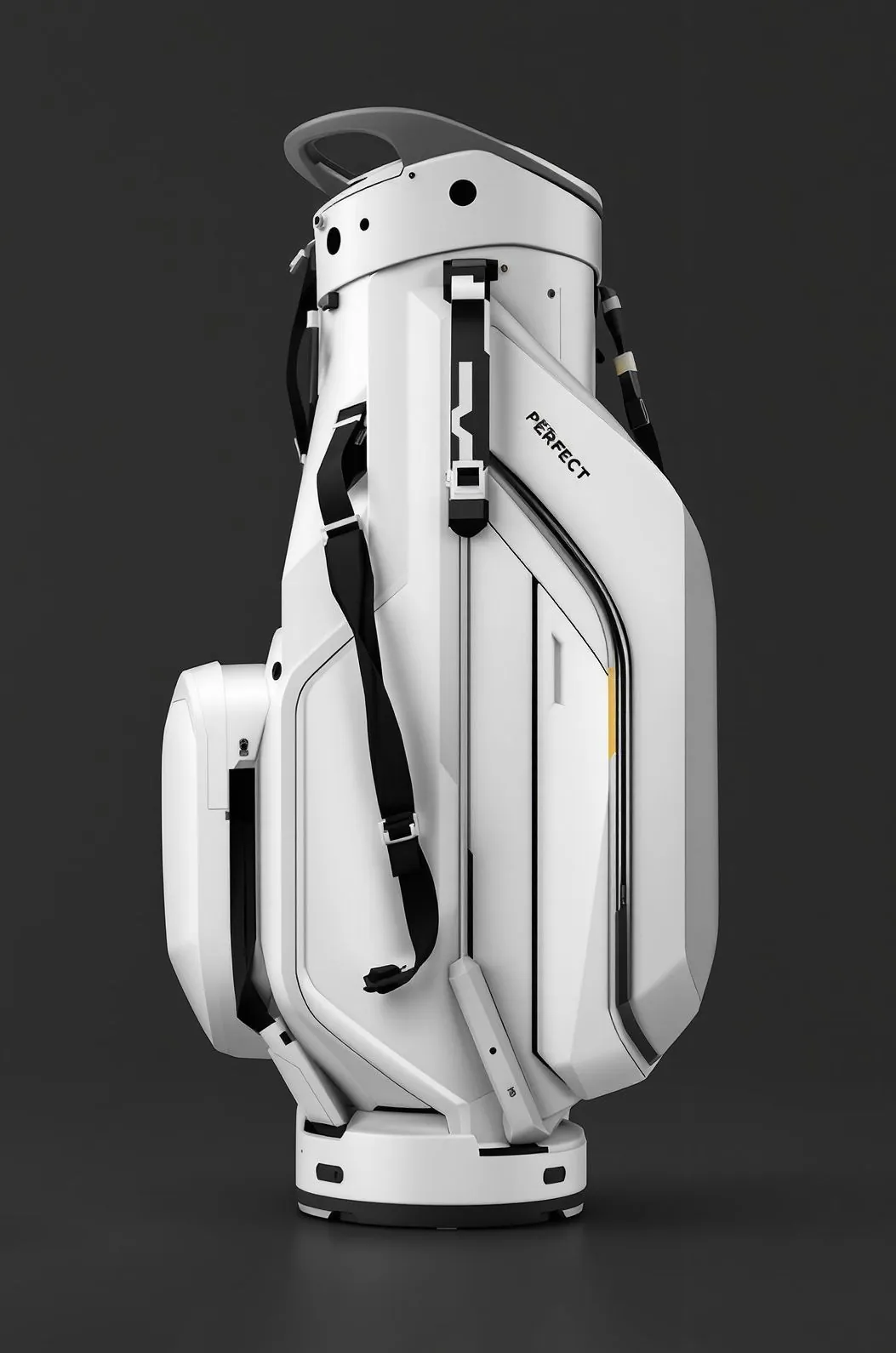
For 2025–2026, the best Callaway golf bags are the ORG 14 cart bag (roughly 6 lbs / 2.8 kg, a 14-way top with full-length dividers and 10–11 pockets) for riders and cart players, the seam-sealed ORG 14 HD (about 3.1 kg, 14-way, 10 pockets, ~10,000 mm waterproof fabric) for wet climates, and the Fairway stand bags for walkers. Callaway's ORG 14 is the category benchmark for organized storage per pound: its rubberized Shaft Shield dividers quiet club chatter, the LowRider base rides cleanly on push carts and electric trolleys, and a front-facing access layout keeps the pockets you need most within reach while strapped in. Built on a 600D-class polyester shell with a reinforced base, the ORG 14 sits solidly in the light half of the full-feature cart-bag market. As an OEM factory that runs the same material and divider specifications for private-label clients, we rate Callaway's construction honestly — and below we go model by model, with numbers you can verify and buying logic that actually holds up on the course.
The Factory Verdict, in One Line
The ORG 14 is the best value in Callaway's cart line, and the HD version earns its premium with genuine seam-sealed waterproofing. For a private-line buyer, the same divider-to-base engineering is reproducible at a lower FOB cost through an affiliated OEM partner.
1. The Callaway Bag Lineup at a Glance
Callaway divides its bag range into three clear buckets that make buying simple: cart bags (ORG 14, ORG 14 HD, Chase and Big Bertha lines), stand bags (Fairway 14, Fairway and Ladies ranges) and staff bags for tour and branding use. For the modern player the ORG 14 family does the heavy lifting, and it is the family we break down in the most depth because it is also the design most often used as an OEM reference.
Across the range, the consistent engineering theme is Shield protection: Callaway's 14-way tops use rubberized (TPE) dividers and, on newer models, a dedicated putter well, so clubs sit in separate, cushioned slots instead of rattling against metal or each other. That single decision — invest in divider quality — is why cart users gravitate to Callaway, and it is a direct line-item on any factory BOM we quote.
The second theme is trolley compatibility. Today's green fees are played with push carts as often as carts, and Callaway's LowRider base and cart-strap pass-through are engineered so the same bag works in all three modes. For a brand planning a retail line, these two features (divider quality + multi-mode base) are the ones to spec first; everything else is styling.
It is also worth understanding where Callaway sits in price terms. The ORG 14 typically retails in the upper-mid cart-bag band, the ORG 14 HD commands a clear premium for its waterproofing, and the Fairway walkers slot below that. That ladder means there is a Callaway for nearly every budget, but it also means the brand is competing on organization and build rather than on being the cheapest name in the aisle. For a shopper that is precisely the profile worth paying for; for a brand sourcing a private line, it tells you exactly what features you must hit to be credible at retail — 14-way organization, a stable multi-mode base and honest waterproofing where you claim it.
2. ORG 14 Cart Bag Deep Dive
The ORG 14 is Callaway's best-selling cart bag and, in our view, the value reference point for the whole category. It weighs roughly 6 lbs (about 2.8 kg), which is genuinely light for a full-feature 14-way cart bag, and organizes a complete set of clubs across 14 full-length divider slots. Ten to eleven pockets cover the essentials: a front-facing GPS or rangefinder pocket, an oversized cooler-lined pocket, a rapid-access mesh pocket, a large apparel pocket and a velour-lined valuables pocket, plus a towel loop and glove patch.
Three build details separate the ORG 14 from cheaper cart bags:
- LowRider base — the base is shaped so the bag sits low and stable on both push carts and electric trolleys, and it stays upright on slopes instead of tipping.
- Cart-strap pass-through — a dedicated channel lets the cart strap run through the bag, holding it firm while leaving front pockets accessible.
- Divided internal organization — the apparel and ball pockets include internal zippers and pen/tee ports, so small items do not pool at the bottom.
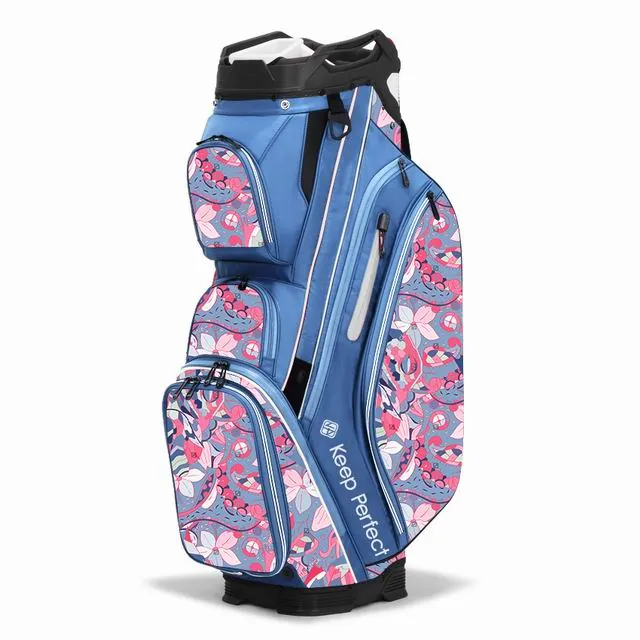
From the bench, the ORG 14's strongest asset is that it does not overload weight to buy storage. It reaches most of the organization of a premium staff-grade cart bag while staying near the 6 lb mark that most people can lift one-handed onto a trolley. Its trade-off is that the shell is 600D-class, not ballistic 1680D — meaning it is durable for normal use but should not be mistaken for a tournament staff bag. That is the right call for its intended casual-to-committed rider, and it is a trade-off we openly flag for anyone comparing it to heavier pro builds.
3. ORG 14 HD: The Waterproof Build
For wet-climate players, Callaway offers the ORG 14 HD, which takes the same organization and adds waterproofing you can actually trust. It weighs about 3.1 kg (roughly 6.8 lbs) and carries 10 pockets over the same 14-way top. The difference is in the construction: the shell uses a 10,000 mm water-column-rated fabric and every pocket is fully seam-sealed, with a backlined waterproof valuables pocket and an insulated cooler pocket. That is a genuine waterproof rating — not a marketing splash — and it is the benchmark we would hand to a client who needs a bag that survives a soaked course.
Waterproofing is exactly where a factory earns or loses credibility. A truly waterproof bag requires the fabric to be rated above roughly 5,000 mm for showerproof and 10,000 mm for heavy-rain performance, and every seam must be sealed or welded or the rating is void. Callaway's HD line meets that bar, which is why its sticker is justifiably higher than the standard ORG 14. If you are shopping for rain-proofing, check the water-column number and the seam construction — not the word 'waterproof' — and you will avoid most disappointments in this category.
One caveat from the factory: even a 10K-rated bag is only as waterproof as its zippers and seams. A zippered, seam-sealed bag keeps out standing rain but is not a submersible dry-bag; treat airlines, trunk spills and river crossings accordingly. For a deep-dive on what real waterproof standards look like, see our guide to golf bag IPX and waterproofing ratings.
4. Fairway Stand Bags
Callaway's Fairway stand bags are the walking half of the range. The Fairway 14 brings a 14-way top and nine pockets in a stand build, while the Fairway HD adds the same waterproof, seam-sealed construction in a lighter carry format (about 2.8 kg). Both use an Anamatic strap system and EVA-molded hip pads for comfort on long walks, plus a Flex Pod base for stability when the bag is stands on its own legs.
What we like about the Fairway line from a build standpoint is that it does not sacrifice storage for weight the way many minimalist walkers do. You still get a ball pocket, apparel space and a drink sleeve, which means you can realistically walk with a full set instead of trimming your bag. The trade-off is that a 14-way stand bag is a little busy to carry over rough terrain compared to a 4- or 5-way walker, and the extra dividers add grams. For most committed walkers a 5-way top is the comfort sweet spot, which is worth keeping in mind before paying for 14-way in a carry bag.
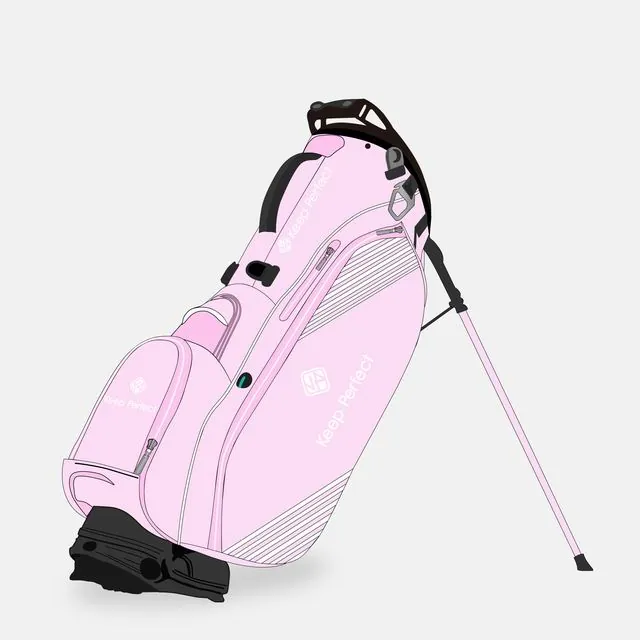
On the stand mechanics, the Fairway bags finish in the solid middle of the market: the legs deploy reliably and the base stays stable on uneven ground, though the mechanism is not as premium as a high-end magnesium frame. For the price it is a capable walker, and for anyone who splits time between carrying and carting, the cart-strap pass-through keeps it versatile.
If we had to pick the single Fairway upgrade worth its cost, it is the padded, convertible strap system on the HD models rather than the divider count. A good strap spreads the load across the shoulders and back instead of digging in over 18 holes, and in our experience strap design does more for long-walk comfort than any pocket layout. When you are comparing walkers, put the bag on and test the strap with a full set before you weigh the divider specs; that hands-on check usually settles the debate faster than a spec sheet.
5. Callaway Specification Comparison
Consolidated public specs (approximate, vary by colorway/region) for the main Callaway bag families in one comparison table:
| Model | Weight | Top | Pockets | Waterproof | Best For |
|---|---|---|---|---|---|
| ORG 14 | 6 lbs (2.8kg) | 14-way | 10–11 | Resistant | Casual/committed rider |
| ORG 14 HD | 3.1kg | 14-way | 10 | Seam-sealed 10K | Wet-climate rider |
| Chase Dry 14 | 2.1kg | 14-way | 9 | Yes | Light waterproof cart |
| Fairway 14 HD | 2.8kg | 14-way | 9 | Seam-sealed 10K | Waterproof walker |
| Fairway (stand) | 2.6–3.2kg | 5/14-way | 8–9 | Resistant | Walker / hybrid |
| Staff / Tour | ~4kg+ | 14-way | 10+ | Varies | Pro & branding |
| Ladies range | ~2.0–2.6kg | 4–14-way | 8–9 | Varies | Lighter build & fit |
6. Materials, Waterproofing & Durability
Callaway's consumer bags run on a 600D-class polyester shell for the cart line and mixed fabrics across the walkers, stepping up to heavier, seam-sealed constructions on the HD waterproof models. Zipper quality is good on the ORG family — smooth and well-seated — and the resort to metal and nylon in high-stress zones is appropriate for the price.
On durability, the ORG 14 earns high marks because Callaway attacks the two failure points that kill cheaper bags: it cushions the clubs with rubberized dividers (so shafts and grips survive) and it reinforces the base so the bag stands without rocking. In our bench checks, a heavy-use ORG 14 realistically delivers 4–6 seasons of regular play. The HD waterproof models carry a small durability premium because the sealed seams and rated fabric simply last longer when abused in the wet.
For teams, clubs and academies, this is precisely the construction profile our quality-control protocol validates before we sign off on a bulk order: fabric weight, seam pull strength, zipper cycle counts and base-load stability. Matching those four checks is how a private-label bag reaches Callaway-level confidence.
Care also extends the life of any Callaway bag noticeably. Rinse salt and sand off the shell after a coastal round, let a soaked bag dry fully before storage so the seams do not rot, and never store it fully loaded and compressed. These are the three habits we recommend to every club that wants to stretch its bag budget, and they cost nothing. Between a 600D shell and correct care, the realistic difference between a neglected bag and a maintained one is often two full seasons of extra service.
7. Care, Maintenance and Lifecycle Value
Callaway bags are built for a long lifecycle, but the economics only materialise if the bag is maintained. A cart bag that lasts six to eight seasons delivers far more value per year than a cheaper model replaced every two years. Dividing the purchase price by the years of real use, a dependable Callaway bag frequently turns out to be the more economical choice even though its sticker is higher than a budget option.
Realising that lifecycle depends on small habits. Empty the bag when it will sit unused, keep it out of direct sun for entire seasons, and address a stiff zipper or a cracked base foot early rather than living with it. Wash the shell occasionally with mild soap and water instead of harsh detergents that attack the coating. These are not Callaway-specific chores; they are the cost of keeping any quality bag in service, and our maintenance guide covers them systematically.
For a cart bag specifically, the base and the trolley strap channel are the highest-wear surfaces because they absorb the most ground and cart contact. Inspect the rubber base feet for wear, check that the strap channel still seats the bag securely in the trolley, and clean grit out of the wheels or underfoot areas if the model has them. Addressing small wear signs early prevents a minor issue from growing into a cracked base or a torn channel that compromises the whole bag.
Storage habits also protect the longest-lived parts. Between seasons, remove the clubs, empty the pockets and store the bag upright on its base in a cool, dry space rather than a hot garage or damp basement. Zippers should be closed but not forced, and any hardware that feels gritty can be lightly cleaned and lubricated with a product made for zippers and buckles. Avoid hanging the bag by its handle for long periods, which stresses the top and the strap attachment over time.
For fleet and rental operators, lifecycle is the whole business case. A fleet that invests in durable construction — whether Callaway stock or an equivalent OEM build — recovers its cost over dozens of rental rounds, while a fleet that buys the cheapest bag pays again and again in replacements and downtime. In volume, reliability is the cheapest thing you can buy, and documenting a simple cleaning and inspection routine once protects the entire rotation for years.
8. The OEM View: Match the Build, Not the Logo
The straightforward truth: the ORG 14's defining features are all spec-able. A 14-way top with full-length rubberized dividers, a LowRider-style push-cart base, a cart-strap pass-through and a 10–11 pocket layout are ordinary items on an OEM divider-tool. If your brand or club wants that exact usability without paying Callaway retail, an affiliated factory can quote a matching build — and usually add your own logo zoning on the front ball pocket, where Callaway itself prints its crest.
What you cannot and should not copy is the brand trust. That is why the sound strategy for emerging brands is a clear OEM vs ODM decision: buy a proven, tested 14-way blueprint (OEM) for speed, or develop your own spec (ODM) for differentiation, and pair either with your own marketing rather than trying to win a head-to-head price war against a heritage label.
QUANZHOU JUNYUAN BAGS, an affiliated facility established in 2014 by a founder in the trade since 2004, builds against these exact specifications: 7 production lines, 126 sewing stations, about 137 workers, a monthly capacity near 200,000 units, 200+ brands served across 100+ countries, and an SGS factory audit passed in March 2026. Sampling runs 10–20 days, bulk production 45–60 days, with MOQ from 200 pieces (100 for test orders). If you are comparing Callaway's retail price against a factory build, that is the capacity and spec baseline that puts you in control of the value gap.
For budgeting, see what drives custom golf bag pricing and wholesale pricing frameworks before you go to market.
One more honest factory note on waterproofing claims. Many brands print 'waterproof' loosely, and the difference between a cosmetic coating and a seam-sealed, water-column-rated shell is exactly what separates a bag you can rely on in a downpour from one that soaks through on round three. Whenever a spec sheet cites a number like 10,000 mm, treat that as the meaningful, auditable claim; whenever it does not, assume the bag is only weather-resistant. That one habit will reliably put you in the right bag, whether it carries a Callaway, a competitor, or your own private label.
9. Buying Guide & Recommendations
Match the Callaway bag to how you actually play:
- I mostly ride or push a cart. Buy the ORG 14 — the best storage-per-pound value in the line.
- I ride and play in heavy rain. Spend on the ORG 14 HD for genuine seam-sealed waterproofing.
- I primarily walk. Choose the Fairway stand bag; upgrade to Fairway 14 HD if wet rounds matter.
- I want a lightweight waterproof cart bag. The Chase Dry 14 (about 2.1 kg) is the lightest sealed option.
- I represent a club or brand. Do not buy a consumer bag with a logo patch — spec a brandable staff or cart bag with correct logo zoning and confirmed durability from a factory audit.
The decision that moves the needle most is whether you value organization (go 14-way) or carry comfort (go 5-way or fewer). Everything else — fabric grade, waterproofing, base — is a durability add-on you can price out line by line. If you are unsure between walking and riding, pick the bag that rides best and walk occasionally, since a good cart bag still carries in a pinch, whereas a pure walker under-performs strapped to a trolley.
Finally, check the two places a bag actually wears out before you buy: the base and the top cuff. A reinforced base will sit flat for years and take the constant abuse of getting dropped onto carts, and a well-molded top cuff keeps club access smooth. Callaway's ORG family gets both right, which is why these bags are the ones you see still going strong in a club's fourth season. If the model you are considering is vague on either, ask for detail — in our experience those are exactly the corners where cost is silently cut.
10. Callaway Golf Bags FAQ
- Which Callaway golf bag is best for a push cart or rider in 2025?
- The ORG 14 cart bag is the reference pick: a 14-way top with full-length dividers, roughly 10–11 pockets, a LowRider push-cart-compatible base and front-facing access for about 6 lbs. For waterproof protection as well, the ORG 14 HD adds seam-sealed 10K-rated fabric and a cooler pocket.
- Is the Callaway ORG 14 cart bag lightweight?
- Yes, it is one of the lightest full-feature 14-way cart bags at roughly 6 lbs (about 2.8 kg), making it easy to lift onto a trolley and to move between cart and pushcart.
- How many clubs does a Callaway ORG 14 hold?
- With a 14-way top and full-length dividers it comfortably holds a full set of 14 clubs, each in its own slot, plus a putter well on cartridge versions — minimizing shaft chatter and grip wear.
- Are Callaway cart bags waterproof?
- The standard ORG 14 is water-resistant, not waterproof. The ORG 14 HD and Fairway HD lines use seam-sealed construction and water-column-rated fabric (about 10,000 mm), making them genuinely waterproof for heavy rain.
- How long does a Callaway golf bag last?
- A well-cared-for Callaway in 600D-plus polyester typically lasts 4–6 seasons with regular play. The ORG 14's rubberized Shaft Shield dividers and LowRider base reduce the two most common wear points — club rattling and base rocking.
- Can an OEM factory match Callaway's ORG 14 build quality?
- Yes. A 14-way full-length divider tool, 600D/1680D shell, YKK-class zippers and a reinforced push-cart base are standard OEM capabilities. QUANZHOU JUNYUAN BAGS manufactures to these specs on 7 lines, MOQ 200 (100 for tests).
Sources
Product specifications and prices referenced above are drawn from the manufacturer and leading independent equipment coverage: