The Evolution of Golf Bag Materials: From Leather to Carbon Fiber
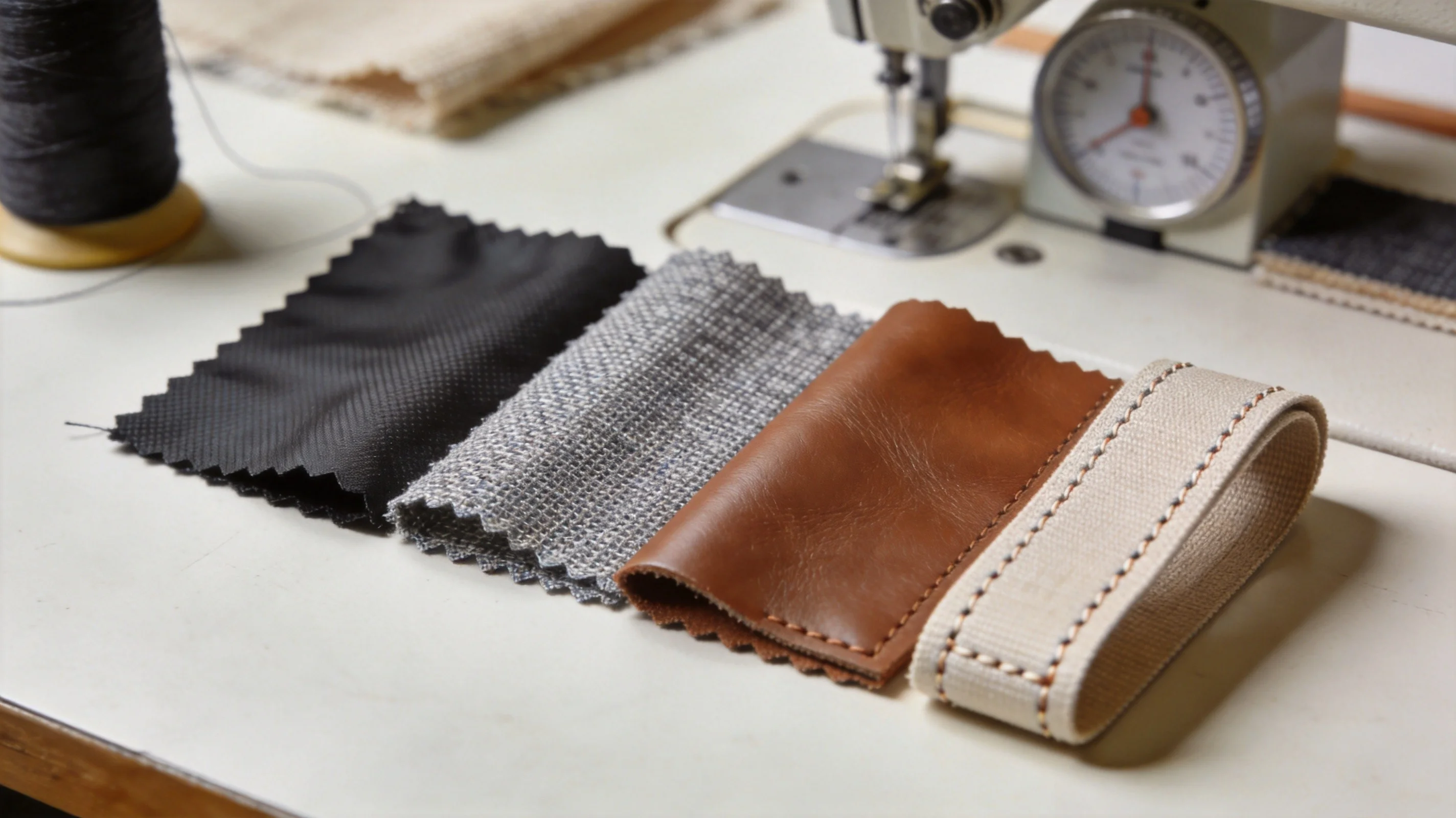
Golf bag materials have evolved from hand-stitched leather cylinders to engineered systems of ballistic nylon, TPU lamination and carbon fiber frames — a shift that cut empty bag weight from over 3 kg to below 1.8 kg while multiplying water resistance, tear strength and service life. This article walks through that history in the way we live it at our Quanzhou, China factory — a facility established in 2014 with seven production lines, 126 sewing machines and 137 employees, serving more than 200 brands across over 100 countries, and audited by SGS in March 2026. Understanding where golf bag materials came from explains why today's bags are specified the way they are, and where the next five years are heading.
The Beginnings: Leather and Canvas (Late 1800s-1940s)
The earliest golf bags were functional cylinders used to carry a small set of hickory-shafted clubs. Leather was the material of choice because it was strong, readily available, and could be hand-stitched by saddlers. A typical early leather bag was heavy — often more than 3 kg empty — and demanded regular conditioning to resist drying, cracking and mildew, because leather absorbs water and degrades when stored damp.
Canvas appeared early in parallel as a lighter, cheaper alternative. A canvas body with leather trim and a leather base captured the premium aesthetic at a fraction of the weight and cost. The trade-off was durability: canvas absorbed moisture, wore through at the base quickly, and offered little protection against abrasion. This leather-and-canvas era established a pattern that still structures the market: a premium material (then leather) for statement bags, and a practical, affordable material (then canvas) for everyday use.
Materials by Era at a Glance
| Era | Primary Materials | Empty Weight | Water Resistance | Durability | Role |
|---|---|---|---|---|---|
| Late 1800s-1940s | Leather, canvas, leather trim | 3 kg+ (heavy) | Poor | Good (needs care) | Premium + value |
| 1950s-1960s | Vinyl, early nylon | 2.5-3.5 kg | Improving | Moderate | Transition to synthetics |
| 1970s-1980s | Nylon, polyester, PU/PVC coated | 2-2.8 kg | Good with coating | Good | Mainstream |
| 1990s-2000s | 1000D/1200D nylon, reinforced bases | 1.8-2.5 kg | Good | Very good | Performance era |
| 2005-2015 | 1680D ballistic, TPU, aluminium frames | 1.5-2.2 kg | Very good | Excellent | Modern premium |
| 2015-present | 1680D+TPU, carbon fiber, rPET | 1.3-1.8 kg (stand) | Waterproof (seam-taped) | Excellent + sustainable | Innovation era |
The pattern across the table is unmistakable: weight has fallen, water resistance and tear strength have risen, and the top of the market has migrated from a natural fibre to engineered synthetics. Each step was not a redesign for its own sake but a response to how golfers actually used their bags.
The Synthetic Revolution (1950s-1970s)
The post-war period brought the technologies that would permanently change golf bag construction. Nylon offered exceptional strength-to-weight, abrasion resistance and the ability to be woven into different densities, while polyester provided UV resistance and shape retention at lower cost. Both entered luggage and then golf bags in the 1950s and 1960s, initially for military-style carry bags and later the full range.
The decisive innovation was coating. Applying a layer of polyvinyl chloride (PVC) or later polyurethane (PU) to the reverse of the fabric gave the shell genuine water repellency and stiffened it into a shape. Suddenly a golf bag could stand in the rain and be wiped clean. Coated synthetics became the industry floor by the 1980s, and they remain the base of most mid-range construction today — a technology lineage that runs unbroken from the 1970s to the present production floor.

The Performance Era (1980s-2000s)
As golf participation grew and brand competition intensified, material specification became disciplined. Denier numbers entered the conversation: 600D and 840D gave way to 1000D and 1200D for wear surfaces, and eventually 1680D ballistic nylon became the badge of premium construction. Reinforced bases, padded shoulder straps and moulded handles addressed the specific failure points that real golfers exposed.
Frames also evolved. Steel tubes of early stand bags were joined by aluminium alloys that cut weight and resisted corrosion. Zippers advanced from generic nylon to higher-grade coils and metal tracks. This performance era is when the golf bag stopped being a simple cylinder and became a compartmentalised, engineered product — the direct ancestor of the modern cart, staff, stand and travel bag you see in every pro shop today.
It is also the era when manufacturing quality control became commercial. Our own test battery, covering tear (ASTM), abrasion (ISO 12947-style peeling and Martindale methods) and water column (ISO 811), grew out of the same pressure to make material claims verifiable. When a brand today asks us for a test certificate, they are continuing a conversation that became standard practice in these decades.
The Modern Innovation Era (2005-Present)
Since roughly 2005 the focus has shifted from raw toughness to intelligent systems. Thermoplastic polyurethane (TPU) lamination replaced simple coatings on premium bags because it flexes instead of cracking, can be seam-welded into truly waterproof assemblies, and avoids the chlorine chemistry of PVC. Lightweighting drove aluminium-alloy and then carbon fiber leg frames, composite base plates, and 300D-600D fabrics in non-critical panels.
Simultaneously, sustainability entered the specification sheet. Recycled rPET fabric, GRS-certified recycled content, and mono-material designs now sit alongside conventional nylon as standard options. The modern era does not discard the 1680D ballistic heritage — it layers TPU, composites and recycled materials on top of it. This is the era our factory was designed around when we began operations in 2014, and it is why our SGS audited (March 2026) production can run premium, value and sustainable constructions on the same seven lines.
Craftsmanship and the Industrial Scale of Evolution
Behind every material step in this story is a manufacturing capability that had to catch up to it. Hand-stitched leather bags were the work of saddlers working one at a time; a 1680D ballistic shell with a TPU lamination and welded seams demands industrial sewing machines with high needle torque, precise coating line control, and seam-joining equipment that simply did not exist a century ago. The evolution of golf bag materials is inseparable from the evolution of production engineering.
This is why scale and capability matter to buyers. A factory that can run heavyweight shells, TPU lamination, and recycled rPET through the same production floor can deliver a whole catalogue, whereas a small workshop may be locked into a single construction method. Our seven production lines and 126 sewing machines are configured precisely to span that range. The 137-strong team brings together pattern cutters, coating engineers, seam welders and quality inspectors who each learned their craft across years of running these materials — the human capital that turns a material spec into a reliable bag.
The practical consequence is that the most advanced materials only deliver their promise when the factory has genuinely run them before. A 1680D TPU waterproof bag produced by a team that has welded that construction for years will outperform a "premium" spec from a factory encountering it for the first time. This is a strong argument for the 200-piece test order — with a 10-20 day sampling window, you verify not just the material but the factory's familiarity with it before committing to a 45-60 day production cycle at scale.
How Evolving Materials Reshaped How Golfers Choose
Material evolution did not just change the bags; it changed the decision criteria of the people buying them. In the leather era, a buyer chose on look and perceived status, because performance differences were small and maintenance was a given. In the synthetic era, weight and waterproofing became saleable attributes that a shopper could compare on a spec sheet. Today, recycled content, test certifications and durability-to-year claims are joining the decision set.
For retailers and distributors, this means the product conversation has become more technical. A buyer now walks in asking about denier, hydrostatic head, recycled percentage and zipper grade, not just colour and price. Suppliers who can answer those questions with documented evidence — certificates, test reports, material traceability — convert more conversations and support higher price points. This is exactly the discipline behind our SGS audit (March 2026) and our practice of attaching ASTM and ISO results to batches.
The shift also explains why the golf bag's weight has become a marketing battleground. When walking carry is prized, the difference between a 2.4 kg and a 1.6 kg stand bag is felt in every uphill hole. Materials that cut grams without cutting durability are the highest-value innovations, which is why lightweight composite frames and strategic 300D-600D fabric placement now headline so many premium launches. We analyse this exact engineering in our lightweight golf bag weight optimisation guide.
Regional Histories of Material Adoption
Material adoption did not happen uniformly around the world, which is itself a lesson for global sourcing. In the UK and Scandinavia, rain pushed early and eager adoption of waterproof coatings and, later, seam-sealed construction, because a golfer who cannot play dry has no use for a pretty bag. In the United States, where cart riding dominates, weight mattered less and the performance and durability story drove premium 1680D construction. In Japan and parts of Asia, precise stitching, elegant hand-feel and premium polyester finishes carried disproportionate weight in buying decisions.
These regional preferences persist today and shape how we structure the material matrix for the 100+ countries we serve. The same silhouette that ships to a rainy European market as a TPU waterproof spec ships to a hot US market as a UV-optimised lighter shell, and to a price-sensitive market as a value 600D construction. Because our production floor can switch materials across the same lines, a brand can address multiple regions from one programme without multiplying minimum order complexity.
The Quality-Control Lineage Behind Modern Materials
Every new material in golf bag history forced a matching advance in quality control. When coated fabrics arrived, factories needed a way to verify the coating actually waterproofed — giving rise to the water-column test. When 1680D ballistic nylon became common, abrasion and tear testing had to quantify its advantage — giving rise to the Martindale-style abrasion and grab-tear methods now standard across the industry. Each innovation added a new column to the factory's test ledger.
Our own test battery today reads like a summary of that history. We run abrasion resistance, water-column (ISO 811) and spray-rating checks for coatings, ASTM tear tests for shells, UV and colour-fastness screening for fading, and static load cycling on straps and handles. Every one of our seven production lines feeds samples into this loop, and each batch that ships with a test certificate carries the whole lineage of methods the industry built up over decades. A buyer who requests a specific standard is, knowingly or not, drawing on that accumulated engineering history.
Our March 2026 SGS factory audit independently reviewed these documented controls, giving us an external confirmation that the methods match what advanced material specifications actually demand. When you see a test report attached to a golf bag batch, you are looking at the modern payoff of a century of material evolution.
Carbon Fiber: The Lightweight Ceiling
Carbon fiber composite is the current apex of the lightweight story. A carbon fiber leg system or travel-bag rail can weigh 30-40% less than a comparable steel part while retaining the stiffness that keeps a full club set upright in the wind. Because carbon fiber is a laid-up composite cured under heat and pressure rather than a woven fabric, it offers exceptional specific stiffness but is costlier and slightly brittle to sharp-point impact — so it is reserved for frames, rails and premium plates rather than whole shells.
For buyers, the practical question is whether the marginal 200-400 grams a carbon fiber frame saves justifies the premium, or whether a well-engineered aluminium alloy achieves your target weight at half the cost. Tour-oriented and high-end travel programmes tend to choose carbon; volume ranges choose alloy. Both are legitimate descendants of the old steel tube, and both live happily with leather as a trim material in the most premium statements.
Where Leather Stands Today
It may be surprising, but leather has not disappeared. What has changed is its role. Modern golf bags use genuine leather for trim, handles, nameplates, and badge details, capturing the heritage aesthetic without inheriting the weight, cost and moisture vulnerability of an all-leather body. Most "leather look" bags are coated synthetics or leather-vinyl that deliver the visual at a fraction of the maintenance.
As material scientists we are frank about the trade-offs: real leather has unmatched hand-feel and evidence of craft, but synthetics win on weight, water resistance, consistency and cost at scale. The result is that leather lives at the decorative edges of the modern bag, and synthetic systems carry the structural load. This balanced use is also why we discuss leather only as a comparison material in our product lines, letting fabric technology do the heavy lifting.
Lessons for Today's Buyers
The history of golf bag materials teaches four practical lessons for anyone commissioning a custom or private-label range. First, match material to use — a walking stand bag and a travel bag optimise differently, and there is no universal best material. Second, weight and durability are in tension, and the winning designs find where to spend the grams rather than eliminating them everywhere.
Third, waterproofing lives at the seams, not just the fabric; a coated shell without seam sealing is only shower-proof, a lesson the industry learned the hard way. Fourth, certifications and test data are the language that converts a material story into a retail claim a distributor trusts. Our own practice of documenting ASTM, ISO and SGS-audited (March 2026) controls is simply the modern continuation of a discipline that began in the performance era.
If you are planning a range that draws on this evolution — whether an entry 600D line, a premium 1680D TPU waterproof model, or a lightweight composite-frame bag — the fastest way forward is a 200-piece sample order with a 10-20 day sampling window. Email service@junyuanbags.com or WhatsApp +86 17750020688 and our engineers will map the right material lineage for your target market and margin.
The Economics of Material Evolution
Material upgrades are rarely free, and understanding the economics explains why the market is structured in tiers. At the value level, 600D polyester with a basic PU coating and standard zips delivers an honest, affordable golf bag; at the premium level, 1680D ballistic nylon, TPU lamination, seam sealing, carbon fiber frame elements and #8 zips represent a genuine step-change in both performance and cost. The tiers exist because not every market, and not every golfer, needs or wants to pay for the top rung.
The economically astute manufacturer prices each tier honestly. A crisp 1680D waterproof bag can support a strong retail margin because its material story is visible and testable; a 600D value bag should be positioned as such rather than dressed up with inflated claims that erode trust. In our OEM work across more than 200 brands we repeatedly see that honesty about material grade builds the repeat-purchase relationships that sustained growth depends on.
Buyers should also consider that material cost is not the only variable. A more expensive shell can reduce warranty claims and returns enough to make the net economics favourable, especially in wet or hard-use markets where cheap coatings fail early. A test order that proves durability in your specific use case is the most reliable way to calculate this trade-off rather than guessing.
Standards as the Baseline of Material Trust
Across every era, trust in a golf bag material rests on a standard someone else can check. The leather era trusted craft; the synthetic era introduced measurable tests; the modern era multiplies them. Today the credible standards span international bodies — ISO for water resistance and abrasion methods, ASTM for tear and tensile properties, and certification schemes such as GRS and OEKO-TEX for recycled content and harmful substances.
A professional buyer should name the standard they expect rather than accepting a vague quality label. Asking for an ISO 811 water-column result, an ASTM tear value, or a GRS recycled-content certificate moves the conversation from marketing to engineering and holds both parties accountable to the same reference. This is the practical language of a century of material progress, and it is readily available from a factory with documented controls like ours.
The Next Chapter in Material Evolution
The next decade will likely consolidate rather than reinvent. Mono-material and rPET recycled fabrics will widen as feedstock and certification infrastructure mature; welded TPU waterproofing will migrate down the price curve; and composite lightweighting will trickle from tour bags into mid-tier stand bags. Smart-fabric features — shells that carry wiring, sensor pockets, or integrated device mounts — will appear in select premium programmes.
But the fundamentals will not change. High-denier woven shells, disciplined coatings, seam integrity and verifiable test data will remain the backbone of a durable bag, exactly as they have been for the past two decades. Supporting more than 200 brands across 100+ countries, our facility is built to carry those fundamentals forward as the material palette evolves.
Frequently Asked Questions
- What were the first golf bags made of?
- The earliest golf bags of the late 19th century were stitched leather cylinders. Leather offered strength and a premium look but was heavy, expensive, and vulnerable to moisture; canvas quickly followed as a lighter, cheaper alternative, often with leather trim.
- When did synthetic golf bag materials first appear?
- Nylon and polyester entered golf bag production in the 1960s and 1970s, initially mirroring military and luggage applications. By the 1980s, coated (PU and PVC-backed) nylon and polyester became the industry baseline for water resistance and durability.
- What is ballistic nylon and why is it used?
- Ballistic nylon is a densely woven twill that historically protected military flak gear. Its high denier (often 1000D-1680D) and tight weave give outstanding tear and abrasion resistance, making it the modern standard shell material for premium cart, staff and travel bags.
- Has the golf bag gotten lighter over time?
- Yes, dramatically. Early leather bags often weighed 3 kg or more empty; a modern lightweight walking stand bag can weigh around 1.3-1.8 kg thanks to 300D-600D fabrics in non-wear zones, aluminium-alloy and carbon fiber frames, and lighter webbing and foam.
- Is leather still used in modern golf bags?
- Genuine leather is now reserved for trim, handles, badges and ultra-premium statement pieces because it is heavy, costly and moisture-sensitive. Most 'leather look' bags use coated synthetics or leather-vinyl that capture the aesthetic without the maintenance burden.
- What will golf bags be made of in the future?
- The trajectory points toward mono-material and recycled (rPET) fabrics, welded TPU waterproofing, and composite lightweight frames. These parallel the sustainability and weight requirements already reshaping the wider luggage industry.
Sources & Further Reading
Related Reading
- Golf Bag Material Science and Innovation — the technical deep dive on modern construction.
- Golf Bag Material Technology Innovations — today's fabric frontier.
- Golf Bag Durability and Lifespan Analysis — how material choice maps to service life.
- Eco-Friendly and Sustainable Golf Bag Materials — rPET and recycled options in the modern era.