Material Options for Custom Golf Bags: Full Comparison
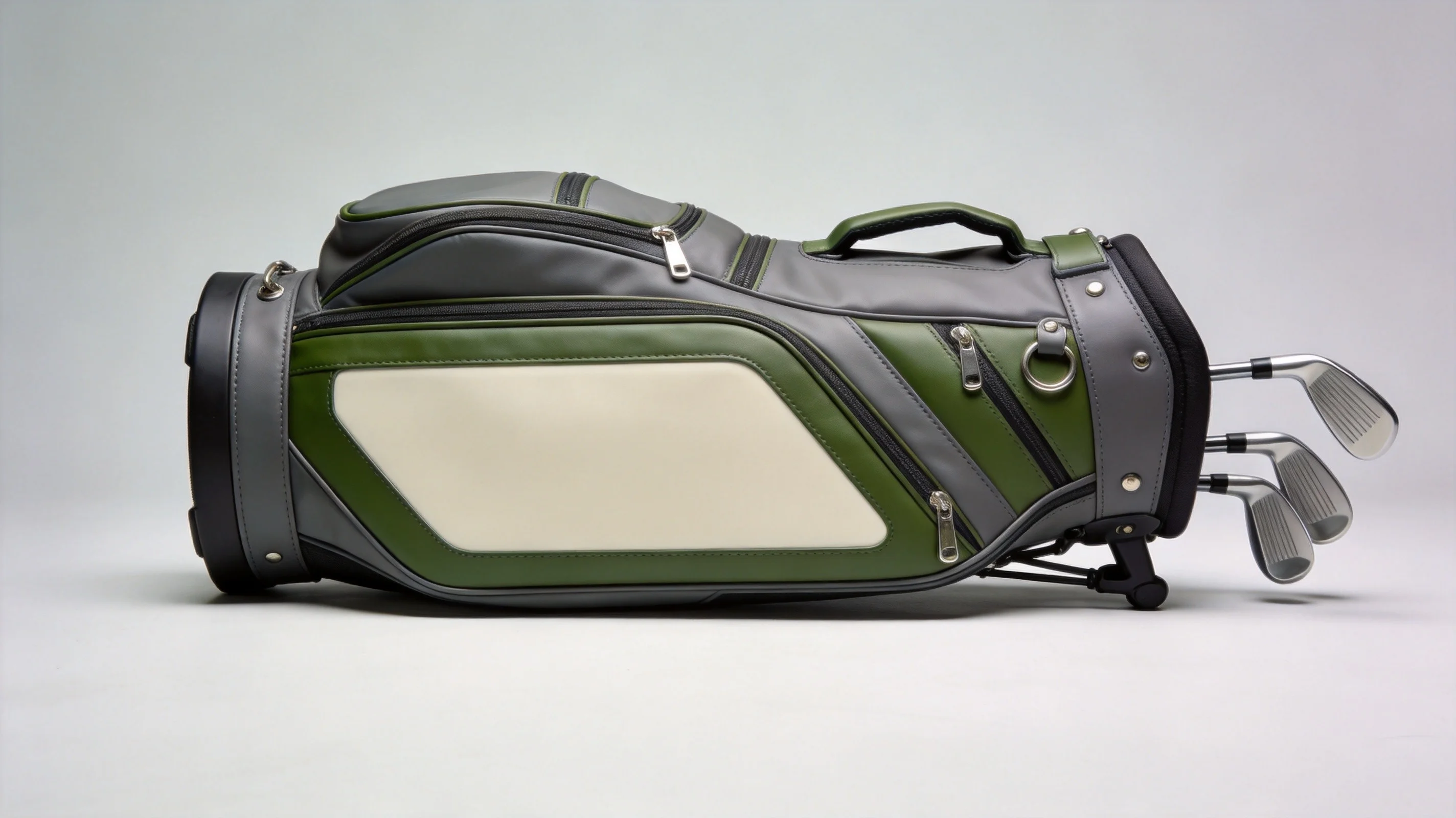
For a custom golf bag, the right material is the cheapest specification that meets your user's needs — and the most common durable choices are a 1680D ballistic nylon or 1000D nylon shell with a PU or TPU coating, graded #8 zippers and a frame matched to whether the golfer carries or rides. This full comparison is written from the product-development floor of our Quanzhou, China golf bag factory, in operation since 2014 with seven production lines, 126 sewing machines and 137 employees, serving more than 200 brands across 100+ countries and audited by SGS in March 2026. If you are planning a custom, private-label or OEM line, this guide maps every material decision — shell, weave, coating, frame, hardware — to documented performance and cost.
Start With Four Questions, Not a Fabric
The single most common mistake in custom golf bag sourcing is choosing a fabric before understanding the product. The right sequence works backward from four questions. First, who uses it — a walker, a cart rider, a frequent flyer? Second, what is the retail price target? Third, what climate will it meet — persistent rain, harsh sun, or a mix? Fourth, what sustainability story, if any, does your brand need? Only when those four are answered does a material shortlist make sense.
In our work across more than 200 brands we consistently find that a brief sketched in answers to those four questions lets our engineers propose a focused, costed material matrix. Skipping the brief and starting from a fashionable fabric leads to over-spec, missed target prices, or bags that fail the one climate that matters. Discipline at the front of the process is the highest-value step you can take.
Denier, Yarn and Weave Explained
A custom golf bag specification is built from denier, weave and coating. Denier (D) measures yarn linear density — one denier equals one gram per 9,000 metres. Higher denier yarn is thicker, stronger and heavier. The weave determines how the yarns interlock: a ballistic or dense twill resists abrasion and snagging best, while a plain or ripstop weave is lighter. A single bolt of "polyester" can therefore produce radically different bags depending on denier and weave.
For shells, the practical ladder runs 600D (economy), 840D (mid-tier), 1000D (strong all-rounder) and 1200D/1680D (premium high-wear). Linings and non-critical panels step down to 300D-600D to save weight and cost. Understanding this ladder lets you spend durability where it is felt — the shell, base and wear zones — and save every gram everywhere else.
Our factory maintains stock of the common shell fabrics so a 200-piece test order can be cut, sewn and shipped on a 10-20 day sampling schedule, and the same fabrics run reliably into the 45-60 day mass production cycle. Stock-grade denier keeps both your lead time and your unit cost predictable.
Material Options Comparison Table
The core comparison of shell materials for custom golf bags:
| Material | Denier | Weight | Water Resistance | Durability | Best Use | Relative Cost |
|---|---|---|---|---|---|---|
| Polyester twill | 600D | Light | Low w/o coating | Moderate | Value stand/sunday bags | Lowest |
| Nylon twill | 840D | Medium | Low w/o coating | Good | Mid-tier stand/cart | Low |
| Nylon | 1000D | Medium-heavy | Good with coating | Very good | All-rounder stand/cart | Medium |
| Nylon/ballistic | 1200D | Heavy | Good with coating | Excellent | Premium cart/staff | Medium-High |
| Ballistic nylon | 1680D | Heavy | Excellent with TPU/PU | Excellent + tear | Premium cart/staff/travel | High |
| TPU-laminated | variable | Medium-heavy | Waterproof (seam-welded) | Excellent & flexible | Premium waterproof | High |
| rPET recycled | 400D-1000D | Medium | Depends on coating | Good | Sustainable ranges | Medium-High |
Use the table to place your brief: budget, weight target and durability floor each point to a row. A value sunday bag is a 600D story; a performance stand bag is 1000D; a premium cart or travel bag is 1680D with TPU. When in doubt, prototype one level above your instinct and let the sample and its cost settle the argument.
Coatings and Laminates Compared
The shell is only the starting point; the coating or laminate is what delivers water resistance. Polyurethane (PU) coating applied to the reverse of the fabric is the industry standard, measured in millimetres of water column. A 1000-2000mm column makes a bag shower-proof; 3000mm+ approaches waterproof; but without seam sealing, water still enters at the stitching holes.
Thermoplastic polyurethane (TPU) lamination is the premium route: a TPU film is bonded to the fabric and the seams are welded or taped, producing a genuinely waterproof enclosure with better cold flexibility and elasticity than PU. PVC coating is cheaper but heavier and can stiffen in cold. For a custom brand, the choice of coating says more about your waterproofing promise than the base fabric does, and it should be backed by an ISO 811 water-column certificate.
Frame Options for a Custom Bag
The frame is the second-biggest material decision after the shell, and it is usually the one most mis-matched to the buyer. A stand bag needs a frame that keeps the bag upright and stable on slopes; a cart bag barely needs a frame at all since the trolley provides the support; a travel bag needs a rigid or semi-rigid frame to protect clubs in motion.
Steel offers low cost and strength but is heavy and can rust. Aluminium alloy cuts weight 15-25% and resists corrosion — the mainstream for stand and travel bags. Carbon fiber saves 30-40% of frame weight with the highest stiffness, ideal for premium walking and travel lines. Glass-fiber composite is a cheaper lightweight alternative. Match the frame to whether your customer carries the bag for 18 holes: if they carry, spend on lightness; if they ride, spend elsewhere.
Zips, Webbing and Hardware in Custom Work
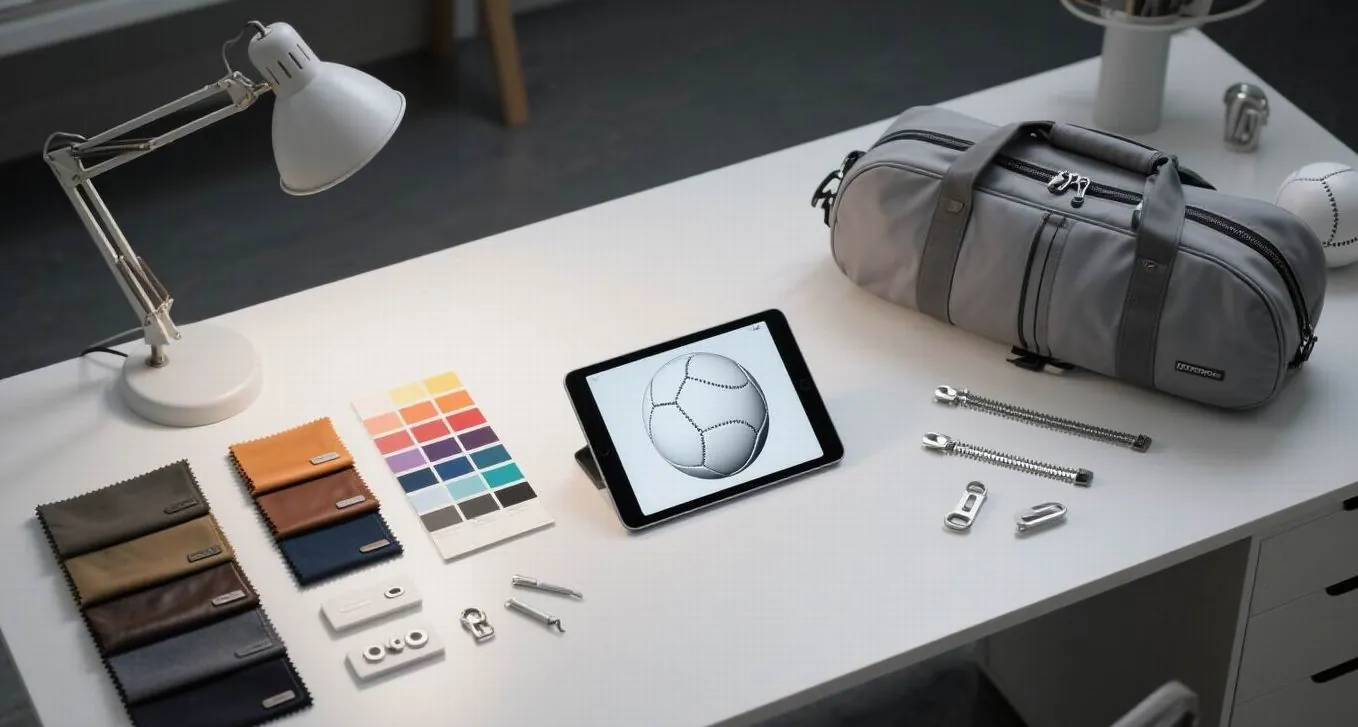
A custom bag is judged on its details, and no detail matters more than the closing hardware. The zipper is the most-stressed moving part: it opens and closes tens of thousands of times under load. We recommend graded coil or metal zippers (often #8 for main compartments) with water-resistant, self-healing construction for reliability. A step up from budget #5 zippers measurably cuts the most common warranty claim.
Webbing carrying the shoulder load should be load-rated polyester or nylon with UV stability so it does not weaken in the sun. The shoulder pad uses closed-cell or memory foam chosen to balance comfort against the bag's weight target. Buckles and sliders benefit from glass-filled nylon. Each of these is a material choice you can specify and test, and together they decide whether your custom bag earns a durable reputation or a stack of returns.
Sustainable Material Options for Custom Bags
Sustainability is now a genuine material option rather than an afterthought. GRS-certified rPET recycled polyester, spun from post-consumer bottles, delivers shell and lining performance comparable to virgin material with a lower carbon footprint. Mono-material design — engineering the shell, lining and laminate from a single polymer family — makes end-of-life recycling practical and is increasingly requested by progressive brands.
Because we maintain material traceability and document recycled content per batch, a custom programme can carry a credible recycled story with certificates attached. When your retail buyer or compliance calendar asks for recycled-verified products, the evidence is already in the batch documentation rather than assembled at the last minute.
Testing Your Material Choices
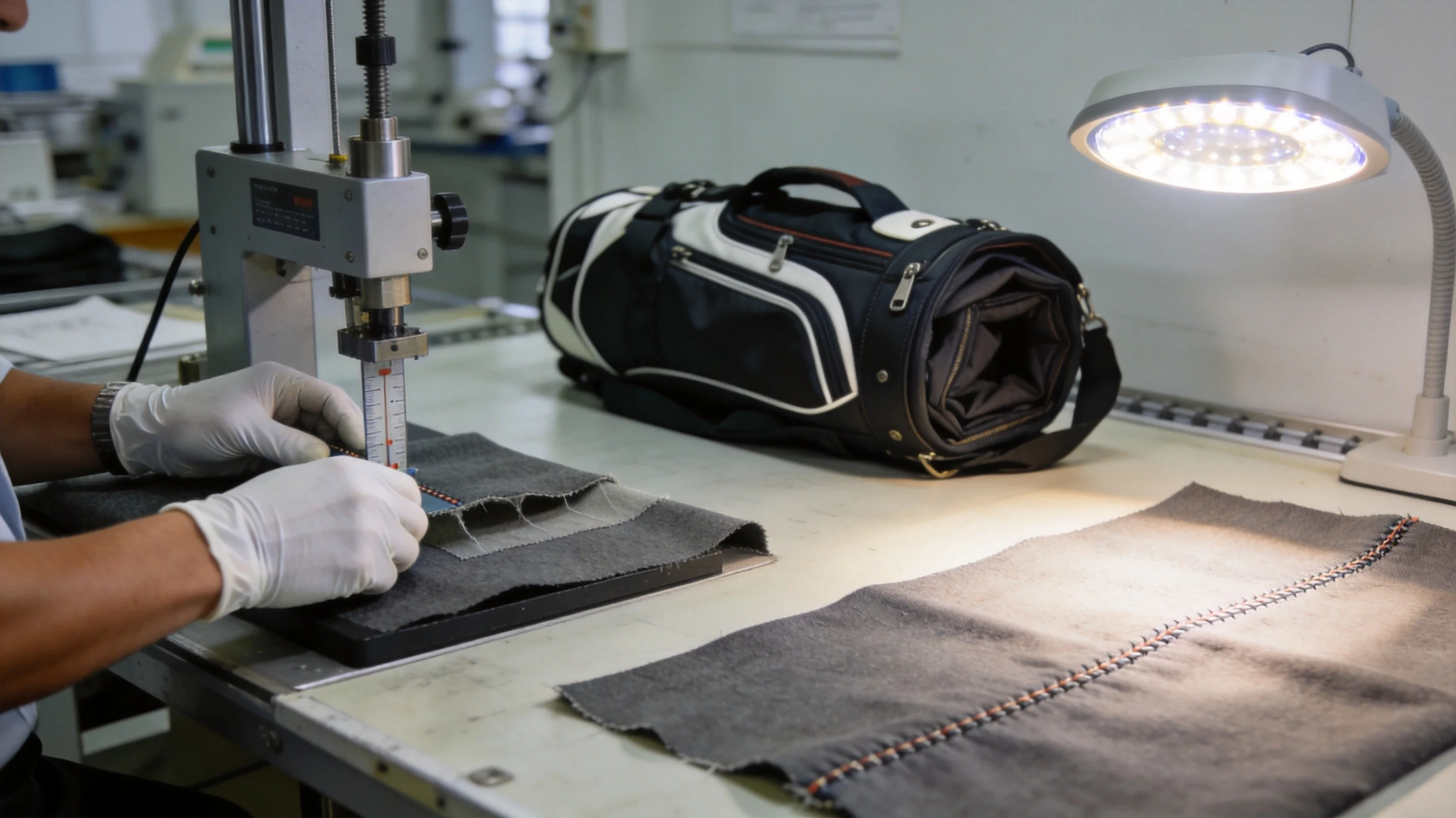
Every material claim on a custom bag should be verifiable. The methods we apply follow industry conventions: abrasion (Martindale-style, ISO 12947), tear strength (ASTM textile families), water resistance (ISO 811 hydrostatic head and ISO 4920 spray), colour fastness to light (ISO 105-B02), and load cycling on straps and handles. Frames are tested for stiffness, deployment cycling and impact behaviour.
Our seven production lines feed samples into this battery, results are documented per batch, and the March 2026 SGS audit independently confirmed the control system. When you request a specific standard, we attach the certificate to the batch. This transforms material choice from a belief into evidence, which is exactly what professional distributors and QA teams demand.
Material Choice and Lead Time
A practical point importers underweight is that material choice drives lead time. Stock-grade 600D, 1000D and 1680D fabric, standard PU and TPU coatings, and common hardware cut sourcing to days. Exotic deniers, bespoke coatings, special weaves and hard-to-source composite parts stretch procurement windows and can push your programme past its launch target. Keeping half your palette on stock-grade materials is a scheduling hedge that costs nothing at retail.
Our 200-piece sample order runs on a 10-20 day sampling window precisely to flush out any sourcing or sewing issue before mass production commits to the 45-60 day cycle. At full capacity our monthly output of up to 200,000 units lets a validated spec scale cleanly. The lesson is simple: the material you choose determines not only the bag you make but how predictably you can deliver it.
Cost, Weight and Durability Trade-offs
The fundamental trade-off running through every material decision is weight versus cost versus durability. Heavy 1680D ballistic shells cost more in material and, potentially, in shipping weight, but they outlast lighter fabrics on the course. Premium coatings and graded zips add cost but cut warranty claims. A durable custom bag is not necessarily the most expensive; it is the one whose durability is spent in the right places.
Our guidance to clients is to spend the budget in a deliberate priority order: first the shell and coating (visible, high-wear), then zips and seams (failure points), then the frame (comfort), then branding and trims (aesthetics). Getting that order right lets a mid-price bag outperform a poorly specified premium one. We can cost each permutation so your target margin drives the spec rather than the other way around.
How to Specify and Validate Your Custom Bag
The reliable route to a well-specified custom bag looks like this. Answer the four questions, draft a material shortlist, and share it with your manufacturer. Request a 200-piece sample order on a 10-20 day sampling window so your team can weigh, load, and weather-test a real bag before committing. Agree the test certificate suite up front so both parties are accountable to the same standard. Then scale into the 45-60 day mass production cycle with confidence.
With a monthly capacity of up to 200,000 units across seven lines, we can ramp your custom programme from validated prototype to full retail inventory. Share your four answers with service@junyuanbags.com or WhatsApp +86 17750020688, and our engineers will translate them into a costed, tested material specification.
Material by Bag Type: A Practical Typology
The material matrix changes meaningfully depending on the type of bag you are commissioning, so it is worth mapping the options by family. A sunday bag is a light, low-cost carry design that can rely on 600D polyester, minimal hardware and no frame — its entire material story is lightness and price. A stand bag adds a leg frame (aluminium or composite) and usually 1000D nylon, balancing carry weight against the durability of being set down repeatedly on the turf.
A cart bag rides on a trolley, so weight carries less penalty and a 1680D ballistic shell with #8 zips and a reinforced base is the premium standard — here durability and organisation dominate the spec. A staff bag, the large pro-shop statement, uses the heaviest 1680D construction and full pocket arrays, prioritising capacity and brand presence over weight. A travel bag is an impact-protection product: heavy padding, a rigid or semi-rigid frame, and abrasion-resistant material to survive airline handling.
A cooler or insulated bag adds an insulation core sandwiched in the shell — usually closed-cell foam — and a leak-proof lining, which is a distinct material system layered into whichever shell fabric you choose. And accessories from rain covers to utility pouches reuse the same shell materials at lower denier. Matching material to bag type is the fastest way to avoid over- and under-spec.
Bases, Linings and Inner Panels
Two under-appreciated material zones deserve separate attention: the base and the lining. The base of a golf bag takes the worst abrasion — it is dragged, set down on gravel, and loaded daily. A reinforced base of stiffened fabric, moulded plastic or rubberised material extends the bag's life dramatically and is one of the best-value upgrades you can specify. It is the difference between a bag that stays upright and one that wears through in a season.
The lining protects clubs and the shell's underside. A 300D-600D ripstop or plain lining is standard; a padded lining adds protection for the club heads in travel applications. Divider systems, the strips that separate clubs, are made from foam-backed or rigid wands whose stiffness and finish affect both protection and the satisfying way clubs slide in and out. Specifying a quality base and lining elevates a bag's feel and durability more than most buyers expect.
UV Resistance and Colour Fastness
Colour fastness to light is a material property that determines whether a custom bag keeps its brand colours in a sunny market. Premium and nylon shells are generally more UV-resistant than low-grade dyed polyester, and coatings can be formulated to shield against UV polymer breakdown. The standard method is ISO 105-B02, which exposes fabric to controlled light and measures fading.
For a branded bag in a hot, sunny climate, colour fastness is a brand-integrity issue: a logo that fades after one season damages your look. We screen materials for UV and extend this to thread and webbing, since these degrade too. Specifying UV-stable dyestuff and finishes, and verifying with the standard, is a straightforward way to protect your on-course brand presence across seasons.
Material and Branding: How Fabric Affects Your Logo
For a custom bag, the material and the branding method must be chosen together because they interact. Heat-transfer printing works best on smooth, heat-tolerant shell fabrics and produces a flat, tag-style logo. Embroidery integrates cleanly on dense ballistic nylon, adding a premium stitched badge that reads as craft. Sublimation suits lighter polyester panels where full-colour imagery is desired. A busy woven jacquard can carry the brand pattern in the fabric itself.
The fabric's texture, stiffness and coating therefore constrain your branding options. A glossy TPU-panel bag may resist embroidery for the same reason it welds: its smooth bonded surface. Understanding this interaction during the material-selection phase prevents the disappointment of discovering mid-production that your chosen logo method does not suit the shell. Our design team aligns fabric and branding together in the sample phase, so the finished bag carries your identity cleanly and durably.
For the wider toolkit of personalisation methods and how they pair with different shells, our golf bag custom personalisation design guide is a useful companion. We always recommend choosing the branding route in tandem with the shell so neither compromises the other.
The Material Bottom Line for Custom Bags
There is no single "best" golf bag material — there is only the best material for your brief, and that brief is defined by four honest answers about usage, price, climate and sustainability. A 1680D ballistic shell with TPU coating and #8 zips is objectively the premium baseline for hard use; a 600D value construction is objectively right for an entry price point. The skill is matching the material ladder to your user, price and climate, then proving it with tests.
As a manufacturer serving more than 200 brands since 2014, we have seen the material decision made both ways — and the disciplined, brief-first approach consistently produces better products, clearer costs and fewer returns. Choose by evidence, prototype before committing a large order, and let documented performance back your brand story — that process consistently produces a better product, a clearer cost picture and far fewer warranty returns over the life of the programme.
Frequently Asked Questions
- What is the best material for a custom golf bag?
- It depends on your target price and usage. A 1680D ballistic nylon shell with TPU coating is the premium standard for cart and travel bags; 1000D nylon balances weight and toughness for stand bags; 600D polyester fits value ranges. Coatings, zips and frame then tailor durability and price to your brief.
- How do I choose between 600D, 840D, 1000D and 1680D?
- Higher denier means thicker yarn and greater tear/abrasion resistance at higher weight and cost. Choose 600D for economy ranges, 840D for mid-tier, 1000D for a strong all-rounder, and 1680D for premium high-wear shells. Match the shell to the hardest use your bag will see and keep lighter fabrics for linings.
- What coating should I use for a waterproof custom golf bag?
- For genuine waterproofing choose PU coating with at least 3000mm water column plus seam sealing, or TPU lamination with seam welding for the highest reliability. Standard PU at 1000-2000mm is shower-proof only. Specify the water-resistance standard and request the test result.
- Should my custom golf bag use a carbon fiber frame?
- Only if lightness on the shoulder is your priority and your price point supports it. Carbon fiber frames save 30-40% of frame weight versus steel. A well-engineered aluminium frame is the cost-effective mainstream, and steel suits budget programmes. Match the frame to whether your customer carries or rides.
- What makes a custom golf bag durable?
- Durability comes from the sum of material choices: a high-denier shell, correct coating, sealed seams, graded zippers (ideally #8), load-rated webbing, a reinforced base, and a frame matched to use. Test each with recognised methods and request the certificates so durability is documented, not assumed.
- Can I make my custom golf bag from recycled materials?
- Yes. GRS-certified rPET recycled polyester is a mainstream option for shells and linings that matches virgin performance with a lower carbon footprint. Mono-material design further improves end-of-life recycling. Specify recycled content and request the certificate.
Sources & Further Reading
Related Reading
- Golf Bag Material Science and Innovation — the science behind modern construction.
- Eco-Friendly and Sustainable Golf Bag Materials — rPET and recycled custom options.
- Golf Bag Durability and Lifespan Analysis — how material choice maps to years of service.
- Golf Bag Quality Control and Testing Standards — verifying material performance.