The global golf bag industry is a multi-billion dollar equipment segment growing through 2030: Grand View Research values the market at roughly USD 1.2-1.3 billion and projects it could approach USD 2.3 billion by 2030, Mordor Intelligence tracks a base near USD 1.25 billion in 2025 expanding to USD 1.66 billion by 2031, while The R&A counts over 112 million golfers playing across all formats worldwide. In this analysis we cut through the segment-level noise — product mix, materials, price tiers, distribution, competitive players and Asia-Pacific sourcing — to give OEM/ODM buyers a functional map of where the industry is headed and how to position a custom golf bag program with confidence.
Industry analysis is most useful when it isolates durable structure from temporary noise. This report follows that principle: it treats widely published market research as directional evidence, cross-references participation data from governing bodies, and ties each finding to a concrete action a factory buyer can take. Our own operating context — an OEM/ODM golf bag manufacturer serving more than 100 countries across 200+ brands since 2014 — anchors the sourcing and production side of the analysis.
Market Structure: Size, Baselines and Forecast Spreads
The first thing any analyst notices about golf bag market data is that forecast baselines differ across firms. Grand View Research estimated the segment at approximately USD 1.24 billion in 2023 and projected roughly USD 2.32 billion by 2030 at a CAGR near 9.5%. Mordor Intelligence positioned a similar base of about USD 1.25 billion in 2025, landing at USD 1.66 billion by 2031 at a ~4.85% CAGR. Verified Market Reports places the market between roughly USD 1.6 billion and USD 2.4 billion across the mid-2020s. These spreads are the result of different product definitions, regional weighting and forecast horizons — not of disagreement about direction.
Beware present-tense precision; the honest framing is a spread. Different houses count the market on different baselines, currency bases and scopes, which is why one credible report says roughly USD 1.24 billion in 2023 and another near USD 1.3 billion in 2025, with growth anywhere from about 4.85 percent to 9.5 percent CAGR. What they agree on is the direction: steady value growth. For planning, use the range, not a single number, and stress-test your line against the slower and faster scenarios.
The robust conclusion is qualitative but firm: the golf bag industry is growing in value, structurally supported by rising participation, multi-bag ownership and premiumization. A buyer should treat the exact dollar figure as secondary and the demand drivers as primary. If participation climbs and premium shares rise, then an assortment weighted toward the categories those forces favor will outperform a static SKU list.
Segmentation by Product Type and Unit Mix

Product-level segmentation shows a market anchored on a few high-volume silhouettes. Stand and carry bags hold the largest value share — Mordor Intelligence puts it at roughly 40% in 2025 — driven by recreational and walking golfers who prioritize portability. Cart and trolley bags form the second structural pillar, with Mordor projecting roughly 5.9% CAGR through 2031 as push-cart and on-course cart play expand. Tour and staff bags anchor the premium end, and travel plus pencil/Sunday bags serve tourism and casual demand.
On a unit basis the picture is similar: stand or shoulder-type bags account for close to half of shipments in several estimates, cart bags roughly a third, and the balance split between tour and travel variants. For a factory, the message is that diversification across these poles is the lowest-risk strategy — a single-category bet concentrates demand risk that standard assortment planning is designed to avoid.
Material Mix: Nylon Leads, Polyester Rising
Materials are a surprisingly instructive lens on the market. Mordor Intelligence reports nylon dominated with roughly 47% of the market in 2025, prized for its strength-to-weight ratio and weather behavior, while polyester is set to grow at a faster CAGR. Recycled synthetics are crossing from eco-niche into mainstream spec as major brands position recycled nylon and polyester as performance materials rather than compromises. Leather remains the provenance of the premium tier, and coated waterproof laminates are standard for cart and travel categories exposed to rain.
Nylon's primacy in golf bags is a durability story — abrasion resistance, reliable weather behavior and a premium hand all favor it, with nylon often cited above half of the market. Polyester is rising on cost and the growing availability of recycled grades, and coated or laminated finishes increasingly feature in both. The strategic point is that material choice is a positioning tool: a nylon-heavy spec reads as performance and durability, while a recycled-polyester spec reads as sustainability. Deciding which message your line leads with is a brand decision made at the fabric count, not the marketing meeting.
For buyers this translates directly into spec decisions. Weight targets push toward lighter nylon or blended constructions; sustainability mandates pull toward certified recycled content; durability requirements favor coated or laminated fabrics. Choosing materials during sampling — not as a retrofit — is the difference between meeting a target at cost and absorbing unexpected premiums.
Price Segmentation: Mass vs Premium
The market splits cleanly into price tiers. Mordor Intelligence reports the mass segment held roughly 59% of market value in 2025, sustained by recreational golfers who prioritize function and price, while the premium category is growing faster at a projected CAGR near 6.2%. Premium growth is driven by the custom-fitting ecosystem, personalization demand and the perception of the bag as part of a golfer's equipment identity. Mid-range products absorb the largest unit share in several analyses, making pricing architecture — not just unit cost — a competitive lever.
Mass-market bag retains the largest volume share, but the premium tier carries the growth narrative and most of the innovation. Because each tier answers a different buyer, a multi-tier line hedges market shifts: value product secures volume and entry-level players, while premium product captures upgrade spend and healthier per-unit margins. Balancing the two is a strategic act, not an accident.
The sourcing implication is meaningful. A factory that can serve both mass-tier volume economics and premium-tier customization is positioned to capture the market's two growth engines simultaneously. That dual capability — clean, repeatable production for value lines and flexible small-batch personalization for premium lines — is exactly the OEM/ODM model we operate.
Distribution Trends: Offline Lead, Online Accelerating
Distribution is consolidating around two channels. Offline retail — specialty pro shops, big-box golf and resort stores — still holds roughly two-thirds of sales, according to Mordor, because premium and experiential purchases favor in-person touch. Online retail is the fastest-growing channel at a projected CAGR near 6.7%, winning on convenience, breadth and price transparency across travel cases and replacement bags. The two channels increasingly feed each other: customers research and compare online, then confirm fit and feel in-store.
Fitting and feel still win in pro shops and retail, so offline remains the largest single channel. Yet online is growing fastest, and its physics reward detail: structured specs, weight data, dimensions and verified claims go onto comparison pages that increasingly decide first impressions. Brands winning online treat product data, imagery and review hygiene as real commercial assets.
For manufacturers, channel dynamics reinforce the need for both strong physical product execution and disciplined digital enablement — clean imagery, downloadable spec sheets and dependable quoting. B2B buyers now place sizable wholesale orders through digital channels, so operational responsiveness has become a sales asset in itself.
| Dimension | Leading Position | Fastest-rising | Buyer Takeaway |
|---|---|---|---|
| Product type | Stand bags (~40% share) | Cart bags (~5.9% CAGR) | Anchor on stand + cart poles |
| Material | Nylon (~47%) | Polyester, recycled synthetics | Lock materials in spec early |
| Category | Mass (~59%) | Premium (~6.2% CAGR) | Serve both value + premium |
| Channel | Offline (~65%) | Online (~6.7% CAGR) | Digitally enable wholesale |
| Region | North America (~47%) | Asia-Pacific | Plan APAC demand uptick |
Competitive Landscape: The Established Players
Market research consistently names a compact roster of global brands as the market leaders: Acushnet (Titleist), Callaway, TaylorMade, PING, Mizuno, COBRA, Wilson, Sun Mountain, Ogio and Motocaddy. These houses define consumer expectations around performance, quality and innovation, and their product cycles set the competitive rhythm the entire industry follows. Their influence is so strong that consumer research often begins with brand reputation before any feature-by-feature comparison.
Leadership brands win on trust, tour association and complete-set ecosystem pull rather than on bag mechanics alone. For an OEM challenger, that means competing where incumbents are least strong: faster customization, better value at equivalent spec, and faster sampling iteration. Position on agility and verification, not on out-advertising a marketing machine.
For private-label and OEM/ODM buyers, the competitive reality is an opportunity rather than a barrier. Established players validate the category and educate consumers on features; factories supply the private-label and value tier that expands the market's breadth. Roughly a fifth of the market is served through private-label participation, and the rise of DTC brands creates room for capable partners who can manufacture to spec at scale. Our brand-versus-manufacturer analysis explores how a factory partner competes alongside household names.
Participation as the Structuring Variable
The single most important external variable for the golf bag industry is golfer participation, and the evidence points firmly upward. The R&A's 2025 Global Golf Participation Report counts 112.2 million people playing golf across all formats — up 4.2 million year-on-year — with 65 million adults and 47.1 million juniors. On-course golfers total roughly 43.9 million, while off-course/simulator formats engage over 68 million. Women represent about a third of adult participation and more than half of alternative-format participants.
Designing around participation data turns vague optimism into concrete line-planning: carry and stand bags for the walking and junior surge, waterproof and cart formats for committed adult golfers, versatile options for off-course and simulator players, and premium models that capture social and upgrade demand among a growing, more diverse playing population.
Every one of these numbers increases the total addressable pool of bag buyers. Juniors and women drive demand for new geometry and colorways; off-course players drive demand for versatile, compact bags; and rising overall participation lifts both first-time purchases and the replacement cycle that accounts for a large share of annual demand.
Travel and Tourism as a Repeat-Purchase Engine
Golf tourism is a measurable repeat-purchase engine. According to the AGIC Economic Impact Report, golf-tourism expenditure climbed from USD 25.7 billion in 2016 to roughly USD 31 billion in 2023. Travel golfers naturally purchase protective travel covers and cases, and many add a packable Sunday bag for destination rounds. The result is a household that owns more than one bag — a behavior market research explicitly cites as a factor boosting average units per golfer.
Golf travel is a compounding demand generator. Rising tourism spending means more traveling golfers, and each trip creates needs the on-course buyer does not have: a protective travel cover, a durable or packable format, and the confidence that a bag will survive airline handling. Whether your line serves resort fleets, retail to traveling players or both, travel-adjacent products convert a single-purchase buyer into a multi-category, repeat customer.
Manufacturers serving resorts, travel retailers and destination clubs should treat travel protection as a complementary upsell to the primary bag, and design Sunday bags compact enough to be genuinely packable. Bundling a primary bag, a travel cover and a Sunday bag into a coherent set lifts order value while matching how travel golfers actually assemble their gear.
Innovation and Technology in the Line
Innovation continues to reshape the product line even in a mature category. Weight reduction is the dominant engineering theme, driven by lightweight materials such as carbon fiber, high-tech nylon and engineered laminates. Organization keeps improving through 14-way full-length dividers and modular pocket systems. Weather performance has matured from a feature into an expected baseline. And a growing premium niche integrates smart and tech-enabled features — GPS tracking, device pockets with charging routing and integrated power-bank sleeves.
Buyers now compare bags on spec nearly as hard as they compare clubs: weight tables, divider counts, waterproof ratings and material grades sit side by side online. The consequence is that innovation must be expressible as data. A genuinely lighter frame, a documented waterproofing rating and a better-laid-out pocket architecture are all measurable advantages a factory can prove in sampling; vague 'premium' claims are increasingly discounted. Innovate in verifiable dimensions and put the data on the product page.
Not every innovation needs to be bleeding-edge to matter commercially. The buildable, spec-verifiable features — clean cable grommets, weather-sealed valuables pockets and balanced weight distribution — are often what differentiate a turning, reorderable product. We break down what is genuinely feasible at factory scale in our smart bag technology guide and our material technology overview.
Regional Dynamics and the Asia-Pacific Sourcing Nexus

Regionally, North America holds the largest share — Mordor pegs it near 47% — reflecting mature infrastructure and high participation. Asia-Pacific is the fastest-growing region, with the highest projected regional CAGR, powered by golf-course development, a rising middle class and the entry of capable local brands. For Chinese factory buyers and manufacturers, APAC growth is a double tailwind: rising domestic consumption plus sustained confidence among Western brands sourcing from a mature manufacturing base.
Asia-Pacific is both the fastest-growing demand region and the manufacturing heart of the industry, and that alignment is a structural gift for buyers. Sourcing where demand grows fastest shortens lead times, cuts freight exposure, eases customs and QC oversight and accelerates customization. For a label selling into North America and Europe from an Asia-Pacific base, the same manufacturing depth can serve both end markets with a single, well-audited partner — a concentration few other industries enjoy.
The practical effect is that the categories China manufactures at scale — stand, cart, travel and Sunday bags — are scaling from within the region that produces them, creating both domestic and export opportunities that reinforce one another.
Cost and Margin Realities in a Competitive Market
Behind the demand story are the cost realities every buyer eventually confronts: raw-material price movement, freight variability, import duties and MOQ economics. Research flags rising material costs and seasonal demand swings as recurring constraints. The premium-tier advantage is margin resilience — higher-value products absorb input volatility better than commodity SKUs — which is one more reason premiumization is attractive to both brands and the factories that serve them.
A realistic margin model accounts for the full chain — material grade, hardware, stitching time, packaging, freight, duty and returns — not just unit landed cost. Options that seem cheap in the bill of materials often surface as returns, warranty claims or rework. Verified build quality is therefore a margin protection mechanism, especially under rising freight and tariff pressure.
Disciplined buyers protect margin by fixing material and construction specs during sampling, consolidating order volumes, and choosing production partners who can hold quality at scale. Cost transparency in the quote — material grades, labor, finishing and packaging line items — turns procurement from guesswork into a plan.
Sourcing Playbook for OEM/ODM Buyers
Bringing the analysis together into an action plan:
Commit the spec in writing during sampling: dividers, waterproofing class, material, labeling, packaging and compliance. Budget realistic sampling iterations, fix MOQ per model, and agree on testing depth for load, seams, straps and zippers. A factory that documents process — and can show you sampling history — is far more predictable than one that promises fast, cheap results.
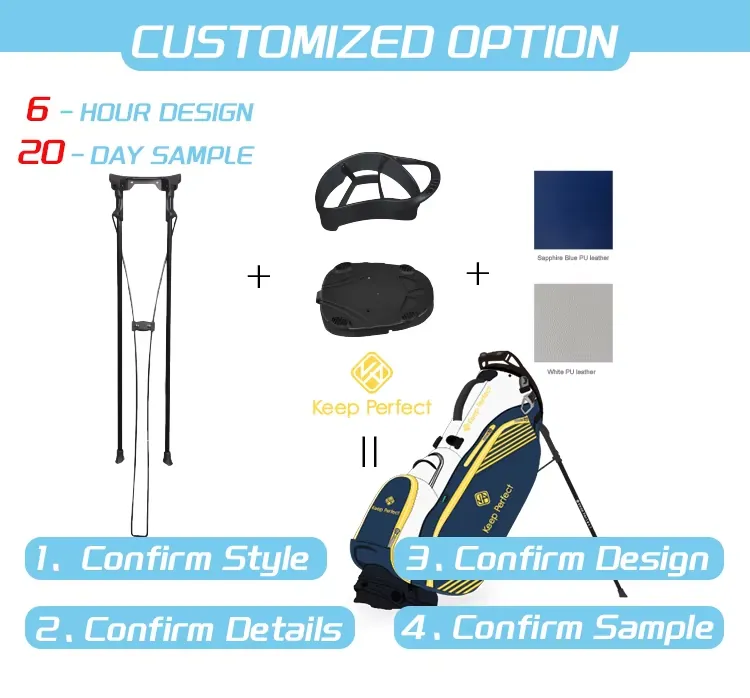
Diversify the assortment. Anchor on a stand bag and a cart bag, then extend into travel and Sunday bags to cover demand swings. Choose materials against targets. Decide between nylon, recycled polyester and coated laminates based on weight, sustainability and durability goals before sampling. Plan for both price tiers. Structure a value line for volume and a premium line for personalization and margin. Enable digital procurement. Prepare clean specs and imagery so wholesale buyers can order efficiently. Confirm commercial terms. Lock 10-20 days sampling, 45-60 days production and MOQ per model in writing.
For the production-side specifics, review our manufacturing workflow guide and our OEM vs ODM explainer before you finalize a partner.
Sustainability and the Circular Market
Sustainability is moving from brand talking point to procurement baseline in golf equipment. Buyers and distributors — especially in Europe and corporate channels — increasingly require documented recycled content, audited factory conditions and reduced packaging. This rewards factories that can verify and trace materials rather than merely claim them. For a buyer, sustainability is becoming a due-diligence box: a factory that can document recycled-nylon and recycled-polyester sourcing, plus water and energy practices, unlocks orders that cleaner branding alone cannot. In the next several years being able to certify a bag's environmental footprint will be a competitive requirement among the most attractive accounts, not an optional differentiator.
Frequently Asked Questions
- How large is the golf bag market and how fast is it growing?
- Most published estimates place the market near USD 1.2-1.3 billion in 2023-2025, with forecasts ranging from roughly 4.85% CAGR (Mordor, to 2031) to about 9.5% CAGR (Grand View, 2024-2030). The dependable signal is steady value growth supported by rising participation, multi-bag ownership and premiumization.
- Which product segments lead the golf bag market?
- Stand and carry bags lead at roughly 40% of market value in 2025, with cart bags projected to grow near 5.9% CAGR through 2031. Tour/staff bags anchor the premium tier, and travel plus Sunday bags serve golf tourism and casual demand.
- Who are the key players in the golf bag industry?
- Acushnet (Titleist), Callaway, TaylorMade, PING, Mizuno, COBRA, Wilson, Sun Mountain, Ogio and Motocaddy are consistently named as the leading brands. Roughly a fifth of the market operates through private-label participation, which is where OEM/ODM factories compete.
- Is premium or mass-market golf bags growing faster?
- Mass-market product holds the larger share (~59%), but the premium segment is growing faster at a projected CAGR near 6.2%, driven by customization, the fitting ecosystem and brand-led upgrade demand.
- What should a factory buyer prioritize in the current market?
- Diversify across stand, cart, travel and Sunday bags; fix material choices in spec during sampling; serve both value and premium tiers; and confirm 10-20 days sampling, 45-60 days production and MOQ terms in writing before committing inventory.